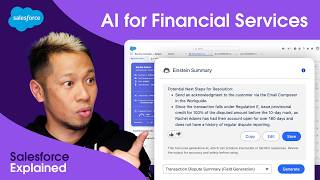
Salesforce Financial Services Cloud uses AI to automate transaction dispute handling. The video shows how Einstein generates next steps and compliant emails automatically, saving time on the roughly $100 billion in annual credit card chargebacks.
Chapters
By the end of this video, you'll learn how to automate transaction disputes with Salesforce Financial Services Cloud. Everyone knows that time is money. And that's especially true in financial services. Banking, wealth management, insurance. They all have to spend a lot of time dealing with things like transaction disputes and policy changes. But they can't cut corners here. Credit card chargebacks alone are costing banks and merchants $100 billion a year. You. You heard that? So today I'm going to show you how you can save both time and money by using Salesforce Financial Services Cloud and AI to streamline transaction disputes. So let's say you're a service rep at Cumulus bank and a customer contacts you to dispute a charge on their credit card. When you pull up their record, this is what you usually see. There's some basic info about their accounts, but if you want to dig a little deeper into something like a recent transaction on a credit or debit card, well, you'd have to navigate to another system entirely. Luckily, your bank's admin has already connected your customer data with Data Cloud so that you can actually see all the data about this customer, like their accounts and transactions. But this is still a lot to wrap your head around. How do you use this information to help the customer? All you need to do is ask Einstein to summarize it for you. But Financial Services Cloud comes with this whole library of pre built prompt templates, including one for transaction disputes. So you don't even need to type out the prompts. It's just a matter of selecting Transaction Dispute from the dropdown menu. Not only does the AI summarize the situation, it gives you the next steps that you need to take to resolve it. And that's great, because maybe you're new at this job or you don't have a lot of experience with this specific task. Now, if you're spending a lot of time researching what to do next, the customer, they might get frustrated. But because your admins have already built prompts that follow your institution's best practices, you can get this done quickly and easily. So now you know what to do next. Send the customer an acknowledgement email. And this part is crucial, right? This disclosure is legally required, and there are a lot of compliance issues to consider. Getting this wrong could actually be a violation of banking regulations. But you don't need to worry about that. You just need to go to Email Composer and click Draft with Einstein. It'll ask for instructions. But that part has already been built out, so you just need to select Transaction Dispute Acknowledgement Then it drafts a fully compliant, personalized follow up to the customer. So now your customer is happy because she knows what to expect and she didn't have to spend a lot of time dealing with this. But you still need to alert the merchant about the dispute. And, and this is usually something that's extremely time consuming because the service rep had to connect to MasterCard to contact the merchant, enter in all the information and verify it. But here you can initiate this with just a couple of clicks and boom. That part right there is why this is such a big deal. Financial institutions can have millions of transaction disputes just like this every year. So if you're saving a few minutes each time, that means you're saving millions of minutes a year. And a million minutes is, yeah, almost two years. That's a lot of time. But instead of spending literally years on this issue, humans and AI can work together to get this done quickly. Hey, that's going to do it for today. To learn more about how Salesforce can help you and your business, click on the link on screen. Also, I'll drop a few resources in the description. Thanks for watching and we'll see you next time.