How We Can Prioritize Equitable Vaccine Management | Leading Through Change | Salesforce
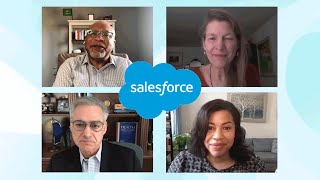
Dr. Camara Jones and other experts discuss equitable COVID-19 vaccine distribution for communities of color, addressing safety concerns rooted in historical mistreatment. A Lake County case study shows how Salesforce technology helped reach Black and Latinx neighborhoods. Trusted messengers and employer engagement are key to vaccine confidence.
Chapters
Sam.
We're more than halfway through Black History Month. A chance for us to come together, celebrate and educate ourselves about the achievements of black Americans. See, acknowledging black history is doing the work to build black futures. You know, so much black history is missing from our lives. It gets left out of school, books, the media, you name it. And that's really painful because there's one thing we need to remember. Black history is American history. Good morning, I'm Leah McGowan here and welcome to another one of our live weekly conversations as part of our Leading Through Change series. A chance for you to hear from leaders who are doing their best to get through these challenging times as well as support their communities. This month is Black History Month, a time to shine a light on the largely untold history of black community and to reconnect to caring, to recommit to carrying forward the legacy of our heroes who fought for the rights, freedom, justice and equality of our people. There's still more work for us all to do to empower black futures. But what's super top of mind for us right now in this moment is, is to protect this community during a pandemic that has disproportionately impacted communities of color. With vaccines on the horizon, there is hope. But how do we reconcile the impact our complex history of mistreatment and mistrust between the community and the medical field? Today, EBONY sits down with Dr. Camara Jones, a physician and epidemiologist and anti racism activist, to discuss building trust with communities of color around the vaccine and how we all ensure equitable distribution for everyone. We'll then showcase a special film on how Lake County, Illinois has been using Salesforce technology to power their vaccine management and make sure it reaches black and Latinx communities. After that, we'll hear from the United States Council for International Business Leaders on what they're doing surrounding vaccine education and awareness. Lastly, we'll be treated with a very special conversation and musical performance by the legendary Herbie Hancock. Now that, my friends, is a lineup. Now, before we begin, make sure you check out the Leading Through Change on the360blog for information on our Leading Through Change trailblazers, thought leaders and customers. You'll see what Salesforce tools they're using and how they use them and the benefits they're enjoying. And as we do every week on Leading Through Change, we wanna uplift and empower others. When it comes to racial equality. We all have an urgent responsibility to act today. We want to bring the full power of our community to help in the fight against systemic racism that has affected the black community for far too long. There's still so much work to be done on this path toward racial equality and justice this Black History Month and every month. Let's do the work. If you can, please go to S Force co NAACP donate and make a donation today. Again, that's S Force. Now, before I pass it over to Ebony, some of you may remember that Dr. Jones from Morehouse School of Medicine joined us back in May to discuss how COVID 19 was disproportionately affecting the black community and how this disease was highlighting systemic inequalities faced by black people. Let's take a look back.
I think it's important for all of us to name racism and to recognize that it's not only foundational in our nation's history, but it's alive and well, and it's revealed in all of its darkness by this COVID 19 pandemic. But it's also revealed in our infant mortality, maternal mortality and the like.
Nine months since this conversation. So what has changed? What can we do moving forward? Well, let's see what Dr. Jones has to say today. Over to you, Ebony.
Thanks, Leah. I just love your reminder that we all have a responsibility to act and that now is the time to dig in and do the work. Black History Month comes with double meaning this year. It's a reminder of our progress, but also a sober reminder of the work that lies ahead, the most urgent being to help our communities recover from the pandemic that starts with vaccine distribution. Salesforce recently launched Vaccine Cloud to support organizations and communities as they manage, scale and implement vaccination campaigns. As vaccine distribution ramps up, it's imperative that we keep equity front and center throughout this process, beginning with access. But as we've seen throughout this pandemic, communities of color continue to be disproportionately impacted and disproportionately served. In fact, in a recent Kaiser Health News report, it showed that in the 16 states that report data by race, people of color are getting vaccinated at drastically lower rates. And yet black, Latinx and indigenous Americans are dying from COVID at nearly three times the rate of white Americans. According to the cdc. Everyone deserves equal access to care. And if we're serious about building an equitable post Covid economy, we need to be just as serious about ensuring an equitable recovery. That's why I am thrilled to welcome back Dr. Kamara Jones, who has been an incredible resource for me and a powerful voice of truth. Dr. Jones, it's so good to see you. And thank you for joining us again today.
It's so good to be back. Thank you.
We are just going to jump right in. I have so many questions for you. First and foremost, so much has changed since last we spoke. I want to start by just checking in on you. How are you?
Well, I'm. I'm doing well now. I have to say that since we last spoke, which was towards the beginning of the recognition of the disproportionate impact of COVID 19 on communities of color and the beginning of the mobilizations, actually, my work on naming, measuring and addressing the impacts of racism has been more and more appreciated. I've been out there in the vineyard for 30 years doing this work, but I've been very busy. I'm heartened that more people are at least saying the right things. They are forming their mouths to say, you know, to affirm that Black Lives matter saying structural racism, systemic racism. That is the thing that is making me heartened. So my work has been very busy since we last spoke. I am also, thank goodness, safe and healthy. I have been hiding at home, basically, and I have the luxury to do that, although so many of our brothers and sisters on the front lines do not have that luxury. And that's why we're more impacted. So as an individual, I'm okay, but I'm worried about our community.
Thank you for sharing that and we are all glad that you're doing okay. And thank you for doing the work every single day. So I'm going to jump right in. We know that news of a vaccine certainly offered us a light at the end of the tunnel. I'd love to know from your perspective why this vaccine is so significant.
Well, what it does is in this war against the coronavirus with bullets flying, let's say it is a bulletproof vest. It's not going to cover all of you. It's not like 100%, but it's like a bulletproof vest. And so it's protection at the individual level. But may I share with you, like how I've been thinking about this recently. I've been trying to think from the point of view of the virus. Because right now the virus has one job, which is to replicate itself, to reproduce itself, to keep. That's the only thing a virus is built for, is to get in, make more of itself, spread to somebody else, make more of itself. And I've been thinking from the virus iview about what we're doing and what the vaccine has to do with that. Right. So the virus is going to attack any available susceptible people. The vaccine keeps people from being susceptible. So that's why it's important our public health measures keep people from being available. If we can mask up and all of that, the vaccine is part. It's another tool in our toolbox. And eventually, when fewer and fewer of us are susceptible, even those people who, for whatever reason can't take a vaccine will be protected by this herd immunity. So the vaccine is important, but right now, the relative importance, if I want to be honest, ebony, the relative importance of the vaccine versus staying on with our public health measures and having the government make it feasible for more people to safely shelter in place by giving us a monthly income. You know what I'm saying? Monthly checks and eviction, not just moratorium, but rent forgiveness. By making workplaces safe for those who have to go to work, by protecting workers in all the ways that they can. Those public health measures right now are perhaps they're at least equally important to the vaccine because the vaccine rollout is slow. We can do the public health now. The public health measures hide us from the virus. The vaccine makes us stronger against the virus, and we need to address the availability of us as virus targets as well as the susceptibility.
I love what you just shared in the imagery around the virus. Eye view. Let's switch and let's talk about the vaccine. What are some of the important things to know about the vaccine and how it works?
So the first thing to know is that there's not just one vaccine in the country right now. We have two vaccines, the Pfizer and the Moderna, that have already been authorized for emergency use. And both of those work in the same way to provide up to 95% protection. The way that they work is this virus that we're fighting against. What they do is they have just made an artificial little piece, not the whole virus. They're not putting a killed virus, inactivated virus, nothing. They have a little piece of the coating that they wrap in fat particles. That's why it has to be kept so cold, because there's something about the fat particles. Then when we get the vaccine, that instruction, the MRNA instruction part of the vaccine helps our body temporarily create just a piece of the virus, the spike, which is the signal that our body needs to recognize. So it's sort of like it's the here I am part of the virus, that if we're going to gear up and be safe against the virus, we need to recognize that right away. That's like the flare. So the Vaccine helps us recognize that right now to create a response. We get the first dose to just get the initial recognition. Then for the Pfizer, three weeks later, for the Moderna, four weeks later, we get the second dose to boost that. Once you have gotten the two doses, you are 95% protected from getting very sick from this virus. Nobody actually 100% protected, according to all of the trials that they used, from having to be hospitalized or dying. Nobody did. Who got the vaccine? Maybe one in 20 might get a little bit of something kind of flu. Like that's the 5%. The other 5% from the 95. But these two vaccines are very, very good on the horizon. There are other vaccines that work different ways to also introduce to our body a way to recognize the spikes from the virus, the thing, but they use different mechanisms. The others are not wrapping this coding piece in fat. They're attaching it to a cold virus type of thing that's been weakened and all. None of the vaccines are introducing the coronavirus into our system. So that's the first thing to know. Because sometimes people get confused about that. Sometimes people, when they hear nanolipids, right, you know, the tiny little fat particles, they think maybe there's some kind of nanotechnology being introduced. That's not happening. None of that's happening. So I have to say these vaccines are really, really important as another tool in our toolbox. It's like a bulletproof vest at the individual level. And all of us, I'm not going to try to coax anybody to take it, cajole anybody to take it, convince anybody to take it. I took it. I got my two doses. I want to inform people, I want you to ask me questions, Ebony, that are the questions that you heard about. Because we shouldn't be trying to convince anybody because we are self determined people, but we should be able to get the information we need to make up our own minds. And I think once we get the information about these vaccines, we're going to say, wow, this vaccine is a lot better than getting infected with COVID and possibly dying.
Thank you for giving me the authorization to just go in on this one. Because I think last time we spoke, and what I loved about that conversation, last time we talked about the misinformation going on specifically within the black community. And I said it before, and I'll say it again, you are a trusted voice for me of truth. So I want to ask you, why do you believe, and thank you for sharing that you took the vaccine yourself. Why do you believe it's safe. Why did you do it?
So first of all, it's not as new as people think in terms of the way of delivering this MRNA technology has been worked on, started getting worked on I believe about with SARS. So that would have been 2002, 2003, so almost 20 years ago, and then MERS later. So people started being interested in how we could develop vaccines against those other things which are also coronaviruses. Okay, so these other things that were in East Asia, these other things, you know, Middle Eastern respiratory syndrome, they didn't become pandemics, but, but these were other coronaviruses, same kind of family of viruses as what we have going on right now. And so people started developing these ideas and that platform a while back. As soon as it became clear that this virus, which is called SARS CoV2, it causes the disease COVID19. But the virus has a name and the disease has a name that this virus, as soon as the, the genetic code for this virus was mapped, people who had already been thinking about these MRNA vaccine platforms started working on this. So that would have been in January and they started the trials in about end of July I think. So that seems short but in the Pfizer vaccine trial they had 44,000 people, in the Moderna 30,000 and and in those trials they did not see bad side effects. Now they didn't, of course they couldn't see a ten year side effect. That's true because so far it's only been out there really authorized in December, but the trial started in July. So maybe we know six months, eight months side effects. But so far, so good, really, really good. The effectiveness is amazing. My understanding of how it works makes me feel very confident that we're not setting ourselves up for long term side effects. We continue as more and more people, last time I heard, and I might be behind the times, but at least I'm going to say, well, I can't remember now, I don't know if it's 30 million Americans now, the last I heard, have been vaccinated with at least one of the shots, you know, of the two shot series. So in all of those people we're not seeing a lot of bad stuff. The only thing that we've seen which is quite rare is if you have had extreme allergic reactions before you can get the shot. But you need to let people know that you carry an EpiPen or you've had severe allergic reactions before that made you short of breath and all of that, and they will watch you an extra amount of time. Right. Those allergic reactions can be treated immediately. Covid is much harder to treat.
Can you dig in a little bit about the side effects? I know many people that I've spoken with who've gotten vaccinated. The results are different. The side effects are different. Some people feel nothing. Some people have maybe a little pain at the injection point, some aches and pain, Some have had some headaches, maybe feeling a little bit under the weather. Does the fact that something gives you a side effect mean that you shouldn't do it?
No. In fact, it's interesting because the vaccine folks, the CDC folks, don't even call those things side effects. They have a word for that. They call it reactogenicity. And the reason they call it reactogenicity is that it's just showing that your body is gearing up. So it's expected. These things that people are having, sometimes a day of tiredness or muscle aches, sometimes even maybe a little nausea and stuff like that, fever, these things, they don't even call them side effects. They call them reactogenicity. It's just showing that the vaccine has done what it's supposed to do. You get these at the second shot, really most often because you've had the first and then you sort of primed the body to react and then you give the booster and the body reacts. Right. But it doesn't react and stay that way. My understanding, I just had a little bit of, I would say moderate pain the first day and a little bit of tiredness. I got into bed. I wasn't like flat out fatigued, but I did get into bed early after I got myself second shot. Other people do have maybe a headache or something for a day, but then it resolves. I just have to say that in all of these things, it's not do I want that or not? It's like, do I want that or do I want Covid, you know what I'm saying? The choice is not, oh, I don't think I want to have a headache for a day or two. It's like, is this going to protect me from getting sick and dying with COVID or even if you, even if you survive Covid, some of the long term side effects, we don't even know what the long term side effects of COVID are, but people are walking around with brain fog and really tired and stuff like that. I would say from everything I've seen about the two vaccines we're using right now, the trade off is very clear. I'm not trying to convince it. I sound Like I'm trying to sell this vaccine. I am not. But I am just saying the way I tweeted it out months before I even knew when I would be able to get the vaccine was we all live with uncertainty in our lives. There are real uncertainties still associated with the vaccine. We don't know the very, very, very rare side effects because we haven't given it to 100 million people yet. So we don't know the 1 in 100 million side effects. Right. We don't know the long term side effects because we haven't even known about the virus but for a year. And so the vaccine just. But for some months. Right. We don't know those things. But we all live with uncertainty. And I would rather live with the uncertainty associated with this vaccine than potentially die from COVID 19 it was a risk benefit analysis and that's how I think. Well, that's how I thought about it.
Thank you for sharing that. How do you think we can stop this cycle of misinformation and really start getting the facts out to marginalized and underserved communities? Because there's obviously there's based on the legacy of what's happened in communities of color, especially around medical treatment has been really unnerving. How do we get over that?
Well, I don't think we need to get over understanding and remembering our history. Right. But then it's not even historical stuff. Sometimes people's reactions are to how they were treated the last time they went to see a health care provider. So what we need to do, the treatment needs to improve. Right. But right now, in the short term around the vaccine, even though when you ask people do you think you'll take the vaccine now or not? Maybe later, maybe after a few months. It is true that in the first surveys I saw, 35% of African Americans said that they weren't going to really think about taking the vaccine right away. But 42% in that same survey of rural people said that 42% in that same survey of Republicans said. And so I am a bit unnerved that yes, there's vaccine hesitancy in our community, well deserved, but there's vaccine hesitancy in all communities and we don't need to make it a thing like that. Well, I'm black, so therefore I'm going to have this vaccine hesitancy. No, let's not glorify vaccine hesitancy. As I said before, what we need to do is go and hear people's questions and answer them. We're not self destructive and we're not crazy, we're not stupid. We have legitimate questions. And so instead of trying to convince us or even have the right role model, if I have questions, give me somebody who can answer my questions and then let me make up my own mind. I think if people's questions get answered, the vaccine is a great tool in our toolbox. You know what I'm saying? I'm not saying everybody's going to choose it, but it's a great tool. And there's a huge, devastating enemy out there.
Right.
And even though you may not yet know somebody who's been affected, it has gotten very close to so many of our families, if not in our families right now, we are more likely as black and brown and indigenous people to get infected because we are more exposed and less protected. Before, it used to be more exposed and less protected because we were in the front lines and they wouldn't give us ppe. Now, don't let it be more exposed and less protected because we don't get offered the vaccine, which is a huge part of the problem, or when offered, we don't want to take it. Let's take that off the table. I think instead of going all about information and vaccine hesitancy, let's answer people's questions and make sure that we put the vaccine where the people are most affected, so that when they make up their mind, they can get it, that they don't have to sit around trying to figure out how they're going to make an appointment, how they're going to get the 30 miles out to the stadium, all that. I would rather focus our attention, yes, on answering people's questions, combating misinformation. But what we really need to do is assure that the vaccine is going to the most affected communities first. That's what equity is about.
That's right. Well, before we close, I just want to give you back the floor. Is there anything else you want to share? Anything else you want us to know?
Oh, I'm surprised that the time has gone so fast. I guess I've been going blue, blue, blue, blue.
So I hope it's always so good to chat with you.
I would say two things. Three things we need to think about. Not just ourselves and everything, but our family and our community. When you think about the vaccine, don't think about, do I feel okay not taking it? I feel safe. Think about your family members. Like, would they want you to be protected? Would they sleep easier at night? Would they breathe a sigh of relief when they heard that you took at least that first dose and then the second. I think that we need to continue with very vigorous public health strategies, both at the individual level in terms of masking up, washing up, backing up, physical distance. Don't go in crowds like if you have to. That's the individual thing. I think government needs to step up to make it feasible for most people to still safely shelter at home. We need to do that. We never tried that in this country. We never tried the most basic thing. Many other countries paid their people to stay at home, to lockdown. So we need to make it feasible financially for most people to safely shelter in place. And for those who must go to work, we must make sure that the workplaces are safe. So the Occupational Safety and Health Administration, a part of the cdc, never had any workplace guidelines that they promulgated or enforced under the old administration. Let's do that. We need to make sure that the workers are protected with PPEs and then those workers who are in food processing and warehousing and all, maybe we need to get the vaccine as a protection there first. I really want to say this, Ebony. We talk a good game in this country about equity, even the phasing of the vaccine rollout. Where the first phase, Phase 1A was going to be health care workers and people who lived in long term care facilities. Phase 1B was going to be other long term, other frontline workers and those 75 and over. And phase one C was going to be those 65 and over and those with other health conditions. Right. We did the first little phase out. Although even those in long term care facilities, really they should have been thinking which long term care facilities first, like those in the most affected neighborhoods or those in the most affected communities. They didn't do that. They didn't think about prisons and jails and detention centers as long term care facilities. So there was a lot of stuff there. But then as soon as the healthcare workers and the nursing homes got taken care of, then many states, maybe most states, put the 65 plus in there next. Got them in front of the other frontline essential workers like bus drivers, postal workers, warehouse workers, teachers and the like. And now because there's so many 65 and plus 65 and over, those other frontline workers have been pushed to the back. Why am I upset about this? There are two sources of risk for COVID 19, hear me out. There's structural risk and individual risk. Structural risk is when you are more exposed either at work or where you live. By the way, society is structuring your risk. You are more exposed. Individual risk is you are more vulnerable either by virtue of your age or other pre existing health conditions. The structural risk is like if I talk about a bulletproof vest, you are where the bullets are flying the most. The individual vulnerability is if you got hit, then you might succumb more quickly. But really because we're so narrowly focused on the individual in this country, it has made the structural risk invisible. I would say instead of understanding that these other frontline workers are at structural risk and where the bullets are flying the most, they should get the limited bulletproof vest first. The 65 and over who are maybe more vulnerable at individual risk but are already hiding safely in their homes and stuff. The ones who are in the nursing homes got taken care of already. So now you have. The others who have been out of harm's way are swarming and we are trumping, if you will, individual risk over structural risk. This is not okay. Why not? Because when you look at age adjusted death rates, black and brown people are dying even more. Just look at the regular death rates. It's two to three times as much when you age adjust. It's more because it's our young black and brown people who are bringing the food to the folks who are delivering the mail. They are doing all the things so other people can safely shelter in place. I say that if we're thinking about this, we need to equip those who are in the most harm's way, the bullets flying the most, with the bulletproof vest. First we need to acknowledge the structural risk because of increased exposure and then take care of the individual risk because of increased vulnerability. But they're already out of harm's way. That even has something to say about where do we put the vaccine? We put it in hospitals, health care settings. That was good because that was a work setting. We put it in the long term care facilities. That's where people live who are at high risk. Well, let's put it in other work settings. Let's put it in warehouses, let's put it in schools, let's put it. And in communities that have been more impacted. Let's keep that structural risk analysis going. Hope I wasn't too wonky with that.
That was very clear and so powerful. I could talk to you about this forever, but I just want to thank you so much for being here. I know that your words are going to help so many people and I really want to encourage everyone. If this conversation is something that helped you personally, please, please share what you heard here today. We're going to make this link available and this conversation available for everyone. So please share it with people. You know, let's get the facts out there so we can stop this cycle of misinformation and let everyone make their own individual choice. Again, I just want to thank you so much for being here, Dr. Jones, and we're going to turn it back over to you. Leah.
My goodness, what an amazing conversation. I could listen to Dr. Jones all day. I'm going to go back and rewatch that and I'm going to be sharing it with all of my community. What a great conversation. Now I'm excited to show our next highlighting next story highlighting the health department of Lake County, Illinois and their vaccine rollout.
Let's take a look.
Lake county is an absolutely wonderful place. We have these magical downtowns.
You might pass a mom and pop store. You can look out the front of the library and just about see Lake Michigan.
We have such a diverse community. People of all races and ethnicities, all gender identities.
There's a broad base of people that have and then there's a broad base of people that are in need. And as we saw the effects of COVID 19, the needs became even more apparent. 2019 versus 2020 is night and day. It feels like a war zone. For every one Caucasian person that had COVID 19 here in Lake county, there were five African Americans and nine Latinos.
We immediately formed these two community partnership groups to reduce the disparity. And that really all comes down to what we call equity. Each of those communities needs something slightly different to get the health care that they need and now to be vaccinated for COVID 19. Once we had the policy and the procedure in place, we then built the technology around it to support that. And that is what allvax is.
Allvax had to be a great tracking tool on how many vaccines we've given out, how many of which vaccine to get in for second doses.
When it comes to vaccines, orchestration, having a single source of truth is the most important thing. The CDC changes their information almost daily. Now our system has to be able to respond to that. Our system can talk to other hospitals, to pharmacies, to businesses and their HR systems. And so we're able to get this 360 degree view of our community members.
Were they a first responder? Were they a factory worker, Were they a schoolteacher? Because that was going to put them into a priority list. We had zip codes that were very hard hit. We want to get those people vaccinated first.
The Salesforce platform allows us to do that in a way that is seamless to our community members.
All these people were helped. It doesn't get any better than that. Doors are open. People are collaborating, sharing data and information. They're going deep into communities to support.
People where they are, which is an amazing thing because that allows us to make sure that everyone who wants to get a vaccine in Lake county can get a vaccine in Lake County.
To be part of this response is such a privilege. You know that for every second shot we're giving, that's somebody less likely to get this, pass it on, and possibly lose the life over this. It's a happy day every time we come to this site to distribute vaccines. We have been able to create transformational change within our community. And having families see the Lake County.
Health Department is our ally.
And what they're offering in this allvax is a trusted source. It's not the government and us. It's us as a community.
We're going to make it.
We're going to be okay.
Wow. All these stories today are just giving me all kinds of feels. What an amazing, inspiring story and a story filled with so much hope that I'm clamoring onto. And we have more for you today. My colleague Rod had a chance to sit down with a panel of experts to dive deeper into the vaccine literacy.
Let's take a look.
Thank you, Leah. I'm excited to be here today with a panel of experts to delve further into vaccine literacy and adoption. The United States Council for International Business, USCIB, has helped launch Business Partners to Convince, a global communication and educational initiative to promote COVID 19 vaccine acceptance among private sector employers and employees. I'd like to introduce Heidi Larson, one of the co founders of Convince, Dr. Scott Ratson, executive director of business partners for Convinced, and Dr. Aisha Langford, assistant professor for the Department of Public Health. Actually, that's Population health at NYU School of Medicine to share more about these critical issues. Welcome, everyone.
Good afternoon.
Hello.
All right, Scott, you've been helping to lead the USCIB Foundation's business partners to commence initiative. Can you tell us a little bit more about what inspired this effort? Sure. And thank you, Rod. It's great to be here on Leading through Change today with Heidi Larson and Aisha. But most importantly, Heidi and I came up with an idea to address the challenges that we saw early in the COVID pandemic. We convened a number of experts from around the world, and we came up with this idea of convince, which is a coalition for Covid new vaccine information, communication and Engagement. And what we've been really focusing on is how we bring convince to people around the world in places where they need the information, where we can communicate better and engage appropriately. The business partners to convince part is the private sector lead in this area and with the US Council for International Business, we put together a network of organizations from around the world, international organization of employers, international chambers of commerce and so forth to begin to diffuse the knowledge that we've had. And Heidi could speak more over the years of her studies of vaccine confidence, to build the confidence with employees, to also give employers the tools to communicate as best possible and to bring the ethical challenge up with equitable, accessible access to vaccinations. So we've been doing that. We have a workplace challenge that we put forward and a lot of other ideas that we think will hopefully get business back and get the world back to where we need to be in a Covid protected world. Very good, very good. Heidi, why is vaccine education and literacy so important right now? And how do we bridge information gaps across communities?
Well, I think it's one of multiple factors that will build confidence in vaccines, but certainly it's having the right information and understanding its context will be foundational to other trust building measures. Vaccines are complicated. I think they're, you know, on the one hand they've become as normal with children as brushing your teeth or had been. And that's changed because our publics have changed. Publics have a lot more access to information, they're a lot more demanding in terms of questioning and it's, we have a bit of an imbalance between the demands of the public and public health authorities in the medical community that is much more used to or accustomed to being trusted for their advice. So I think the more we can get an equilibrium of information about vaccines, not just take it, it's good for you, but taking that further and it's particularly important in this context of COVID because it's not just about one COVID vaccine. We're at frankly the beginning of a rollout of multiple different types of vaccines, different doses, different storage requirements. So it's really important that we try to support everyone with having a better understanding in lay terms of what are the differences, why it matters. And in the case of COVID we couldn't have an opportunity more than today to demonstrate the value of vaccines beyond your personal health.
Thank you, Heidi. Aisha, as we've discussed earlier with Dr. Jones, there's a huge issue with community trust in vaccines, particularly with black communities. What's the impact of this mistrust and how do we start the conversation to resolve it?
It's a great question. As you all know, the history of abuse and mistreatment in clinical research and in routine medicine over time has contributed in part to this mistrust and vaccine hesitancy. I always like to note that luckily things are improving. Even over the last four or five months, we've seen willingness among all racial and ethnic groups, including black adults, improve over time. So I'm always mindful of not painting a broad, broad brush that everybody's afraid and fearful because there are many people who are willing to get the vaccine. Some of the conversations that I've seen just on the town halls that I've been on over the past four or five months, the conversation has now expanded to equitable distribution of the vaccines. And are the vaccine sites and availability going to be in the places where people are most hardest hit, which a lot of times are where black and brown people live. I think some of the ways that we can help build trust and alleviate some of these fears is through education, through trusted messengers, through having many, many messages and many support partners at various levels. Some people will trust me because I'm a scientist and other people will trust me because I look like them. Other people will trust me because I went to church with them for the last 15 or 20 years and they know me in that context. So I think it's really important that we partner with the scientific community, but also to understand that communities and patients and community health workers, there are a lot of people that really can be advocates for vaccines. And we really need to partner and listen to them. And so I think that's one way to kind of help get the word out and help reduce some of those fears that are well justified trust.
Thank you, Scott. Businesses are actively figuring out how to address vaccination, reopening and support their employees. What are you hearing from companies on this issue? Well, I think Dr. Larson and Dr. Langford are great important tenets of building trust and building vaccine literacy. And we're hearing that companies want that information as well. That's why we've put together with business partners to convince a global COVID 19 workplace challenge that will give companies the ability to sign on and the tools again to listen to their employees needs. So they really need to understand the sentiment of where they are and their concerns, where they'll give people the latest public health guidance and the ability to follow that, which includes social distancing, which includes hand washing, and of course includes mask wearing and vaccination when available, promote the vaccine literacy with the trustworthy sources that I think both Aisha and Heidi have mentioned. Encourage this vaccine confidence not only with themselves, but with their companies, but their families and the communities, advocate for accessible and equitable distribution of vaccines. And then finally, which is I think the key, the engagement, engage with the communities, engage with the schools, engage with clergy, religious organizations, other community outreach groups and all of that together is where companies want to bring back the trust that they have as both members of the community, employers and, and then the success, hopefully that we can help convince in a positive way altogether on this workplace challenge. Sounds pretty exciting. Aisha, what role can businesses play in building trust and supporting equitable vaccine distribution?
Well, building upon what Scott just said, I totally agree. I think businesses have a really important role to reiterate and to share information from public health professionals. I think visual signs in businesses like I see every day, like wear your mask, practice social distancing. Many of the businesses in my local neighborhood actually have stations with hand sanitizer. And so all of those little things are really important. I think many businesses are in communities and they are local by nature. So when it, when the time comes and if it's feasible, I would love to explore opportunities for local businesses to, to potentially serve as sites for vaccine distribution and or partnering and helping just be a trusted source of information for the community. So when people come in having maybe handouts or signage around what the latest updates are around vaccinations and I always like getting freebies or like kind of incentives to kind of do pro health behavior. So when the time comes, local businesses, who knows, maybe can give out stickers for, you know, I got vaccinated or coffee or just positive things to let the community know that they are on board and that they support these public health measures and that vaccination is really a community, a business, a church, it's everybody's job. And the sooner that we all can do this together, the sooner we can get back to some idea of normal. Although normal may not be exactly what we remember, but I think we all are pushing to get on the other side of COVID and I think vaccination will be a really, really important way for us to get there.
Wow, great ideas. And Heidi, how can businesses collaborate to share information and serve as allies for underrepresented communities?
Well, I think businesses depending on their size, but there are some very large businesses like Salesforce, but many others that the employee base is a community in itself and we belong to as individuals to multiple communities as aisha mentioned. You know, on the one hand, we have our religious community, whatever, you know, depending on your denomination, you have your professional community, you have your workplace community, you've got your, you know, maybe geographic community that you've been living in for a while. And that where the more we can have those communities intersecting and remembering that employees, you know, are interacting in these multiple spheres, I think we shouldn't forget too that it's not just businesses informing and supporting their employees, but the employee base is a huge asset. And also I think businesses need to listen to their employees. And part of that is creating a dialogue because it's going to be really important. Important that the kind of information and support that does go to the employee base is relevant to their concerns. And what the concerns are in one industry or company might be different than another. You know, an airline company, the employers are going to have eager to hear more. It's very relevant to their, to their lifeline. Other businesses will have different characteristics. But I just think the multiplicity of communities coming together is really powerful. And I think we shouldn't forget that every day we move through Covid, we're creating a new history that people are going to remember. And if we can replace some of the older histories, we'll never replace them. But if we can add to community memories a good memory, a positive memory, that in this really difficult time, my company, my employer was there for me.
Wow.
Well, thank you, Heidi, Aisha and Scott, really thank you for being with us today and thank you for what you do.
Thank you.
Thanks. Thank you.









