HubSpot Spotlight: GROW Edition
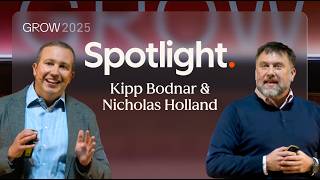
Kip Bodnar presents Loop Marketing, a four-step AI playbook for the modern era, and reveals HubSpot lost 140 million visits in 2024 but gained higher-quality traffic. Nicholas Holland demos HubSpot's AI tools and shows how to build teams that blend human and machine work.
Questions this video answers
140 million visits in 2024.
They converted at 13 times the rate of visitors from traditional Google search.
Chapters
Thanks so much for joining us here at Grow Europe. I'm so excited to be with you all. I'm Kit Bodnar. I do marketing at HubSpot. And today I get to talk to you about a couple of my favorite, favorite things. One, I get to talk to you about AI and I'm an AI dork. And we're going to talk a lot about AI this morning. You're going to hear it throughout the day. The other thing is, I'm a marketer and I love marketing. Give me a little woo if you're a marketer in the room. All right. We got a ton of marketers here. I'm very excited about that. And if you're a marketer, it's been a little dark out there. And like I said, I'm an AI dork. I'm a marketing dork. I read a lot of just what's happening in the marketing community. I go in the marketing subreddit. One of the saddest places on earth is the SEO subreddit right now. Like, if you just want to be really depressed, go, go read Reddit SEO. It is people basically being like, my traffic is going way down, I'm getting way less engagement with my email marketing, my ad costs are going up. It's been a really tough time for business, but also, especially if you're a marketer, because the marketing game has changed so dramatically. I'm here to tell you though, that I have been through the AI journey the last couple years. I've been in that dark place. I'm gonna give you some sobering stats in a minute of my personal dark place. But we've come through the other side and learned a lot. And working with AI, we've been able to transform the marketing work we've been doing. And I wanna share a lot of what we've learned with all of you today. What's interesting about where we're at is that I've been at HubSpot for quite a while and I worked with Brian and Dharmesh to really pioneer the inbound marketing movement. And the challenge is that inbound marketing playbook is not working as well as it once did. It used to be that you could really just create a bunch of content that's really valuable and pull customers to your website. That whole motion has been disrupted by AI. But what's interesting is that we're not in a full blown marketing revolution. We're not going to have to completely change everything and how we think about doing marketing. Instead, we're in A marketing evolution. And we are actually taking the foundation that we've all built over the last 10 years of doing really great marketing, doing marketing online, and actually building on top of that for this inbound era. And I actually think that's very exciting. It's not that we're all having to relearn something brand new. And I want to kind of explain what's happening for everybody out there who maybe isn't as close to the weeds of marketing as somebody like me. The biggest shift that's happened is that a business used to create valuable content, answer questions about its business, provide how to information, post that on its blog, on its website, and in exchange, people would come from search engines to find and engage with that content. And I remember when you would look at something on Google and you have no good answer, right? You just see this list of links and none of those lists of links were relevant to your question at all. And over the last decade that's changed dramatically and now there's really good answers for most Google search queries. However, ChatGPT launched in 2023 and it really changed the behavior for buyers and it changed how people discovered information. And this relationship between search engines and businesses got broken in that process. So that original kind of inbound playbook was very, very straightforward. It's very linear, very clear funnel. You could generate awareness, pretty straightforward on a couple of channels. You could get a lot of consideration visits back to your website through this very predictable SEO and paid and email marketing playbook. And then you would convert a pretty fixed percent of that traffic into customers. And that was marketing. And that was marketing for the last 20 years. And it was a lot of fun, it was great. Now marketing has changed and the funnel looks very different. And one of the ways it looks different is that the awareness stage at the top of the funnel has, has completely scattered. And what I mean by that is there are far more places for your buyers to discover you. When I started doing marketing online it was, oh, there was a couple social platforms, we would do webinars, there'd be a handful of things. Now it's, you have short form video, you have YouTube, you have influencers and creators, you have Reddit, you have so many places for these conversations and this awareness to happen. And so if you're a business, the opportunities at the very top of your marketing funnel have never been bigger and never been broader. And that is a big implication on your strategy. The next thing that happened is that consideration phase and people coming to your website to take that initial action. Got completely broken. This is the part of marketing where the marketers are feeling the pain. And when I say it's dark out there, this is largely what I'm talking about, is that the visits to the website are going down for the average marketer. Why did this happen? This happened for a whole host of reasons. The biggest reason is that you can go to ChatGPT, Perplexity, Google Gemini, and get most of the research and information you need there instead of needing to go to a business website. And so what's happened because of this is this very unique dynamic, and it's really important that everybody here understands it. We're seeing a decline in the volume of traffic, but we're seeing an increase in the quality of that traffic. And so, for example, for us, a visit that comes from One of these AI search engines like ChatGPT, they become a customer at 13, 13 times the rate as somebody who came and comes from traditional Google search. That is vastly different. Like that is. It's not a little bit better. That's 13 times better. And that is a massive shift that is happening in marketing. And so you would say, well, why the heck is that happening? What's happening to drive that? Well, because you can get so much detail, so much research, and have it presented in such a personalized way through these AI search platforms. When you go to a website, you know that you're ready to take action. You're no longer looking at all these pages and doing research. You're like, I've done that. I'm ready to take the next step. And so that quality of traffic has changed dramatically. So consideration's feeling broken right now. The really cool part of doing marketing now is that that conversion stage of the marketing process completely transforming the inbound marketing era was about. I had a lot of control of getting more visits to my website, but I didn't have a ton of control of converting those visits into leads and customers. Now, the AI marketing era is very different. I have less control of getting visits to my website, but I have an immense amount of control of converting visitors, those visits into customers. And we're seeing a boom in conversion rates due to increased personalization using AI. And if you're a marketer out there, one of the things you are for sure gonna be doing over the next year is using AI to create more personal experiences to increase your conversion rates. So you're seeing a massive funnel transformation. That's one of the things, like, if you are talking with your folks at work, you're talking about how your business is going to grow. This is one of the images I'd like you to really save into your mind that the marketing funnel and how people discover your business has changed dramatically. There's much less leverage in that consideration and visit stage, much more leverage in that conversion stage. And you actually have a lot of new opportunity in that new broader scattered awareness stage. And that's the new modern marketing function. So it used to always be about traffic volume, now it's about conversion. And that is a big shift. And the reason that's a challenge is because a lot of us that are marketers have our existing metrics and dashboards and reports set up for this visit based world where, hey, as long as I know that I can get more visits, I know I can get more customers. And that world is changing dramatically. And it's not just more visits, more customers, it's how do we actually change that conversion rate? And I'm coming to you all with some firsthand experience. Who here has lost traffic from search engines over the last year? Raise your hand. Okay. Tons of people. I'm not asking you raise your hand alone. I went viral for losing traffic last year. We lost 140 million visits in 2024. That's a lot of visits. And that was a painful process to go through. And we went viral on LinkedIn. All these articles got written because we lost a lot of traffic, especially from Google search. And we learned a lot in that process. And so when I say traffic is going down, traffic's really going down. And we saw it firsthand. There's some interesting things we learned going through this not awesome, not fun process of losing a lot of traffic. HubSpot's still been able to grow and grow at a really nice pace. It's because we did a few things. There were a few lessons that I want to share with you all today. We did three key things that really mattered. The first was we diversified our sources of traffic. About five years ago, the vast majority of our traffic was from Google search. And we realized we were way over dependent on Google and even agnostic of AI because we weren't predicting any of this was going to happen. We said, hey, we are really reliant, we need to start shifting our strategy. And so we diversified our traffic. We invested in YouTube, email newsletters, social content. We really diversified how we were showing up and where we were playing. And and so we were actually able to grow traffic from a lot of new sources and we were actually able to offset some of that decline from traditional Google search. The next thing we did is we embraced Answer Engine optimization or aeo. And that is what the industry is largely calling how you influence the mentions and citations of your company in these new AI search engines. So that'd be perplexity. Gemini, ChatGPT, Claude, et cetera. Answer engine optimization is a game changer. About a year ago, our traffic from Answer Engines was a rounding error. You barely notice it. It's grown hundreds of percent, it's over 10% of our traffic growing rapidly. And it's a big part of our strategy and I think it's gonna be a big part of all of yours. It is a no brainer opportunity for the marketers in the rim. The last thing we did and we talked a little bit about the opportunity in that conversion stage of the funnel, we deeply personalized our content. We were able to use AI to actually create scale personalization in a way that just was not before possible. And because of that, we saw increases in our conversion rates. 100, 200, 300, 400% improvements, not the classic one, two 5% improvements that you kind of could iterate on in the pre AI era. And so those three things really transformed our ability to grow despite the disruption that was happening in traditional search engine optimization. And I think these are all major opportunities for all of you. And in doing all this work over the last couple of years, what we started to realize is that there was a new playbook for growing and marketing your business that was emerging. There became an obvious set of things and an obvious set of steps that anybody could do to make their marketing better and work better. And we basically said, hey, we should actually try to codify this playbook and share it with the world because we've learned a lot and, and we want everybody else to learn from the work that we've been doing. And we're calling this playbook loop loop marketing. And loop marketing is a new way of thinking about marketing for this post AI era. Just like inbound marketing was the way of doing marketing in the second generation of the Internet. Loop marketing is how you think about doing marketing really well in this third generation of the Internet, this AI era of the Internet Internet. And this playbook is very different than the old inbound playbook. And the other thing I would say that's really important is that this loop playbook that I'm walking through, it's not a new funnel, it's a new playbook to apply to any of the marketing campaigns or tactics that you're doing. And so there's a few things that are different Inbound marketing was all about how do you make it really easy to get information accessible to your target audience. This new loop marketing is making it easy to get for your prospect or customers to get the answer immediately. And sometimes that's like an awesome AI chat agent on your website. Sometimes that's how you show up in answer engines like ChatGPT or Google Gemini. That makes it immediately easier for your customers to get the answer. Thank you. The next thing that's changed dramatically is that buyers were obsessed with research in the inbound era. They wanted all the how to content, all the product detail pages, all of that. Now they care about that research still, but it's happening in a fundamentally different way. And so they are now moving to decision much, much faster. AI is delivering that decision and that quality of information at a much faster rate than was ever possible in that inbound era. And so because of this, we have this new playbook that I want to share with all of you. It's got four steps and like I said, it's not a new funnel, it's a new framework so that any marketing channel, any marketing campaign you run, these are the four steps that I'd hope that you implement. And if you implement these, you're going to get much better results. I've shared some of the results we've gotten already. Early adopters are seeing some similar results. It's also a great framing. And one of the reasons we did this was to answer the question. The question I got over and over was my CEO is coming to me and saying, hey, we should do more AI in our marketing and our go to market. What do we do? This is how you answer that question. You use the loop. And there's four steps. The first is the express stage. So how do you express who you are and the story you're trying to tell as a company? The second stage is tailoring that story individually to your audience and individual buyers. The third step is how do you amplify, how do you promote that story out in the world so that people actually see it, engage with it and take the step that you want them to take? And then how do you then evolve? Which is the fourth step, which is using AI to get real time insight to improve and optimize the performance of your marketing in real time. In the AI world, you don't sit around and wait for like campaign summary decks and dashboards. Months or weeks later, you get them in real time. That's one of the big changes that's happened. So this is the loop and I could talk to you theoretically about the loop, but instead I took some time and I did a loop for a company here in the uk. I think there's some folks from Fresha in the audience today. And Fresha is an amazing, amazing company. They are building software to service the wellness industry. So if you run a salon, you run a spa, you're using Fresha's technology to go and actually manage your booking, your payments and a lot of your operations for your business. And this is an amazing company and they help their customers with a bunch of problems. One of the most important problems that they help their customers with is no show bookings. So preventing people from booking an appointment, not showing up, and having that customer lose revenue. So, Fresha, awesome business. I want to walk you through what the loop would look like specifically for this business and for a campaign that Fresha would want to run. And so we're going to start with the Express stage. Again. This is the first of the four stages and there's a few things that you're going to want to do. You want to define who your ideal customer profile is, and sometimes that might be for your whole business, sometimes that might just be who you're talking to for this specific campaign. And we have a very specific campaign we're going to run for Fresh here today. We want to define the voice, the tone, what it looks like, looks like, feels like to hear this story and to represent Fresha. And we want to test your content. One of the big uses of AI is AI is a great feedback and thought partner. Many times I have run surveys or focus groups and I've gotten very similar feedback from a really trained AI agent or assistant that I didn't have to go through all the time and expense to run a big, inexpensive focus group or survey with. And so here's Fresha. They've got a very important segment that we're going to focus on for this campaign. We are going to talk to salon owners who have one to three locations and have this no show booking problems. These are one of the best customer profiles for Fresha's business. So now that we know who we're talking to, we're going to create a style guide. And that style guide is not just colors and fonts. Those are important, but it's really what is the language, what are the value propositions that deeply resonate with this audience? And so these are things like from empty chair to fully booked, Fresha has real core hooks that they know resonate with their audience. And we want to incorporate that so when we're working with AI to create content, content AI knows that has the context to understand that these are the messages that really work for these businesses. The next thing, and the last thing we're going to want to do is we're going to take this style guide and we're going to feed it into our AI assistant. In this example, we're using Breeze Assistant from HubSpot. You can use the awesome HubSpot and chat GPT or Claude integration. There's a bunch of ways to do this, but you want to get this style guide in into your AI assistant so that it has the context and you can start building rough drafts of your campaign assets, whether it be emails, whether it be ad copy, whether it be website copy, all in with your AI assistant. So now if you do those things, a couple of awesome results happen. You can actually drastically increase the speed of which you create content because you've done the hard work up front, you know exactly who you're talking to, you know the style guide, the tone, the messaging that you want to use in this campaign and it's been given and trained your assistant to actually basically then create any campaign assets. So speed goes up, cost goes down. This is one of the early use cases for AI and if you haven't gotten started using AI in your marketing, this is a very obvious place place to start. The next stage of the loop is all about tailoring that content that we just built. So like I said, we just work with our assistant to get kind of initial rough draft copies of different marketing assets. But then we want to make sure that those assets are tailored specifically to an audience because they get much better engagement, much better conversion. And so if you're Fresha, what you want to do is you want to craft very individual messages. There are a couple elements of modern marketing that I think are a no brainer for every business. Tailoring their content with AI is one of them. And the reason it's so important is because gone is the day are the days of I'm going to create this very static email copy that is going to be the same to all thousand, ten thousand people I'm emailing, except with maybe a couple little different personalization tokens instead. What's happening and what companies like Fresha are now doing are creating very personal, individualized messages using data and artificial intelligence. What these messages are the equivalent of would be the equivalent of a human going and researching and, and doing like a half an hour of manual work to create this very personal, unique message. But instead of a Human taking this, taking 30 minutes to do it. We're using AI to do it, which means we can do it at a much bigger scale than having humans do it manually. And what happens is you have very contextual messaging. So like in the example here, you can call out the exact specific, not just number of no shows, but what this specific business could do to address the no show problem. What I love about the Loop is it keeps that core message and problem you're trying to solve, but it delivers it in a much more modern and much more effective way. Another example of this is how do you actually apply trend data? And so these would be like customer email examples. You can also use benchmark data for product prospects who weren't using your product or service yet. There's a bunch of ways that you would actually go and build these messages. I'm happy to talk to folks about this later today in person, but what you're really trying to do is make it feel like this was a message that was carefully crafted just for this person in this business versus a blanket message that was personalized just a little bit. So that's tailoring. And if you tailor your message message, you are going to see massive improvements of your engagement and your conversion rates. Whether that's messages delivered on email advertising, WhatsApp, SMS works very, very well. Now you can have the best message in the entire world, but if nobody sees it, doesn't really do you any good. And so this is where my favorite part of the loop comes in. I'm all about amplification. How do we distribute and get our message out in the world? And if you're Fresha, I want to give you what an amplification strategy might look like for the campaign. We're talking about giving you, trying to give you the real deep, practical examples of what you would do. And if I were running this campaign, if I was running this work for Fresha, I would say, okay, I want to have a short form video Strategy, probably on TikTok and Instagram Reels where I have customer testimonials, customer advocacy around how we have helped them solve their problems. And I want to deliver that in a modern hook forward way in these short form video formats. The next thing I want to do is I want to make sure I have a really good strategy on Reddit, because one of the other things about Reddit is that it's a major source, especially for ChatGPT in terms of recommendations for answers and response to questions. And so I might start a fresh, a subreddit or I might participate in existing subreddits for businesses in the wellness industry and represent and help those businesses solve their problems through our best practices. The data we've learned, it's not just pitching Fresha software, it's Fresha has some unique expertise and data that it can give and provide and because of that is going to become a more trusted and cited source both on Reddit and an AI search. The last thing I would do is I would invest in YouTube. One of the themes we're seeing in distribution is that we're moving from text based content to multimedia content in a very aggressive way. YouTube is one of the biggest search engines on the planet and as Google search gets disrupted, YouTube search is a huge opportunity. And so I would have probably product demonstration videos and instructional tutorial videos on YouTube to get that long tail of YouTube search and get more customers from YouTube. And these would be the three places I would play if I were fresher and I was building the strategy. The other thing I would do, and it's important double click, is AEO Answer Engine Optimization. I said there are two things if you're a marketer, you're for sure going to be doing over the next 12 months. One is tailoring and personalizing your messages with AI. The other is AEO. Those are the two no brainer marketing tactics that are working out there for any business, any market right now. And answer engine optimization is very different than search engine optimization. And I've given you at HubSpot we're obsessed with like before and after slides. This is like we love this format because it gives you such click clarity as to what has actually changed. And one of the fundamental biggest changes is that customers aren't scrolling through the first five links on Google or the first couple pages on Google search results. Instead they're going to one of these AI search engines. They're asking a question and they're getting a response. And either your business is in that response or it isn't. And that is a massive change. It's a step function change in how people discover you. You used to at least get a little bit of awareness and traffic. Even if you were like at the bottom of the first page or the top of the second page of Google search results. Now if you're not one of the couple of companies mentioned in a response, you're going to be invisible to your prospective customers. That is a massive, massive change that's happened. How you actually show up in these AI search engines is becoming very different as well. When we talk about AEO there's two words that you'll hear a lot, mentions and citations. Mentions means was my company or product mentioned in the answer? Citations means, was there a link in that answer back to a resource or a product or part of my website where I'm actually going to actually get traffic from those, those given searchers? These are the two things that you have to really think about in this answer answer engine world. The other thing you have to think about is your share of voice, which is the percent of, of times you are getting mentioned when somebody is searching for a given topic. In these new AI search engines. It is a very different process that is happening out there. And if you don't begin your AEO strategy now, you're going to see your awareness and your traffic out in the market really decline as more and more people use AI as their primary method of search. And the biggest thing I would say is that the old way of SEO, you only just optimize for website visits. Now you're gonna still get visits from ChatGPT and Gemini and Perplexity, but you're also gonna see your direct traffic increase because you're gonna get mentioned in those AI search results. But it's actually going to show up in very different ways. Okay, so that means for a company like Fresha, five tips for salon owners to avoid no shows would be the old way of doing this. The new way is I'm gonna use use chatgpt. Ari has the context about my business so I can ask a broad question like, what's the best way to prevent no shows? And it's going to give me a very personalized contextual result. The last step of the loop for Fresha is all about evolving. And it's how do you analyze the results from these first steps in real time and get real insights? And so for a company like Fresha, it might be, you know, what, what deposit setup, tutorials get the highest completion rates. These are steps on my website that are part of the campaign I'm running. What's actually working the best? How do I double down? How do I actually know where to lean into for my marketing efforts? What I've done here is tried to give you a scorecard. And each step of the loop has a couple core metrics that should actually improve if you're doing it correctly. This is not theoretical. This is not some kind of boring framework. This is a framework that we've been using to get real results in our marketing and increase the core metrics that we're looking at. And here's a quick cheat sheet. I know everybody's taking pictures of it to actually help you understand and frame whether you're doing it well or not. So this is the Loop. It's awesome. I highly recommend you all think about deploying it in a marketing campaign or marketing channel and test it and see how it goes. My favorite thing, though, about the Loop is not that it's a great framework for growing your business, but it does something very important. The important thing it does is it brings together humans and AI. The best marketing in the world isn't being done just by humans. It isn't being done by these material, mythical autonomous AI agents. It's being done by humans and AI working really closely together to execute new ways of doing marketing that weren't previously possible in the earlier generations of marketing. And with that, I want to introduce Nicholas Holland. He runs our AI products here at HubSpot, and he is going to show you some amazing stuff we've been building to bring humans and AI closer together. Thanks, everyone. Appreciate your time this morning.
All right. What's up, Gro? How are you guys doing? It's a fun fact. I was walking here and I come to find out that this is the first meeting place of the United Nations. I don't know if you guys knew that, but for me, I was like tourists snapping pictures. It's pretty awesome. So it's a great venue. So, all right, so let's get into it. So thanks, Kip. Appreciate you. Hello, Grow. I'm Nicholas and I lead everything AI here at HubSpot. And Kip just talked about the Loop, your new growth playbook. But he also said something really important that I want to stress. To make the Loop work, you need a team where humans partner with AI, a hybrid team. And so we've reimagined HubSpot for your hybrid teams, and. And today, I'm gonna show you how to build yours. So it all hinges on a platform approach. And this is where we unify context about your customers, your teams, and your business, all to make it the foundation for the platform. And this makes every action smarter and faster, whether it's humans or AI doing the work. And we've made it easy to use. So today, what I want to talk about is a blueprint for how to build your hybrid team. First up, it's all about uniting your data. This gives the context and the foundation for everything that you need in the Loop. Next up will be about enabling your people with powerful tools that help them them do what they do best. And finally, it'll be about building your AI team so that you can take growth to the next level. Now, we want you to walk away from Grow today with everything you need to build your hybrid team with HubSpot and for you to put the loop to work. So we're going to start first on the first step of the blueprint with Unite youe Data. So today, your hybrid team is only as good as the data that powers it. But here's the problem. Most of your data is trapped in emails, calls, and conversations. We call this unstructured data, and it makes up 80% of your data today. It's siloed across tools or. Or departments that really should be working together, or it's just plain bad. It's riddled with duplicates, it's incomplete, it's messy, and in the worst case, it's all three. So if you want your hybrid team to be successful, these challenges are a huge threat. And so we're gonna try to help you solve all of them, starting with the smart CRM. You. You see, some CRMs are just a system of record. They need manual updates. They're hard to maintain. Data gets out of sync. And so we thought to ourself, what if we could make a CRM truly smart? What if it was light, easy, effortless? What if it did work for you? And so we did just that. And we're going to see some demos. So, first, I want to introduce you to Drew. She's a growth marketer, and she used to start every Monday as a data detective. She would export lists, she's pulling engagement data, she's manually updating spreadsheets just to figure out who to target. And before she knew it, it's Wednesday, and she hasn't done any actual marketing. And I'm willing to bet some of your weeks feel like this as well. But we're about to change her life with a little smart CRM magic we call self Generating data. Now, on Monday mornings, Drew opens HubSpot to find all of her records updated. But she didn't work. Over the weekend, her smart CRM did. It reviewed call transcripts, support tickets, customer emails. And it used conversational enrichment to pull in things like new contacts, employee changes, and out of office notices. It can even track signals so that she gets the right data at the right time. She can see if any of the companies she's following raised a funding round. Maybe they expanded globally, had layoffs. And if Drew wants to see this data in a different view, she can see it in our new flexible views with a Board, a calendar, a map, a report. You see, the smart CRM isn't just helping Drew unlock trapped data. It's giving her time back to be a better marketer. And this is what the loop is all about. Having this clean foundational data that really helps you create your ideal customer profile or your icp. So now Drew has all of this data that's being kept up to date, but that's really only half the battle. She needs to know what to do with it. And this is exactly what Smart Insights delivers. Drew used to spend hours reviewing call notes and emails just to try to spot important changes. But now with one click, Smart Insights creates an overview of everything that matters. It gives recent interactions, an activity timeline of every customer, touchpoint, even account notes. And with column insights, Drew can see important changes like health scores dropping or deals heating up. The Smart CRM also gives the smart digest, also gives clear recommendations. And this is how your smart CRM becomes your competitive advantage. It doesn't just store information, it gives you intelligence. Okay, so that's how we solve trapped data with the self generating CRM. And we've made that data actionable with Smart Insights. But here's the thing. Some of your most valuable customer data isn't living in HubSpot. It's siloed away in external sources like Google Sheets or Snowflake. And some of you probably have gone to great lengths to build these syncing solutions back to HubSpot. But we feel like the stakes are even higher nowadays. You really need a place for connecting all of your data in one place from every source. So I'm so excited to introduce you to Data Hub. It's built for the Go to Market team. It can handle any kind of data from campaigns to sequences to reporting. It's no code, and it uses AI to give you the most complete context. Now let's go back to Drew. She's got an idea for a campaign, but she needs to start by better expressing her brand and to create that ideal customer profile. And remember, Express is the first stage of the loop. And so right now, her ICP is incomplete because she's missing data from external sources. So let's give her a safe and powerful place for her to connect that data. This is Data Studio. She can connect revenue and product usage data just by adding a column. So with Data Studio, Drew can connect Snowflake to see product usage data directly in the CRM. She chooses which fields to import, and Data Studio takes care of the rest. So now she can see her product usage data to find Great upsell targets. And with smart columns, she gives Breeze a prompt like, tell me if there was any recent funding from these companies. And she gets a new column showing the details. Drew can even use this data across her workflows, her reports, campaigns. This is the foundation for expressing your brand in the loop. So this brings us to the last challenge. Bad data. She's connected all this amazing data, but she's not really confident she can start her campaign yet. Because you want to know what bad data really looks like. It looks like when you get that email that sees says dear first name at the top instead of your actual name. Bad data doesn't just kill that campaign, it kills your business's credibility. Drew really needs to trust her data before she can tailor her email to her highest value prospects. And this is where the data quality tools come in. This is our set of AI powered tools that help Drew with data hygiene. It gets rid of data, duplicates, it fixes formatting automatically. And she can also enrich records with a single click. This fills in missing information all before it can impact Drew's campaign. Now she can create content that she truly trusts and that feels truly personal. Because now it's based on complete, accurate data. So let's go back to our data challenges and how we've helped Drew solve all three of them. The smart CRM solves trapped data and makes it actionable. Data studio takes care of siloed data and data quality cleans up bad data. Now, thanks to HubSpot, Drew has complete customer context. And with the Smart CRM and data hub, you just completed step one of the hybrid team Blueprint, Unite your data. This will be the foundation for your hybrid team. So let's put that data into action now with Enable your people. Your hybrid team wins when people do what they do best. Because at the end of the day, AI doesn't make creative breakthroughs, great marketers do. And AI doesn't close deals. Your best reps do. And AI doesn't build lasting relationships. Thoughtful CSMs. Do you see? The beauty of hybrid teams is that they multiply the impact of your people at every step of the customer journey. So we all know that the funnel isn't flowing like it used to. And Kip just gave you a new playbook. Now, I want to start with how that playbook impacts marketers the most, because that's where we've seen the most change. So we've shown how growth marketers like Drew can fuel the loop with unified data. But let's see how she puts it into Action with Marketing Hub, we'll start with Express. Now, Drew just defined her audience and she knows her icp and she used it to make a style guide inside of HubSpot. All that's left is for her to create content and map it to how it comes to life across different channels. Marketing Studio is Drew's new home for content creation. Built for the loop. She gives it just a single simple campaign idea and it uses everything it knows about her business to map out a full strategy, from social content to marketing emails. And she can work together with her whole team in real time with the visual canvas. They can customize flows, they can use Breeze to create more content or assign tasks, all without switching tools. Drew just turned one idea into a complete multi channel strategy. But before Drew can launch her campaign, she needs to tailor her message in the loop. And we're helping Drew tailor her message with segments. Segments is the evolution of our lists feature. Now, segments can help Drew discover new high intent audiences that she can target in her campaigns. She gives Breeze a prompt like show me website visitors from our recent product launch. And what will happen is it'll give her segments that she didn't even know exactly existed. She finds a ton of education companies that have spent time on her page, and she can refine that segment by the content they engaged with, how long they stayed on the page, actions that they took. And just like that, Drew has now discovered a new high value audience. Now, all good marketers like Drew know that once you have your audiences, it's all about making that content personal. And for that, email is still number one. This is where she really needs to be hyper targeted and hyper personal in her messaging. An AI powered email is our new feature to change the way Drew thinks about email marketing. And we've been testing this here in HubSpot and it's increased our own conversion by 82%. Let's take a look. So Breeze uses Drew's CRM to create a personal email for every single contact. And it chooses the best time to send based off when those contacts have engaged in the past. So Morgan in education gets a totally different email than Jordan in healthcare. But both emails resonate with them. And we've taken that same technology and applied it to other tools like CTAs and landing pages. Because when we say things like hyper personal personalization at scale, this is what it looks like. Okay, so Drew's now ready to take it to the next stage of the loop. She's ready to amplify. Now, Kip talked about how amplifying your brand means evolving from SEO to aeo. And Drew wants to get ahead of this. She wants to show up in LLMs when prospects are looking for solutions like hers, because she knows that search discovery is changing. And so let's help her do that with our answer engine optimization feature. So to start, Drew shares a little bit about her business, like what she sells, who her best customers are, and it gives her recommendations on how to appear in those searches. To apply those recommendations, she goes to the blog editor and there Drew can even see how to how she scores again competitors whenever it comes to that. This is how Drew goes from being invisible in AEO to becoming a top answer. But the crazy part is, is that it's not just about being the top answer. It's about what happens after you've become a top answer as well. And this is why we've also added AI referrals to HubSpot traffic sources. So now you can know when LLMs are sending you leads and you can use that information to create even better campaigns. Now we are all in on the Loop Growth playbook and we use it ourselves. Every tool I've shown you today will help your marketers put the loop into action. But there is a lot more to discover. So please make sure you check out the Marketing Hub sessions and the demos today. Okay, now that marketing is in full growth mode, the leads are pouring in, right? But Drew notices a problem. The deals are stalling. And she's not alone. 86% of B2B deals stall at some point, getting from yes to a signed deal because that process is completely broken. Think about that. 9 out of 10 deals stall. Your sales reps are spending hours creating a corporate quote. They're chasing approvals, they're playing email tag, all while prospects are there ready to buy. So we are going to fix it. This is our new AI powered CPQ for Commerce Hub. It's modern quoting that's actually built for closing deals and it's available in public beta. Now let's take a look at it. So first, Breeze generates a quote based off the context from your Smart CRM. It already knows details from emails and sales calls, and so it'll suggest customizations like line items and terms. And then you can use Breeze to also add a personalized cover letter based off things like deal history. But we don't just stop at the quote. We've built in E Signature and Smart Sharing to make it easy for your prospect to review, approve and sign all in one place. The best part is every interaction gets Captured back to your smart CRM and you get to see an overview of all your deals and their status. This is what it looks like to close deals at AI speed. Okay, so we've just completed step two of the hybrid team Blueprint. Enable your people. We've given your teams AI powered hubs that help them do their best work, from launching marketing campaigns to closing deals. And there's some really cool stuff I didn't even get to today from Sales Hub and Service Hub. So again, please make sure you check out the demo lounge. There's a lot of cool software out there. So now it's time for my favorite part. Makes sense. As the head of AI build your AI team. So your AI team has two parts. Assistants that help every employee and agents that work as your digital team members. This is where humans and AI come together, where working side by side becomes real. So first up is Breeze Assistant. This is your companion that's available everywhere you work, whether you're at your desk or you're on the go. I want you to imagine that you are a sales rep with a high pressured meeting, but you have zero prep time. With just one click, Breeze Assistant changes everything. It knows your calendar and it can help you prep for your next meeting. It lays out objectives, talking points, focus areas, all based off the context that it has in the CRM. It even pulls things like deal history. And it can connect to external systems like Google Drive, for example. One of my customers said to me, he was like, wait a minute. So are you saying I can say what's going on with company A and it'll answer the complete picture, not just what's in HubSpot? And I was like, that is correct. He's like, that's amazing. What is amazing about that example is that Breeze Assistant knows your business extremely well because it's built on HubSpot, but also connects with other systems. But we also know that nearly half our customers are using multiple LLMs to get a little AI help. And that's why we're also excited to be the first CRM to connect with the big three models, ChatGPT, Claude and Gemini. I have so many customers coming to me being like, Nicholas, when is HubSpot and Gemini going to get together? And today they are. All right. All right, so if you have Breeze assistants to help out every employee, let's talk about how you take your teams up a notch with Breeze agents that handle work from start to finish. And I want to tell you about three agents that we think every hybrid team needs. And we've made Doug, these are so important. We've made these available to everybody, regardless of the hubs. So first I want to start with a customer agent. And if you're already using Customer agent, you are going to love what's new. A customer agent has been incredible over this last year. It already resolves over 65% of issues automatically on average. And so we asked ourselves, like, why should we limit this power to just support? Don't customers need help at every single stage? So we reimagined customer Agent to be your always on concierge. It greets homepage visitors and it turns them into qualified leads. It books meetings for your sales team and it still solves issues with personalized answers. It works across your website, email, even WhatsApp. That's important for my Europe friends here. And with these updates, Customer agent does so much more than just resolve tickets. And it works across marketing, sales and service. Now for the second agent. We think every business needs meet our newest agent, the data agent. Data agent is like a dedicated ops team member that works 24 7. And so with a simple prompt, you can create a smart property that does pretty much anything. But an example here is like research the top three competitors for every company in my CRM. And just like that, DataAgent pulls from the web files, support, tickets, calls, emails, and after a quick preview, you can save that data to the smart CRM. And Data agent will always keep it up to date. Now, there's one more agent we believe every business needs, and that's the prospecting agent. Now, we've given it some major updates this year, like new account research on ongoing account monitoring and dynamic outreach, all to help your sales team build a better pipeline. Let's take a look. So Prospecting Agent combines data from your smart CRM and the Internet to give you a full picture of your prospects. So first, let's enroll a set of prospects that I met at GROW today. It's easy to set up this agent with the same rules that I would give a person. Like, here are the targets that I want. Here are the maximum times that you should reach out. Here's what you should talk about. And I'd like you to follow this tone, like be casual, for example. And because this is a new teammate, I want to review every email before it goes out. For now, from there, the agent finds all sorts of interesting details like new funding, market expansion, et cetera, news. And it creates an outreach strategy for each prospect. And the best part is it's dynamic. So as it finds new information it actually updates its outreach along the way. Okay, so now we've got the two parts of your AI team in place. Every team, every employee has an assistant. Every team has their agents. But every business is also different and you need options. That's why I'm excited to introduce you to the Breeze Marketplace. Think of Breeze Marketplace as your new home for building the best team, the best hybrid team for your business. You can discover new agents and you can put them to work fast. Let me show you how. So we have agents for every go to market team and you can browse and learn more about each of them. So let's say that my customer satisfaction has recently taken a hit and my team feels overwhelmed. We need an agent that can help. So let's add the customer health agent. It tracks health indicators and it alerts as soon as an account needs help. Just what my team needs. Now we need to customize this agent because just like people, your AI team needs to be trained for specific jobs. This is Breeze Studio, your home for customizing your AI team of agents and assistants. Now, I want to customize the customer health agent, so it alerts me when a customer hasn't finished onboarding or has low logins. Setting up these customizations is easy. You just give it a special set of instructions. You tell it what risk signals to look for, like maybe a health score below 70. You give it any additional context that it needs, and from there, your agent is live. It's working with your data, it's following your rules, it's solving your specific challenges. And in minutes, you just went from discovering an agent to help having a new digital team member working for you. So there you have it. You've just completed your blueprint. Now let's recap what it takes to build your hybrid team. First, unite your data with a smart CRM that thinks and acts for itself and Data Hub to connect and clean your external data. Second, enable your people with AI powered hubs that that help them focus on what they do best. And last, build your AI team with Breeze Assistants and agents. Now, we've covered a lot today. These product demos are very heavy for a lot of customers, but hope you kept up. But there's so much more that I want you to explore. And we have a ton of information on our fall spotlight for marketing, sales and service. There's cool features out there, like how do you spot risky deals? We've got AI that helps you find themes in all your support tickets. We've got huge updates to the HubSpot developer platform and way more. The cool part about everything I've talked about today is that it's all available for you to put into action now, and you can start to use the Loop playbook also as your guide to grow. So I want to say thank you so much for being with us today. I hope you learned a lot and I want to encourage everybody. Roll up your sleeves, get out there and actually play with some real software are down in the demo pits today because we're all learning together. So thank you so much, Gro. Appreciate you guys. Cheers.









