Humanoid Robots and AI: Driving the New Industrial Future | Dreamforce 2025
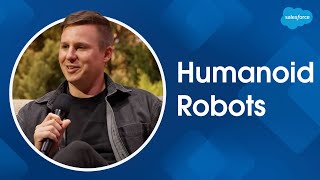
Brett Adcock, founder of Figure, discusses building humanoid robots with neural networks for general-purpose tasks. He predicts speech-controlled humanoids in homes within years and more robots than humans in offices within 5 to 7 years, with minimal regulation compared to aircraft.
Chapters
All right. Good morning, everybody. How are you? Ohio Gozaimas. Ohio Gozaimas. Great to be with you this morning. We have an incredible morning speaker. How many of you are interested in the future of robotics? All right, well, you're in the right place then. Fantastic. You got the right guy. Brett Adcock, Come on out. Bret. Brett, great to have you. Welcome to Dreamforce.
Thanks for having me.
Everybody here is interested in robotics. We're going to have a great time. You brought some friends here. Do you want to introduce these guys before we get going?
Yeah, our friends. Yeah. Nice to meet everyone. I'm Brett Adcock. This is our basically three generations of humanoid robots at figure. So on the right, we have figure one, which is our first generation that we unveiled. We actually had this robot walking in under a year since we started the company, which is really fun. And this is our second generation robot, figure two. And then last week we unveiled figure three, basically our latest generation robot.
Very good. All right, well, let's talk. Brett, come on, let's have a seat. All right. Okay. So, Brett, you are. Well, you know, I don't think a lot of people really know you and your background and kind of your Midwest roots. So why don't you just tell us a little about kind of where you're from, your background, kind of, you know, how you grew up and. And then before we jump into all the good stuff.
Yeah, sounds good. And thanks for having me. This is like an incredible event. Yeah.
So we are thrilled to have you, actually. So thank you for being here.
So I grew up in the Midwest, central Illinois, actually on a third generation farm. We basically raised corn and soybeans. And then basically since high school, middle school, started building software companies in tech. So now it's been about 20 years or so building technology businesses. I spent about 10 years building software companies, ended up selling one, and then started a company about eight years ago called Archer Aviation building electric aircraft and then started figure about three and a half years ago. So we build humanoid robots now.
Before you get in there, you went pretty quick, because I do think people don't really know what Archer Aviation is and how incredible that is in the work you did. So why don't you just kind of just hit exactly why that is, what that is, because it's so relevant before you bridge into figure.
Yeah, so at Archer, we build electric vertical takeoff and landing aircraft. So it's like kind of a lot of words, but basically you're building basically a fully electric helicopter merged with an airplane that can basically move people in and around cities. So the goal is like roughly half the world lives in cities today. We're stuck in traffic. I was stuck in traffic on the way here.
I could have used one this morning, actually.
I know we all need them. So our goal here is to basically help solve this congestion by moving things into the air. You can do that now with fully electric propulsion systems. It makes it far safer, cheaper. You can basically just build an overall better product. So we've now designed five generations of aircraft at Archer. Our current version, Midnight, is a piloted four passenger aircraft that we're working to certify here in the US with FAA right now.
You made a point to focus on the word piloted.
The quickest way to get into the airspace and actually ship the product is a piloted. We live in a piloted airspace today. I think there's no reason that you can't do this autonomous from a technology perspective, but I think being able to then deliver product in the market within a sub 5, 10 year, basically in a reasonable timeline. We have a pilot at airspace today. We can certify an aircraft and get type certification with this. So our route is basically piloted and then over time, slowly remove the pilot.
So, Brett, this is very important because I think this really sets up the whole conversation because here you are, you're building soft. You come out of the Midwest, you built this great software company. Now you start Archer. You have this huge aggressive vision for Archer. You have this aircraft in your mind. It's doing this, it's doing this. Right. And it's not just piloted, it's also autonomous. That's something, you know, we've seen in the movies and the cartoons. We don't have any of those flying around San Francisco exactly right now. Right. I didn't. That's not how I got here today. I would have loved to been able to, you know, land right here, but, you know, you just, you envisioned it, you built it, you built a factory to build it. You did it all right here in the United States. Just take those little pieces apart. And how long were you at Archer? Was it four years, five years? What was the total period? And you took it public as well, right? It's a public company.
Yeah, I guess the fun stuff.
Tease it out a little bit for us.
Sure. Well, so I basically had to go back to school to learn how to build electric aircraft. There's this funny thing here where I found experts in certain areas of rotorcraft, vertical lift and normal airplanes and then electrification, but none of them overlapped. The rotorcraft folks that built helicopters didn't understand the physics and the aerodynamics of forward flight. The folks that are doing electric propulsion, like batteries and electric motors didn't have no clue. Nothing in aviation it's really that electric. So we didn't find a good mix. I basically went back to school and I started the company out of the University of Florida where I basically went to college. Basically moved back, started a small team there. We started building small subscale aircraft for evtol. At some point I got the hang of this and we ended up moving the company out to California and then we started.
Most people say small aircraft. They think it's a DJI drone or something. That's not what we're talking about.
No, like a 1215 T wingspan. It's pretty big. But you know, Archers Midnight aircraft has like a, you know, greater than 40 foot wingspan today. Six like 6,000 pounds maximum takeoff weight.
Like I only know it because all of a sudden I was in a hangar in San Francisco and all of a sudden one of them was in there and I was like, what, what is this?
Yeah, what is.
This is crazy.
It works like, it flies like every flight every week. So yeah. So basically had to figure out how to marry mechanical engineering structures with aerodynamics, controls, embedded systems. It's quite hard. And then all the.
How did you do it so fast? That's what I just couldn't get my head around. I mean, it seemed like you went from zero to prototype to production. Literally. What was it, a matter of two years, three years?
Yeah, we really spent a lot of time learning. I spent the first year kind of as a crazy person trying to build out this very complex spreadsheet of how the whole aircraft worked from top to bottom and size it. I called it my aircraft sizing engineering sheet. And it was basically an input to say, how big do the wing need to be? How many motors, how many fan blades, how big the battery system is going to be. And then you could basically boil everything down to like what I call like.
What we call just at home writing a spreadsheet of what I'm at.
Like I'm at like a Marriott in Atlanta doing a course with a NASA professor on like a NASA guy on like electric like electric propulsion and trying to put this all together. And I had a really hard time. Ended up moving like down to like Gainesville, Florida and spent some time there like trying to work on that and then prototyping those, the physics of that and see if it worked. And I got a lot of the physics wrong. The first few innings I built the wrong aircraft completely. And I basically laid out the propulsion system wrong. I laid it out like longitudinally, and it really wants to be lateral distribution for lift. Really want good axial flow into the fan blades. Sorry, a little too intense. But I basically figured out the physics of it, of what worked, and then just worked like hell towards the vision of how to do that and chew it down. It's no different than what we do. At figure now we're like, we're. I don't want to jump too much bigger, but we're three years old. We built like, basically three generations of like the best humanoid hardware in the world. And so I think it's just like we getting the right.
The reason why I think the Archer story is so important is because I think, you know, that you kind of. You proved out that you could integrate hardware and software together and you could also deliver the electrical capabilities and also kind of overcome the physics. Yeah, yeah. And then you had. Is there an autonomous Archer today?
Our first few generations of maker in early midnights were flown autonomously without or flown without a human in the aircraft. But our current generation of. Of aircraft for midnight and the ones that will bring to market are all piloted.
Because when you started Archer, we weren't really at the kind of threshold of AI that we are today. Right.
I called Michael Romandowski, the then director of the FAA. I cold called him in 2019 and I asked him, I want to bring autonomous aircraft to market. And he said, don't do it. He said, the airspace today is piloted. If you can get the technology built and the aircraft built, we will certify it and you can fly it and you can get it in the market if you do autonomy. There is no roadmap right now for having any definitive year that you could sit there for two decades or a decade, theoretically.
That's in the United States. There's other countries who are a little bit more aggressive in terms of. I was just in the uae and they have, I think, a goal of having autonomous aircraft flying in their airspace, like in the very short term.
I think it's like 60, 70% of all flights are done in the Europe and US today. And like Yasa and Europe and the US FAA are like the gold standards. If you can get certified in one of these two regions, you can get certified everywhere else.
Is that thinking about, like, what Zipline is doing and what these people are doing in terms of like drones or you or is when you started carrying people? It must be. It's a whole different.
These are civilian Type certified aircraft. Space that needs to be RAC rated to 1 in a billion hours to catastrophic event 1 times 10 to the minus 9. You have to develop intrinsic safety on the aircraft with redundancy so that you can achieve these. It's a very different ball game. You can short circuit this and try to get certified in other countries. Ultimately, you need to design a safe system. We travel today. It's the safest form of transportation in the air, anywhere you go, better than any form of transportation you take. It's because of the intrinsic safety that the aircraft and the design process they go through. And you can short circuit it. You're just like, you're short circuiting this safety goal and you're going into markets that are smaller, lower tams. And ultimately you need to be in the biggest markets in the world to build something massive here. And that's the FAA and yasa. And the YASA really piggybacks in the faa. So you really didn't have the FAA as the gold standard for the globe on aircraft certification.
When do you think half the people here will be coming to Dreamforce in some kind of autonomous aircraft?
Oh, man. At this point, it's just largely a certification level timeline. So the only thing left is basically to get certified and get what they call a type certification. Once that's done, you can start taking civilians and start charging money for flights. It's governed federally in the U.S. so you have to get federal certification and then there's some other types of certification you have to get. But largely you have to get a type certification. And that's taken anywhere between like three and seven years for most fly by wire aircrafts here in the US So we're in like a, like we're in the middle of that now, just going through that whole process. So it's like, it's largely a regulatory timeline now.
So what do you think the time frame is for? You know, let's say, like I said, like here's a large conference, 50,000 people. They all came in, you know, with pilots. When would they come in? Like 50, 50% without pilots?
Hopefully in the next, like. Well, it depends then. It also depends on like how long it takes to build enough aircraft and saturate these markets and enough people here to take it. That's a different story. But like, when can we.
My friend is a pilot just sitting in the front row, so he's listening very carefully.
When can I fly this? I certainly under five years, maybe as soon as two or three. That was kind of be the balance I would say yeah. Yeah.
All right. Well, this was. This was important for me because before we get into the robots, I really want people to kind of hear that you have a deep understanding of not just this category and where this is going, but also this idea that it's.
Yeah. Can I say something real quick?
You can absolutely do it.
When you think about the components needed to build an electric aircraft, you basically need batteries, electric motors, control software, embedded systems, sensors, and structures. Those are the same things we need to build a humanoid robot. Exactly the same stuff. It's all different components and all different ways to design it. It's orthogonal in the design space. There's not a single thing that we'll use or want to use from aircraft. But it's the same stuff. It's the same team members.
But you laid out also that there is a whole ecosystem, though, around it of governance and compliance and all these other pieces as well. Right. So the stack is not. It's more than just a technical stack. There's also a governance stack and a societal stack and awareness. That is going to be different, though, between kind of the rapid kind of adoption of robots and even kind of where we are right now in autonomous aircraft. Is that. Is that the right way to think about it or is it wrong?
Yeah, I know. It'll take a lot longer to, like, get certified with Archer and basically, like, scale that. Human robots is almost like the opposite land. There's, like, almost no regulatory. There's no regulatory.
These aren't coming with pilots.
Right, no pilots. Okay, sorry.
And is that exciting you that there's no pilots? Is it easier from a governance perspective and compliance? Is that it's exciting? Is that freeing for you in some way?
It's exciting for me not to have this binary regulatory body in here saying you can go. No go for an entrepreneur. You want to get product out.
There's no F.A.A. for robots.
There's no FAA for robots. So as soon as we can build.
Something intrinsic, should there be? I read the book, by the way.
I know you did.
There were some bad things.
Yeah. Watched the end of the movie, saw the movies.
Our futurist wrote Minority Report. Yeah. And I saw a few other movies, too. I won't go through the names.
I mean, it's like, you think there.
Will be an FAA of robots.
There's a difference between a robot and a humanoid robot. Like, we talk about, like, there's, like, all these articles coming out of, like, China, like, how many robots they have. Like, these are industrial robots.
I saw some nasty videos Backstage.
Yeah, that was crazy. But like, you know, we think about like what real robots have been been or we've been around. It's like we've been around these like, you know, like giant kuka, like 7 degree of freedom, like, you know, warehouse industrial manufacturing.
All right, let's not go down this rat hole. So let's just step back and come back into reality. So here you are, you're from the Midwest, you're in Florida, you've got the entrepreneurial bug, you're doing the software thing. You're like, I can do more than software. I can do engineering. You've got your spreadsheet, you have your NASA guy. You're defining the future of air flight and the future of flight. And here it is. And now you're seeing it and you're going, now you build the company, it's public, you've done it a few years and you go, no, no, I'm not going to do that anymore. New company, boom. Figure, now that was only like 36 months ago, right? Okay, Is that right? Is my time flame right or wrong?
It's like a little over three years.
Three, okay, three years. Sorry. So three years ago, all of a sudden you say, oh, I'm new company, I'm going to do autonomous robots. Now we have three generations of robots. Just, you're going super fast. What has happened? How did you get to figure one so quickly? Everyone all of a sudden said, wow, here we are in figure one.
Yeah. The short answer is, when I started the company, we thought about all of those things you just mentioned and felt like, how do we do this better than ever before. We started with, here's our culture, here's our mission, vision, values, here's what we care about, here's where we want to go in the short term, here's where we want to go long term. We care about things different than most companies. We care about turbos, like, like turbo velocity. We want to move extremely fast. We want to build a extremely flat org. We want to be really hands on. So everybody in my org here at Figure Cads are codes. We don't have like executive rooms. Like, we don't have anything else. I sit on the floor next to engineering and our goal is to zoom.
With people like me. Little robots are walking around behind you.
Yeah. You're like, that's cool. We should have that at the bent and. Yeah. And the goal was to basically like work on something extremely challenging. And the only way through that problem is to work extremely fast, unblock the critical path of like lessons learned about what works, what doesn't.
Did you, were you able to take a few engineers from Archer with you or were you, you know, did you just kind of start with a green sheet and your own, just your own skills?
Yeah, no, we have, we have a whole crew of folks that I've been working with now for like almost 15 years actually. Like my first employee at my Veteri. And early folks are here today. Lee and Logan, they're right there in the front row.
Would you guys stand up if you're here from a figure and just be recognized? Fantastic.
Yeah, so we have. And then we had a whole crew from Archer join, so we had like the whole core team from Archer there. Core team from Veteri? Yeah. Like Dana took me public at Archer. She's right here now from figure. So yeah, we have a. We. We started with like incredible team. I, I was lucky enough to have enough money to like self fund the whole thing. So we were just like, like we went to 30 people as fast as possible. I think we got the million a month of burn in like month four. So we were like, it was like we were just at the, at the start line. Like we want to walk the right architecture of humanoid within 12 months since the sequel.
So day one, you had how many people there in the office with you?
This me, like Lee and Logan, a few. We were at the WeWork in Palo Alto.
Five to ten.
No, like, yeah, like three to five, something like that.
Three to five.
Pretty early on. Not like day one, but like call it month one or something like that.
And then after 30 days you had.
How many people within like four months we had like 20 to 30 people. So it took some time to recruit the best talent in the world. We were, we were hiring from like.
The best robot and literally within what, a year? Or is it 18 months? You had figure one?
No, no, no. We, we, we like, we had our C Corp like filing date in like May of 2022. We walked that first robot you see on stage dynamically around the office in under a year from when we started the company. And it was incredible and it worked. And we made a lot of decisions right. We made some wrong. And then we just like revved it into version two. And then we got a lot of things right, we got some things wrong and we revved it again into version three. Version three for us is a robot that we think we can ship at scale. It's designed for high rate manufacturing. Manufacturing. It's 90% cheaper in cost. It's just a Robot that can be fully general purpose.
Okay? Now, Elon Musk kind of Sundays, look, there's three things here. You got the software, you got the hardware, and you have the manufacturing. And you're going to have to. He wants to press out a million of these and that's like, obviously he's got the Tesla kind of factory experience. You got kind of the same thing with the Chinese. Where the Chinese have this kind of factory experience, high volume manufacturing. Then that's what a lot of people are thinking. Well, the Chinese right now, they're pressing these cars, the BYD cars or the Huawei cars or whatever it is, and they're coming over on these huge tankers. And God forbid we ever turn in any kind of military situation or at least turn into military objects, because all of a sudden they're going to get loaded onto those same tankers that are bringing those cars over. They're going to be bringing over the robots. So just address that. How are you going to build a million of these or 5 million of these or 10 million of these?
Can I take a little like detour from this for one second?
You absolutely can. Interview.
There's like, I get this question a lot. It's like, how are you going to make a lot of robots and how's it going be low cost and all this stuff? It's today. That's not the issue. The issue today is you're watching the market and like everybody's out there doing like theatrics with robots, like open loop theatrics. They're like dancing or they're teleoperating the robot. It's like a movie set. And we're not at a point in society where anybody can be at a point where if you can make a million, you can make them work. You're talking about one of the hard things about humanoid robots is just like that's a little tangent is there's 40 degrees of freedom on this robot. A degree of freedom is a joint. A joint can theoretically spin 360 degrees as a motor. So the amount of states the robot can be in, the amount of positions it can be in are 360 degrees to the power of 40. That means there's more states of the robot, the more positions it can be in than atoms in the universe. You can't code your way out of this problem of getting that thing to do general purpose work. You have to use a neural net to learn those representations. That's the invention. Society made this blobby tissue that can learn that stuff. And you need to then put in.
Do you see this as the hardest.
Problem, the manufacturing problem's problem number 50? It's not even close. And everybody's like saying, who can make more? Nobody can even make a robot that can't operate without a teleoperated human in most cases. What you saw in the unveil last week for us is every task the robot was doing and manipulating objects was done by a neural network. We did it over, like, over a dozen different types of use cases. We did it fast, we did it under 30 days, maybe in a few weeks.
And that's also what you demonstrated, right, at ups, Right.
That's what we do.
Have them on the assembly line now for quite a long time where they're sorting packages.
So it's that, right? It's a BMW. We've been now there for five months now. Since April. We run 10 hours a day. We've run every single working day. And the same robot that's running right now in Spartanberg was running in April when we started. And so we're getting, like, operational readiness and making sure the robots can actually do real work every single day. So at some point this will turn for us of, like, how do we manufacture at real scale? Which is what we're working on now. So if you came to our office, we have a whole facility called BotQ, kind of like HQ, but for bots. And we're trying to make, we're trying to make thousands of robots as we speak right now. And it's hard. And the whole place is like, just like the software, it's advanced, like software layer for, like, manufacturing. Everything's, like, networked. All the tools talk to each other. We, we, we can scan a robot and know every single torque we put on every single bolt. It's unbelievable. The place looks, it's, it's phenomenal, actually, of my favorite places to visit. So we're learning how to do that. But the big next step is who can solve. It's a race right now for humanoids of who can solve general robotics. Who can solve an intelligent, like, human, like, intelligence in the physical world. That's the race. That's what I would be scared of.
And when will you be there?
We feel we're at the, we feel we just hit all hands this week. We all feel, it's like now we can see it and it's like this little light at this tunnel and we don't know how far it's going to take, if it's going to take a month or if it's going to take a year, we see it now.
Okay. But put a stake in the ground.
I think we'll be able to do general purpose work with a humanoid by just through speech and have it do everything you'd want it to do in unseen places like a home. It's never been in. Next year.
Okay. When will 5 vendors exactly like yours be at that same spot?
When will what?
When will five vendors exactly like you be at that same spot?
It looks at the. As of right now, we're multiple one or two years beyond anybody else in the world.
So in three years, like, when will five vendors exactly like you be at that spot?
Certainly under five years.
Five years, certainly. When will five vendors exactly like you be able to press a million robots?
I think you could figure out how to build a million robots fairly quickly if you had general purposeness today.
Okay. But if you're able to deliver the bullet, say within five years, is the manufacturing this going to be some hard to like, no. Cross bridge or not?
No, it's like people like generally. So when we started we were like, oh, we're going to do car manufacturing. And if you guys ever been in a car manufacturing company, it's like the most complicated thing I've ever seen in my entire career.
Your company's already worth more than every car company that I can think of. Your last funding round I think was like at 30 billion. A year ago it was at 3 billion and three years ago it was at, I don't know what your first round was at 100 million, 500 million. A billion.
A little under 500.
500. So you went 503 billion, 30 billion. So you're already worth all the car companies you go buy. You could probably go buy whatever you want.
You're going to build a company 200 times more valuable than Apple. You solve this, it's half the world's GDP is human labor.
Your goal is to build a company 2 1/2 times more valuable than Apple.
You will build a company like maybe a hundred times. You'll build like definitely tens of more valuable than Apple. You will build a company worth tens of trillions for sure. If you can solve this problem. Tens of trillions, like half of GDP is human labor. You could deploy almost an infinite amount of synthetic humans. It's not about just doing what humans do today.
It's about like, your goal is to build an infinite amount of synthetic humans.
You're building a new species.
I think that. Is that what you said, the goal?
Yeah.
And. But it's not. And will there be other forms? I mean we're looking at the human form, but in the back we're looking at all kinds of like we saw the Transformer movie. I don't know if you saw it. There were different forms. They do different things that look like a car, then they look like that. Yeah, you know. Is that where we're going?
I don't think so. I think humanoid robots will be so much of a plurality of like of robots out there, you won't even recognize the other ones. I think for various reasons. One is you want to generally manufacture one product at really high scale to get cost down. That's like a pretty easy. The second is you want to be able to understand what the training set is for neural nets, our training set for humanoids. This is an unfair advantage which we're taking human data for like navigating around. We can take data from just humans walking around an apartment and we can navigate around now just from that human video data. And we can touch things like humans and grab things. We have five fingers, we have hands. Like we have the same affordances as a robot. As a human, the robot has. Other robots don't have that and they're not intelligent. So you're gonna have a situation where a robot goes out and every day while it's doing things and it's messing up, it's getting better about those mess ups. It's making less of those, it's sharing that back to the mothership. And they're basically doing. We're basically training all that information to every robot. So unlike humans where I have to watch all my kids learn how to walk by basically like they don't listen. They just want to do their own thing. Right. And figure things out. And humanoids are different. Once one robot knows how to move packages or do your dishes or whatever. Every robot in the fleet knows this. So you have a situation happening where you're basically going to have like recursive intell. Intelligence will be climbing and you'll be decreasing costs. And a wheeled robot, a one arm, it'll just won't be able to compare because you're going to have a humanoid 10 grand, 20 grand or in the limit, cheaper because it's going to make themselves and then you're going to have intelligence getting smarter every single day. And I don't think you have a world full of different types of affordances given the world today we live in is made for humans. We had to come upstairs and stuff to get here. It'd Be like a general purpose robot will just beat out everything in my view.
In the movie. We are legion. We are bob. These humans have evolved. You already know where I'm going. Yeah, okay, go ahead. In the book, we are Legion. We are bob. The humans evolve into these robots and then launch themselves into space and it's the end of humanity. And do you see that? Do you see that kind of world? How is in your science fiction mind, you know? You read the book.
Yeah. I'm like laughing because like we were behind the stage talking about like the what is like if you keep drawing out the future. I'm a big sci fi nerd like you. One of the things I'm excited about is self replicating Von Neumann probes in space where robots can basically build themselves and go out and mine methane and do the right things on different planets and build more of themselves and basically colonize the galaxy this way. And I think this will happen. It looks like it might even happen in our lifetime, which is funny. I think it'll happen in our lifetime. I mean we're like, we're compressing all the world's knowledge.
So. We are Legion. We are bob. This is factual. It's not science fiction. It's factual. It's near term reality.
It feels like it's possible, my guys.
In your mind it is possible.
Oh, it for sure will be possible. Yeah.
In your mind for sure it is possible. We are legion. We are bob. Yes. Shaking its head.
It's just a matter of time. I mean like we'll approach this. Yeah, it'll work.
Self replicating.
Yeah, well, I mean we're like, we.
Have robots in outer space. We have robots going with human consciousness. You've woken up inside one of these? Yes.
Yeah, I think you could like, are.
You going to wake up inside of one of these? Which color did you like that you want to be?
We have like this really cool like Dune outfit concierge robot. Our release. I want to wake up in that outfit. I was just like, I'm like laughing.
Pointed to one of his employees.
Yeah, I was laughing because like we were talking about stage about this and one of, one of the guy David's like, do not talk about any of that. They don't want to hear about this.
Yeah, don't talk about any of that. We won't go there. Don't worry. But we're going to. We are legion. We are bob. Infinite numbers of synthetic humans in outer space. Self replicating.
Yeah, we're, we're building a new species here and it's going to be like, will you, like we'll start with, you know, thousands and millions and billions and.
Like, we're not building robots, we're building a new species. Really?
I think you're building a new species with onboard intelligence, onboard consciousness. Yeah, I mean we're.
It's not intelligence at this point, right? It's beyond intelligence, isn't it? What's the difference then between intelligence, consciousness and then what we're talking about when all these robots are talking to each other and communicating in ways that somehow maybe we don't even understand how we communicate and share? Like, we are talking at many different levels right now, aren't we? So now explain that in terms of the world of the robot.
One thing I want to say is like we're talking about self replicating robots is we will be also putting our first robots on the manufacturing line this year, which will be really cool as we think about ultimately closing the sloop on robots that are truly self replicating.
Now. I just want to come back to. There are short term needs in our society now, as you know, or you may not know, but Anyway, we have 50,000 people here and we're a little bit. We just gave the SFPD a million dollars for sign on bonuses because they need to hire a lot more cops. Because we only have about 1500 cops in our city and we used to have 2,500 when Gavin Newsom was the mayor. Today we have about 1500. So I was just wondering, while you're talking, see and looking over here and you know your narrative around synthetic humans, do you see this as that you'd be selling these to SFPD and saying, look, you're down 500 or 1,000. I can offer you robots to do some of these jobs even if they're not armed or not militaristic. Is that a role that you see them playing in cities? When you're looking at the video, you could see a lot of use cases.
It just does everything a human can. It'll just do everything a human can. Our whole product roadmap is designed more and more to what humans can do. Figure 3 was designed almost specifically for our neural nets. The heads, hands, everything was designed to learn better from humans. And that trend is going to continue for like that trend that'll go a long ways.
How many Times has the DoD showed up at your headquarters already?
Yeah, we get hit up like all the time for this. We put in online our master plan when we started. We won't do anything militarized right now. And I don't think we have.
I saw that movie by the way, and how that started.
Yeah, exactly. They're just like, oh, just do a little trial.
We're not going to do the DOD and we won't do anything. Great.
I just, I don't think it's, it's not what we want.
Google also used to say that, by the way.
Yeah, it's just like not interest for us. We want to. The civilian is the area of shipping robots in the home and the workforce. That's what gets us excited. That's what we want to really help out with. And we don't really. There's a whole other picture over here. It's like.
But when they're synthetic rep self replicating, will they make the same decision? Because you said they're self replicating. So at some point don't. They're going to make their. They can choose on their own. Why are you deciding for them?
Yeah, and one of the like, really core reasons, like also like wanted to work on this project to start this company is I feel like if we didn't.
It's a cool career that you've decided to work on for like how old are you now?
I'm 39.
You're 39?
Yeah.
It's going to be a cool life ahead. Right.
I'm excited. We're like, just work on something incredible. And like I was going to say is like, if we were like, if we were not doing this, it feels like we're approaching. We are like, we like, you know, we like, we kind of approached artificial super. We're approaching artificial super intelligence. And these systems even digitally are going to get so smart and so capable in the future here that if it's not humanoids doing the work, it's going to be humans.
How will we know that we've achieved artificial superintelligence or AGI or ASI or whatever we're calling it?
We've just did this thing with the world and did this LLM thing and we just drove by AGI so fast and everybody just kind of waved by and we're kind of already past that. I think if you surveyed everybody four years ago and said like, is that thing AGI? I'd be like, yep, that thing's for sure AGI.
So I think we originally it was really defined as what you said earlier. That is, you painted the picture the we are bob, we are legion picture of the self replicating. Right.
Yeah.
Today the AI is not, it's not self engineering, self replicating, which I think was the definition. I mean, I'm not going to put words in your mouth, but I think that the AGI asi, like it's self replicated, self engineering. It's not just, it's not just Claude, you know, kind of helping you to make your code more efficient. It's building the new Claude. We're not exactly at that level, are we? Or are we?
We're like on the exponential, so it's really hard to tell. It feels like. I wouldn't bet against it.
In your mind we are.
I mean, we're heading towards it right now.
In your mind, you already see that happening?
Yeah.
Like you have total clarity for that vision.
Internally, we get to sit at least a little bit.
What's the one thing that you see that you think nobody sees?
I mean, we listen, we sit here internally, we get to see a year or two, we feel and see a year or two out at least in the robotic side of things. Like it's what we see. And we see this stuff only getting extremely capable, very cheap and human like intelligence in the home, things like this. We see that now. We do some of it. We do like pieces of it. We, we can't do all of it yet. We can't drop a humanoid in and say, clean my house, I'll be back at 5 and it's done. But we see the path of that that's for sure gonna happen. And we're just like, how do we get there faster now? And that's what we're doing every day in the. You know, when you go back to the office today, we're just like, we're sitting there obsessing over that. One problem is how do we solve general robotics.
In our industry, people are always overestimating what you can do in a year, but underestimating what you can do in a decade and certainly two decades. In two decades and 20 years at Dreamforce 2045, when you come back for this follow on interview, what will we be discussing and what will be happening? Or will I just be talking to a figure?
Well, you're all flying here in an Archer aircraft. And one of the things we have at company goals internally that you should have, it'll be good for me is having more humanoids at our office and humans. And we want to do that really fast. And I hope by way before then we come in here, there's what, 40, 50,000 people here. I hope there's more humanoids than humans here at the events to be crazy. And the crazy thing is like you'll see at one point, more humans.
There'll be more humanoids here than humans.
Yeah, for sure. They'll be doing everything. There's like a ton of humans here doing stuff. All day long. It'll be humanoids doing all that work. It'll be talking to them in real time, speech to speech, which we do at our office.
And this is the short term.
This is way before 2045.
This is way before 24. 5. This is really what year this is for sure.
Like sub five. Seven years for sure.
Five to seven years.
We'll have more humanoids than humans in our office next year for sure.
So in seven years I can see that there's, you know, people here of all ages in the audience, right? And there's also, you know, people in their 20s, in their 30s, in their 40s. The life that they're going to experience.
It's going to. It's like hard to comprehend because we're like literally building sci fi right now. The whole world is. And we're like, you watch sci fi movies, you're like, oh, that's happening right now. It's like, what's the next, like, what's beyond this? It's like hard. I don't know, like. But it's definitely the most entertaining and interesting time to be alive in history.
So.
Yeah, I mean, I think one thing that you see from like at least the demonstrations we're doing is like you can see all these things. You can see incredible hardware now is getting cheaper. We can make them. We're trying to make them in even higher volumes. Like you can see pockets of this doing like the hardest things possible you'd want it to do in a home, like laundry and dishes. It's doing it with neural networks that we trained on human data and we can do pockets of it now. You showed it in the release. We can navigate around, we can talk to humans, we can do these things. It's not all quite there where it's like all perfect, where package it up and you can get it and do all that. But it's like that's coming. That's not coming in 10 years.
Let me ask you one more question that we didn't address. Are you going to have to build your own Manhattan size data center to drive all these things or are you going to use others data centers? How do you look at it? Do you see this as a vertical stack that you need to own the data center or are you going to have to partner with somebody? Because all of a sudden I'M sure that Sundar is coming here tomorrow. I'm sure he's not thinking, I'm never going to do this. You've got all these different cast of characters and they're all trying to acquire as much energy as they can acquire, build the biggest data center they can build because they see a world where all these fast food. If you go to Burger King two blocks from here, there's still humans making the burgers. That's not your reality, is it? That there's.
Do humans want to be making burgers?
Okay, exactly. So there we go. So your reality is within a short period of time. You said five to seven years. Will we go into the Burger King a couple blocks from here? There is, let's say the figure robots making the burgers or other kinds of technology doing that. But if it is figure, is it on your data centers, is it other data centers? How do you think about your architecture in the long term in terms and data? And then of course, that must shift because you're about to launch all these robots into rockets and become self replicating in the universe. So I don't know how they're going to have to connect to some kind of data center.
I mean, they'll probably have to do fully embedded systems there, like onboard compute to do that really well. Okay, so, okay, one lesson learned I've had from figure last three years is that I figured there's like a pretty mature, efficient world. We can go out there and get things like motors and batteries and cameras and all this stuff and we would just put it into the robot. Maybe we do some stuff, maybe we don't. And I was like, I'll do some stuff and we'll go buy some stuff. And like that thesis is just like thrown out the window high speeds. We, we have to design. We design everything now. We design our cameras for generation three. We do our motors, battery systems, sensors, everything. Most of the things we deal with.
Software, rare earth metals.
Yeah, we actually that'll be easier because.
Once you launch them out in the space, they can just mine the asteroids and then you don't have to worry about that anymore. Get on other planets. We don't have to worry about this planet. We can just mine whatever we need.
Yeah, we should be able to do that.
Yeah. This is very limiting being here on Earth, isn't it?
It's pretty.
Got to get the hell out of here. I mean, think about all the stuff we got out there. We can just get this done. There's a lot of ladies and gentlemen, was this Great. Please thank Brett Adcock. Well done. That was awesome.
Thank you, J.









