Injustice and Race: A Conversation On How We Can Take Action | Leading Through Change | Salesforce
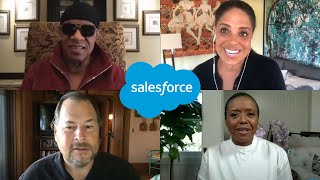
Marc Benioff, Melody Hobson, Soledad O'Brien, LL Cool J, and Stevie Wonder discuss systemic racism and George Floyd's murder. They focus on concrete steps: audit your own house (people, purchasing, philanthropy) and set measurable targets for change.
Chapters
You.
Hello and welcome, everyone, to Leading Through Change. My name is Ebony Beckwith, and I'm Chief Philanthropy Officer at Salesforce. Just want to start off by saying that today's episode is not originally what we had planned, but in light of recent events, instead of canceling, we really wanted to make space for this very important conversation because there is a lot of pain in the black community. And like so many of you, sometimes I feel like I have to hold it all together. The truth is, I am heartbroken. I am outraged, I am grieving, and I am also scared because against this backdrop of a global pandemic, we also are experiencing the ongoing effects of systemic racism. That's not new. It's been around for many, many, many years, far too long. And it's really hard to imagine, where do we even start? How do we make change? This is going to be a very difficult, yet powerful and very necessary conversation. So we're going to have to get uncomfortable, get comfortable being uncomfortable. And it's okay, I think, to acknowledge that we don't know the right things to say. We are feeling some kind of way. I feel very overwhelmed. I often am at a loss for words right now, and I'm sure many of you feel that way, too. You know what? We also don't have all the answers, but what we do have right here, right now is a platform. And we are committed to using our platform to make change, because together, we believe that we can do this. So today, we'll be joined by the powerful voices of Melody Hobson, Soledad o', Brien, LL Cool J, and the legendary Stevie Wonder. And at the end, we're going to end with clear calls to actions that everyone can take today. I also want to promise you that this is not the end of this conversation. It is only the beginning for us. Again, we cannot shy away from it. We are going to address this head on. So now I want to bring in Salesforce chair and CEO Marc Benioff. Marc, welcome. I know you care deeply about this issue. You and I have had many conversations about this. So as CEO of Salesforce, as a parent, as a friend, as a human, I'd love for you to start by sharing what's on your mind right now.
Well, you're on my mind, Ebony. So thank you for saying that. You're on my mind, and Christina's on my mind. And so many people who put this program together are on my mind because of the conversations that we've had in the last few days. But let me just begin by thanking everybody for joining Us today. Thank you for being here. This is such a deeply troubling moment for all of us. And I think, like many of you, I have a very heavy heart about this terrible murder of George Floyd and countless others that we've had to recount. You know, there's something about trauma like we're going through right now is that when we have a trauma like this reopens all the other traumas. It's like a window that we look through to see everyone else that we've lost. And it's upsetting. It makes me incredibly angry. It's horrifying. It's inexcusable. It's everything we don't want in the world. And we have to find ways to repair the world, to come back together as one humanity. And, you know, I think, like what you just said, EBONY is so powerful that this is really the latest example of the systemic racism that continues to plague our country. And these are difficult times. We're living through one of the most challenging moments of our lives, of our country. That's how I feel. Personally. I feel like this has been one of the most challenging moments of my life. I was just reframing it. The last time I saw Melody was in February. We were in Chicago together. And when I think about everything that's happened since then, I just can't believe it. There's no way I could ever. If someone had said all these things are going to happen, I would not have been able to put it together. So I just want to be absolutely clear where Salesforce stands as a company, that we're guided by our core value of equality, that we stand as allies with the black community, with you, ebony, with Christina, with all of our closest employees, leaders, so many of who are so deeply suffering right now, who are grieving, who are angry, who, as you said, are so justifiably afraid. And I'm afraid also. I understand. I feel the fear. But I think we have to be here to listen. We have to be here to learn. We have to be here to come back together as one humanity, to support our employees, our customers. We have to be here to support our communities, all of our stakeholders. We have to be here for everyone. And I hope that through this dialogue and through having a multi stakeholder dialogue which we so strongly believe in, and that we've done so many times on programs like this or Dreamforce or other events around the world that we've hosted, that I hope that we will all join together and learn more about how to be active allies. I hope that we can all join together and learn how to heal. I hope that we can all join together and have a dream of what's possible in the future because we have people on the program today who have those dreams, who have those visions, who have those insights, ideas and they're people who I've learned so much from. I'm so humbled to be here today to hear from so many of these amazing leaders and I feel that we're all so fortunate to be able to hear from them today and to have that vision from them and to listen so closely to them. But I want to welcome our first guest, Melody Hobson. She is the co CEO and president of arieyl Investments. As I mentioned, we were just together last in February which feels like a lifetime ago. She is of course on the she's the vice chair of the board of Starbucks. She's a director of JP Morgan Chase and Quibi which has since launched since we were there in Chicago, which is a short form video company if you don't and I couldn't be actually any more thrilled to have Melody with us to discuss these important topics. She has been so important in my life in this area, in so many areas actually. I just think about all the areas that she touched in my life. But Melody, thank you for being here.
Thank you so much for having me.
I'd like to just open it up and just give this forum to you Melody, and let you speak to what's on your heart right now and what you're feeling and how you see things going forward and the approach to repair the world and how we move forward.
Well, there's a lot in that first opening question. I'll try to do my best to be as thoughtful as I can. I think there are a lot of people who feel the way that I do of all races. So I don't make this specifically about being black, but I do think there's about something that is being black that is particularly traumatic because you can see yourself and the people that have died, that have been murdered and you really are clear about the fact that there's nothing about status or socioeconomic condition or education at the end of the day in those situations, what people see as black and I've said this many, many times that I'm black first in my own mind and what I believe others see, I embrace that. But I recognize that that creates sometimes challenges and sometimes great opportunities. And when the challenges are not great, they're really bad like we've seen in this horrific situation. I'm Horrified in every way by this murder. And I've been very. I'm glad that you called it a murder, Mark, because some people say death or he passed away, he was murdered. And I've talked about the fact that I've never seen a murder of a person ever on video in that way over that amount of time, more than eight and a half minutes. So to watch something like that and just to be a human being, you feel so helpless. And so I just incredibly sad. And then when you watch the lack of reaction by those who are actually inflicting that fatal pain, you just. You can't believe that a human being can do that. Or the desperate pleas of the people who are filming it saying, please stop. So there's a tremendous amount of sadness. And that sadness is compounded by the fact that we all know that this just happened to be videoed. This happens every day in our country in places close and far, but there's just no camera. And so this is not an isolated event. It, in many ways, is a regular event in America and has been for a very, very long time, which we all know now. I say all that. My heart is heavy and sad, but I wake up every single day with hope. And I believe in always having the glass half full. And I 100% support the protesters who are out standing up for their rights and fighting for change. The heroes in my life are people like King and Mandela and Gandhi who stood up in a nonviolent way. And while I stress the nonviolent peace, I understand the violence. I don't agree with it in any way at all. Because we've had a situation where we have a pandemic, a health crisis turn into a global financial crisis that has now turned into a race war. And some of this has been a pot boiling over. Because right now I just got the statistic. Half of black America is unemployed. And when you're unemployed and you're angry and. And you feel that you've been abused and mistreated and disenfranchised, you get mad. And you also may feel desperation. And in desperation, people will do a lot. So I know that's a lot that I've said. My feelings are tremendously heavy. And at the same time, I say, because people are going out and saying, this has to stop. Not the violent piece, the peaceful protest part. It tells me that this country is engaging in a dialogue that is essential, but it won't be enough. This won't do it, and we're done.
Well, you touched on so many things and there's so much to talk about. One thing that I've been feeling so strongly, which you just articulated so beautifully, that we are dealing with many crises at once. There is a pandemic underway. There is an economic crisis, which you're an expert on now. We're in a race crisis. We're very much in a global leadership crisis as well. We can feel that there's many layers here. When there's so many layers, what is the first step? How do we move forward when you have so many layers of crises happening at once?
So I think for this one, which is immediate and it's major, I just start with what I know. People ask me what to do. I'm like, look at your own house. Let's start with your own house. Start with your own commitments. And the words that you stated around diversity. And one of the things I think about corporate America talk has been very, very cheap. My husband is George Lucas, and I call him Yoda's dad. And Yoda said, do or do not. There is no try. But for whatever reason, in corporate America, on issues related to diversity, leaders talk about the fact that they're working on it. I mean, it's literally, you hear it over and over again that they're trying really hard. And yet in everything else we do in corporate America, you don't get points for trying. You either get it done or you don't get it done. And when you don't get it done, you don't have your job. We can't work on hitting our earnings targets. We can't work on the project launch date. It has to happen, and if it doesn't, there are consequences. So I think from a corporate perspective, we have to be very clear about our own house. And at Ariel, we talk about the three Ps, people purchasing and philanthropy. And one of my favorite lines of all time that I love in the investment business, math has no opinion, just count. And when you count on those things, what does the leadership of your company look like? When it comes to diversity, I start with leadership. Everyone wants to talk about the pipeline or the interns. I think the top sets the tone. Who do you do business with? Are you inclusive in your business practices? And when you are philanthropic, do you consider everyone? It's interesting because people often put the philanthropy first. They think the philanthropy serves, you know, settles the score. But we don't want donations. We want opportunities as a community. And at the end of the day, when those opportunities are fairly dealt out, I think we get plenty of chance to show what we're capable of. And so thinking about this fact of just counting and measuring and really having targets. When I say targets, people think about quotas. But we have targets for everything else in what we do. Everything. When we get hired as an investment manager, people say, how much can you outperform your benchmark? They pin us down. And if we don't hit those goals over a reasonable amount of time, if we don't have a good reason, we may not keep that account. So, again, this idea of having targets, looking at our own house before we go out and try to solve social justice and all the things that need work. Let's start with our own power alley of. Of what we know that we can control and where we can move the needle.
Well, I think that's so powerful, what you said. People and purchasing and philanthropy and starting with your own house. You know, at Salesforce, we say, let's start with our core values. What is really important to us. And we know that one of our core values at Salesforce that we operate from is equality. It's one of the reasons that we've been able to connect with you on so many programs, Melody, and why it's so important that you're here today. And then we talk about how do we operationalize that value? How do you create equality, like you're saying, in the board level, the management team. I'm so fortunate to have Ebony running this program today who directly reports to me. She's had such a huge impact on. On the company. We have also so many. We have a chief equality officer at Salesforce. He's Tony Profitt. He said such a huge impact on the company. We recently had the vision to have a greater impact that he could also run recruiting and that Equality and recruiting to be connected. This idea of pipelines and all this becomes very amorphous when we can actually say our quality programs and our recruiting programs are one integrated program.
And here I just have to give you so much credit, Mark, because I had heard you say this. I've seen the leadership that you've attracted to your company. Bernard Tyson was a very close friend of mine. Robin Washington is someone I know. So I know at your board level, Tony was someone I knew from before he joined you at Microsoft. And when he took that job and said, I'm reporting directly to Mark, that spoke volumes to me about how serious you were. I remember. And I'll use Ariel as my own story of pitching business at Salesforce and meeting Mark Hawkins. You're the great leader that you have there, who was awesome and had breakfast with me one morning at 8am and he said, I believe what you believe, we believe what you believe. And when we find people out there who have good products or services to offer to our team, in our case, we're in your 401k plan. And we're so fortunate and so appreciative of the opportunity, we want to work with them. And you actually put your money where your mouth was. You actually came through on all the things that you talked about. Very few companies have been able to get this far and I'm sure it wasn't easy, but the one thing was, you were very intentional, as you've been with all the things that you've done, as you've grown that business and this intention equals everything I've seen you far exceed expectations in everything else that you've done. And I don't say that as just a pat on your back or because we're one of your managers. I say it because I've actually seen it as being true. And if this could be emulated, if your voice could be out there with other leaders like you, it's great you have me and it's great you have Soledad. But there are a bunch of CEOs that could learn a ton from what you have already done. And if we could pay that forward in that way. Instead of people just again, continually talking about how they're working towards a goal that they won't set a target on and can't hit, and they don't incentivize people to hit, I think it would just be a game changer. So much about the civil unrest is about economic inequality. When there's a fair opportunity for success or failure, I think it takes so much angst out of everything. Even little kids want things to be fair. It's one of the comments they'll make that's not fair. And one of the reasons I think that our community has succeeded so much in sports, and I said this the other day, is because the Frito line doesn't move or didn't move when Michael Jordan went to shoot. But in so many other things, we do the free throw line moves.
You mentioned Bernard Tyson. We lost him tragically last year. He was an incredible mentor to me. He was on the board of Salesforce. He's an incredible human being. One of our executives sent me this beautiful text that he wrote in 2014. I posted it last night on Twitter. I'll read the last paragraph of it. He said, the pursuit of life, liberty and happiness can become a reality for everyone if we eliminate issues standing in the way of improved race relations. I love this country, and we've made so much progress, but we're not there yet. With deeper understanding and thoughtful and positive participation, America and Americans can live up to our full potential in a country built on diversity of thought, spirit, race, and experience. Very powerful.
And what I loved about Bernard so much is he was unapologetically black. When you met him, you knew he never left behind that core part of him. He brought it into every room, and he fought for what was right. And that is, you know, so many people fear having a voice that big and fear leaning into these issues. And Bernard never did so. I so loved him, and I'm so sorry about his loss as well. But you got to see a great one and work with a great one. But your even identification of him and having him on your board again says a lot.
Well, I'll tell you the thing that you mentioned, and I think it's important that we do talk about this because it's connected. You know, we talked about how we're going through a pandemic crisis, an economic crisis, we're going through a race crisis, we're going through a leadership crisis. And you touched on economic inequality and the critical importance. But it's tied as a thread through all of these. And we know that here in San Francisco, where I live, we've had some very troubling problems with the pandemic, especially in areas of San Francisco that economic inequality exists so deeply, where we have found multifamily residences that we didn't know existed. That is where we have had the greatest spread of the pandemic. We've also seen and found for the first time, multifamily dormitories in these areas. There's very high percentages of infection. It's tied together that when inequality is allowed to continue to persist and exist, when we allow these inequalities to exist, then we can have many different types of problems. And it seems like we have to continue to work to resolve this and find greater equity for all of us. How do you see that?
One of the things that I believe is that one of us is all of us. And the pandemic is a perfect example of that. You can't avoid it based upon your socioeconomic condition or the color of your skin or even your geography. It hit all corners of the world. Now, maybe staying in your house keeps you safe, but at the end of the day, at some point, we all have to go out, and we have an equal chance of having interactions that are problematic. Now we also know this pandemic has disproportionately affected black and brown communities because we are disproportionately on the front line. I saw a number, it's like something like 10% of black people can work from home. It's a really low number. We're out there on the front lines delivering food, working as checkout people, doing all the essential services. And that's actually one of the things that I love about the silver lining of this issue is people now see all of these people who are essential in a very different way. The person who is stocking the shelves or standing behind the checkout counter, we know their names, we're applauding them, clapping for the person who is the Amazon delivery person. That is a great outcome that you can see people that you never saw before. But we are on the front lines, which disproportionately puts us at risk. And then on top of that, we don't have the same healthcare coverage as our white counterparts. We have pre existing conditions, we live in food deserts, we can't get the freshest food. And so all of that leads to a situation where when we do get hit with COVID we have worse outcomes. And I'll use myself in this situation. When I was growing up, the melody that you know today, that is co CEO of Ariel and does all the things she does was a very different person when I was child. And you know that Mark, I was the youngest of six. My mother was a single mom. I never had healthcare as a child. The only time that I went to a doctor is when we went to the emergency room. And this is just the truth. We didn't go to the dentist. Things like that that people take for granted, I just didn't have that experience. So I understand that my mom could have been doing everything right and still not be able to pull that part off and have that basic coverage for us. And so that's not her fault. So when people don't understand the conditions that lead to these disproportionate, preexisting conditions and things like that, they have to understand the context of all that leads up to that. Healthcare in our country I believe should be a right. I believe it is a right. It's a right as long as a hospital cannot turn away. And if you have a gunshot or a heart attack or a stroke, you can't be turned away by a hospital, which means it's a right. But our health coverage, it doesn't work that way, which is a whole nother story. But that story is coming back to bite us now because that's a part of the pandemic deaths. So again, we're back to one of us is all of us. One of us is all of us. This one person being murdered has reverberated around the world and that has upset businesses, it has upset cities, it has upset people and their sense of safety.
And.
And again, one of us becomes all of us. We can't remove ourselves from all of this trauma that is existing in this country. And in many ways, if we would accept that and embrace it and become a part of the solution, which I think so many people want to be and now have to back up their words with actions, I think that it actually changes the whole narrative, oh, that person doesn't have health care. That's actually my problem. That person is homeless. That's my problem. We have this kind of economic inequality in this country and 50% of black people are without jobs. It's actually my problem because when the pot starts to boil, it will become my problem in a way that will be much harder to solve.
Well, Melody, thank you. Thank you for everything you are doing and thank you for coming us to a moment like right now. We're very grateful to have your wisdom and your continued mentorship in this critical area. And thank you for everything you're doing for the world as well.
Thank you as well. I really appreciate you, ebony.
I'd like to bring it back to you now.
Thanks, Mark.
And again, thank you, Melody. That was wonderful. It's great to get to your point of view. Now I'd like to welcome to the show Soledad o'. Brien. Many of you know her. She is an award winning journalist. She's the CEO of her own production company, and she is the host of Matter of Fact. And she is someone who always keeps it real. And that's why we love her, because she never holds back. Soledad, welcome to the show.
Thank you very much. I'm so happy to be here. And it was so interesting to listen to Mark and Melody really talk about what's at the heart of what everybody's experiencing right now. I think the challenges and the opportunities, too.
So tell us your reaction to everything you've seen today. In the spirit of you keeping it real and speaking up, what are you seeing?
You know, it's been a very interesting time. And I think what Mark really framed very well was this idea that, you know, the murder that we saw really unfold over eight And a half minutes was not about an individual. Right. It's about people really frustrated with what is a lack of justice, economic justice, criminal justice, social justice for black people. And it's been going on for a really long time. In 2008, I did my first documentary, Black in America, until like 525 years ago. But it was 2008 and we did an entire doc that just looked at criminal justice. We did it again about nine years later where we looked at Stop and Frisk in New York City and so little had changed. And I'm sure we could do it again in five years and so little would have changed. It's, I think, very, very frustrating for people who are trying to articulate, for people who are not black and who do not live these experiences around policing, how exhausting, how traumatizing, how crazy it is to live in a world where you are assumed to be guilty immediately. There's a video going around. It takes place in Van Nuys. I saw it this morning. And it's a family. And you see them flagging down police cars because there are looters and they're waving their hands frantically and there's a local reporter with them who's waving her hands as well and capturing all of it on camera, on TV camera. And the police finally circle back around and they come and the first thing they do is arrest the family in front of their own restaurant as the looters run off. Right? Because they were black and sort of the assumption is there's something happening. Run and arrest the black people. As the Rapport reporter is saying, the looters are getting away. And I remember watching that this morning and thinking, I don't think I've done a documentary which spelled out in two minutes the story of being black in America. Like this idea of they're trying to get help and instead they end up within a two minute window under arrest. The family and completely misunderstood. And that they had talked about trying to protect their community and nobody cared. And it was really, it was really sad and frustrating. And I think that's where America is right now.
So given that and that people are trying to help, it's being misunderstood. I know a lot of people are wondering what they can do to help. Do you have any advice on that?
Yeah, you know, I mean, I think there's a lot of, in this day and age, hashtag whatever or tweet your support of. I mean, that's nice. I think it's irrelevant. And I think Melody actually really spoke very clearly about it. It's about tangible, intentional change. Right? Number one, start where you are. I always tell reporters, don't tell me about who you're booking today in the middle of riots. What are the stories that you do? Do you cover these stories? The coronavirus was the top story until the protests became violent. Right. Violence is what moved those stories to the top of the newscast. You could be doing stories about what's happening in communities all the time. They just don't. And so I think when we started doing Matter of Fact, which is a public affairs show, it airs on Hearst station, just under 2 million viewers every Sunday morning. And one thing that we found was we actually had to track how we told our stories. You know, if we're going to be committed to diverse voices, maybe we should really track to make sure we're doing what we say we're doing. And we're going to be committed to anybody who's on the air as an expert. We should track. You know, are we really talking to experts? We did a segment once on millennial voting, and I remember we booked a very nice guy, middle aged guy to talk about it. And I remember thinking, we need a millennial voter, right? She should be talking about why she doesn't vote. And so for us, we really learned it's about holding yourself accountable and tracking these things and being very intentional. You can't have good wishes around what you hope one day your executive team is going to look like. You actually just have to say, here's what we need to see. I often have blunt conversations with executives around you. You if your refrigerator was having problems and you were selling refrigerators, you'd want to know why. How come you don't want to track why all the black people are leaving your company? How come you don't want to track why you have not been able to promote people of color within your organization? And I think it really is a matter of people understanding. There's a certain amount of intention around it. So my answer to what can I do? Number one is be intentional and track things. And number two, really make sure. Don't just be an advocate in, you know, yay, Hashtag, black lives matter. But actually in meetings, be that person who says, I agree, I'd like to see a more diverse team. I agree. I don't know five people who'd be great candidates for this job. But, you know, I know someone who I could bring in who could give us advice. It really is as simple as that. Because as Melody pointed out, in business, you're held accountable for these Decisions. It's not like we all just, gosh, boy, I hope I make my numbers. Oh, you make your numbers or you don't work there anymore. You lose your job. And I think we have to hold people accountable in that, whether they are reporters or running businesses. This idea of, I want to be an ally. So did you see what I tweeted? Hashtag blah, blah, blah is just not good enough.
So, Soledad, let's dig in there. I love what you were saying about business and leaders and going back to Melody and looking at your own house. What is the best way for leaders to engage? And also, if you're not a leader in a company, let's say you're in marketing or in communications, what can you do to help make change?
Listen, I think communications really leads the way and part of the challenge. And I think Mark mentioned this. We're in this leadership challenge where today a bunch of senators were asked, well, what did you think of what the president did yesterday? And all of them, I mean, it would be laughable if it weren't so sad. Sort of said something like, I didn't see it. I don't know. Which is clearly not true. Leaders step up and say, I recognize that this is actually my job. Like, I'm responsible for this. So here's a plan. And by the way, get on board. Or maybe this is not the right environment for you to be working in. Like, here's what we're doing as an organization, and I think the best leaders are able to articulate that and give reasons for why it's important. And it's good for the bottom line for the organization and good for the not bottom line of the organization. And all of that is communication. But it's about genuinely trying to figure out your messaging and what you're trying to do. I mean, we've seen so many really kind of amazing messages from people who are like, here at Fill in the Blank company, we believe this. And sometimes you're like, okay, well, let's not examine what you're really doing. And I really want them to say, rather than releasing a message, I'd like them to say, you know, we. Wow. Seeing these protests really made us recognize that economic inequality and racial injustice. We're done. We're done with it. We see what's happening. So here's what we're going to do at our company. We're going to do these four things to make change, and we don't have to send out a really nicely worded statement with a great background and cute Pictures, we're actually going to do something. And I think when you do that, we know companies are more trusted than media and then politicians and most institutions. People want to work for organizations that believe in something. I think it's very good for those organizations to say, here's what we believe. We want to support our employees in this endeavor as well. But you can't be hypocritical. You actually, you have to do what you say you're going to do. And I think one thing we're seeing right now is America talks as a nation. We have this sense of like, here are the ideals of America. Well, we need to live them for everybody. Not to some people. MLK said that, what, 50 years ago, we now need to live the stuff that's on paper about America. And I think that shouldn't be a big ask.
Right?
Right.
Soledad, one of the things I love about watching you is that you are super quick to call out fake news, misleading headlines, mistakes by the media. It makes. Makes you really great. So how do we as individuals not get caught up in all the misinformation out there?
Yeah, that's a really great question. And first of all, I think most reporters are trying to do a good job. And one reason that I, I call it out and I name names, I don't like doing the generic, here's generally what has to change. I like to say, you, this is wrong and you wrote this because people need to understand and be accountable to what they do and for the work they're doing. I think it's really about giving feedback when there's a bad headline. People need to understand this is not a good headline. This headline is misleading. And also, frankly, local journalism is really suffering. So it is about saying, you know what? I am going to subscribe to the Detroit Free Press and the Miami Herald. Those are all places where people in the wake of the pandemic are actually losing their jobs and they do such good work. So I think it's about really supporting good journalism, but also with your support saying, hey, so I write checks to you, I expect you to do a good job. I expect you to elevate experts, I expect you to ask tough questions, and I expect you to. To really be good reporters on these important stories about American democracy.
So one of the things I hear a lot is that right now people really don't know what to say. Even as a black woman, it's hard to know what to say right now, but it can be very basic, like, do I say black?
If you're white.
Do I say, Do I refer to you as a black person or an African American person? How do you deal with giving people a common language? I'm sure you deal with this a lot. What are your.
Yeah, you know, I used to have a friend, every time she talked about black, she'd whisper, she'd be like, black people. It's so weird. It's so weird. You know, I am a big fan of the straightforward approach and I really admire people who go in and say, this is a little foreign for me. So I'd actually like some help here. Are you fine with this? Right? I mean, I think we're doing that more as Americans. What do you want to be called? Every time I book someone for my show, right, I say, here's the title I have for you. Is this what you want to be called? I have your name as Jonathan Doe, but do you like John? Do you like Jonathan? What do you want? I mean, it's so simple in some ways of just asking people and I think it's fine to say, listen, a lot of the people I deal with want to be called black, but some people want to be called African American. I want to get this right. How do you feel about it? Or even I've now had people say to me at events where you hand off an award, normally I would hug you, but we don't really know each other. Are you cool if I hug you or is that going to be creepy? And I'm like, thank you for asking. Now that you've mentioned that, I'm good with being hugged. I think it's just communication, right? It's just about making sure you're communicating with people. And I think also recognizing if you're putting out statements that somehow everybody says, wow, that was a photo and there are no people of color or that was really tone deaf. It probably means around your table are people who are either afraid to weigh in or you just don't have the right people around the table, right? You need that person who's going to say, I hate to be the bearer of bad news, but we cannot as an organization put out a picture that's all 55 year old white men, like, that's not who we are or boy, that is who we are and this is embarrassing. We need to change that. And you need those people around you who are willing to give you feedback. And I think when you don't have those people as an organization, you really suffer. So. And listen, Melody Hobson has been that person in many, right? This is why she sits on a lot of boards because she's willing to say, let me tell you, from my experience, here's how I can add value. I think it's as simple as that. But if you're not getting that feedback, it means the wrong people are around the table for you.
I love that you just mentioned Melody and she touched on economic inequalities. And I know you feel some kind of way about black wealth and whether or not we should be worried about it. Can you tell us your opinion on that and if we should be worried?
Yeah, we should be terrified, actually, because black wealth, by Some estimates, in 40 years or so will be at zero. And so that's bad for America generally. Right. People like to think, like, there's these communities, but actually we're more like a boat. So you can't spring a hole in a piece of your boat and be fine. Maybe short term you could be totally fine. Long term, it will suck you under. So, yeah, economic inequality is a huge, huge problem. I think we have a lot of issues around education and understanding. When media talks about black wealth, it's sort of like no context or no idea that for many hundreds of years there were a whole bunch of people who were slaves, so they were not compensated for their labor. And so it's. People talk about black wealth, like, why don't those black people have any money? Like, well, let me tell you about redlining. Let me tell you about the failures of the GI Bill. Let me tell you about the inability for people to have equality and access and opportunity. We don't do enough. I think as journalists framing and explaining, we just say, did you know black wealth is going to be this? So that's hugely problematic. And I think as people think, think about, well, what can I do? You know, the. We have to really help people understand the history of America. When I learned, I grew up in Long island and Robert Moses State park was a place where if you cut school, you could drive out and go hang out at Robert Moses State park, the beach, basically. And when I learned that one thing Robert Moses did was he created overpasses on the state park so that city buses could not bring black and brown people out from the city. He didn't want city, you know, city people, meaning brown and black people. Right. And there's tons of this history of people who were very intentionally. It wasn't an accident. Robert Moses wasn't like, oh, my goodness, what did I do? The overpasses are too short. It was intentional to say, not those people. I don't want those people on my beach. And I think when we understand the history of people who've been excluded, then you have to say, okay, well, people who are good hearted will say, well, shoot, that's crazy. We need to work around that. How do we fix that? How do we change that? But you certainly cannot pretend as if it's not an issue and it's not something that we don't need to discuss. And this exists in why highways are where they are. Communities, black communities that were economic engines, New Orleans, Oklahoma, where they were just destroyed so you could put up a highway or destroyed because they were completely competing with white businesses. So I really feel like we are at a time where educating people about why we are in an unequal circumstance today is really essential. Otherwise, people just don't understand it, to be honest.
Soledad, thank you so much for educating us on this call. Thank you for lending your powerful voice to this issue. And thank you for being here with us today.
Of course. Thank you for having me. Nice to see Ebony.
Pleasure.
It just keeps coming back to me that this is just such a deeply troubling moment for all of us. But there are people and there are thoughts and there are visions to help us get to this next level. And I think, like all of us, you know, I continue to have very heavy heart about this murder of George Floyd. And as I mentioned, the countless others and, you know, the, I, I have to be honest with you, it was Stevie who brought it to my attention almost as soon as that video became aware. And when I saw it, I just, it was probably the most horrible thing I've ever seen in my life. I have never seen a murder like that. And it was just terrible, inexcusable. I, I, you know, it, it really is just the latest example of systemic racism. It continues to plague our country. These are really difficult times, and we're living through one of the most challenging moments of my life. I think of many of our lives, and I do want to be absolutely clear where Salesforce stands as a company, that we're deeply guided by this value of equality. And we stand with allies with the black community, so many of whom are suffering and we've heard today leading through change. So many people are suffering and grieving and angry and afraid. So we're here to listen and learn, to support our employees, our customers, our communities, all of our others every single day. Thank you for everything. And with that, Ebony, I just want to bring it back to you. And thank you and Christina for today's program. I want to thank LL Cool Jeff. I want to thank Soledad o'. Brien. I want to thank also Melody Hobson. These are the words we need right now. The love we need, the light we need to get through to the other side. Thank you.
Thanks, Mark. And again, I also do want to thank Christina for producing the show and the amazing people that put this together. And also thank you to of our guests for being here today. I feel really hopeful from this conversation. This is really hard, but it's really part of the process and it's how we make change. And like I said earlier, we have to get comfortable being uncomfortable. We heard from Melody who set the tone and what business must do. We heard from Soledad who gave us tangible actions. LL talked about. It's more than just writing a check. It's about creating opportunities. And I really love Stevie. You brought it really back to the heart. So for me, as I grapple with this shared lived experience with all of you, I really find comfort in knowing that we are not helpless. We are not hopeless. We are all in this together. And I again, really appreciate all of you for joining us today. So ultimately, this for me is about human decency. It's about loving your neighborhood. And I hope that that's one thing that we can commit to doing today.









