Inside Breeze: The Bold Truth About Being an AI Leader | INBOUND 2025
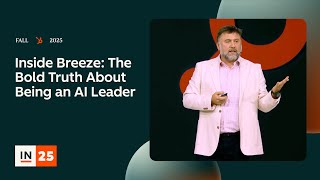
Nicholas Holland, SVP of Product at HubSpot, walks through a three-pillar approach to AI leadership: give every employee a work-specific AI assistant, provide background agents for teams, and embed AI features across the platform. HubSpot announced 20 new agents in Breeze Marketplace and rebuilt Breeze Assistant for iOS and Android.
Questions this video answers
Nicholas Holland — SVP of Product at HubSpot and head of AI.
20 agents (announced at INBOUND).
iOS and Android (mobile apps).
MIT said about 95% of AI initiatives in companies are failing to deliver value.
Chapters
What's up, everybody? Can you hear me? Okay? All right, good. So, hello, I'm Nicholas Holland. I'm the SVP of product here at HubSpot and the head of AI. And, man, what an incredible event. Thank you so much for coming to my session today. All right, so over the past couple of years, AI has become this emergent technology that sometimes oscillates between kind of a cool proof of concept, what I call neat to. It's moving more and more towards the opportunity to become necessary in our business. And many of you feel this tension, I think, in all of our businesses, from, you know, what you're in the keynote today to what you experience in your. Your business life. It's like you get sold a slick demo and you then start to play with it, and sometimes you see it just falls short. And this highlights what I see everywhere. There's this big gap between the expectations of AI and the reality of what's actually out there. The problem is that AI is dominating everything. So, you know, it's dominating every conference, right? It's dominating every headline, it's dominating your boardrooms a lot of places. And it's creating these sky high expectations a lot of times from leadership. And the reality is that when you try to implement it, you run into some real challenges and this big disconnect that we see, it's like, AI is transformative, but the reality is when you try to implement it on the ground, the messy reality really hits you hard. So people are like, what do we do as our next move? So today I want to kind of cut through all of this noise and talk about how HubSpot is creating a clear path for businesses like yours to become AI leaders. All right, so we're in the middle of these major technological shifts right now, and you guys have seen some of these already. I want you to step back and I want you to think for a minute about, like, the mainframe to the PC. Some of y' all might not be this old, but when this happened, this was a lot of transformation for businesses. But then you had the PC to the web, and that's where companies like HubSpot emerged. Like, when you had SaaS and a lot of these Internet services, you then had mobile. A lot of us have started to see, like, is the app released on iOS first, or do I have to wait for it to get on Android? I'm Team Android. Don't judge me. And of course, you see now that, like, AI is a new type of transformational technology. And again, we think this is Going to have a pretty big impact on businesses. So just like with all of these previous transformations, many businesses had to relearn how to utilize it and how to put that into their operations to grow. So with each of these transformations, the one thing I do think is important that a lot of people don't like to talk about is that there will be winners and there will be losers. Like, the stakes are high for many of our companies. And the reality is, is that a lot of you are facing this challenge right now. This is what I'm seeing when I talk to you. So I see a lot of people say, do I do nothing? Sometimes what I call strategic procrastination, or do I basically unleash my team and say, let's go do AI. You go do AI. You go do AI. Everybody goes and does AI. And the problem is that when I talk to customers, I hear this deep worry in their voice. They're like, man, I don't know how to make the right decision. I don't know what to do. I'm thinking I'm going to take a sit back and weight approach or I'm going to dabble it in. You know, some of you may even have like that one person on your team who plays with AI or that little tiger team that you set off in the dark corner to do that. And I empathize with those people. They're like, you know, I know AI is important, but I don't want to basically over commit, make a wrong decision, spend money that I don't have. So the other hand, though, is that at Spring Spotlight, I was talking to a customer who came to me and he said, I got to be honest with you, I'm exhausted. And I said, what's going on? He said, we're doing everything. I don't know whether it's chatgpt. Should I be using Gemini? Should I be using Claude? And then my team comes to me with all sorts of individual tools that I need to pay for. That's what they're saying that it means for us to really be deep into AI. Do you know what I should be doing, Nicholas? And this is really what I'm seeing. These two bookends. It's that, do I do something or do I do nothing? And I'm just kind of waiting for everything to kind of give me the right answer? Or am I on the opposite side where I'm using 50 plus tools and I'm telling everybody to go do all the AI stuff? The problem is that on that other side, you guys Maybe just saw a recent published study where MIT said that 95% of kind of the AI initiatives that you do in your companies are failing to deliver value. This is, like, really tough stuff for you to figure out what to do as a company. So here's what I thought I would do today. I want to cut through the noise, and whether you're doing nothing or whether you're all the way, you think you're an AI master of the universe. I want to give you what we think is kind of a practical playbook for how to approach AI for any company right now. So we started off first, HubSpot. We were like, AI, Is this legit? Will it be transformational? And I can tell you, after three years of us working on it, it is absolutely legit. It will be transformational. So then we were like, okay, HubSpot has always been the champion for our customers. We want to help you grow better. So what we want to do is we're going to make all of you AI first. This is what we talked about. We're going to be AI first. You're going to be AI first. But when we started talking with a lot of customers, they were like, I don't want to be AI first. I want to be customer first. I want to be growth first. AI to me, is just a technology. And they were right. They were right. You don't hear anybody nowadays saying, like, hey, Nicholas, we're Internet first, right? And so because of that, we said, okay, well, if it's not about being AI first, what is it about? Well, for us, it's about how do you apply technology, something like AI to help you grow? And so it's like, how do you apply AI to marketing? How do you apply AI to sales? How do you apply AI to service? How do you go deeper into these functions that serve your customers? That's where you should be thinking right now. That's what we're thinking about. So for us, it wasn't like, hey, let's help you now be AI first. The key here was we want to help you be an AI leader, someone who knows how to apply AI to these problems. And when you do that, you realize that now you're going to apply AI to real business problems. Sometimes you'll hear people call them use cases. And the deal is, I want to use AI to find more customers. I want to use it to connect with them. I want to use it to deliver value. This is about going deeper. This is about doing things like reflecting on your business problems, focusing on a few key areas and doing those things better. So I want to break down what being an AI leader means. It's these four things. This is a good picture. You'll be able to get a chance, take another picture in just a minute. But first, I think that every employee needs an AI assistant and this framework. I was just talking to somebody before I got up here. This is not HubSpot software push framework. This is for. Even if you weren't using HubSpot, I would stand behind this. I think that everybody, each of your employees, need assistance that work with them to make them better at their jobs. The second thing is I think your teams will gain leverage whenever they have agents that work for them. And then third, I think the company gains leverage whenever it utilizes software that has AI seamlessly built into it, purpose built to try to solve the issues that you bought that software for. And you've heard it repeatedly, AI is only good as the data that it has. And so you really need a unified data platform to pull this all together. This is HubSpot's bold vision for helping organizations become AI leaders. And I'm going to walk through each of these three pillars to show you how to go deeper on these. All right, so let's dive into pillar one. Every employee needs an AI assistant. Here at Inbound, we launched Breeze Assistant. It was formerly called Copilot. And what our customers have started to tell us is that they're seeing this like an executive assistant or an AI chief of staff. And this isn't the Copilot that we had last year. We actually rebuilt it from the ground up. It's powered by ChatGPT, but we connected deeply all of HubSpot's context data and tools so that it can deliver far more than what most AI assistants can do for you today. And many of you already use LLMs or large language models. You might use a ChatGPT, a Gemini, or something like that. But the problem is that you're not the same person at work as you are at home. And we believe that you're going to start to need a work LLM or a work AI assistant to really help you be more successful. And that starts with, for example, something like having deep memory about you. Breeze Assistant is something where it needs to know your preferences, it needs to know your role, it needs to know the company that it works for. All of these are critical to make sure that it delivers relevant work output when you're working with it. The other thing is that we're excited to announce that now Breeze Assistant connects not Just with the web, not just with HubSpot data, but, but also it connects with all of your business applications. So it can connect with Office 365 and SharePoint, it can connect with G Suite, Gmail, Calendar. It even connects with systems like Jira, Confluence. And so what this means is that whenever you ask Breeze Assistant a question, it doesn't just answer from the knowledge it has, it actually reaches out across all of those and provides citations back to those. The other thing is that we know that work doesn't just happen while you're at work. We know that it works while you're, whenever you're at home and on the go. And so we wanted to make sure that you could take Breeze Assistant with you. And so that's why here at Inbound, we're also announcing that you can Download it from iOS or Android and take that with you as well. Too often personal AI is what your experience is whenever you're trying to do use AI at work. And many of you know if you're business owners for sure there's a lot of shadow it. A lot of people bring in their personal AI to work, but this creates issues because there's data leakage. A lot of you don't know that you may have agreements with these LLMs where it can train on your data. And so what our customers said to us is that they want something that's secure, deeply knows their customer, or deeply knows their employees. And it gives real leverage to them while it gives real peace of mind for the business. All right, now I talked about unified data and I want to give you an example of how this plays out with something like Breeze Assistant. Right now in Breeze Assistant, when you open it up, it connects to your calendar. You get single click meeting prep. So that means that now you can know everything about that contact, you know everything about the interactions that they've had with you. If you have files like an RFP or a proposal sitting somewhere in your file system, it'll know that as well. That's what Breeze Assistant can do. And what this means is that to get a complete customer view, you have to connect both the structured data, the CRM stuff, etc. With all of that unstructured data as well. That's how you pull all of that together and that's powerful. All right, so you've got this assistant that works directly with you. But what we've also found talking to our customers is that many of your organizations are also going to need experts that exist in your organization. Something like, imagine your Sales team has questions on territory splits. How do you handle commissions? What's the best sales playbook? How do we work against this competitor? Those are all things that a lot of your team members will need. They'll need experts in those areas. And so that's why here at Inbound, we're also announcing custom assistance. Think of these as like AI that you can tailor to a specific task and give it specific knowledge that then all of your teams can use to get out of that, to start getting information, the expertise that they're looking for. Now we have a couple out of the box. So one, as an example is like the brand assistant. If you want to tell it all about your products and services, you want to let it know how you compare against competitors, things like that. The sales coach, I just told you lots of playbook type stuff. How do you win deals? What's the best way to close on certain types of clients? And the other one I want to touch on is the ICP assistant. Morehouse College is really interesting because they're using this because they specifically have to talk to parents in a certain way. And so they have an ideal customer profile assistant for their parents, how parents will react to stuff. But they also have an incoming freshman ICP assistant as well. And they're able to go and ask questions of how will they react to this campaign? How will they look at this marketing piece? How would you talk to them about this? Those are examples, but those are just ones to get you started. You can also go very easily create your own assistance. And we've made it so that you see here, with a single dropdown, you can go to any one of those assistants, anywhere that Breeze assistant is in the same interface. Again, we want to put AI in the hands of your people, where they work. All right? So right now, again, your teams, right now your employees have assistants, both their AI chief of staff and the experts that are on their teams. Now what I want to talk to you about is Pillar two. We think agents need to be available to these teams, teammates that work in the background, for example. And I want to talk about a few of these. So first, we're announcing 20 agents today here at Inbound that you can go discover in the Breeze marketplace and you can enable them and they can start working for your teams. But I do want you to step back for a minute and I want you to imagine a world where your employees, yourself, you have assistants that are working with you. You chat with them, ask them questions back and forth. But then you have agents that are working in the background for you, like this is what it's going to look like to be a hybrid team of the future. An example of this, I'll go into deeper on a few of these is Customer Agent. Now we launched this a year ago and what customer agent is, is an agent that interacts, has tier one interactions when people come to, you know, your website, your email, your WhatsApp. And it's pretty good at solving issues. In fact, for some customers it's over 90% resolution. But on average across the whole system, it's got a world class level of like 65% resolution, helping out on support issues. But today here at Inbound, we want to go further than that. So what we're announcing is that Customer Agent is evolving. Lots of our customers said to us, our customers don't stay in a box, they just don't have a single support issue. They also have product questions, pricing questions, they want to talk about things pre sales. And so in that world, we noticed that a lot of our customers wanted a full front office concierge, something that can be with their customers throughout the whole journey. How many of you have ever called in, you've given all your information, your account number, your history, the problem you're dealing with, only to be passed off to somebody else. And we. And once again, you have to repeat all of that information. Again, this is an example of something that Customer Agent solves now because it's connected to all of your data and the CRM, et cetera. So the reason why it eliminates this is because it's not just working on a single support issue. It's also working on marketing issues, sales issues, anything that the customer wants to talk about. It's here to service them, which is great because it meets them and follows them throughout the whole customer journey and provides a delightful experience. Now the easiest way to think about this is smush together like your best sdr, like an inbound person who takes those in as well as with your best support rep. And what this means is when someone comes in, it can engage with them, talk with them. It can also start to qualify them as a lead. It can route them off to a sales rep if they want to talk to a sales rep. It can schedule time on a calendar if that's what they want. And if they don't want to do any of that, it can still flag them as a lead so that later on it can be perhaps worked by another agent. The cool part about this is that this is only really possible because Customer agent doesn't Just understand your knowledge base. It understands your website. It understands all the information that you train it and feed to it. It understands all the short questions that you give it along the way. It understands everything about how you do business and it can provide that to your customers. Now. So now you've got customer agent working at the front office and you want to go add some more agents. I want you to go to Breeze Marketplace because when you go here, this is where you can start to find all of those agents and start to test and play with those. And another one that you might find here is the prospecting agent. So this prospecting agent is unique because again, we started working on this a year ago and what our customers said to us was we really want this to do deep research on an account. Then we wanted to keep monitoring that account for new signals and we wanted to dynamically reach out. And so if something comes up along the way, it shouldn't just be a sequence of reach outs. It should be something dynamic where it's changing and adapting along the way. And that is what prospecting agent did. And what's amazing about it is that the sales teams now are starting to get warmer leads, higher response rates. And when our customers are using this, they're seeing two times higher response rates than if they just put it on automated outreach. They're seeing 95% decrease in time researching. That's like a big one right there where reps are spending a lot more time on quality conversations. And in general, right now, across the board, we're seeing teams that are using prospecting agent gets two times the number of leads overall. The other agent I want to jump into is data agent. Again, this is like a rev ops agent. The easy way to think about it is it does a job. It fetches information from a source. And what's cool about this is like a 24. 7 research partner directly inside of HubSpot. And it can research CRM data, it can research call transcripts, it can research the web. It's pretty powerful. And so here's an example of how it works. A new lead hits the CRM and right off the bat, data agent goes to work and it can start to look at, okay, are they hiring an hr? So maybe you use this as qualification. You know, if they don't, if they're not hiring an hr, I don't want to talk to them. And then you want to go into, you know, what products did they mention in the conversation whenever we were talking to them? That's where it goes in. And you can start to do more personalization data. Hey Jim, I know you mentioned X, I'd love to talk to you about that. And then also you can do something like segmentation. Do they have an office in a particular location like Georgia? This is an example where now you can do segmentation and all of that is available in HubSpot so that you can do more automation, deeper personalization and better segmentation and you can do it at scale. We've got many other agents that you can explore as I talked about, but there is one other one that just came up recently that I thought would be interesting. When sales wins a deal, they almost always kick it off to some service delivery or success person and there's always tension there. A lot of times they'll say, hey I saw you close a deal, tell me what are they looking for? And the sales rep a lot of times will say, well just read the CRM and if you've ever been on the receiving end, that's like 20 phone calls, 20 emails, 20 conversations. It's really hard. So another thing that we had, it was a customer who inspired us to go build like the customer account handoff agent so that it's an ambient agent that listens in the background when the deal is marked close. It processes the entire CRM, does a beautiful account handoff. No more fighting between sales and service, which is great. These are examples of digital teammates that you know, help your customers. They monitor prospects, they help with account handoffs and they do it 24, 7 working in the background so that your teams can focus on what matters most growing your business. Alright, so you've got these agents, I've got, people ask me all the time, man, there's a lot of agents, what am I going to do? How do I work with these? How do I manage those, how do I make them fit my unique business? That's why today we're also pretty excited about announcing Breeze Studio. Now with Breeze Studio, this is the command center for your agents. This is where you configure, customize them, give them unique knowledge. This is where you orchestrate your agents and assistants. And what's cool about this is that you can also give them all sorts of new knowledge. So it's easy to train the agents, you can give them custom instructions, it's easy to guide them and it's also you can give them new capabilities because in this kind of no code editor, you're able to select from 50 plus tools each of which give the agents new capabilities. What's cool about all this is like, step back from, just from, from the software we're talking about and just realize that pretty, pretty soon everyone is going to become an agent manager and an agent trainer, and you're going to see that on your path to AI leadership. All right, so pillar three. So we just talked about all your employees have assistance. We talked about your teams have gained leverage from agents. And I want to move on to the last part, which is your company will gain leverage when it adopts software that has AI seamlessly built into it. So at HubSpot, we learned that while assistants and agents are really powerful, what really people want a lot of times are things that are easy and fast, and nothing is easier, and nothing is faster than clicking on an AI feature or what we call a spark right where you work. And there are over 100 of these embedded all throughout HubSpot. And each of these are designed to save you time. And I want to show you just a few of these to see, like, how they amp up and make your teams better. All right, so the first is like the sales meeting note taker. On this one, we're trying to turn every conversation into a competitive advantage. So whenever you have a conversation, it transcribes it. It does post meeting, follow up, it puts tasks out there for you, it updates the CRM, and it gets you prepared for the next meeting. All of that's directly inside of the sales workspace. The other thing we talked about is in Marketing Hub, as you guys know, search is really changing. And so we're moving from kind of the 10 blue links with SEO to we're moving to a world where now people are going to, you know, these AI systems and they're asking a question there, and they're just getting one beautiful answer. That's why we call it aeo, which you might have heard earlier today, or AI Engine Optimization. And again, we decided that we wanted to build this directly into HubSpot. But today I also wanted to tell you guys that I was talking to some analysts recently, and they were like, you know, can I see this? And instead of them having to go log into HubSpot specifically right now, you can just go to HubSpot.com aeograder or just literally type on your phone aeo grader, and each of you guys can go mess with it right now and you'll start to see how you show up on ChatGPT, Perplexity, Gemini, ET cetera. All right, and finally, for, like, service users, I do want to talk about AI reply recommendations. Once again, like, this is built Right into Service Hub. And what's cool about this is as you're working on a ticket again, Breeze is always monitoring what's going on and, and it's providing recommendation of knowledge based articles, blog articles, and it's also always giving you a recommendation on how you should reply next, which is really awesome for your customers. What I love about these is that I do wanna point out cause people are really nervous about how they're being charged. Like these embedded features are coming to our customers at no additional cost. This is not like where you get nickeled and dimed. You know, somebody happy with that. Okay, you get a lot of AI with HubSpot whenever you just buy it right out of the box. So that's something that we've heard from our customers. And the cool thing is, I'll say is like, be wary if you can buy a dumb version of somebody's software. Be nervous. Like when you buy HubSpot, you get tons of AI right out of the box. You don't have to spend money just to get AI, which is great. All right, so I want to come to the realization that like the future is hybrid teams. You're going to have humans doing work, you're going to have agents doing work, and you're going to have systems that really help human, humans and agents work together. This is going to be what it looks like to be an AI leader. And a lot of this is only possible because HubSpot is this United platform where it unites your marketing sales service, but it also unites your structured and your unstructured data. This is the platform that makes a lot of this possible. All right, so I want to bring it all together and walk you through kind of the day of three different people. This is like bring it all home for you. All right, so first I want to talk about Gabby. So she's a marketing manager at a small SaaS company and she starts off her day with Breeze Assistant. She gets into work, she clicks it and she says, you know, how did our campaigns perform over the weekend? Breeze Assistant goes to work, starts researching what has happened and it starts to give her a detailed answer about leads that she captured. Open rate, click through rates, et cetera. So now she goes and looks at the leads that she captures and she's like, okay, I want to pull these leads further down the funnel. We're going to start working these leads. And so what she does is she asks data Agent, she comes in here and she says, all right, I want to know all the company news and I want to know if they've had any recent product launches. And so when she comes in here to Data Agent, you can see it starts to pull that information down, which she can use in her segmentation and her automation and her personalization. So finally, I want to point out this, like, really elegant, kind of cute feature, but now they migrated from mailchimp and she's like, oh, I don't have a designer. How am I gonna get these designs into HubSpot? And so again, another little place where the sparks help out is that she just grabs her Mailchimp template and HubSpot elegantly uses AI to just import this directly into HubSpot for her. No code, make it super simple. Again, this is an example of some of the embedded features that we provide to our customers. All right, the cool thing here is that Gabby's now producing more high quality content because her AI is handling the insights, it's handling the research and the optimization for her. All right, so let's go talk to Mike. Mike is an enterprise sales rep and he's really, really busy. So Mike has an important meeting today. He starts early from his car and the first thing he does is just tap on the meeting to get single click meeting prep for his meeting, who he's meeting with, company background, all their recent interactions. He has the meeting, he gets back to his desk, and when he gets back to his desk, he sees that prospecting agent has picked up three leads for him, which is really great. He's like, man, that's awesome. And one of them is with a company that's in Seattle. He's like, look at that. So he clicks Breeze assistant and he's like, hey, can you tell me about sports teams in Seattle and some facts about them? A lot of times you're looking for, like, things to have conversations about. He gets some good details, and then the rest is that Breeze has put all sorts of things into his sales workspace in terms of next actions, meetings that he has to have, etc. Mike is closing more deals because he's spending more time on high quality conversations instead of researching and admin time. All right, so let's go last to Sarah. So Sarah, she was drowning in tickets. She runs a. She's a customer support rep. But back at the Spring Spotlight, she heard about HubSpot's customer agent and she went ahead and implemented that. And she's like, man, this is really amazing. But it's only answering questions that was in her knowledge base. She's like, a lot of times people are asking questions about what they purchased. She really needs customer agent to tie out to the CRM. So here's what's great. She goes in and she says, all right, you know what we're gonna do? We're gonna add CRM data. I wanna add what their subscription type was, the details of that directly here to the customer agent. And I want it to be secure. So I'm gonna say, hey, make sure that they just validate who they are via email before they do this again. This is all kind of no code. So what's nice is that now she comes in here and she says, I will let customer agent start to give order status. And it has all of these different ways that people can ask questions. And she's like, I'd also love it to reach out to my point of sale system, like where we have all that. So again, right here she just does a single post where it goes to a third party system and can give an update on what they purchased. What I love about this is that she's now set it up so that it will answer general questions. It'll also go check their order status and it can also go look up from a third party system. But some of these tickets get escalated to her anyways. And so what's nice about this is that she goes into her help desk workspace, she's looking at a ticket and she simply says, hey, summarize this ticket for me. Tell me what's going on, what should I know about before I dive in and start trying to work on this tier 2 support issue. It gives the background on the ticket and then you'll see that on the left hand side, it starts to have a reply recommendation. She's like, all right, let me see what Breeze is recommending I do here. She clicks it and again, like all of our solutions, Sarah is in control where she can read through things and if everything looks good, she's able to go ahead and proceed and send that on. Sarah went from drowning in tickets to now she is a rock star at support. She's crushing it. And this is what AI looks like whenever it's handling a lot of the work, day in and day out. So look, three different Personas, three pillars, notice the pattern. You got Gabby, Mike and Sarah all have Breeze assistant as their AI Chief of staff. They all have agents doing work for them in the background and they're all using the embedded features to basically get more out of HubSpot. And this is because they all work on one unified foundation. This is what AI leadership looks like team this is what it'll look like in your businesses. So you remember that exhausted customer. You know, here's exactly what I told them. I want you first. Don't try to do everything. Just do these four simple steps. Number one, get Breeze assistant. If you don't already have one internally as an assistant and deploy this to your team. This will automatically start everybody down this path. Number two, start with customer agent. It works across marketing, sales, and service. You can deploy it today. It gets you started with your first agent that's working for you. Then go to the Breeze marketplace, explore some of the other ones, expand your hybrid team. Start to look what that looks like whenever you have all of those different options. And then last, get your unstructured data connected into HubSpot. Start unlocking all of those sparks and those powerful features across HubSpot. Guys, do these four things and you will be an AI leader. And I just want to say that, like, we are in the middle of this major platform shift, and just like the transition to the Internet, some companies that move decisively are going to thrive, and there will be some companies that don't, and they will get left behind. So HubSpot's commitment has always been like, we want to make your business the winner. And so we built this platform specifically to do that so that you can become AI leaders without the complexity and without the hype. So thank you so much, guys. Come talk to me afterwards. See you at the booth. Appreciate everybody. Check us out@HubSpot.com freeze.









