Inside Smart CRM: How Unified Data Unlocks Growth | INBOUND 2025
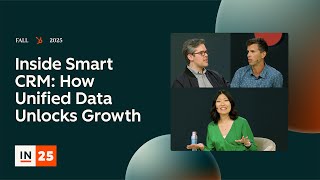
HubSpot's Jared Williams, Jeff Henson, and Katherine Mann explain why unified customer data matters for AI. Fragmented data costs money and slows growth. HubSpot is launching Data Studio, Data Agent, and Smart Properties to make unification easier.
Questions this video answers
INBOUND 2025 (panel recorded on or around September 15, 2025).
Jared Williams — VP/leader of engineering at HubSpot; Jeff Henson — product team for DataHub (product leader); Katherine Mann — group product manager, Customer Profile group at HubSpot.
80% of your customer data is locked up in unstructured data (cited from the keynote referenced in the panel).
Data Studio (public beta started at INBOUND 2025).
Data Agent & Smart Properties; Data Studio; data quality UI (includes dedupe, enrichment, custom dedupe rules).
Chapters
Oh, you have to hold your. Oh, my thing.
Everybody, welcome. You're here for Inside the Smart CRM. How unified data unlocks limitless growth. Whether or not you're in the beginning of your unification journey or you're in the thick of it, or you're somewhere in between, you're in the right spot. My name is Jared Williams. I lead engineering here at HubSpot. I've been at HubSpot for nearly 14 years and I've been in nearly as many inbounds. This year, I'm thrilled to be on stage with two of our fantastic product leaders, Jeff Henson and Katherine Mann. Feel free to introduce yourselves.
Thank you. Hey, everybody, I'm Jeff. I am on the product team for DataHub and I live in Boston, which means that I get to travel for this trip to San Francisco. Shout out to my wife who is watching our kids. And I've been at HubSpot for just about five years. So some projects of mine that you have probably messed with are things like custom objects, associate, flexible associations, and association labels. All the good stuff.
Big deal.
Katherine, over to you.
All right. Hey, everyone. Thank you so much for being here. We're super excited to be here. I'm Kathryn Naman. Pronouns she, her, and I'm the group product manager over the customer profile group. So anything related to records, customization, CRM, I'm your person, similar to Jeff. We actually started around the same time, so I hit my five year mark and right after this I am jetting off to sabbatical in Asia. So can't wait for that. Oh, thank you. Yeah, I'm super excited.
That's awesome. So today we're going to do a deep dive on unified data and how that is transforming the way that we do business, but also the way that we support our customers. We're going to talk about where traditional CRMs are falling short and we're going to talk about how the HubSpot Smart CRM is helping us tackle some of those challenges as AI becomes central to how we think about customer relationship management. So not to zoom too far ahead, but to kind of start at the beginning. Jeff and Catherine, I'd love to start with what are the biggest challenges that businesses face when their customer data is scattered across multiple places? And how does that really affect their growth?
Yeah, good question, Jared. First, does everybody know what we're talking about when we say unified data? Everybody really familiar. You've probably challenged with it already. You know the challenges better than I do. I think about it in terms of two things. The first is, are we able to store all of your data, the messy intricacies of your business, so that the software actually reflects the reality of your business and your reps? And then the second thing is for a particular prospect or customer, are we able to store the 360 of their experience with your company? How did they discover you? How do they close become a customer? What does their current contract look like? What kind of support interactions have they had? So that's unified data. What does it look like when you don't have that? I think it breaks down to your team is less efficient. So inefficient and ineffective. Inefficient because your reps are having to open a bunch of different systems to try to track down those data points. They're doing a ton of research, manual research, on their own as opposed to having it already and in one place for them ready to go. So the end result of that is teams that have people have 40 tabs open. I think every call that I have with a rep, they talk about how they started with a 40 tab setup and, and how we've gradually made that better then ineffective. So if you don't have the right data, you're going to send a generic outreach. You're going to send at the wrong time. You're not going to include something that feels personal and that just doesn't work in the competitive markets that we all operate in today. So ineffective and inefficient is how I think about it.
Catherine, Nice. Yeah, I want to tell an anecdote. So something that happened to me when I was prepping for this trip is I was as an anxious person constantly checking the weather app to see what the weather is pack. This is my one time a year that I get to dress up with all my nice clothes that I have. And yeah, usually it's sweats. And I was checking the weather and I was like, wow, I'm so bummed because it's gonna be rainy and cold and it's gonna be in the 40s and I kid you not, I was packing a wool coat and my boyfriend was like, I'm not seeing rain in the forecast anywhere. What are you talking about? And so I was like, obviously you're wrong. Right? All the women know what I'm talking about. I was like, obviously you're wrong. I'm not even going to double check. And I kid you not. About five minutes ahead of the Uber arriving, it dawned on me there might be another San Francisco. Did anyone else know this? So there is in Fact, a San Francisco, Argentina. And I was in fact looking at Argentina. And so with five minutes, I had to last minute take out the wool jackets and put in all of my new summer clothing that I was going to have. And I learned something new, which is that in fact there isn't San Francisco, Argentina. I did not learn that. I was wrong. So this is not recorded. Don't tell my partner that. But I think the point I'm trying to make here is if you don't have a single unified source of truth, then you're going to be making these critical decisions off of potentially very wrong data. So similar to what Jeff was saying, tying it all back in, you have the chaos that is caused by having not unified data is not just bad for internally in communications, it's bad for your growth and it's bad for your customers as well.
That's awesome. So what I'm hearing is that both internally and externally, not having unified data creates all this friction for your team. It makes it harder for them to do their jobs and your customers can really feel the effect of that as your team tries to engage with them, whether they're prospecting or a customer, whatever the case may be, it creates a ton of friction. So I guess with that in mind, I guess practically, what are some of the HubSpot best practices that you recommend to address these challenges?
Yeah, so unify on HubSpot.
That's my best. There we go.
Really though, we have done a lot of work over the last couple of years to make it possible to connect all of your data into HubSpot Custom Objects, the object library, and the expanded set of default objects that we launched last year. Association labels. Anyway, the list is very long, but the purpose of doing that is to make it so that regardless of what shape your data is in or what source it comes from, you should be able to store most of it inside of HubSpot. So that's my dream. The other best practices that come to mind, the first one is to assign a data dri. All the successful customers I've ever talked to had someone in house that it's their job to make sure that the data is coming from a reputable source and that it's consistent and high quality. And that person needs to have the mandate to be able to go and say, I need access to this data and we need to do a transform or whatever it is to get it into the CRM. So I think that's a top best practice for me. The next thing is you have to make sure that you figured out how you want to shape that data, like store it in your CRM and you should get your validations set up right from the start so that as much of the data as possible is coming in high quality. So this year we launched or last year we launched property validation. So you can actually tell define on the property what an acceptable value is and what a non acceptable value is. So whether that's your reps are manually putting in data or it's coming in through an import or via API, you can send them back an error message if that data is not looking right. And then this year we launched auto formatting, so it actually catches the value on the way in and it can fix an issue. So phone number, for example, we can prepend a country code to get that right. So make sure that as you're defining what the data is that you want, you set your CRM up right to organize it that way. Yeah. And then I think like the last best practice I'm going to mention is I think a lot of people want to store a ton of data, like literally everything and they want to add more things. You know, have the sales rep ask this, have the sales rep ask that. You have to have a set of core properties that you say these are the golden properties or however you want to think about it, that we want to make sure those are right for this report or this key automation. And those are the ones that you're reviewing regularly, those are the ones that you are running like a automation on to just make sure it's very, very high quality data. You cannot track everything in your seat and then also keep it very high quality. That's my take.
Yeah. Just a couple of thoughts to add on there. So can I actually get a show of hands? How many of you think unifying your data is important? Okay. And I promise this is a safe space. How many do not think it's important? All right. No one's brave enough to raise their hand. Okay. So I think we've established that point. But a lot of what we talked about today is the technological challenge of those blockers. And I want to focus a little bit more on the personal and the alignment organizational challenges that you might face. So this afternoon when Jeff and I were getting lunch to prep the panel and yes, I swear we prepped earlier than that, but we did a lot of prep earlier today. We sat with some really nice customers. So shout out to Rachel and David if you're out there. But we picked their brain to see if what we were talking about was gonna resonate with you all. And as we listened in horror, we heard about how these poor customers, they had just gone through this merger. And Rachel, as the singular data dri was going through so many spreadsheets, so much bad data, and it was her job to get that all into the CRM and make it clean, clean. And I think that really that story was so powerful to me where she literally was like, I'm at the end of my eight months where this project is wrapping up. It's definitely been that labor of love. But I think it's so critical that you have someone who is driving this forward now. In order to establish that organizational alignment, I think three things I would recommend is one, you really need an executive sponsor. So, you know, we have a Jared here who could definitely serve as that, but someone who's going to help you get that alignment of why it's important.
You need a Jared.
Yeah, you need a Jared also. And the second one is you also want to have these shared KPIs. I think some of the challenges that you face are aligning your marketing and sales and services and you have your own tech stacks and you don't want to align to a different tool. But if you have a shared KPI around something like revenue or you're trying to increase your mps, then I think you have hope of aligning everyone around the same goal. And I think the last thing in terms of making sure that this is a continuous process is you could set up a governance group where you have every single team is represented there and hopefully they are running decisions by each other. You have everyone's buy in. And so I would just kind of recap find your Rachel is what I would say.
What I love about this is that there's very good, solid software advice in there, but there's a lot of good organizational advice in there. It's not just the software, it's also how you work together. One way I think about this, if I take a big step back, is that if you're an athlete showing up to compete, at some point you have to sit down and you have to put your socks on and your shoes on. You have to tie your shoes and you have to start with the fundamentals. And so when you think about unifying your data, you have to think about the people problems. You have to think about the foundation of like your data model, your governance, how and where data is used. You have to think about the experience that you're curating for your users and your customers and how they experience that Data too. So all these things are super, super important. I guess continuing on this thread a little bit, Unified data also isn't a brand new topic for us. We've been talking for a long time. HubSpot wants to build easy, fast and unified software and the world is changing. AI is everywhere. And so I think to pick up next, I'd love to talk about how has Unified Data made, how has AI made unified Data that much more important and what happens to businesses that don't establish this AI foundation that we're talking about.
Yeah, so the way that I'm thinking about it is AI in that case is just another teammate. And the thing that we let we're pretty good at as humans is connecting dots and, and doing that work of opening those 40 tabs and doing the work we need to do as a sales rep to figure out what's this company's pain points, what market are they in, what's the message that's really going to work. If I try to hand that over to an AI, but the data is extremely fragmented or there's just huge gaps, it's going to come back with a really generic response. So the AI is only as good as the data that you give it. And you really do have to give it in a way that it doesn't have to do a ton of work to go get it. At least today that's how, that's how that works. So we can think of Unified Data as the context that makes the outputs of these LLMs non generic really useful for the customer. So I think that's like a really core piece of. It's always been the case with unified Data and now AI just like supercharges that. The other thing I would say here is that feedback is something that as humans we're not very good at that I'm excited to see see agents and LLMs take on. So what I mean by that is the LLM made a recommendation or I made a recommendation about what segment might resonate with this message. Right. I'm setting up a campaign I'm not really that good at then taking that, the feedback on that campaign and going back and saying how should I have adjusted the messaging or the timing or whatever to improve how it resonates the next time. But an LLM is really good at taking the activity data which is also stored in HubSpot and then pulling out an insight. Like the people who got this, you know, at the beginning of their workday seem to respond better. They find those patterns in a way that that humans don't. So I, I'm really excited about bringing that feedback element into this unified data conversation because it's a place where humans weren't good at doing pattern matching before. Too lazy. Yeah. What do you think?
Yeah, I think in the past unified data was all about reducing the barrier to entry for insights and value, where if I'm building a workflow, if I have access to unified data, I have everything that I need for the right branching, logic and conditionals, that sort of thing, and so I can actually build the right workflow. If I'm building a report, I have access to all the data I need to get genuine customer and business insights. You know, not something that's compartmentalized or you know, a partial result or something where I have to take a few leaps of faith to like really believe that, you know, that the answer that I'm getting from the report or if I'm building personalization, you know, I can build something with the full context of the customer journey so I can provide something that's really thoughtful and intentional versus maybe canned and cold. And so where unified data in the past was all about like, you know, I think value and insight, I think what unified data does in the world of AI is it actually reduces the barrier of entry for intelligence and efficiency. And the more that we all use agents and assistants in our day to day work, and I think we're all going to use them more and more as time goes on, the more you'll realize that if your agent or your assistant doesn't have access to the data that you need for whatever reason, it's going to face the same problems that your teams face today when your data isn't unified or it's hard for someone to reach. And so imagine a customer support rep who's trying to help a customer and they have to hop between different products, 40 different tabs, they realize they don't have access to some information so they can't actually get to the insight they need to help the customer. And if that human faces a problem, eventually the AI that you're trying to be, the AI process you're trying to build, are going to face the same problem. And so while it was important, I think previously just from a customer experience and employee experience, for Trexit to really lean into unified Data, it's that much more important in the world of AI where these processes are really good, are what's going to drive efficiency in your day to day and your go to market. One thing I want to call back to too From Karen's keynote earlier is she mentioned that 80% of your customer data is locked up in unstructured data. And as much as you work towards unifying your data stack, the thing you have to think about as the second order problem is how do you actually leverage that data that you're unifying? How do you leverage that unstructured data? Those, those meeting transcripts, those emails, those notes, the documents, et cetera, et cetera. And a lot of that comes from extracting those insights because a lot of the early efficiency you'll get from using AI in your processes is through the self generating CRM. How do you take the context from that meeting and use it to drive updating properties in your CRM or creating your tasks or follow ups or those sorts of things. And so I'd love to talk about that next. Kathryn, I'll turn it to you. How does HubSpot do that? How do we extract meaningful insights from entrepreneurship data while ensuring, super importantly, that business can actually trust the insights that we're pulling out?
Yeah, it's a great question. I do promise to answer it, but first, was I the only one shocked by when I landed how many AI billboards there are here? Yeah, okay. Okay. I think it's actually more of. I would love to see a photo of billboard that doesn't mention AI. So if you have one, please bring it to me. I'd like some proof. I think I would just want to start with what we mean when we talk about it because I think AI kind of loses meaning and it's just so overused at this point. So what Jared is talking about is how something that Gen AI in particular is really good at is processing long pieces of data, usually unstructured text, and fighting those patterns for you. If you think about your teams and how much of your day is probably spent, you're in meetings, you have calls, you have notes, but how often are you able to step back and actually see the patterns across those? It's really hard to do. So I think AI, what it really helps with is cutting through the noise and telling you what's actually important. So when we talk about AI and especially unstructured data, entering that insight, we are building an insight engine that we are taking and processing all of that data. We are working while you are sleeping, as you rightfully should. And I hope you're getting your eight hours and drinking water psa. I saw a couple people take a sip. Okay, that's good but. And that's where we're going to surface it and it's also about quality over quantity. We don't want to overwhelm. So there's a couple examples that I want to give my teams. For example, they just built these AI catch up cards. They're on the record, Maybe you've seen them, there are summaries in there. There's also a really cool feature where we have customer health sentiment based on recent engagement data as well as pain points and positive feedback as well. So for example, my colleague Colin, who's in the crowd in our sample record, he wrote Colin is awesome. So every time I demo I get positive feedback that Colin is awesome. And I wish he had put Katherine was awesome too. But that's okay. So far customers have really loved it in the private beta and they're saying things like this really helps me just cut through the noise and I can save time because I am able to focus on the records that actually need my attention and not waste time on the ones that don't. And I'll give one more really quick example just to show the breadth of what we're doing on top of CPQ that you've heard about as well as for those who maybe were here earlier, brand identity was talked about as well. But I thought this was really cool where we are combing through your recent call engagements and we're looking at these pain points and seeing what resonates with customers and we turn that into a personalized brand voice for you all. And not only that, then anytime you generate content that's AI related, whether it's a marketing email or you're drafting a blog or you want to create a new landing page, we are using that same voice that is resonating with customers and applying it to all the content that you're generating.
I love that. It's not the era of AI, it's the era of the self generating CRM. And I think the important thing about that is you can actually spend. Your reps can spend more time talking to to who they want to sell to or your existing customers and less time doing all this sort of like manual routine work.
Yeah, that's right. Yeah. I think one of the things I wanted to get across is that when we talk about leveraging AI inside of HubSpot, it is to augment all the people that work inside of our customers, companies. Like there's brand new things that we can enable them to do that we couldn't let them do before because that data was kind of like locked up in that. No one's going to go read that entire Code, call, transcript. The way that it works today is the sales rep kind of takes like notes, you know, scribbled notes while they're talking, or they use, you know, something else and then they just go. And they have to manually put that in the CRM. If we could erase that for sales reps, if we could erase that for CSMs, like how much more data around the customer's goals, their aspirations, the progress that they've made, all that stuff could be available to, in this case, an LLM to propose some ideas. Like, hey, csm, you're about to create a renewal. This was their aspiration. This is the progress that they've made so far. Here's some recent support interactions or social interactions or whatever. Here's how we might frame that. Here's three options, and that is augmenting humans, not turning us all into robot slaves, as it were.
Okay. All right, well, Jeff, personally speak for yourself. I would love to read all of your college transcripts. There's a lot of wisdom in there, but we can stay.
Yeah, no one needs that.
We don't. One thing we didn't hit there was the trust part. Catherine, do you have anything more on that?
I do, thanks for asking. How many of you have tried out Waymo while you were here? That's it. We're a tech conference. I thought. We're tech people. Okay, more of you need to try Waymo. And I promise I'm not being sponsored. Yeah. Thumbs up. Thumbs up. Yes. Yes. Thank you. Okay, so I tried it on a flower 45 minute ride, which is, yes, admittedly risky for the first time. But I think the thing that surprised me the most was how quickly it built up trust with me. When you first sit down, it tells you about how it works, how you can pull over if you need to, how support is there. Most importantly, they say things like, oh, we're not actually listening to you, so sing away. But I think the feature that I really liked and really built trust with me was they have this panel, and I'm not talking about the iPads that Teslas have out there. Sorry to the Tesla owners, but it's like this iPad that actually shows you the 360 view of what it's mapping. And what I really loved about that was it built up trust with me. Because I was like, wow, it's actually better than a human driver. It can see things a way that a human driver couldn't possibly see. It can see all of the people crossing, you can see the cars. And I think that's what's really important when it comes to AI features. And I would also say I come from Boston, so so far Waymo has not ever flown flipped me off. So I think it's a lot better. It's a better experience. And if I could say in terms of what we're doing at HubSpot, then I think building that trust through transparency is really important to us. And we're doing that in three different ways. So the first is always making sure that you all feel like you're in control. Yes. I know that we are working on agents and we want to make sure you all have input into that you can curate what the agents are doing. But for example, if we are going to draft an email for you to a prospect, we let you review that before sending it so you're still fully in control. I think the second thing is around making sure it's not a black box. So just like Waymo was showing me that this is how it's mapping out the surrounding area. We want to tell you what is the logic behind what we're doing, how does it actually work? What are we sending, what are we not sending? And the third, I think is really important, is around user controls, talking with a lot of customers, especially those of you who deal with pii. They tell me like, the minute you mention AI, my eyes glaze over. It's just not relevant to me. So I think that's why it's really critical for us to keep working on things like user control, so that you all are control of what data is being sent over or not, as well as things like the date filter range and even things like tone of how it's recorded.
Super important considerations. And like these are things we absolutely have to get right. We're still really early on AI, but these are, these are the kind of the early innings of also understanding, like, what does it mean to be secure, compliant, build trust. Interesting UX challenges and different challenges ahead. All right, I'm going to move us along. We're going to run out of time here, but I want to, you know, now that we've talked like a little bit like high level as well, I want to talk about, like, what are the things you're most excited about in this context of unified data and AI that we're launching at Inbound this year?
We launched a lot at inbound.
200 features are here.
200, okay. Yeah. I will say that even inside of HubSpot, it's crazy. I took last week off with my family and took vacation and I came back And I cannot even try to catch up with all the things that we're launching. But from a narrative perspective, what I really hope that you all take away is that we're taking this data challenge really seriously because it underlies so much of what success is going to look like going forward. The three things that I will call out that we are launching, the first one is Data Studio. So we talked about that at the keynote. Kara also did a demo of it over there. I don't know if she's doing an encore of that. But the point of the Data Studio is you've got data in another system and it's really hard to get into the CRM because maybe you don't want to store it there or it's not in a shape that is ready to be stored in your CRM. You can bring it into the Data Studio so it leverages all the power of our integrations, our data syncs our marketplace, and then you can experiment with that data. You can report on it straight from there. You can build a segment and launch your campaign without having to publish it to the CRM. So it keeps things nice and clean. That's one. Another one that I want to mention is we are launching a new data quality ui. So that means new. We're bringing together all the dedupe stuff, all of the formatting recommendations, and we're bringing enrichment and missing data all together in one screen. We're launching custom rules for deduplication, which I'm like super excited about, so you don't have to go off. Just our version of what duplicates look like. You can define your own. That is on Data Hub, I think that's going to be Pro plus. And then the last one I'll mention, and that is getting a demo. Like right now, wherever Rachel is, it's about to start, is the Data Agent and Smart Properties. So the use case that I talk about with Smart Properties is when a new lead comes in, you ask your SDRs to go find out a bunch of information to see if they fit our icp or should they go to corp, or should they go to mid market or where should they go? The Smart Properties, which is a power that the DA agent has, takes in a prompt. You can send them to the new company's website and then they can come back and answer a question like, are they a law firm? Yes or no, Are they. What size is the company? Where are they located for territory? So all the stuff that you would have assigned to an sdr, you can now assign to the Data agent, and it can go out and get that for you. So that can be web research and we also have call transcript parsing as well. So anyway, I could talk about that all day, but you could go over to the data hub or Smart Smart CRM boots and I'll be there.
Check it out.
Yeah, check it out. Katherine, what do you got?
Yeah, I'm just laughing because I'm like, clearly, product managers can't count. We can't just do one. It's like being.
Yeah, exactly one to five.
But I think it's. It's so hard. It's like being asked to pick your favorite child.
So we're group product managers and some of our product managers are here. They work super hard on.
They did work super hard. Really?
It's amazing. Anyway.
Exactly. So I also have three, but I would say the first one, I will say I've never seen this before. Customers actually promise to get tattoos if we release this for inbound. And so I'm happy to say we actually released it ahead of inbound, which was conditional display logic for record middle columns. And actually it's for. Oh, you could applause. No applause. Okay. Okay. Thank you. Thank you. Some skyer. APPLAUSE all right. They promised tattoos. So I was going to say, if anyone has seen Max Cohen, let him know that I'm coming to actually check on that tattoo. And if he didn't get one, I have a fish sticker that was the best I could find.
Nice.
Let him know. But that's really important because that helps you show the critical, only relevant information at the right time and the right place. And then the second one, shout out to Noah sitting up here. He and his team finally delivered on something you all have been asking for for years, which is more properties in the association. Cards on the record. Right. Sidebar. And so now you can show up to. Oh, that one got some applause. Okay. It's always so hard to know. And so that has now up to five secondary properties, and you can see a lot more at a glance. And then the last one, really quick. When I say it is hot off the presses, I mean literally. On Friday, the team released a new feature called Process Guides. And this is a replacement for those static playbooks in which you can create very flexible and dynamic views for your reps to collect data. And it actually will change based on what the response is so, so long to the endless scrolling in the carpal tunnel if you're going through this playbook trying to get to the bottom. But yeah, I was super excited about that one. And like Jared said, we have so many more. But what is one that you would like to call attention to?
I'm going to copy Jeff and say Data Studio. It makes unifying data as simple as adding a column to a spreadsheet effectively. And so I'm really excited for, from the early results I've seen from customers to use it, it's incredibly impressive. I'm excited to get it in more people's hands to see what value they can get out of it. And at HubSpot, we love to build with our customers and so also excited to get your feedback and see what else we can do to make unifying your data even easier.
Public beta started today.
Nice. All right. We somehow quickly ran out of time and I would admit that Jeff and I probably blacked out on stage. That just happens when you're speaker. So I hope, Jared, you've been listening better than we have. What is the one takeaway you would want this audience to have?
I think it's that unifying your data isn't just like a technical problem to solve. We mentioned it's an organizational problem, it's a software problem, but it's really the foundation to transforming your business from reactive to productive. This is about supporting your existing teams, your existing customers and how they expand experience you. But it's also about your AI transformation and how you lead there and that leads to your personalized customer experiences that are really going to drive your growth. So a lot of exciting stuff here. Thank you, Jeff and Catherine for this great conversation. I hope this is useful. Again, we like to build with our customers, so please come to us with your feedback, what you're looking for. But otherwise, if you have a great, great inbound. Thank you.
Have a great inbound, everybody.
Thank you.









