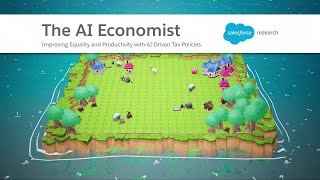
Salesforce Research built an AI system that designs tax and subsidy policies by running simulations where agents trade resources and an AI economist optimizes for both equality and productivity. Early experiments show it outperforms baseline tax models.
Chapters
At Salesforce Research, we seek to build AI that positively impacts the world. We created an AI framework to design economic policy. We call it the AI Economist. Economies revolve around people who focus on their own outcomes, for example, by gathering resources, trading, and building to earn income. Economies are part of broader societies. Across societies, governments tax and subsidize to promote their own socioeconomic objectives. In our experiments, we focus on economic equality and productivity. But how should tax policies be designed? If taxes are too high, people's motivation may suffer, hindering productivity. If taxes are too low, equality may suffer. Using reinforcement learning and economic simulations, the AI economist designs tax policies to achieve equality productivity goals set by the government. In our simulations, AI agents pay taxes. While the AI economist recommends how to set taxes, It also advises how to subsidize and redistribute wealth. Here is one of millions of economic simulations in which AI agents collect and trade wood and stone and build houses. We compare many simulations where the AI agents and AI economists continuously learn to adapt to each other. Each AI agent trains to maximize its own monetary outcome, while the AI economist optimizes social welfare for all.
In our experiments, the AI economist improves the equality productivity goal over tax models like the Free Market and the Saez model. For now, our simulation is still relatively simple. Realism, scale and computing power will continue to advance over the next years. Eventually, people can define wide ranges of social welfare goals like sustainability, and use AI economist policies to achieve them. Imagine what a future AI economist trained on the equivalent of millions of years could do to support better policies in the real world.