Introducing... the NEW Slack!
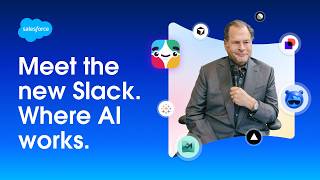
Marc Benioff and Salesforce leaders unveil a revamped Slackbot that acts as a personal AI copilot with memory and extensible skills. AgentForce, their AI agent portfolio, hit $800 million in ARR with 169% year-over-year growth. Live demos showed Slackbot creating presentations, scheduling meetings, and orchestrating workflows across apps and data sources.
Chapters
We've reached an agentic inflection point. AI agents executing entire workflows, apps and agents, agent force.
This is the powerful moment, and our agents now have encyclopedic knowledge.
It's a win for the consumer.
It's driving down costs. Customers aren't going to deploy just one agent. There's going to be many agents.
Big companies are using agent force.
AgentForce is now an $800 million business. And to see the velocity—
this is an agentic revolution.
We're going to this incredible new world, the agentic enterprise.
Being agentic enterprise, all of a sudden you have a supercharged business. You've got the ecosystem, you've got the platform.
This new agentic enterprise is a system of context, a system of work, a system of agency, and a system of engagement, all front-ended by Slack is our operating system.
We run our full business in Slack. Slack makes facilitating conversations so easy. It's how we communicate with each other. It's how we plan with each other.
All your CRM data.
I cannot live without Slack.
All the apps.
How do you help everyone move faster? It's the front door to the agentic enterprise.
And then we blow the bank up.
Slack Bot allows us to keep up with all the collaboration that's going on at the company. We are always trying to pull off the impossible. If you're running a business without Slack, You're doing it on hard mode.
I will literally protest if you get rid of Slack. It's invaluable. Slack is completely foundational to the approach. We've saved and made at least $4.5 million just because of how we're using Slack.
What's really evolved over time is how much we've been able to connect it to other systems. By being able to bring our Salesforce data into Slack, I've seen our time in the deal stages go down by up to 60%. At Rivian, Slack brings our people, data, processes, and agents together into our flow of work.
Say context is worth 100 IQ points, and you see Salesforce Data 360, Tableau, and Slackbot coming together, it simplifies so much of our workload.
Slackbot is my chief of staff. It saves me about 30 minutes a day. Now that I use Slackbot, I cannot go without it. I think we're in a new era. Agents enabling you, that's really where the magic is.
Okay, good morning everybody, how are you doing? All right, we're happy to have everybody here. It's gonna be a great day. We're really excited to celebrate Slack, and Slackbot, and Salesforce, and we're gonna just get going here. So, we're gonna meet the new Slackbot, where AI works, and before we do everything, we're going to try to entertain you this morning, we're gonna try to inspire you, we're gonna try to motivate you, motivate you, but mostly we're going to try to do what? Does anybody know? How do you know that? Incredible. We're going to try to thank you. We always try to start with some gratitude because we know that we cannot do this alone. We are deeply grateful to you, to every single one of you, all of our employees, our customers, our partners, our influencers, the media, our investors. We cannot do what we do without you. So thank you. And we are deeply committed to all of you. We're deeply committed to our core values, to trust, to customer success, to innovation, to quality, sustainability. It's been 27 years, amazingly, of Salesforce. Hard to believe, actually. And Don Clark is in the back. I love these meetings because he always comes, who wrote the first story on Salesforce. So thank you, Don. Software goes online. So thank you, Don. And I'll just say that way back when, 27 years ago, we had a great idea. It was beyond software as a service. It was to take 1% of our equity, profit, time to put it into a foundation to commit it to our values. And it has resulted in about $1 billion now of giving, 10.5 million hours of volunteerism, more than 64,000 nonprofits and NGOs run for free. On our services all over the world. And probably the best thing we ever did is that we encouraged 19,000 other companies to join us in our 1-1-1 mission, which has resulted in about $3 billion of philanthropy. So we continue to encourage and evangelize that incredible opportunity, and a core part of that is right here in San Francisco and in Oakland. We have now done more than 286 million dollars in all-time local giving, which is awesome. Thank you. Especially focused on our public education. As you know, we're mostly focused on our public schools, the local San Francisco Unified School District, our core partner, the Oakland Unified School District, our local NGOs, and we're so grateful to all of them. And we're also very proud to see the tremendous transformation of San Francisco that's underway. And we are a significant funder of that. We're putting our money where our mouth is, putting millions of dollars into investing in our local city services, including our police department, to get our city back to where we all want it to be. We're deeply committed to doing well and doing good. It's been an incredible journey over 27 years. This year we'll do over $46 billion in revenue. Hard to believe. Incredible margins, more than 34%. More than $16 billion in cash flow will be generated by the company, uh, this year, which is why we have so much to give away. And Q4, which we just launched, was our best quarter ever with more than $11 billion in revenue, more than $72 billion in, um, RPO, which is, uh, deals we signed but not yet recognized. So an incredible future coming, uh, for Salesforce, and the best numbers not only that we've ever had, but these are the largest numbers anyone in the enterprise applications business has ever delivered. Now, beyond the financials, this is about 27 years of innovation as well, which is why we're here today. You're about to see the next level of that. I know a lot of the people in the room have been building and participating and creating this amazing level of innovation, and we're going to see some awesome things with Slack. Now, before we do that, I just want to give you a brief AgentForce update. We have an incredible tiger by the tail with AgentForce. It is our fastest-growing product ever. More than $800 million in fourth-quarter ARR. Incredible 169% year-over-year growth. 771 agentic work units. And what that means is actually complex transactions that are getting generated by these agents to make this happen with more than 23,000 customers. And you can see those customers all over the Bay Area, but really all over the world, including Pandora, amazing company based in Copenhagen, Denmark. And in Copenhagen, Denmark, and How many of you have been to a Pandora store in the mall? Okay. If you go online, you're in the mall, you're in service, you're using Salesforce. Even their point of sale is now Salesforce. Customer service is Salesforce. Sales is Salesforce. Marketing. Incredible company. Lennar. How many of you live in a Lennar home? Anybody? Oh, well, got to buy some more Lennar homes. So we have agents scheduling 12,000 tours. Amazing for them. How many people flew here on Southwest Airlines? We've got to start getting committed to the Salesforce customers. Come on. It is amazing to see what Agentic AI is revolutionizing all these customer experiences since we first launched Agentforce Now. It's been a couple of years. So we know there is still very much now what we call the Agentic divide. Used to be the digital divide. Now it's the Agentic divide. Between we're having these great experiences with our customers, but still we know there's many companies who have not yet crossed this chasm, which is why we have Geoffrey Moore over here to help us to learn how to cross the chasm. But we think that in this moment of transformation, one of the things that we've seen to help these customers move through the agentic divide is Slack. And Slack is how work has been getting done. Been an incredible journey, 5 years of Slack. We have delivered already 2.5 times revenue of growth since the acquisition on Slack. It'll probably be 3 times by the end of the fiscal year. We have about a million businesses running on Slack. It's been a huge growth story, and to help me understand that, communicate it, is where is my co-founder, Parker Harris?
Right here, right behind you.
There he is. Very good. Please welcome Parker. Parker, before we go on, you have been doing incredible work with the mayor in transforming the city. You're part of his leadership team. Give us a quick update. How is things going?
Well, I think things are better than ever, and I think part of it is Mayor Lurie's dedication to the city. Like, he is everywhere, and if you follow Instagram and you see him, he is dedicated to the city. We are making it safer, He's very pro-business as well, because we need more businesses, we need more businesses downtown. And also we gave some money. One thing we did around safety was around this drone program, and I visited. So downtown there is an office building, and there are police officers sitting in that building, and they manage drones from the tops of rooftops here in San Francisco to keep us all safe, to follow during an incident. They actually follow the perpetrators, arrest them, with everyone being safe, perpetrator goes to jail. It's pretty amazing.
Very exciting. So I saw that on Minority Report. It gets very interesting in the future.
Okay.
All right. Thank you, Mark. Well, let me just start by saying, you know, I am a co-founder with Mark. It's been 27 years. 2 years ago, I dropped into the Slack business unit, and I did that because I saw an opportunity to get incredible value out of this asset. We are lucky to have Slack, and you can see it by the numbers, you know, 2.5 times revenue growth. 900% growth in AI users, but also just an incredible team and an incredible amount of innovation that you're gonna see today. And you know, you can see it where Slack is where the biggest brands work. So, you know, a lot of the many large companies, the category leaders are living in Slack. Amazon, one of our biggest Slack customers, actually, it's unbelievable what they're doing with Slack. Verizon, Target, but also here in San Francisco and kind of everywhere, The top AI companies, you know, where do they work? They're not vibe coding in their own place to work. They all live in Slack. Anthropic, you'll hear more from Anthropic today, a great partner with Slack. OpenAI, you know, every single AI company lives in Slack. And it's not just getting work done in Slack, it's AI work getting done in Slack. So, look at this number. So, 300% growth in custom AI agents since February. So, two things happened. This is people building applications, building AI agents, and running them in Slack, 'cause Slack is the best place for humans and AI to work together, or even AI to work with AI. We opened up our APIs, a real-time search API, as well as the MP server GA, and that happened in February, those two things roughly in February, 300% growth, like a rocket ship. Unbelievable. And you're gonna see some of that today. But Slack is brand new. Slack is brand new. It's where AI works. We're gonna walk through what's, what's going on with Slack, what is new about Slack, and it all starts with Slackbot. How many of you have not used Slackbot? Okay, that's good. Yeah, I, I hope every one of you is being honest because Slackbot I'm really so excited. Slackbot is the fastest-growing feature I have ever seen at Salesforce, maybe in the industry. It is unbelievable. It knows you, it's your teammate, it's your collaboration copilot. It's like right there with you, doing work with you and doing work for you, and it's magic. It's out of the box and it just works. It's also that Slackbot is expanded with skills through all of these partners, these partner applications. We have a huge AI marketplace. You know, I showed you those custom apps being built. There are companies building their products right into Slack. If you use Dropbox or DocuSign, if you use Linear for coding, unbelievable experience within Slack. And Slackbot can take all of those and gets even more powerful through all of those skills. It's also about CRM. Salesforce, if you didn't know, is a CRM company. Check out our ticker symbol and you'll remember that. And there's a lot of small businesses that start in Slack. And when they start in Slack, don't they need to sell? Don't they need to market? Don't they need to service their customers? Why not just do it right within Slack? So we have CRM built into Slack for small businesses. That's out right now. But we're not stopping there. Because we're actually disintermediating Salesforce while we do this. We are basically saying, why should I ever log into Salesforce? I built the Lightning UI. I, I worked really hard on it. Why should you ever log into Salesforce again? Maybe you never will. Maybe you will go into Slack because Slack is that new engagement layer for enterprise software, for developers. And it's also, as I said earlier, where the AI is. You're gonna get the AI help. So sales is different. Deals are closing more quickly. Service, field service, IT service, HR, everything is changing. Every single, if it's not changing fast enough, I guarantee you Marc will be beating people over the head in Salesforce and say, why are you not going faster? Slack is also where you manage agent force. Slack is your, Slackbot is your employee super agent, but there are a lot of incredible agents being built on our platform, on Agentforce, for sales, for service, for marketing, for every use case you can imagine. But as an employee, should you have to go, "Well, I need to do this, but which agent should I choose? Let me go through the UI and find it." No, you don't have to do that. Slackbot knows you. It also knows all of the other agents that are out there that it has access to, and it'll just hand off to those. It will orchestrate to those agents. To get you, get your work done and make you more productive. So Slack is the front door to the Genetik enterprise. So this is Salesforce's architecture, and Slack is a key part of that. Down at the bottom, AI is nothing without data. If you don't have the right context, we all know that AI is really dumb, you know, bad data in, bad data out. So you gotta start with an amazing data layer. So that comes with our Data Cloud, It comes our Data360, Informatica, new acquisition, unbelievable asset for us of bringing your data together. And then you have your system of work, all of the applications. You know, there is no SaaSpocalypse. That is just ridiculous. Every, you know, everybody needs their sales, their service, their marketing, all the applications, all the workflows. Everything our customers have invested in is incredibly valuable today because it's now powered by the system of agency. All of the AI has the access to that data and all of your business processes, and then surfaced through that new engagement layer, which is Slack. And so I would prefer for you to see this technology instead of me talking about it. So we're gonna let you meet the new Slack. We're gonna show you demo after demo. You're gonna see what I'm talking about. And to start, we're gonna have the star of the show, Slackbot, and the star of the show, Rob Seaman, GM of Slack. Take it away, Rob.
Thank you, Parker. Thank you everybody for being here. This is the first time I've worn glasses in public, so I noticed yesterday I couldn't actually read that screen, so if I trip and fall, give me a little grace. Anyway, I'm so excited to talk to you about Slackbot. I used Slackbot this week for, I had it translate some Italian handwriting through an image into English. I gave it a deck that I was going to review with Mark and said, "Hey, can you play Mark and play devil's advocate and let me know what questions he might ask?" It truly is an indispensable teammate. It is smart, it is pleasant, and it's endlessly useful. It's smart because it knows you. It knows your priorities, the projects that you're working on, but it also knows what's important to your team. And it knows what's important to your company, because the priority, the goals, the top projects of your company are reflected in channels in Slack. It's pleasant because we've given it the voice and tone— who here uses Slack? All right, cool, a lot of you. So it's pleasant because we've given it the voice and tone and irreverence and playfulness of the Slack product, but also because it knows your personal preferences from session to session. We've given it memory, So it knows if you prefer to create slides in Google Drive versus, say, OneDrive. We know what emojis you prefer to use when talking to particular colleagues versus your boss. And I think you'll see, as we show you all the new capabilities that we're introducing and skills that we're introducing, the upper bound of use cases for Slackbot is truly limitless. Now, before I show it to you, I wanna talk a little bit about how it works. So we're proud to say that we've built this with Anthropic. We've got Ami from Anthropic here who's gonna talk to me later. Um, when you ask Slackbot a question or you give it a directive, a couple things happen. This is dramatically simplified and it's not always linear. First is context engineering, and this is kind of the magic. So this is where the system prompt for Slackbot is. This is where the RAG happens that pulls all the valuable information from Slack, but also the valuable information from Google Drive, from Atlassian, from other systems that you might have connected into your Slack as a user. It's also where your preferences are pulled in to make it personal to you. We then reason over what needs to happen in order to accomplish the task or answer the question. And when it's reasoning, it's reasoning over Agentforce agents, it's reasoning over every connected system in Slack, every action it can take in Slack. But every one of those ecosystem apps and agents that Parker mentioned can register their MCP servers for use by Slackbot in their app manifest, so it can reason through and figure out which ecosystem partners it should call, and then it calls those tools. And at the end of the day, the user gets what they want. And it's often a surprising and delightful moment where you're like, oh wow, I didn't know it could do that. Or, oh wow, I didn't know it was going to be that good. And I couldn't be more excited to show it to you. I need the glasses for the showing it to you part. So I'm going to do that through the context of a customer. Everybody know who MrBeast is? All right. 90% of the content on my TV, thanks to my 11- and 9-year-olds, is MrBeast. Content. MrBeast has 470 million YouTube subscribers. That's more than The Rock or Tay Tay, I think. They get about 350 million views per video on average. Behind the faces that you see on TV are over 500 employees. I think we have Louis here who's the CIO of MrBeast. So thank you to MrBeast for being a customer.
But they are, I mean, they are a content production machine.
They run contests, they run stunts, they blow up buildings, they have a camel, as I saw, that walked through their headquarters. It's just a really fun customer to work with, and they live on Slack, and they use Slackbot pretty indispensably throughout their day. So Dylan, why don't we show some of the new features that we're announcing today in Slackbot through the lens of MrBeast? All right, so this is Slack. For those of you that don't use Slack, we're looking at a channel. This is Jimmy, for those of you who don't know, this is MrBeast himself. Now, who here has ever had a boss swoop in and say at the very last minute, "We're gonna make a big change to what we have planned," right? All of you, exactly. It happens a lot. Not here at Salesforce, but apparently it does at Beast Enterprises. So Jimmy says, "We need to make a pivot from where we're gonna run this stunt to two other locations." And so we're gonna ask Slackbot, "How can we make this pivot?" Now, that's a very basic question with very little context. So one thing I want to point out here is Slackbot has situational awareness. So it can actually see the channel or the canvas that I have open here to the left of Slackbot. So it knows that Jimmy actually asked for us to pivot, in this case, I think from Fiji to two other locations. Now the first thing you'll see it's doing is it's loading this relocation skill. Now Dylan, if we go up to the skills tab, skills is one of the new things that we're announcing today. So I think this is becoming a bit of a standard, but this is a way for people to extend Slackbot. That's for users, for companies. We're gonna have an out-of-the-box catalog of these skills. People can contribute to them and share them with their colleagues. But these skills are a set of instructions, again, for how to extend Slackbot to execute a specific process. So apparently this relocation stuff happens a lot at Beast Industries, so they built a skill specifically for that. If we go back to Slackbot, you'll see it has loaded that relocation skill, and it started to execute it. Now, what it's doing in here, one, it's pulling in that context, so it's searching within Slack. It found this stunt brief from the past, and it's taking the information about this current stunt we're trying to execute, joining it with that template, and what it's gonna do is it's gonna go create a presentation, on brand in the Beast Industries template, and it's going to share it back into this channel. Now, what's happening there as it's doing that is it's also going to check the calendar of me and the people that need to be in the meeting that are in this channel. Okay. So it's going to create the deck. It's going to find time for us all to meet together to review the deck synchronously, and then it's actually going to send that message and share all that content to everybody on this team. One of the most powerful things about Slackbot is it's a personal agent for me, but one of the most powerful things about Slack is it's a multiplayer environment. So I'm taking all of this insight, all of this knowledge, all of this power, and I'm taking it out of single-player mode, and I'm putting it into multiplayer mode, and I'm doing that in a channel. So here you can see, it's built out the deck. We're gonna show that to you in a second. I keep forgetting to do that, That's super cool. And we're gonna ask it to share it back in the channel. And so as it does this, it's gonna ask me if I want to share that back in the channel because the user's opting in for Slackbot to act on its behalf. And so when we go in and actually preview that particular deck, you're gonna see that it has created it on brand and in the Beast Enterprises corporate template. I think you can just scroll up and click on the link the top in the Slackbot conversation there. Yeah, if you scroll, actually scroll down, there you go. You see that? If you click on that. Oh, we're having a little bit of a demo issue here. But what this is doing, as I mentioned, again, it's read all that content, it's booked a meeting for us, and it has created that presentation with our monitors, we're not actually able to do the preview and show you the presentation right now. Uh, we'll give that one shot, uh, again, and if that doesn't work, we're going to hop over and fast forward to the meeting. Cool. Why don't we hop over and fast forward to the meeting, Dylan? All right, so we're going to hop over to the meeting, and here's— we've got a couple things that are happening here. So one, I want to call your attention to the fact that this little thing that you see on the right at the bottom This is not Slack. This is not your traditional Slack client. This is Slackbot out of Slack, okay? So what we've done is we've picked Slackbot up out of the container of Slack, we've set it down on your desktop, and made it available to you there. The very first thing Dylan did here is ask Slackbot to start taking notes on the meeting that you see at the top here. That meeting is a Google Meet. So what Slackbot is doing here is this is actually tapping into my local audio, and becoming a personal note-taker on my behalf. Now, I have a budget up over here on the left, and I'm not good at numbers or math, and so I am gonna ask Slackbot to take a look at this budget and see how we can make this pivot from one location to two locations happen under budget, okay? And so I opted in to have Slackbot look at my screen there, so it's taken a screenshot of that spreadsheet that you see there. And the cool thing about this is if it can't actually read the spreadsheet, it'll actually go into the Google Drive connector search for and find that spreadsheet through Google Drive and read it that way. And what it's going to do is it's going to come back with a summary of how we can actually make this, this pivot happen within budget. But it's also going to spit out a dynamic user interface. It's a dashboard for how we can make that happen that I can share with the rest of the team. So this is two things. One, Well, 3 things actually. Slackbot out of Slack, onto your desktop. 2, Slackbot listening to the meeting as it's happening on your behalf. 3, Slackbot reading your screen. And then 4, Slackbot actually creating content for you on the fly. So here you can see it's written the executive summary about how we can make that pivot, and now it's spit out the dynamic user interface that's a dashboard for that budget analysis. And Dylan's gonna go back in and share that back to that survival channel. Now, we're a minute and 45 seconds into this meeting and I haven't been listening at all. Does that happen to any of you? Happens to me a lot 'cause my screen looks like this and I've got things going up and I've got ADD real bad. So in this case, I'm gonna say, go ahead and catch me up on the meeting. So what this is gonna do is this is gonna look back through what it's been listening to and actually tell me what's been happening, what I need to get up to speed on, or if any action items, God forbid, have been assigned to me, while I haven't been paying attention. All right, so we'll turn those meeting notes off. I could take those, do what I please with them, share them back in the channel. But you've seen a ton of stuff here. And what you've seen is, again, taking it out of that personal agent world for Slackbot and putting it back into a multiplayer context. So all in this survival stunt channel, Jimmy asked for a pivot. We created a presentation. We booked a meeting. We sent a message. We analyzed the budget. We got an executive summary of how to make it happen and a dashboard for everybody to align on and go make this happen. This previously would've been days or even weeks worth of work that happened in a matter of minutes. All right. I showed you a number of things. We're actually announcing 30 things today-ish. The hero things that you saw there, one, you didn't even get to see voice, which you can go out to the demo booths and see that. But we introduced a new concept of skills, like a really powerful way for individuals and teams to extend Slackbot. We introduced deep research, which would have taken too long, I think, for this meeting, but you can have it exhaustively research. That's what I had it do for the, presentation I was giving to Mark. I was like, can you exhaustively research this and figure out what questions he might ask me? 5 minutes later it came back and I was like, oh wow, that's really good. We've also given it memory, so it's got that, that personal and pleasant nature to it. I think the intelligent note-taking for you is game-changing. It really helps us with our product design and engineering meetings as we're jamming on how to actually make









