Jewel on Working From Home's Impact on Agoraphobia | B-Well Together | Salesforce
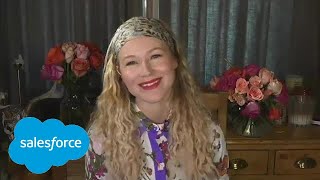
This is a transcript of a July 31, 2020 YouTube interview on Salesforce’s B-Well Together featuring musician and mental-health advocate Jewel. She recounts her upbringing in Alaska, periods of homelessness and agoraphobia, and how journaling and short mindfulness exercises helped stop her panic attacks. Jewel describes founding the Never Broken program (three-minute scalable exercises for at-risk youth), cites program outcomes and broader mental-health trends (pre-pandemic increases in suicide and depression), and notes new music inspired by these themes.
Questions this video answers
July 31, 2020.
70% (claim stated by Jewel).
99% of their kids earned their own college scholarships (claim stated in the interview).
90% (claim stated in the interview).
15 million copies (claim stated in the interview).
Chapters
Hello.
Hello and welcome back, everyone. Thank you and good for you for making another choice to prioritize your own well being. And joining us here today on Be well Together and oh my gosh, we are so not going to disappoint. Today we have an extremely special guest with us. You know her as a. A Grammy award nominated singer and songwriter and musician and author and poet and just someone who has really been inspiring us for decades. But Jewel, yes, Jewel is so much more than an incredibly talented artist. She is just an unbelievably impressive human being. She is a tireless advocate for women, for children, for mental health. She's the founder of the Never Broke foundation, which is something I've really loved watching bloom over the last couple of years. It's an emotional fitness destination that gives everyone the tools to really create the change in your life that you want. Through this period, she's launched this amazing show on Twitch Live from San Quarantine series, which has been tremendous. And today she's with us and she's going to talk about the work that she's doing around mental health advocacy and the impact that everything that we are dealing with is having on things like anxiety and fear and grief and depression and all the things that we're all trying to kind of keep our head above water on. So with that, I would like to introduce Jewel. Thank you so much for joining us today. Jewel. Hi. Thank you. So I would love for you to just kind of start off by talking about your journey and what you've been doing over the last couple of months.
Sure. I guess just to introduce myself. I'm from Alaska. I was raised on a homestead. My family were pioneers. They were from Europe and escaped the Second World War to form this utopian artistic colony in Alaska where they were giving you free land if you promised to move up there and not die for a whole winter. So. So I was raised by these very sort of idyllic philosophical grandparents and my dad, of course, that were all very musical. So I grew up singing with them at a young age. It's an amazing place to be raised. It's such a beautiful, beautiful place. And there are so many great things about my family. My grandfather ended up becoming a senator and helping draft the Alaska Constitution and just an amazing American story. There was also a lot of hardships. You know, I think the type of personality that has the will to hike across glaciers and forge a new land out of nothing is a certain kind of personality. So there was sort of the dark side too. My dad had a really Abusive childhood. And when he went to Vietnam, it was relaxing. And that's when he realized he was in trouble because Vietnam was absolutely relaxing for his nervous system. So he came back from the war, married my mom, had three kids. My mom left when I was 8, and my dad took over raising us. And his PTSD started triggering. But of course, words like PTSD weren't really around. They didn't really exist. He did what most people do to try and medicate, which is drink and try and numb and quiet, that amount of stimulus and feeling. He became abusive when I was 8. And we also started singing. There's lots of good stuff, too. I've been singing with him since I was five. We would tour Inuit villages, Alaska native villages, you know, land on a ski plane and be picked up by a dog sled. And singing was a part of my life since I was very, very young. My parents did shows in hotels. So when my parents got divorced, my dad and I became a duet and we started bar singing. So I started singing in bars when I was about 8. And I watched a lot of people drink. I watched a lot of people in pain. I was watching my dad in pain. I went. I could tell we didn't know what to do with pain. You know, I could see all these different coping mechanisms. I didn't know that word, obviously, but people in relationships, there was rage, there was anger, there was drugs, there was drinking, and none of it worked. I got to watch these people, up until the time I was 15, slowly kill themselves sadly. And I remember making a promise to myself that I would figure out what to do with pain. The way I saw it was sort of like there was this original hurt. And then people had all these ways of avoiding the hurt, but it made a mountain of pain. And they still had to somehow now do this, dig back through all this stuff that they did to get to the original hurt anyway. So my goal was to try and just figure out how to deal with the hurt without adding stuff on. I thought it was the only genuine shortcut life offered. I moved out at 15. Pretty young to move out. I was paying rent. I was hitchhiking into work. I was getting myself through school. I knew that statistically, kids like me end up repeating the cycle that they're raised by. And I didn't want to be a statistic. I didn't want an end up in an abusive relationship or using coping mechanisms like drugs and alcohol. So I started off on what I called my happiness project. I was journaling a lot. I was reading a Lot. I hoped that my logic and my reason could maybe help me find better ways of being. I called it an emotional English. So each of us in our house are raised with an emotional language. It's the language of our household. It's how we deal with conflict and how we express love. And a billion data points and our brain pattern matches. It's how our brains learn. So our brains are wiring themselves and we're creating arbitrary names. So let's pretend. My mom told me a red apple is yellow. And she's like, that's the color yellow. I'm always going to think red is yellow. I call it emotional dyslexia because it's the same with feelings. When we are hurt, when we don't feel safe, when we're in an abusive environment in our household. But we're told we're loved. And in some way we are. My dad definitely loved me. That's the data points. And it's a million data points. It's more data points than you can really comprehend of what my brain was arbitrarily calling love. Is that love? Is it what I would want to repeat as an emotional language going forward? Not necessarily. So learning how to retrain my brain was this very daunting thing. At 15. I started by watching other people looking for other behaviors. Because you can't really abstain from a behavior forever. You know, you can't live in a vacuum. You have to replace it with a better behavior. And that's a lot of the problem with our self, you know, growth and our self learning is we're told what to abstain from, but we're not really given practical tools to exercise to replace and create new neural wiring. Because that's what has to happen. We have to stop engaging behavior that's going to start helping our brain stop building the neural pathways, right? They're going to start starving that neural pathway. It's going to get weaker unless it's traveled down. And then we need to create a new practiceable habit to help us rewire and build new neural pathways. It's a lot to be up against, I guess, for any of us. And I was pretty optimistic about it. And I did quite well. I got myself through school. I ended up getting to go to an amazing fine arts school in Michigan. Moved to San Diego to take care of my mom, who was ill and was working in a warehouse answering phones. And my boss asked me to have sex with him. And when I turned him down, he wouldn't pay me, wouldn't give me my paycheck My rent was due and so my mom and I had to leave where we were living. We got kicked out. I started living in my car. My mom went back to Alaska eventually. I kept thinking I'd figure it out. I just didn't really think it was that dire. I grew up in a saddle barn in Alaska with no running water, a coal stove, and my brothers and my dad all sharing one room. So being by myself in a car in San Diego, it didn't seem like the worst situation. And I was really convinced I would get another job in a couple months, save up for a deposit and get a new place and get back on my feet. But it just didn't work out like that. I had bad kidneys from a pretty young age. I was sick. I couldn't afford medical care. I didn't have insurance. My panic attacks started increasing. I started having panic attacks when I was about 16. I didn't know what they were. You do feel like you're dying. It's very, very shocking and very scary. Of course, I didn't tell anyone out about it. So when I started living in my car, my anxiety increased. I actually almost died in the parking lot of an emergency room because they wouldn't see me because I didn't have insurance. I had blood poisoning. Luckily, a doctor had seen me get turned away and he came out in the parking lot. I was sitting in the passenger seat of the car I was living in. I was throwing up all over myself because I didn't have antibiotics and I didn't have the energy to move. I had blood poisoning. And this doctor tapped on the window. I remember I was covered in my own vomit. It was not my shining moment. And he handed me antibiotics and they saved my life. And he gave me his business card. He actually saw me for free the entire time I was homeless. Just an amazingly actual nice human which was so rare for me to find. I tried to get jobs, but between being sick and the panic attacks and the amount of energy that it takes, I had an idea of what homeless people are like. Before I was homeless, you think they have so much time on their hands, they have all day to do a job hunt. That isn't what it's like. It's hard to describe how much energy goes into being an animal, to surviving, to food, water, shelter. Right? That's what all animals worry about all day long. That's a full time job when you don't have those things taken care of. And really to me, that's what separates an animal from a human. Is we have figured out this amazing luxury of how to have those things taken care of. It was exhausting and frightening and all kinds of things. So I became agoraphobic, which is a fear of leaving your home, which when you don't have a home is, you know, turn into strange things. Like, if I leave the street corner, I'll get sick. My car eventually got stolen. I wasn't living in it. I wasn't sleeping in it when it got stolen. So that was good. I just came back to my spot and my car was gone. I was shoplifting a lot. One day I was looking in a mirror. I was trying to steal a dress, and I saw my reflection. And I was like, oh, my God, I'm a statistic. I did not beat the odds. I really set out on this thing to not be a statistic. And here I was, homeless and stealing, and I realized I would be in jail or dead if I didn't turn my life around. And I remembered this quote that was attributed to Buddha, that happiness doesn't depend on who you. Who you are, what you have depends on what you think. Basically, that form follows thought. I was stripped of everything but my thoughts, and I thought, I have to see if this is possible. So I didn't steal that dress. And I tried to figure out what I was thinking. But when you have severe anxiety, it's actually very hard to witness your thoughts in real time because you're pretty much just disassociating and out of your body the entire time. So I started writing what my hands were doing, and that ended up being my first mindfulness exercise. Those words weren't around then. There was no such thing that I'm aware of as the word mindfulness. I had heard, of course, of meditation, but I started realizing that my hands were the servants of my thought. So if your thought cools down into action, you can see what you're thinking by watching what actions your hands are taking. So that was my huge plan. I didn't steal the dress. And I'm like, I'm going to journal about my hands. It's a pretty silly life plan. But it seemed like something. So I just started really paying attention to what they did. You know, how many times did I wash my hands that day? How many times did I shake hands? How many times did I not shake hands? Was much more like me, just anything they did the most minute things. I had no idea what I was looking for, but I hoped I would see some kind of pattern. At the end of two weeks, I did See a pattern. I quit believing in myself, which is weird. You know, I worked since I was little. I had earned a living in all kinds of ways my whole life. I was a hard worker. And so that was strange to think I couldn't do it anymore. To think I was no longer capable or worthy of having a job. My self worth was so affected and so impacted. It's hard, you know, when you're homeless and you're walking down the street and you see people cross the street just so they don't have to walk by you. It really is like being less than a human. Like you really do feel dehumanized. It's very hard. But the interesting side effect of this exercise was that my anxiety disappeared while I was journaling. It was so mind blowing. It was so obvious because I was crippled by anxiety. So the side effect of my anxiety disappearing while I was journaling was very, very noticeable. And I got very curious about it, which, by the way, is a hallmark of being mindful. If you want to be mindful and you're wondering how tricky is it and how hard is it, just be curious and observant because you have to be here to do that. So that's the quickest hack into mindfulness, is just be observant and curious. When you have tremendous anxiety, start getting very curious about the colors in the room, the smells in the room, the texture of the fabric that you're wearing that forces you to be present. I learned so much that year. I realized our brains are naturally addictive and that I don't think God made a mistake like, sorry, humans about that one flaw. Your brains are addictive. There has to be a biological reason our brains are addictive. It has to be for our benefit. And I realized I could get addicted to good things. We just get addicted to repetition, basically, is what that is. And so I started to realize there was this triad of what's now called a habit loop. I didn't know the word at the time. I called it a triad, but it's basically a stimulus, a response and a reward. I noticed me being homeless really upped my stimulus. I stole. That was my response. And I felt calmer and in control. I felt like I was taking care of myself. There was neurotransmitter, you know, biochemical rewards. And I couldn't change being homeless right away. I mean, I worked at it every day, but it isn't the easiest thing to change. My response, though, is completely within my power every single second of every single day. That's the good and the bad news. So I decided to really focus on my response, and I chose writing. I'd been writing from a young age. I had zero plans of being a professional writer. It just was something that I knew calmed me down, which is really important to note, because I started to notice there's only two states of being. There's dilated and there's contracted. And every thought, feeling, or action leads to one of those two states. So when I was stealing, I was getting excited, which, believe it or not, actually contracts your system. Excitement is not the same as a calm, open feeling of happiness. But we confuse excitement for happiness in our modern age. But that's another topic. So writing dilated my system. Now what's happening is an actual. You know, it's amazing. I learned much later. I could tell it physically then, but now you can actually see when your system dilates because you're engaging in gratitude, curiosity, writing, journaling, going for a walk in nature, meditating. Your whole system dilates. Your blood pressure drops because your vascular system dilated. Your neurotransmitters change, and how your blood flow travels in your brain actually changes. It can go now to your frontal lobes instead of just your amygdala. So, anyway, I started stumbling on this stuff when I was homeless, and I started figuring out how to be happy, like, genuinely. I started getting a momentum. I started writing right instead of stealing. So I wrote a lot. I became very prolific. I started singing in a coffee shop, and I got discovered. And I was actually really scared when I got discovered, because you take somebody with my background and all the emotional baggage I have, and God forbid you ever throw fame on that mix, and you have every disaster you've ever seen of every musician that's killed themselves with drugs. I didn't want that to be me. I almost turned my record deal down because of that. And I remember this moment, walking on the beach, and I was like, if I keep my number one job to be a happy whole person, where that's my number one job, where all my creativity and all my curiosity continue to be focused there. And my number two job is to be a musician, because my music already was an extension of that journey. My music already was. My hit song Hands is about my hands. I mean, it was about my mental health journey, about me understanding if my nature, if my nurture wasn't good, do I still get to get to know my nature? Like, or am I just screwed? Like, are all of us screwed if we didn't have good nurture? I proposed not. I was going to refuse to go through life saying my nurture was bad. Oh, well. And so I made that my number one job and I always stuck true to it. It's why I took years between albums. You know, I did stuff as a, as a musician. I ended up becoming wildly famous on the COVID of Time. My first album sold 15 million copies. I got so famous, way more than I ever thought with a folk album. And I quit for two years, which, you know, made my label crazy. It's not what you should do if you want to continue being famous. It kills all the momentum you worked so hard to build. But I needed it for my mental health and I needed that type of thing often. I needed a break often. And nobody around me was going to give it to me if I didn't say, that's it, I'm stopping until I feel like I can go on and adjust. So that's sort of my journey. These exercises I invented, I wanted to, I really believe they'd work for anyone I knew they rewired my brain. I could tell, I could feel it. Because with time, my stimulus has changed, my response to stimulus has changed, my habits changed. And it was a change from the inside out, which is really important. And I stopped being agoraphobic and I got my panic attacks to go away. And this is without therapy. I never had therapy. I never had access to therapy. When I got famous, for some reason, I still never did therapy. I just was able to get so many results for myself by remaining so curious and developing new little exercises and saying, oh, now this is a problem for me. How do I, what do I do to really get at the root of it and change it? So I wanted to help the kids in the world that didn't have access to therapists, didn't have access to any kind of help, didn't have families that were necessarily able to help them either. So 18 years ago, we started inspiring children. We work with suicidal kids. Most of our kids had multiple suicide attempts, suicidal ideation, extreme anxiety, extreme poverty, extreme abuse. And we started giving them these tools that I developed, simple three minute tools. And you just wouldn't believe the transformation. And again, without therapy. Not that I'm against therapy, but we have to have scalable tools. And quite frankly, I know a lot of people that are in therapy, they never are getting the results. They feel better talking, but they're not really changing. And if we're not really changing, what's the point of therapy? It's not working the way I think it should be working. So creating this curriculum was just an amazing experience. To be able to see the results in these kids that began meditating, being mindful, realizing not every thought and feeling is a fact, realizing their happiness was up to them. Nobody was coming for them. They were coming for them, but they could do this. Last year, this year actually, 99% of our kids earned their own college scholarships. These are not kids that were recruited for their academic abilities. They were mostly flunking out in middle school when we got them. 90% of those scholarships are Ivy League. So it's just incredible to see. We did start a website. It's called Jewel Never Broken. There is a. I did write a book about my life, so if anybody wants to check that out, it's called Never Broken. And the website's called Jewel Never Broken. And it shares these simple three minute exercises that do help rewire your brain. Help you make a habit out of happiness, I call it. And they were proven to work by a neuroscientist. So that's my spiel.
And I tell you, you can tell me that spiel every single day of the week. And every single day of the week, I will find myself like jotting down more notes. It's so amazing. Thank you so much for sharing that. You know, I'm really curious. You had mentioned that, you know, I think similar things, a habit of happiness, you know, addicted to the repetition. I think it's really interesting. I'd be curious to hear from you kind of what you're doing in this time as a mom, as someone who's teaching, who's, you know, living with all the new rules of this quarantined world. And I think a lot of people are finding that repetition to be really monotonous and just kind of a grind. And I'm curious to hear from you, kind of when you think about your own mental health and how you're creating those pathways to happiness with this new level of restrictions in today's environment. Kind of what you're learning and what you're sharing with your child and your overall coping. Because I think it's a, it's a, it's a much modified version of what you grew up with. But different. But different and has its own challenges that I think a lot of people are experiencing and trying to find their way through.
Before the pandemic hit, we were in a crisis. Suicide rates have gone up 70% since 2006. That was pre pandemic. 70%. That's a really ugly number.
That's a huge number.
Depression rates are at an all time high prescriptions for anxiety, all time records. So we had a problem before this. Now you take people that aren't comfortable in their own body, that don't like the thoughts and the voices in their head, and you make them sit with those voices where they can't distract themselves anymore. I don't know that it's a new problem. It certainly layers complexities and triggers and all kinds of things. Fears for sure, you know, but it's the same problem. What do we do with our thoughts? How do we be happy sitting alone in a room? You know, the reason a lot of people don't want to meditate is because they have to stop and listen to what they're telling themselves. And it's not pretty. I wouldn't say this stuff to someone else. I said to myself in my head, and if I started to notice and really stop, I started to make myself right when I was young. And this is an exercise we do with our kids. We call it the lies in your mind. But when you're really anxious, that's your body's way of telling you that you're not in agreement with your life. Nothing's wrong with you. Like your anxiety is a beautiful signal. It's like a car alarm on a car. It's your body's way of saying, hey, we don't feel good. Something you're doing or thinking or something that you're around is violently disagreeing with you. We ignore that sign. It almost makes me cry. Because we just ignore the fire alarm and we medicate it and we go right on doing what's clearly not in agreement with us. When I began to flip the script and say, nothing's wrong with me, something's right with me. My anxiety is trying to tell me something. What is it trying to tell me? When I would sit down and invite it to get closer, it started to change. And that sounds counterintuitive because we want to take our most uncomfortable aspects of our personality, right? Our impatience or our intolerance or our irritability or anxiety. We want to push them away. Well, it just gets worse and worse. It doesn't change. We want things to change. The only way to change it is to bring it closer. Peace is not the absence of something. It's coming into harmony with what is. That's a massive sentence. Peace is not the absence of something. It's coming into harmony with what is. We can fight what is as long as we want. We can stiff arm it. We can say it doesn't exist. It still exists. I Call it the truth wins. The truth wins. So the quicker we can get curious, the quicker we can get excited and go, oh, I'm anxious. Thank you. What am I thinking? Feeling, doing that's making me anxious. And that's a whole journey to become mindful enough to stop and go, what was I thinking? And that's where I'd carry a notepad around and I would write down the horrible things I was thinking or the horrible people I was surrounding myself in that were the only form of kindness I knew. But it wasn't great. It wasn't great kindness. It wasn't a high level, but it's what I accepted, it's what I tolerated. And when we tolerate the intolerable, we get sick. There's so many things I could expand on, I guess just to keep it really short, I would say that this is an exciting time. And the quicker you can flip that narrative from, this is the worst time and the strangest time and the most awful time. The time is. It is what it is. So we have to figure out what to do with it. We can stiff arm it and wish it was going back to normal. Was your normal really that great? Could you have improved it? And this is what is. So the quicker we can come into harmony with it and get excited and get curious and get observant and go, what isn't working for me? You always have the power to change it. If you want to be a victim, this probably I'm not the person to talk to because I'm the person that believes, you know, living in your car, you can change your life. You really can. There's really no excuse and a lot of people don't want to hear that, but you create your life. I really believe it. And if you're not showing up, you really can't complain that your life's a shit show because it's like not being in your house and letting your house fall apart and then showing up one day and being mad that your house is a mess. We are not showing up. Learning how to show up is a skill. It's a practice. It definitely takes work. It's not easy, but neither is being dysfunctional. Dysfunctional is exhausting. Like, I was exhausted being dysfunctional. And yeah, it's really hard work to change, but at least there's a light at the end of that tunnel.
So all of this opportunity, really, which is what we have right now, when, you know, maybe your life wasn't that great, you know, you were kind of walking through the motions and you were Very, very busy, you know? But you're letting your house fall apart. I'm curious if through this opportunity and these learnings and this time, this gift of time we've really been given, if it's influencing any new music that you're thinking about or anything new about the times, are your hands kind of creating some new beautiful piece for us?
Yeah, I have some new music out. Excuse me. I have a song called Grateful that's out, and I have a song called no More Tears, and they were definitely influenced by these types of thoughts. And just trying to inspire us, that's the hard thing. Right. When we become disillusioned, we get tired, our body aches. We just don't really have the will and the energy. Nothing's that fun. So inspiring ourselves, figuring out how to get ourselves excited to have that burst of energy, like, okay, I got this. Music has a tremendous ability to do that. It does it for me. It's my medicine at least. So hopefully it works for other people, too.
Oh, my gosh. Well, you have been healing me for decades. I think you've healed a generation. So I am grateful for you. I am very, very grateful for you, and thank you for your time today. It's always such a pleasure and just a very inspiring story and woman. So we really appreciate you coming on the show today.
Thank you. Thanks for having me.
So, to everyone out there, good on you for taking a moment to really think about the kind of person that you want to be on the other side of this. I'm grateful that joined us today. Be happy, be well, and we'll see you back here next time.
Bye.
Bye.









