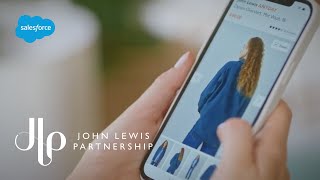
Short promotional video (John Lewis Partnership with Salesforce) explaining how John Lewis uses CRM, AI, and data to personalise customer journeys and reduce returns. Speakers highlight Marketing Cloud for tailored marketing, Einstein One (notably Tableau Pulse) for identifying return trends and surfacing top insights to buyers, and an example where analytics-led actions produced a significant reduction in return rates and improved customer experience.
Questions this video answers
April 29, 2024
Chapters
At John Lewis, we've seen quite remarkable shift in customer expectations over recent years.
One of the main reasons customers shop with us is they see us as a very trusted retailer. The challenge for us is to replicate that in a digital environment.
We know that our customers lead busy lives and we have so much rich data available and we want to ensure that every decision that we make is informed and empowered through the use of data.
The collaboration between John Lewis Partnership and Salesforce has been transformational.
What I love about Salesforce is the seamless integration across all of the various different products in our role.
Actually, it gives us more opportunity to focus on what's the next best action for the customer. What are we trying to do next? So this is marketing Cloud. This is what we use to send all of our marketing communications across the business. We're able to look at customers who perhaps I've got an interest in fashion, and we're able to then tailor the push messages all to do with fashion.
And so we can delight our customers with emails that relate back to their previous shopping decisions.
The power is shifting to our marketeers who know what the customers want and we can see the commercial impact almost immediately.
And so with CRM, AI data and trust, we can create an exceptionally personalized experience for our customers.
The key part of the Einstein One platform that we've really been excited about is Tableau Pulse. That's really revolutionized how we've been able to look at returns. If you think about a digital journey for a customer buying, say, a new jacket, they may start that journey with an email from us and go, great, that's the jacket for me for the weekend. They'll buy it online, they get the jacket home, and maybe it's not quite right for them, maybe it's a little too long in the arms or doesn't quite fit around the shoulders as they'd hoped it would do.
And so if they do need to make a return, we want to know why.
Customer will log on to johnlewis.com they'll click on the returns icon where they tell us the reason that they're returning that product.
The AI can communicate with them based on their previous shopping history and can guide them on the way to making sure that the returns process is as easy as possible.
So what our partners in the commercial buying offices can now see every day, every week, is the trends in items that are being returned.
Our buyers can go straight into Tableau Pulse. And the top insight is that the number of returns for a particular brand seems to be increasing versus the same month last year. And so I want to know why. I want to know exactly what's happening within that brand that could be causing this increase in returns. And what's great is that without even asking any questions, Tableau Pulse has given me the top insight about the change. And as a result, we've seen a significant reduction in our return rate, which means a better experience for our customers.
And so Tableau's been a real game changer for us.
We are able to create highly personalized journeys using Marketing Cloud. We're able to visualize the output of the data using Tableau. So we're seeing amazing benefits thanks to the Einstein One platform.
If John Speed and Lewis was around now, he'd be all over this stuff.