Lead the Energy Transition with Data and AI - World Tour Atlanta 2023 | Salesforce
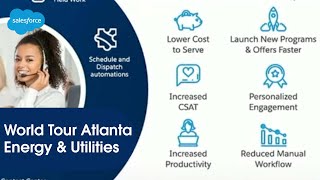
Larry Goldstein from Salesforce argues that energy companies need to abandon legacy systems for an AI-powered platform that unifies customer, asset, and partner data. He demos how AI can transform contact centers and field service, and warns that organizations must adopt an AI strategy now to keep pace with the shift to clean energy and distributed resources.
Questions this video answers
Larry Goldstein, Senior Director of Solutions and Product Strategy at Salesforce (Energy and Utilities product organization).
30% of global capacity in 2022.
$1.7 trillion (projected for 2023).
Chapters
You. Hello and welcome everyone to our session on leading the energy transition with Data, AI and CRM. My name is Larry Goldstein. I'm senior director of solutions and Product strategy here at Salesforce as part of our energy and utilities dedicated product organization. First off, I'd like to thank all of our customers who are here. You are our true trailblazers. And also thank you to all of our partners in attendance who work so hard to make our customers successful. We are in the midst of the biggest change to the energy and utility sector in the past 100 years. And it's happening now. We've talked about it for a long time. It's happening now. In 2022, 30% of the global capacity was delivered through clean energy. And we're just getting started. We're in the midst of a massive investment from both public and private sector in the energy transition. For 2023, it's projected that $1.7 billion, excuse me, $1.7 trillion. An even bigger number is going to be spent to work on the energy transition. And it's not just about delivering and installing renewables and installing new infrastructure. The whole way that the grid operates is changing. We're going from a one way grid to a highly distributed grid infrastructure with DERs of every size and shape. And that's going to require orchestration of those DERs in a way that has never been done before. And it's not just the grid that's different and is going to be operating differently. The relationships you have as energy utilities and service providers, the relationships you have today are going to have to expand significantly. Your customers who used to be a billing node at the end of your delivery network, they're now generators, they're now prosumers. They now are partners for you as you work to manage and deliver a safe and reliable grid. There's a whole other ecosystem of third party parties out there that you're going to need to start to work with, whose data workflows and even their customer relationships are going to be critical for you as you manage and manage the grid. Automotive OEMs with their telematics data, energy service providers and contractors who are installing renewables and working with your customers on energy efficiency programs. All these folks are companies and businesses that you've never worked with before that you need to bring into your environment, both from a data perspective and from the flow of work. And it's not just doing this. Energy transition is the only job that any of you have. The key tenets of our industry are delivering safe, reliable and Affordable energy. And those key tenets, those key foundational points of our industry are under a lot of pressure today between the economy, world events, fluctuating energy prices, and just the sheer cost to make the grid resilient against the very things that we're trying to address with the energy transition as we experience more frequent, more intense wildfires and storms. So it's a massive undertaking. So the challenge here is transform now. But how and when you think about what that transformation looks like, you really need to understand that what we're talking about here is transforming at a massive scale. We firmly believe that you need to have efficiency and speed and flexibility at scale for us to get through this energy transition. And the current systems today, they weren't built to do that. And so we really need to rethink about what we need from platforms to actually get us there. What we're talking about here is actually pretty cool stuff. It's how do you actually personalize one to one for millions and millions of customers across hundreds of millions of assets and working with companies again that you've never worked with before. So what we need here is, is a new kind of platform that allows us to cultivate these energy relationships going forward. And what I can tell you is that the existing legacy platforms and systems that all of you have today, they're not going to get us there. A lot of these systems, as we've talked to customers, and I get the luxury to talk to customers from every sector of the industry around the globe, as I talk to customers, they're still living with systems that are old, fairly rigid, old data architectures and models that really don't accommodate bringing in the different types of data streams that we're talking about. And they don't allow you to make changes to your processes in a way that allow you to scale. We talk to customers who are now not just selling commodity, but offering new non commodity products and services. Their systems won't let them offer those services. It takes forever for them to get new offerings out to their customers because of their existing systems. So when we talk to our customers, they pretty much tell us we feel stuck, you know, we need another way to do this. And you know, it's not a knock on your CIS system or your other legacy operational systems. They do a good job of what they were built to do. Your CIS system gets the bills out every month. That's important. Your operational systems keep the lights on and keep us safe. All good things, but they're not built to do what we need to do. And many of you have been trying and trying really hard, bolting on capabilities to these systems and stretching them beyond what they were purpose fit to do. And it's not just the systems that have to change, it's the method of work. And when you think about what goes on in your organization, it's 2023. But I can tell you from the conversations I've had with many of you, a lot of your processes are still manual, or even the ones that are digital have kind of gaps, because then they have manual steps in between. And the waterfall development cycle that all of us, including myself, who actually came out of the industry working for one of the big IOUs here in the US those waterfall processes where you build an application and take two years to do it, and then that application doesn't significantly change for five or 10 years. Those days are gone. In two years, our industry looks very different than it does today. And so you need a system that can cultivate these relationships and give you the speed and flexibility to adapt to an energy transition that's happening now. And as you've heard today in some of the other sessions, there's incredible power when you bring data and AI together with the world's number one CRM. We really believe that this is what's going to unlock that speed, that flexibility, that efficiency, and to be able to do that at scale. And as we talk to our customers, we really understand that it's again about these relationships. So when we talk about this, we talk about in the context of the Energy Relationship Platform, how do we give everyone a single view of the customer across your organization, across your partners, across the ecosystem that you need to build out as part of the energy transition. And as we look at this, what it really looks like is this Energy Relationship Platform. This is the thing that's going to get you there. This is what's going to allow you to keep your existing systems in place, your cis, your other operational systems, they're not going anywhere. And we're not saying that those need to move again. They do a good job of what they were built to do. But what we're trying to do here is unlock the data across those systems with things like Mulesoft, our enterprise API platform, and integrate the data from these systems, harmonize it together in data cloud, put intelligence around that data with Einstein and automation, and bring all of this into the flow of work so that you actually are able to have a connected experience with your customers and your partners. And really, it's this dynamic, really what we're talking about here Is this dynamic relationship between your customer data, your partner data, your asset data, your assets are talking to you now with Gen AI, you can actually now have conversations with your assets and your customers assets. And it's that dynamic relationship between all this data that then puts the power of all of this together at your employees fingertips so that they can help their customers. Whether it's helping your customers reduce their carbon footprint or even help them better manage their bill and their energy use. And so the idea here is that we need this different platform to be the way we execute and scale for the energy transition. Now all of this is powered by AI. So we talk about bringing all this together with MuleSoft and Data Cloud and Einstein is really the accelerator for all of this. And what I need to tell you is that every energy company, everybody watching this today, both in the room and streaming online, you need to have an AI strategy today. Why? Because the productivity gains, the efficiency gains are real. We're starting to see this already with customers. You heard Connor talk in the keynote today about productivity where by 2030 it is expected that 30% of employee time is freed up because of AI. Imagine that in our space, imagine a contact center agent who has two additional hours every day because all the transactional work has been offloaded and made more efficient. With AI, those contact center agents can now be repurposed to be the energy advisors you need and want them to be for your customers. Think about your key account representatives who, many of whom manage, you say key accounts, you think they're managing one account. Many of them are managing your large commercial industrial customers. 50, 100, I've heard, even 200 accounts. Imagine if you could give them a day back per week in productivity, how many other customers could they work with to help those customers get to their net zero goals and, and in turn help you get to your net zero targets. And so this is really going to change the way that we work across every aspect of your ecosystem. And what we're going to do now is frame this more specifically down into some use cases so that you can start to see where the opportunities are across your business and, and start to think about where the right place might be for you to start your AI journey. So we really believe that personalization is key and it all starts with your data. So again, the ability to bring this data together not just from your internal systems like CIS and your other legacy systems, but we're in the energy space. So the ability to bring in weather data, telematics from EVs for managed charging to Bring in data about building stock to know that a home built in 1958 in Northern California, where I live, by code, you didn't have to put any insulation in the walls. Perfect opportunity for an energy efficiency retrofit. So this personalization scales across your business, whether it's helping your customers on their own carbon net zero journey, or even helping in a more proactive way. The many customers that you have that are struggling to pay their bills proactively being able to engage them before they're three or six months behind on their bill so that you can actually get them proactively on a bill payment program or a bill assistance program if they're income qualified. And this personalization is going to drive your whole service experience one to one service experience, where you're going to now start to get efficiencies and reduce your cost to serve. We talked about the cost pressures and the affordability pressures in our space with many of you going to your rate case, asking for in some cases 10, 15, 20% increases to try and cover these costs. Well, we really need to change the operational model and help you drive more efficiencies with how you serve your customers and lower that cost to serve. And finally, personalization matters as you start to manage this distributed grid where again you have customers as generators. How you start targeting those customers to identify who can help you manage during peak times of day, how you can start to learn and plan where the electric vehicles are being deployed within your service territory, and how to make sure that you get those customers on managed charging programs so that not everybody in one neighborhood at 8:01pm after peak hours are over, all start to charge their EVs at the same time creating a new problem at the local distribution network. So this high hyper personalization is key, but as we look at use cases, they go across the entire organization. So we've talked about that key account manager being able to help your customer on their net zero carbon reduction journey, the ability for that salesperson to be able to use Einstein as a co pilot to help them target the customers who are best fit for the utility programs that you're offering today, and then create the outreach that's attractive that engages those customers in a conversation so that you can drive adoption of your energy programs, your clean energy programs. On the service side, we talked already about reducing cost to serve driving efficiencies, both in terms of service responses, that copilot helping that contact center agent, but also being able to help with summaries of those calls and automatic generation of knowledge Articles, all things are going to help you scale and again free up that contact center agent so that they can actually become energy advisors to your customers and have more meaningful conversations with your customers when they call into the contact center. And the use cases go on and on, not just even the ones on this page. So I've had conversations with regulated utilities who regulated utility who came up to us and said, hey, you know, we've got thousands and thousands of pages of regulatory filings and documents that we have. How do we take Generative AI and now start to kind of put all that data together and make sense of these filings so we can actually do better and be more efficient and and more effective as we go into our next rate case. I've talked to utilities who manage hundreds and hundreds of vendors, subcontractors who go out and do the work to maintain and upgrade that grid. And the procurement department's asking us how can we leverage Generative AI to make that procurement and RFP process more efficient and more effective. So this is just a sample of some of the use cases, but as you can see, it goes across every part of your organization. What I'm excited about today is to be able to tell you that everything that you've heard Salesforce announce relative to Generative AI for sales and service is available and deployable through Energy and Utilities Cloud today. So Energy and Utilities Cloud is our purpose built cloud built on top of Salesforce Sales and Salesforce Service that extends the capability of those clouds and delivers purpose built applications specific for the energy and utility sector. So the MY account portal pre built with Energy and Utilities Cloud Energy specific contact center pre built and further configurable with Energy and Utilities Cloud field service capabilities. And we even have we just launched at Dreamforce we launched our clean Energy programs platform. Everything from program managers being able to set up their programs and manage to their targets in terms of their energy savings and carbon reduction goals and customer adoption goals and also being able to actually help with the whole application process workflow at scale. All of these are applications that are purpose built with Energy Utilities Cloud and we keep coming up with new innovations three times a year. So now you can actually leverage all the capabilities that you're hearing in the sessions today for Generative AI with Energy and Utilities Cloud. So that means today you can start taking advantage of of those service responses and call summaries and be able to get efficiency in terms of when you go out in the field and have kind of workflows that help your field technicians be efficient. But also be safe. And we're going to show some of that in a couple of minutes. And so our roadmap is to not just leverage we what's being built across salesforce broadly for AI, but again, just like energy and utilities, Cloud's purpose to extend that and make that purpose fit for the energy and utility sector. So what that means is bringing in carbon data, bringing in energy data, bringing in weather data and other data sources that are going to help inform the AI and make that grounded data part of the AI responses. And in reference to those responses, we're actually building out prompts that are specific to utility and energy provider specific use cases so that you can actually get those prompts, still have the ability to modify them further, but we're going to give you the base prompts you need for a variety of use cases in order for you to actually be able to deploy this easily and quickly across your company. And we're also partnering with a number of providers out there who have kind of specialty capabilities in the energy industry and have data, whether that's telematics data and managed charging data and bringing their capabilities, their analytics, their workflows and their services capabilities, managed services capabilities and bringing that into our AI folder. So what we're going to do now is we're actually going to demonstrate the power of AI and the way that we're going to start is we're going to start with showing how the power of AI can improve and drive productivity in the omnichannel service experience for your contact center agents. So with that, Adama, if we could get started with the demo. So here's Lauren. Lauren's a residential customer. She's on the My Account portal built by Energy and Utilities Cloud. She's a customer. She's a solar customer as well. And she looks at her bill and like, wow, $445, that's incredibly high. That seems pretty high to me. I wouldn't want to be paying that. So she wants some help trying to understand what's going on with her bill. So she's going to go to the chat and wants to talk to an agent. When she starts chatting, she gets Jonathan, one of our best agents. But Jonathan, as smart as he is, as good an agent as he is, he's got some help with him too. He's got an Einstein co pilot with him. So when Lauren asked, why is my bill so high, Einstein's there to help Jonathan answer that question. Einstein is grounded in the CRM data and company data that you have. So we understand, yes, Your bill is higher. But what Einstein's also able to see is that you've got solar. And we've noticed your solar production's dropped through the floor. So something's wrong there. So we start asking some questions. Anything change that? You know about the other thing? Einstein, as it keeps looking into the data, realizes that, hey, we have the model and type of the inverter that Warren has, and we notice that a whole bunch of other customers are having solar production issues who have that same inverter ever since the last software update was deployed. So now we want to get a technician out to Lauren's home to go take a look at her PV system. So we get that set up, and now that contact center agent is closing out the call. So instead of now having to kind of go look at their notes and kind of retype everything up, Einstein's generating the call summary already for that agent. The agent has full control, just like they had control over the responses to edit or make adjustments. They can modify that call summary. And since the agent realized that, hey, you know, a lot of other customers are having this problem, I think it's important that I should create a knowledge article and let Einstein create that knowledge article that I can post so that other agents, if somebody calls in with some of these same issues and same inverter, will actually have that available to them as well. So we're now kind of leveraging Einstein to share that knowledge, share information, and make that available to others across the organization. So what we've really demonstrated here is with the copilot on Jonathan shoulder, we're able to leverage the data that we have, both in the CRM and elsewhere in your systems, to help identify what is likely a potential issue here with Lauren as it relates to her bill. That high bill prompt is what all kicked that off for Einstein. And now we're going to continue with our journey and go to the field service experience where that technician's now, Lena, our technician, is now going to go to Lauren's home and actually go investigate what's going on with her PEV system. So when Lena arrives, Einstein's already there and ready for her with a work briefing that basically tells her everything that she's going to want to check out about the entire PV system to see what's going on. Starting first and foremost with a safety check. We want to make sure our technicians are safe when they're doing work out in the field. So we've got our steps, we've got our safety check. And just like the contact center Agent had the ability to weigh in and decide whether this was useful information that Einstein was providing. We're also getting the field technician do that as well. So we decide whether that's some information that's valuable or needs to be modified next time. So now we're going through our checklist here and we've gotten to the solar inverter and there's a knowledge article that Einstein's popped up of. Here's the things you want to check when you're looking at the solar inverter. Now, the technician, as they're going through here, sees there's an error code on the screen. So they take a picture with their phone, upload that picture, and now Einstein knows the version of the inverter, they see the error code and now Einstein's like, hey, you know, that error code is indicating that this thing needs to be completely reset. Let me give you the steps that you need to walk through to reset this particular inverter. So now we reset the inverter. Wow, great. Solar production is now up to what you would expect. Everything's great. We got lots of solar cranking on a bright sunny day here at Lauren's house. So now Lena is going to start to wrap it up. So now we're going to get our work summary in the field. So again, as Lena's putting away her protective equipment and packing up her tools, we're already generating a work summary that is stored internally so that you can track what's going on and tie that back to the work order. And we're actually now in able to actually, before Lena ever leaves the house, we're actually able to provide that summary now to Lauren. So she knows exactly the work that was to be done. So we've demonstrated here just one aspect, the tip of the iceberg of what we see as the potential for AI for utilities in the customer service experience. We did the omnichannel end to end experience where we started with the contact center agent. We brought it all the way out to the field and back. And you saw insights with co pilots both for your contact center agent and for the field technician. You saw efficiency, so that neither that technician nor contact center agent had to do a lot of administrative work and typing and call summaries. And then we also made sure that that technician was safe in the field with Einstein making sure that we go through the right steps so that everything is done in a safe and protected way. So again, we're excited about the opportunity, we're excited to work with you. We've been working with so many of you trailblazers and this is just going to be great. And all of this AI capability couldn't have come at a more important and critical time as we go through this energy transition. So thank you for being here. For those of you who are here in the audience and online and want to continue your trailblazer journey, please go online, download a free trial version of Energy and Utilities Cloud. Learn about all the applications I described that we've pre built specific for the Energy and utilities sector. For those of you who are partners, go on to Partner Learning Camp. Learn how you can become an Energy and Utilities Certified accredited professional. Thank you again. We really want your feedback for these sessions so appreciate you filling out the survey again. Every survey will get you entered for a drawing for pass to Dreamforce 2024 and finally appreciate for those of you in the room if you can just grab your headsets and bring them. Drop them off at the back table on your way out. Thank you so much and enjoy the rest of Atlanta World tour. Thank you.









