Leadership For A More Resilient Future | Salesforce
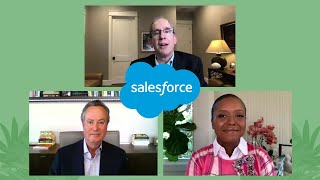
Mark Hawkins, Doug Peterson, and Melody Hobson discuss how leaders can build resilience through the crises of COVID-19, racial injustice, and climate change. They argue that companies need stakeholder capitalism over shareholder-only focus, that diversity is a competitive advantage, and that individual action on voting and mental health matters.
Chapters
Across the world today, we are facing a health crisis, an economic crisis, a social unrest crisis, and a leadership crisis and a climate crisis. I mean, when you think about how do you address one of them can be paralyzing, let alone all of them. But we have to take a deep breath and remember we have a platform. Each of us have a platform and, and we can make a change no matter how big or small. And that's our responsibility. We need everyone to help drive the change our planet needs at the pace and scale necessary to feel the effects for current and future generations. We're already seeing the horrific effects of climate change with the wildfires on the west coast, the flooding in the south, the burning Arctic, and the list goes on and on. I mean, I personally experienced it when I couldn't leave my house for several consecutive days due to poor air quality. And let me tell you, that was a real big wake up call for me. And I realized and will not take for granted what a privilege it is to have clean air. And I realized, you know what, we can't just talk about it. We can't just tweet about it, we can't just post about it, we can't. We gotta be about it. We all need to do something and act now. Good morning, I'm Leah McGowan Hare and welcome to Leadership for a More Resilient Future. Now, if there's anything that's certain about 2020, it's the fact that no longer is it business as usual. Now's the time to recommit to company values and broaden the idea of who our stakeholders actually are. There are customers, our employees, partners, shareholders, communities, and yes, even Mother Earth. And to honor that commitment, back in January, Salesforce set a goal to mobilize and support the conservation, restoration and growth of 100 million trees by 2030. Not in support or excuse me1t.org a World Economic Forum initiative designed to support the trillion tree community. Now this morning, we launched a digital tree tracker. To learn more about our goal and join us in our journey. Check out salesforce.com trees now before I hand it off to our amazing host, Salesforce President and Chief Financial Officer Mark Hawkins, I want to preview the next hour. Mark. Doug Peterson, President and CEO, S&P Global, and Melody Hopson, Co CEO and President, Ariel Investments, will lead a discussion that will offer practical suggestions, considerations, best practices to help everyone lead in this new norm. The intention is for us all to build a better understanding about how investing is and environmental and social practices not only help our planet, but Also will reboot our economy quicker and more efficiently and we need to commit to take action. Finally, we will close with a special performance by LT Smooth. And as you know, Salesforce, we want to help those who need it the most. Millions of people already rely on the United Nations World Food Program for food they need to survive. And let's be real, COVID 19 is making those situations even more challenging. The pandemic could double the amount of people suffering from severe hunger by the end of the year. Now in order to avoid a food hunger pandemic, the world food program is scaling up to reach 138 million people across 1883 countries with life saving support. Now if you can please go to salesforce.com wfp and join us in ensuring that the world's most vulnerable have enough to eat. Once again, that salesforce.com WFP Salesforce will be matching donations of $150,000 up to September 30th. Again, that's salesforce.com WFP now it is my pleasure to welcome our host, Mark Hawkins.
Well, thank you so much, Leah. I really appreciate it. And thank you to all of you for joining us today. You know, in the US Right now, we are facing a series of crises. We have the global pandemic, we have systemic racism, we have an economic crisis. And that's all in the backdrop against the persistent climate crisis. And we know that that is a situation that is really serious that we have to address. My heart goes out to everyone affected by the wildfires and all the smoke that Leah had mentioned, as well, as well as those on the east coast that are keeping a close eye on the most recent hurricane that's coming through. You know, one of the things that we know is there's a very interconnected nature of all these different crises. And it's acutely important that we never forget that those that are most marginalized and most underrepresented are impacted the most. And that is really heartbreaking. And yet one of the things that we have to think about is in order to drive true change, we must show compassion. We must show resilience, we must show adaptability. And we must be looking beyond our own four walls to really help and make a positive difference. We can't have a lasting solution if we try to do it alone. We can't create all the change that we need if we need it to work alone. Only what we need to do is take a moment, take a moment to really invest in new and more resilient and inclusive economy. This is critical to Us and one that ensures that the long term health and equality of all of our citizens and drives job creation and protects our planet. That's what we need to do. And we must ensure that our businesses continue to serve all the stakeholders, our customers, our employees, our partners, our communities, our shareholders and our planet. That's for sure. The needs never been greater. The challenge has never been larger, the urgency has never been more pressing. And that's why I'm actually excited to be here today with Doug and Melody. And we're going to talk about activating how they're activating their leadership during this important time to really create positive change that the world needs. And I hope today that we all leave and then we have a clear action on how to progress and really contribute to our more really sustainable and resilient and inclusive economy for future generations. That's my hope today. And so it's going to take each one of us to activate, to do our part, to help. And so with that note, I'd like to move on to Melody and to Doug. Melody and Doug, thank you again so much for being here today. To say it's extraordinary times just feels so underrepresented. It's so bigger than that. We really, really need to address these extraordinary times with urgent actions. We have real challenges, but we also have opportunities. I want to start by asking you really what worries you in times like this and what do you see as some of the biggest barriers to progress? Let's start with the problem. And Melody, if you might start, then we'll follow with Doug.
Sure. Thank you so much for having me and thank you for having these incredibly important conversations that I know make a difference in the world. I appreciate being included. When I think about what worries me right now, there are so many things, as you said, how do you even sort through all of this? I have this saying, there's no bottom to worse and I feel like that is truly true. Right now we can't hit bottom. But I do think my biggest worry right now is a zero sum mentality. And what I mean by that is I feel like we have the zero sum mentality that is very clear in our politics. It's becoming increasingly clear in our policies. We see it in business and I think now we're seeing it around race and this idea is. And not now around race. We've seen it around race, but now it's evidencing itself again. And the reason I say that there's this sense that if you win, I lose and there's not enough Room for everyone. And again, global politics, we see it our own US political system, especially right now. And again on the racial issues, I think that's what has kept us back and held us back for so long as a country, which is this idea that you will take something from me if you can improve your lot in life. And I think that is a losing strategy across the board. And we need to rethink how we assess both opportunities and challenges in this country because I see more opportunity in these challenges where others see again, this winner take all mentality as being the only way to play the game.
That's very, very powerful. Thank you for sharing that and I really hear your point of view. Why don't we focus on win win versus win lose, which is a losing strategy. Thank you Melody, for sharing that. Doug, I'd like to get your point of view as well as we start to face off with the problems and we really then need to migrate to solutions. Your thoughts?
Yeah. Thank you, Mark. Melody, it's great to be here with you and Leah, thank you for that introduction. What I find right now, first of all, there's a point of view I want to share, which is more about the micro, the micro aspect of this pandemic. And that means each of us individually and at our own company, how are we able to think about putting our people first? And this is a time when everybody's life has been upended and it's not just the United States, it's something that's global and across different industries. Some people have had to be laid off, furloughed, other people are working from home or different circumstances. And not only is it pandemic of a health crisis, there's also a broader wellness crisis. And mental health is so critical right now. And I think that this is one that we can't just back off from. We have to take a stance about ensuring that people are getting proper health care beyond just the pandemic itself. But let me also echo some of the comments that Melody just made and talk about it as a polarization, this win lose approach to attacking political issues, looking at the different problems we have, that somebody's always going to have to lose and there's no compromise. It's frustrating to me, especially coming from the private sector where many times we have no choice, we have to compromise. And I can show you so many different really good outcomes around the world of infrastructure investment. Right now we have this race for an effective vaccine, an effective safe vaccine. This is a classic example of public private partnership and where the Public sector and private sector have to work together. And I really look forward to us finding more solutions that bring the private sector in to use our expertise of project management and delivery of execution and using the best of the public sector together.
That is also a really powerful statement to help us again get away from this win lose mentality and really bring the best and the brightest in all circumstances from private sector, from public sector to help our society and help our humanity. And I think that's a compelling point to deal with. So thank you both for sharing that. Very, very powerful. I have to say, let me dig a little deeper, Doug. You talked about public and private and the criticality. It's frustrating to all of us that we don't get more benefit than we could. To your point, you've seen a lot in your days. Even prior to S and P, you're with Citigroup all over the world. You DEALT with the 1980s, inflation, you dealt with some of the deflationary times approaching in the 2000s. You dealt with the financial crisis. And that's really important to have that experience bas and so. And you've done it successfully. And so the question I have that you might share with, you know, all the audience is when you think about activating your leadership at S and P Global and you think about driving change through Covid, what should happen in response to these crises which would accelerate progress toward a sustainable and resilient economy. Any other additional commentary there?
Yeah. First of all, as you said, I've been had a really blessed career. I was able to live all over the world. I was trained, people took risk on me and I learned a lot. And over those years I built a conceptual model about leadership that a great leader needs to have a vision which provides direction. A great leader also needs to have integrity. And by that I mean a system of values. In addition, you have to have accountability. A system of management and communications is a glue that holds all that together. And so during this crisis in our own company, I've been applying all of that in a way that you can bring people together to have solutions for how we serve our employees, how we serve each other, and very importantly, with what we do at S and P Global. We need to be in the markets every day. We can't stop. We're calculating the s and P500, the Dow Jones, we're providing information to the markets all the time that people use to make critical decisions. And we came up with a whole new set of analytics and research on Covid and on the impact of healthcare on the impact of economies to keep things moving. But what you talk about now is we're going to be looking at a challenge of completely new ways of how we're going to work. How are we going to work in the future? How are we going to look at the speed of technological change? I think that in the pandemic itself, we can look at a lot of the negative aspects, but a couple of the very positive aspects is that I've seen other organizations, including our own, really make incredibly fast decisions and quick technological changes in their organizations. Things that before would have taken years for people to undertake. They've been able to do it within a matter of months. And I think there's a lot of positive coming out of that. And we can apply that, that speed of technological adoption to other parts of our world. In addition to that, we. I think that there's a broad discussion going on about purpose. And I'm on the board of the Business Roundtable, where last year we changed our definition of the purpose of a corporation to include all stakeholders. And I think right now more than ever, this dialogue about purpose, about the why, of why we exist and who we're serving, is more important than ever.
If I could just chime in on this just really quickly. I was in a room and a leader said something I thought was very profound. He said, what do we have to thank Covid for from the perspective of business? That's a real. That's turning a crisis on its head and trying to find the silver linings in this situation. I do think there's been a great deal that has been accelerated in this process and in many situations, especially in business. We can thank Covid for stripping down some of the bureaucracy that exists in our companies, because it wasn't possible for that bureaucracy. It's not possible for it to continue and us to be efficient in the ways in which we are working from all corners of world. I also think this acceleration of digital. I saw a joke that said, who drove your digital transformation? And the answers were, A, your CEO, B, your CIO, C, COVID 19. And I think that COVID 19 obviously has done a big job of driving the digital transformation in the world, obviously in our country, for sure. And those are things that will democratize knowledge and information and will pay dividends in ways that we can't quite, quite fully understand yet. So there are some things here that I think we can be grateful for, despite all of the pain and anguish that we've had to endure.
I totally agree. I feel like we've had 10 years of digital enablement all over the world in like six months that it's causing people to completely rethink and reimagine what is possible on the digital side. I couldn't agree more Melody and Doug on that and thank you for sharing that. And I agree the point of bureaucracy and, and things and it's a classic case of trying to get good out of any situation, even if it's a tough situation as we've all been talking through. So thank you very much for that. One of the things that, that brings me to is I think about, I talked about Doug going through all his changes and experiences and Melody, you have an amazing background and career. You've been at Ariel since leaving Princeton. You're the co CEO of a great firm. You have seen your fair share of evolution and change in the company. Now we're in the middle of all these crises. I guess the question I have to you is how do you find the right place to drive impact and how do you. Ariel, what are you thinking about in terms of activating leadership and driving change at Ariel, which is a great firm, it's interesting.
We pull from our DNA and from our roots. Our foundational beliefs are always driving. They're at the core of everything that we do. And it's interesting those beliefs line up with this time in a way perhaps they never have before. Our company is 37 years old. We were the first minority owned investment firm ever started in the United States. And at the end of the day we know we're selling performance. Investment results are what counts. But we think our investment results are improved by the fact that we bring together very diverse people to solve really hard problems on a day to day basis. And we believe that leads to better outcomes. So we view diversity at Ariel as a competitive advantage. Now that being the case, when you think about the issues around civil unrest and racial unrest in this country, we think they perfectly intersect with economic inequality, which is also in our wheelhouse. It's this wealth gap in this country that really has created the problems that we're seeing spill out into our streets and lead to the level of anguish and anger that exists today. And I tell people this in a way that I mean it. I am never, ever, ever for violence, ever. However, my hero in life is Martin Luther King and Gandhi. Those people, those are people that I revere. However, I have said to people, if your children were hungry, what would you do to try to at least put the critics in the seat of those who are really in desperate circumstances and so at Ariel, when we lean into our DNA, the foundational founding of our company around diversity, and we see what's happening right now, it becomes very, very easy for us to really speak our truth. And our truth is about inclusion and our truth is about a society in which everyone has an opportunity. I tell this story all the time that when I was growing up, my mother, who was, I was the youngest of six kids to a single mom, my mom would tell me, melody, you could be or do anything. And I have a seven year old daughter right now who just turned seven. And I always tell people, I tell Everest, Everest, you can be or do anything. But I want you to believe that is true of anyone and everyone. That is a different way of walking into the world and seeing people. And I think that way is much more important and appropriate in terms of realizing the possibilities for every person walking this planet. If we could get into that mindset as a society, which we try to live as a value at Ariel, we think that that could make a huge difference. So we lean into our core beliefs and our core DNA in this moment. And it is leading us into conversations like this and other conversations that can be incredibly uncomfortable for people, but where we feel a great deal of comfort and confidence.
That's super helpful. And I've had the great pleasure to talk to you, Melody, before and at Salesforce, Trust, innovation, customer success and equality are our core values and they really drive us. When you say lean into your values, it means so much to me and I think so many people that are watching today. So thank you for that and clearly making a positive difference. One of the things that I'd like to also, as we keep looking through this is we've covered some of the challenges of COVID we've covered some of the challenges of racial injustice and inequality. And one thing this week, of course, is UNGA week, and we're touching also on the climate change and all the things that are happening there. I'd love to get your perspectives from both of you on what do you consider is the key environmental challenges facing your companies and how are your organizations thinking about that from an ESG standpoint on the climate change side of it as well? Maybe I could start with you, Doug, and then, Melody, you could add in.
Yeah, Mark, before I go there, I want to just make one quick comment on the last interchange we had. And it's something that I lived as, you know, around the world. I was 10 years in Latin America, six years in Asia. And sometimes people ask me a question. What were the Aspects of leaders that are common around the world and the countries you've lived and where you've worked. And it's a foundation of respect and it's something that to me is quite important that we always operate from that, from that foundation and my own approach. I grew up where my grandfather used to have a saying that was Cada cabezas un mundo, which means every mind is a world. And it starts with that approach to respect. And I think so important to think about fairness. And during this pandemic, we've also seen that the approach to how we think about our employees and society and the community and we have to think about how we can ensure there's no discrimination that, that it's whether it's ethnicity or religion, that this is something global. But right now it's an open wound in the US and it's something that all of us have to be responding to and ensuring that we're taking care of. Now, to your question about climate and this being one of the most important topics and crisis facing the entire globe, again, we look at this for our company. We're doing a lot to try to ensure that there's information and data and analytics. And we have an approach where we've either purchased companies through acquisitions or we built up our own analytics so that any cfo, treasurer, a board of directors, an investor would be able to know what is the impact of my portfolio and my investments, whether it's opening a new plant, moving into a new country, it's a portfolio of investments. What is the impact of that investment pool on climate, on climate itself? And how do I know what the carbon attribution is? What will be the forward looking potential risk of that portfolio to the climate change? But also as an opportunity, which companies and which organizations are approaching climate change with a transition plan that is, maybe they're still in an industry that we can consider dirty, but they have an actual plan in place to make that change. One last comment on it. We made a decision that our own company, if we were going to be a credible rater and data and analytics provider for ESG data and analytics, we had to live that ourselves. And we talked with our board. So this starts at the top. And I went to our board and said, we want to be the best in this, we want to be credible in this, but we can't do that if we don't live it ourselves. Which means that when it comes to governance, we made a decision that we're going to keep a split between our CEO and our chairman. We Shaped our board with a diversity of thought, diversity of ethnicity, of different backgrounds. We think about our own approach to S, who are our suppliers, who's in our supply chain thinking about our employees and in the G, in the E, we have our own plans for ourselves about carbon recapture travel, the footprint of our buildings, water usage. We've shrunk our paper usage over the last five years by 90%. We're now attacking single use, plastics, et cetera. So we feel like not only are we going to be providing the market with data and analytics that people can use, but we also have to live it ourselves.
Yeah, very, very powerful. Thank you. And Melody, I don't know if you'd like to share an Ariel, how you're thinking about it and love to hear your thoughts there as well.
Sure, I'd love to do that. So I'll start off with just a quick story which is that I swim and one of the things that I do when I swim, I have this coach and he makes me put on these latex mittens and when I'm swimming with the latex mittens, you have fest, they're called festival gloves. You can't use your hands. And halfway through the lesson he allows me to take the gloves off and he says, use your power for good. And that has become a metaphor for me because once I have my hands, I can do things differently. And he's like, use your power for good. And I thought a lot about that. So I do believe all of us have power in every seat that we're in, in every walk and corner of society. And the question is, how will we use it? And so at Ariel, as shareholders, we recognize we have unique power in terms of the companies in which we are invested, where, particularly on the domestic side where we own small and medium sized companies, we tend to be very large shareholders of our businesses and very long term shareholders of our businesses. So they welcome our ownership. And as a result of that, we view ESG as we approach ESG as a rich risk management from a risk management perspective. And so what I mean by that, we're going to be assessing the relevant disclosures that a company makes and deciding if those disclosures meet our standards and are driving towards the kind of change that we think is important to see in our society around everything from water to environment to a whole host of issues. And we want to make sure that we're probing them on these issues so that they know it matters to us. So we'll ask them questions about diversity and inclusion, not only at the board level, where we want people to count by ethnicity, as opposed to putting together these multicultural umbrellas of numbers where you can't really distinguish who, what, when, where, but also grow throughout the organization to be able to show us how they think about diversity and inclusion. We like counting and we like accountability, and that's a part of our ESG conversation. So at the end of the day, as shareholders of public companies at Ariel, we're trying to use our power to increase diversity in boardrooms and throughout the C suite and throughout the companies that we own, because we think that is the only way to be a truly outstanding 21st century company. And also to make sure our voice is heard around the key issues affecting our society, particularly as it relates to environment. And also making sure that we're very, very clear about what we expect when it comes to governance and really looking out for the shareholder. One last point. I've been on the board of Starbucks for many, many years. And when Howard Schultz retired as chairman of our board, he told me a story about the fact that every single meeting he was ever in, he looked out into the boardroom and pretended there were two extra seats. Those two extra seats were one of a shareholder and one of a teammate, a partner of Starbucks. That's what we call our employees at Starbucks as partners. And I thought that was a very profound statement saying I wanted to always picture them in the room to make sure that everything that was said and everything that was done, I'd be proud for them to hear. And so when we think about governance, that's the kind of way that we're hoping our businesses are run by the senior leaders of those organizations.
I like that. I think that's super powerful metaphor that he came forward with. Thank you for sharing that. I also just have to respond that I really can feel the values from both of your great firms. And as you describe them and I really resonate at Salesforce, we talk about doing well and doing good. And actually I really relate to your point of use your good, use your power for good. And I think one of the things that's really helpful is for people to stretch their imagination. Don't even think about it. Just for. Obviously we need to have people. We need to have a quality of our people. We need to have a quality of presence so people can be there and represent. We need to have a quality of how we spend our money and how we invest our money. We need to look at every aspect of what we do as an organization to say, what are we using our power to? Your metaphor for good. And I think it's a very powerful dialogue. And I agree with that. So thank you for sharing that.
And I just want to add one point on this and hopefully not speaking too much, but people always tell me, some people say, well, I don't have any power. I'm a lowly this or a lowly that. No, first of all, I don't believe anyone is lowly. But I just give them a simple example, and I say Rosa Parks refused to move out of a seat and changed everything. And so when you think about power, it comes in all forms and all levels and all kinds of. Comes from all different perspectives.
I couldn't agree more. Power, we all have it. We can use it. And if we all use it for good, the momentum of that just creates something very, very positive. And I also want to touch on Doug's point on respect of every individual, wherever you're at in the world. Isn't it amazing when we just give folks their due respect? We are a community. This is not a win loss. This is we got to be together. And I think you've very eloquently called that out. But both of you, I want to ask you just a couple more questions here, if we may. What is one thing that you want to share with anybody that's listening right now that either you want to ask them to do or to consider or that you just want to share with them that you haven't had a chance to? Just something that's near and dear to you. This is an opportunity with a big group of folks as we all navigate and we all look to lead and create a more resilient future. Melody, why don't we start with you and then, Doug, maybe you could follow up.
Vote.
Vote.
It's very simple. Vote. And what I like to tell people all the time, people died for us to vote. They did. So let's just start with the American Revolution. There were a lot of blood in that Boston harbor as people sought independence. And then let's start with the suffragettes, where women gave their lives and livelihoods for that equal right, even though black women weren't given it at the time. And then obviously, if you go to the Voting Rights act during the 60s, where people of color had to push very, very hard for all of the various ways in which voting was prevented and couldn't happen, which we're seeing again. And I think we all have to remember that it's a sacred duty and a sacred right, and it really matters. And I am not partisan in this perspective. I have my own, obviously, beliefs, but I do believe voting is critical to maintain our democracy.
And I think the other thing is it engages people. You feel like it is part of your democracy when you engage and vote. And so that's. I totally hear that. And a very powerful recommendation. Thank you on that. Doug, I'd like to ask you just a similar point as you have this audience and we're navigating to create a more resilient future. I'd love to hear your perspective and anything you want folks to hear or you just want to share.
Yeah, I could go on all day just on this topic, but let me start with one which is take care of yourself right now. I talked before about what could become also a mental health crisis in this country and around the world. Get some sleep, get some exercise, look at your diet. Because I know that the audience that's listening to this call, this is a sophisticated group of people and there's a lot of people that depend on everyone on this call. Your family, your employees, people you work with. You have a lot of impact on the world and people are going to pay attention to you. But take care of yourself. And sleep is so important. Diet and exercise, just do it. Because so many people depend on you.
Yeah, I couldn't agree more on that. I think that's a powerful bit of advice for us in that respect as well. One of the things that I would just say as I think about it also from my own point of view, I love the vote. I love to take care of oneself. And I also think that was touched on earlier is just continue to look for the opportunities that we can make things better. And it really brings me to a good point in the discussion today, which is on my mind. The biggest thing I want to ask people is ask. And what I'm asking myself is what can I do as a person, not somebody else, but what can I personally do? And then what can all of you do that are listening? But then what really motivates me and always gives me a glimmer of hope in the horizon is what can we do together to really not only build a resilient future, but really to have empathy and compassion for all of us that are in our communities around the world? Doug, like you, I lived around the world. And I think one of the things you learned very quickly is not only a genuine respect for the individuals, but a general respect for differences and culture and society and never to forget that and always bring that respect to the table. So what can I do? What can you do? What can we do? I'm always encouraged by the flywheel of progress when we do that all together. So I couldn't thank you enough for being a part of this dialogue. These are two amazing executives that we have, two friends. I'm very grateful for that. And on that note, I'm just going to turn it back over to Leah.
Thank you Mark. That was an absolutely amazing, engaging. I was here taking all my notes and I loved what Doug said around how this current situation with COVID really broke down the bureaucracy barriers and how public and private are working together for the greater good of working toward that vaccine so it is possible to and I loved what Melody said around what drove your digital transformation. Was it your CEO, your CIO or Covid?
Either way you got there.
And I love the CTAs of VOGT and mental health. I cannot agree more. If anything become more present and relevant in my space was like definitely more mental health care from meditation, prayer, whatever it is that works for you and definitely exercise your right to vote. So so many great gems. I'm going to go back and rewrite and take more notes. So I thank you for that masterclass, Mark, Doug and Melody. Now if you want to learn more about how to harness the power of trees and the best ways to tackle the climate change, please check out Trailhead, Salesforce's free online learning platform and check out this trail mix on S Force Co Sustainability. Now it is my pleasure to bring our very next guest, our musical guest LT smooth.
Thank you Salesforce. Fly, fly away Come fly, fly, fly away Fly, fly away Come fly, fly, fly away with me I was traveling down lead drive in my hay stew Watching the sunset and enjoying that beautiful view I was traveling down a lead drive in my greenhouse too Listening to music from dawn and out east road. Fly away, Come fly, fly fly away with me Fly, fly away Come fly, fly, fly away with me I was drumming down a legion drive in my age too Watching the sunset and enjoy that beautiful year I was traveling down a le drive in my green day Listening to music from dawn and out to the street Flying, flying away.
Come.
Fly, fly, fly away Fly, fly away Come fly, fly fly with me. Sam. I was traveling down e drop in my H2 watching the spirit sunset Enjoying that beautiful view I was traveling down in my green age too Listening to music from dawn and now to fly fly fly fly fly you I said fly fly away Come fly, fly, fly away and fly fly away Come fly, fly fly away with me. Fly with me flying. It's you that I'm thinking of it's you that I'm thinking of it's you that I'm thinking of it's you that I'm thinking of the first time I met you I was standing on alone looking for a place to sit looking so pretty with your eyes smiling from head to toe so I asked for your name but you didn't say so shy you were to me but I didn't mind because you were right next to me happy as can be it's you that I'm thinking of it's you that I'm thinking of it's you that I'm thinking of it's you that I'm thinking of the next time I woke up I'm driving down the road all I can think of is you the little time you spent was a nighttime for me to know that I know you if I get another chance you again I will never let you go feel so strong you are the one to never to go it's you that I'm thinking of it's you that I'm thinking of it's you that I'm thinking of it's you that I'm thinking of Sam. Waited on all my life someone just like you my soul wakes my heart races wanting to be with you Take my hands run away through the sunset All I want is to spend my life with you you that I'm thinking of it's you that I'm thinking of it's you that I'm thinking of it's you that I'm thinking of. Sam. It's you that I'm thinking oh it's you that I'm thinking of it's you that I'm thinking of it's you that I'm thinking thinking of it's you that I'm thinking of it's you that I'm thinking of it's you that I'm thinking of it's you that I'm thinking of.
Thank you. Lt. What an amazing performance. He always can set the mood and set the week right for me. And also thank you to Mark, Doug and Melody for such a great conversation. Just wonderful things to think about and I'm reared up and ready to take action. And thank you to all of you for joining us today. Now before we wrap up, there's a reminder to make sure that millions of people worldwide do not go hungry during this crisis. If you can please go to salesforce.com wfp and join us in helping this organization. Through September 30th, Salesforce will be matching donations up to $150,000. Again, that's salesforce.com wfp now if you want more, Salesforce is amplifying our big presence at Climate Week by shining the spotlight on climate advocates through our very own Be well Together. Earlier today on Be well Together, we had Ayana Elizabeth Johnson to talk about ocean conservation solutions grounded in social justice. And this Tuesday, September 22nd at 9am, we'll have a close Salesforce friend joining us, the one and only Jane Goodall. Please be sure to tune in to this inspiring Be well series at SFDC Co B well Together now. Until then, please take care of yourself and each other.









