Leadership in the Fourth Industrial Revolution — World Economic Forum, Davos 2018 | Salesforce
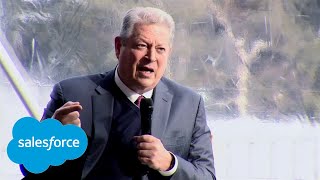
Panel discussion (Davos 2018, Salesforce-hosted) on Leadership in the Fourth Industrial Revolution. Five panelists (Will.i.am; Lorana/Global Shapers; Al Gore; Diane Greene; Joe Kaeser) give short (≈3-minute) forecasts for the next five years (to 2023) and longer-term reflections (10+ years). Major themes: a shift from phones to always-on voice/AI interfaces and a coming class of AI-native devices; community empowerment via AI and blockchain and data-as-currency/individual data ownership; an accelerating sustainability revolution (renewables, electric vehicles, Paris Agreement five-year review); and risks from inequality and disrupted labor markets, with calls for business to serve society and net-net GDP growth to include displaced workers.
Questions this video answers
At the World Economic Forum in Davos, recorded January 30, 2018 (Salesforce-hosted panel).
Diane Greene: "Google Cloud is powered 100% by renewables."
"Center for the Fourth Industrial Revolution" (San Francisco center referenced by the moderator).
The Paris Agreement (referenced as entering its first five-year review period).
Chapters
Foreign. Good afternoon, everybody. And how are you all doing? Are you guys having a good Davos experience? It's a very. It's a super pie thing. It's a. I've been coming here since 2002, and I think this is one of the most positive and exuberant world economic forums I've seen in a lot of different dimensions, and I'll tell you that. And we talked about this last year at this lunch. We are really doing some great stuff with the World Economic Forum, and it's great to have a fantastic partnership with them. We have some of their leaders here today, and you probably know that we announced it last year that we built this amazing center in San Francisco called the center for the Fourth Industrial Revolution. Really looking at how all these new technologies, not just the information technologies, but also the biotechnologies and the huge changes that are going on in the world, how they really intersect with what everyone is doing here. And it's been a great experience. I know we've had the opportunity to welcome many of you also to San Francisco, and we have this kind of Davos experience in the center, and it's been great. And I'm a little bit on a little bit of a high right now because I just came from a news conference where we're announcing another dimension, which is that the World Economic Forum is formally getting into something that I'm extremely passionate about, which is oceans. And I think everybody knows about the oceans. And one of the key sustainable development goals for the United Nations, I think it's number 14, is ocean health. Is that right? Dominic is here who runs it, so it's good that he knows that. And the World Economic Forum is spinning up a team actually under Dominic to focus on oceans. And, you know, this is such a tremendous convening authority and ability to work with other international organizations. For the last several years, we've been bringing ocean content here. Now it's formalized as a program. And I've already heard some exciting things about how it's having other ramifications. So just congratulations, Dominic, and your whole team and everything you're doing on the WEF side. And I think Murad is here, who runs the San Francisco Center. Are you here, Murad? I know, I saw. Oh, and here's Murad. So congratulations, Murad, on all your accomplishments this year. It's been amazing what has happened with the center in San Francisco. I've been a trustee now of the World Economic Forum for several years, and to be able to work with these incredible executives has been really an honor and a pleasure. And then to see them take the power and capability and network of the World Economic Forum and apply it not only to all of our work and everybody represented in this room, which is a great representation of Davos, including all the great companies and non profits, non governmental organizations, governments, but I also have just noticed how their passion for making change happen has been so incredibly powerful. So I want to do this. I want to start the panel and bring up our panelists. As you know, every year we have this fantastic lunch and we are actually, I hear a siren outside, which is that signals that we're supposed to start the panel. Panel, I think. So every year I try to select five panelists that I think can best illuminate the future. You know, this program that we're going to do over the next about 45 minutes is really to talk about where are we going in the future and how are we going together to make to do as the World Economic Forum says so well to improve the state of the world. So let me introduce you to the panel. We have a fantastic panel. Well, first of all, we have an alumni here. So Will, I am is here. He's been on the panel for several years.
Will.
No introduction needed. Awesome. And good friend. And also performed last year as well at our party. We're having a great party tonight. I hope everybody is coming tonight. We actually have Lucas Nelson performing, who's right over here. So congratulations, Lucas, thank you for coming all the way from Maui to perform tonight. And oh, and I didn't even say thank you to LT Smooth right here. All the way from the big island of Hawaii. So I got two Hawaiians. I got someone from Maui and the big island. Actually, he's from New Zealand, but he lives in Hawaii now. Got to clear that up. Okay. And also I want to introduce you to somebody who's new on the panel this year, a phenomenal entrepreneur, an incredible part of the World Economic Forum community in the shapers, which is our young, aggressive CEOs and entrepreneurs. And please welcome Lorana. So, Laurana, come on up here, all the way from Brazil. Thank you very much. Someone who needs no introduction, but I'll give it to him anyway. Somebody inspires me every day. Puts me, always puts me on my game, challenges my thinking, makes me to go forward and realize how little I have accomplished in my life because he has done so many incredible things. Not only has he won the Nobel Peace Prize, not only has he been the vice president of the United States of America, but he is our tireless Advocate for the environment. Please welcome Al Gore. He said that's his car alarm outside. And a very close friend of mine from San Francisco, one of the great computer scientists and leaders of our technology industry, founded one of the great companies in our industry, VMware, and is also now not only a member of the board of directors of Google, but is also the Chief Executive officer of Google Cloud. Somebody who I look to for vision and inspiration and where our whole industry is going. Please welcome Diane Green. And coming back over here to Europe, I actually know a couple people in Europe, not that many, but a great executive who I have the honor of serving on the International Business Committee of the World Economic Forum. We call it the ibc. Someone who I've really enjoyed getting to know, but makes incredible products and technologies. I'm sure everyone has had an experience with him. But please welcome Joe Kaiser, the CEO of Siemens. Well done. So we have these five incredible people that I've enjoyed hand picking because I feel they can give us and open a door, which is, and I should just say that is what I plan to do, which is I really hope that all of them and together with all of us, that we want to open a door to the future. We want to open a door to the future. Go through it, take a look, see where we're going. We'll keep what we like. And if we see some things we don't like, we're going to have to commit to changing those and improving them. Cause that's what we do here at the World Economic Forum. And we're gonna do that kind of in two stages. And what I'm gonna do, first of all, I'm just gonna ask them, where do they see things in the short term in the next five years? Let's say, where do they see the next major leap in each of their industries that they're in or products that they're working in or partnerships that they have. And then we'll go out a little farther into the future after that, we give each panelist about three minutes to talk. In the back of the room, we have actually a counter that they get to watch, so hopefully they can all see that. So we can set the counter for three minutes. And then after taking that 15 minutes, then we'll go a little farther out and see where we're going to take this even farther every year. This panel has been remarkably clear on where the world is going. And I'm sure that we're about to get some incredible wisdom and enlightenment. So Will, let's start with you and let's take a look. I mean, here we are, it's 2018, and you know, the world has changed. There's no doubt about it. We can see how it's changed in many different dimensions on the technology side and political, socially, how the world is reshaping itself. Where do you think we're going to be five years from now in 2023?
2023. How we are obsessed with phones.
We.
This is, this is not what humanity looked like in the past. Always having to take a device with you everywhere, always listening to you all the time. So me being optimist, five years from now, we will have something else, and that is this voice. There's gonna be a lot of voices. You'll be talking to everything, your refrigerator, your television, the house, your car. And maybe there's a version of the future where. It's going to get really complicated really fast because it's going to be so different from where it was yesterday that it might not gel with all these different voices. What we're going to want is one thing and there's going to be like this fight for who. What is that dominant voice? And if you're going to have something around you all the time, it's going to be something that you love and that it loves you. Right now the phone doesn't really care about you and it's going to feel like people are going to be addicted to it, like they're addicted to their phone. Now the feelings you get when you walk out of the house and you left your phone, it's going to be the same feeling as if you can't plug into your voice thing that knows everything about you and the world you live in. And finally, data is going to be working for people. Right now, it's working for companies. And we're almost there because people are realizing that data is currency, communities are realizing that. And I said this four years ago when I was like, yo, identity and data are going to be married. And we're almost there where the idadity is in our life. But we're not being educated, the people aren't being educated on the power of data because the companies are benefiting from all our data things that are free. It's the first time in human history where something that's free builds a company that's more powerful than governments. That's crazy shit. And five years from now, I think there's going to be an awakening and there's going to be products just like there's, you know, the iPhone is a Device made for the Internet. There isn't a device that's made for AI yet. And that will happen five years from now. AI devices, and hopefully they, they. They empower people and communities.
All right, thank you very much, Will. And now let's go over to Lorana. So, Lorana, you've been spending a lot of time with the Shapers. You're here again at the World Economic Forum. You're working deeply in the areas of artificial intelligence yourself. Give us your vision. Where are we going to be five years from now in 2023?
Thank you, Mike. Good afternoon. So, in my opinion, I'm part of the global Shapers community, and this is one of the most enriching experiences in my life. But looking for five years from now, I see communities playing a very strong role in any relationship that we are having as human beings. So us organizing more as communities, and not just in a city level, but communities based on values. So shared values and how strong we can create changes. And in we organizing communities for a few years, of course, but with AI and blockchain technology right now, we can make a voice to these communities. And in the next five years, I think we will learn to use communities to influence democracy, to influence society and companies, too, on saying, like, okay, what. What do we want? We can communicate on that based on shared consciousness as a community. And from now on, we can walk a path to create change because the empowerment of communities that will happen the next five years, I think it's based on human relations going online, but eye to eye or even offline, and as in this event, seeing other shapers with some sparkling and saying, okay, we have something in common and we can do something about that. And before that, transparency and distribution was not that easy. But with blockchain technology, we can have trust and transparency more easily. And AI is helping us to organize this consciousness, getting information from what we believe and sharing as a whole. So I believe in communities. I think this is the empowerment of the next five years. And then based on values, they can merge and create social change, social justice, and even have a bigger voice that they have right now.
Very good. Thank you, Lorana. Mr. Vice President.
Well, Mark, first of all, where do.
We go in 2023?
Yeah, easy questions. Thank you for having us all here and thank you for your leadership in leading a company with purpose and in demonstrating that you can do good and do well at the same time. Thank you. While your back was turned and after you started, I want to acknowledge the arrival, if I may, of Washington State's governor Jay Inslee and his wife Trudy, one of the leaders in the US on the climate movement. So in looking five years ahead, it might be useful to look five years back. Five years ago, just to pick one example. If somebody had told me that in the year 2018, marriage equality would be the law of the land in all 50 US states and gay marriage would be not only accepted but honored and celebrated by two thirds of the American people, I would have said, well, I hope so, but what are you smoking? But it happened because that long struggle reached a point where it was resolved into a choice between what's right and what's wrong. And when that threshold was crossed, things changed. Social change sometimes follows a pattern described by the late economist Rudy Dornbush. Things take longer to happen than you think they will, but then they happen much faster than you thought they could. We are at a moment now in the climate struggle that will determine what the world in 2023 looks like. Will we be celebrating? Will we breathe sighs of relief? Or will we struggle with a burden of guilt that we are condemning the next generation to an impossible future? This year is the beginning of the first five year review period where every nation in the world that signed up to the Paris Agreement and the US is still in, by the way, can't legally leave until the day after the next presidential election. And if there's a new president. Excuse me for a moment. There will. A new president can simply give 30 days notice and we're back in. So in 2020, every nation will be called upon to make an assessment of whether or not they can increase their commitments to do more in reducing greenhouse gas pollution and land destruction and deforestation. Because the cost of renewable energy is falling so quickly. This year we'll see $0.01 per kilowatt hour electricity from solar because batteries are coming down so quickly, because electric cars are coming down in cost. India said in only 12 years, 100% of all their cars and trucks will have to be electric. I wish the US could move that fast. China's leading. We're at the early stages of a sustainability revolution that is giving CEOs and executive teams the ability to manage electrons and atoms and molecules with the same precision IT companies have used to manage Bits. And Diane can tell us something about that. It's empowered by the IoT and artificial intelligence and it's changing everything. It has the magnitude of the industrial revolution, but the speed of the digital revolution. So I will predict for you, but I have an addendum that by 2023, we will be able to say we are now on the way to solving the climate crisis. But here's the we have to make that prediction come true. And the people in this room, I call upon you to be a part of this commitment. The entire future of humanity is at stake.
Thank you, Al. I'm proud to let you know that since the last Davos, now Salesforce is now a Net Zero company. So we're very happy about that. So thank you, Diane.
Okay. And I'll just say that Google cloud is powered 100% by renewables. So we were carbon neutral and now it's all renewables. So what's happening? The big trends are clearly AI devices everywhere, human computer interfaces getting much, much easier to use for people to interact with a computer, and then accessibility from anywhere, Internet accessibility from anywhere, and things available in the cloud and at the edge. And it's all moving kind of fast and it's a little hard for us to keep up because there's so many ways to take advantage and there's so many ways to abuse all this technology. You know, on the more, you know, looking at sort of the optimistic views of what all's happening, one area is to look at education. And I think increasingly technology is becoming incredibly easy to use. What a programmer can do today you couldn't have dreamed of five years ago. And so I imagine in five more years what the kids are going to be doing in first grade is going to kind of blow our minds. And I think the result of that is going to be a lot more diversity in terms of shaping technology. I think there'll be, you know, even numbers of men and women. I think there'll be, you know, underrepresented minorities using technology in very powerful ways, you know, on an equal footing with the white men. And so anyhow, so I think education and education is going to change and become a lifelong thing. It already is sort of becoming that way. And maybe in five years it'll be so easy and so much a part of life. And because people realize they have to keep up with this fast moving world of technology that people will learn all their lives. And then if you look at, you know, artificial intelligence, it's becoming, you know, when I talk about developers, it's becoming democratized. You know, people will be able to use what data they have to get machine learning to get AI advantages, anybody will be able to do it. It won't require a PhD in computer science or machine learning. And I think then if you kind of drill down and for example, take something like health, I think Increasingly we're going to start taking charge of our data. I think every individual will own their own data. You know, you'll wear your device on your arm and you'll be able to start thinking about outcome based health and only going to the doctor when you're diagnosed. Thank you.
Thank you, Diane. Joe.
I truly do Hope that the 49ers are going to win the super bowl because it is about time now to get this one straight. Then also in five years from now.
I believe they're going to need to come back to San Francisco.
Well, they have a new quarterback. That's a good beginning. So we'll take it from there. And as you know, no one likes the New England Patriots. So maybe we put it back to the West Coast. So since we have the most important matter has been said, maybe we move on to the next thing. I do believe in five years from now the E commerce and the consumers will have driven the value chains to a massive improvement of efficiency and that will foster growth. So the B2C is going to be the growth engine of this world going forward. Technology is there, people need to get used to it and the middleman will be cut out of a complicated process and that will foster growth from the consumer environment supported by technology. That's what I believe you also will see five years from now. We also will see the first meaningful use cases of the Internet reaching the industrial world today. There's a lot of PowerPoint, a lot of talk about it, but no one really cares about the customer value rather than saying what's good for us and not for the customer. That's in five years from now. In five years from now. I also do strongly hope that my most exciting business I have in this company, which is healthcare, which is a business which defeats cancer, which have people make a better life, a longer life that we are going to have defeated cancer in five years from now. And I know Bernhard will help us with that because he actually is the one who's got the best bodyguards in the world taking care of our body. So that's kind of what I believe we also will have five years from now. We also will have a helpless government all over the world. No way, no way, no recipe how to deal with the fact that we are living in a world where data go everywhere, anytime to anyone in this world. And not understanding that no wall as high as it can be built will prevent consumers and people to communicate each other about anything, anywhere, anytime. And hopefully by that time blockchain will help us to qualify data to Be trustful so that we do not rely on alternative facts or fake news. And, you know, that we do not need to win prizes for the ones who got the fakest news in the world. So that's, I guess, what we have in five years from now.
All right, so thank you, Joe. So let's use that as a bridge. I mean, we kind of did a broad brush on technology. We hit a lot of different technologies, we lightly touched culture, We. We did a quick flyby on the environment, you know, going a little bit deeper into some of those social issues and society issues and just taking off and riffing off what Joe was, where he was going, and going deeper into the social and cultural side and how the world and our communities and our interactions with each other and our governments are going to change. Where will we be when we look out a decade from now or more? You know, when that clock starts to say more than 20, 30, you know, when we really see all of this take hold? Where are we going? Well.
If you were living in the dark ages, you didn't know it until the next age came and said that was a dark age. So this new age that's coming is going to name this age that we're in, the inhumane age. And we're going to a age where it's the human age, we're better humans to humans, where it's not money over people, but people for people. And it'll be the first time there's something in society, that spirit, smarter than us, that we built, that forces us to do what it can't do. And that's have a heart. AI is never going to have a heart. It's never truly going to love. And that's the time when we. It's going to be like the human love age. At least that's just me being optimistic. And that's the only thing that makes sense of what we're doing. Why are we putting everything in the cloud? Is it just for companies to be rich and powerful? Like, what is this all about? And why did we all sign up for it? Why? What's the purpose? What is it for? Life was cool back then. When we didn't have the Internet, we actually talked, got information. When we got it. I really believe it's because. Because something's coming. There's an awakening. It's gonna be loud, and it's gonna remind us that we have to, you know, be the best version of ourselves to make sure everyone else, like someone said, you know, it's gonna take over jobs and then if you think about it, my grandma, I was raised apostolic, which is like super Baptist, baptized, filled with the Holy Ghost, spoke in tongues, they all that my grandma would say, like, you know, in heaven. My grandma, she passed away. Now is she working in heaven? Are you. Isn't life. Are we living to work? Maybe we're going to get to a place where we don't have to work and just spend time with each other. I'm not saying I want that future because I like to work, I like to create. But my job was to create and bring escape and joy to people. That was my job. That's how I walk the planet and do the things I want. Because I make stuff to make people happy. That's my service and maybe that's what the future looks like. Musicians are very unique. We are here just to make everybody feel good, to make you realize I have the same pain as you Blues. To give you a perspective like, hey, everything's gonna be alright. I've been through that. And because I come from this world of music, that's what gives me this optimism on what this new instrument is gonna help us do. My instrument is a computer, or Miles Davis was a trumpet, but he made a spiritual connection. And hopefully this instrument called artificial intelligence is going to help us be better humans.
All right, Lorana, you can see where we're going, so why don't you take us to the next level?
That's beautiful. Will, I think what you said is really related to what I believe too, as someone who understands that we are living the fourth industrial revolution. And as a revolution, and it's why we are here to talk about, we also need a revolution of morals and new values. We need to have a revolution around that too. Speaking about technology is amazing, but I think we are 100% sure that the technology is evolving and we can make a lot of things with that. But before having a revolution of values, we need to have value, creativity. So be creative around what we want to create. And in my opinion, like, in the long run, we will understand that one of the values of this new society is abundance. Understanding that this scarcity that we have based on fear is really related to the fear of not having money, of not having a job, not having someone to care about you. And when we start organizing ourselves in communities, relying on humans, relying on our value as a human being, not as a machine, a robot, a producer. Because then the robots can be robots and we can be humans, then we will understand that we have a lot we don't have.
Lack.
Lack is Something that we create. But look at this view. The world is abundant. We have so many things. And I think organizing these resources and understanding from a perspective of creativity, morals, and the world that we want to create will make us more relaxed about who we need to be and more optimistic enough to innovate on humanity. So the value of people, and for me, like as my company work with time as a value, as time as a common currency, I believe that these will become more and more like the level that we want to work with. So I give your time, you give my time, and we are equal. Like, everyone has a role to play because it's our uniqueness that creates the diversity that the society needs in the next years. A robot can create a lot of things, but the diversity of a human being comes from our uniqueness. So asking ourselves who we are and then going back to engage and create and just be yourselves, it's part of the journey. It's very easy to see the challenge that we are facing in the next years too. But I think collaboration, equality and love mainly are the things that will allow the abundance to raise and show itself.
Well, al you open the door to equality in your opening comments. Where is that? You know, when you look at where Will and Loran are kind of pointing us, what kind of fuel is that giving us?
Well, Martin Luther King famously said, the moral arc of the universe is long, but it bends toward justice. We don't know how long the arc that leads us to greater equality really is. But Loranna mentioned the role of fear in every human heart. There is a struggle between hope and fear. And those of us who, all of us who want to move toward greater levels of justice and social equality have to pay attention, careful attention, to the factors that increase fear. And in the world Today, in the US and in quite a few other countries, we've gone 40 years with no increase in middle income wages when adjusted for inflation. Simultaneously, the wealth creation at the top of the income ladder has created persistent and growing resentments that these fantastic improvements have not helped the average person. We also see a wave of refugees, and much of it driven by climate change and. And these fears of being left out, left behind, make people more vulnerable to demagogic appeals to blame the other. And so resentment of immigrants, resentment of refugees, prejudice based on race, gender orientation, religion, become more potent and make it more difficult to move as quickly as we all hope to do toward higher levels of social equality. There's no doubt in my mind that the long arc will reach that goal. But here in Davos. This is almost a cliche to say that the specific center of gravity here on top of this mountain is oriented more toward the top. 1/10 of 1%. Actually. The actual membership is quite diverse in every category, but it has that reputation and the pervasive feeling of happiness, enthusiasm for the good state of the global economy. You watch the television coverage. Oh, the economy is great. Well, well, it's not great for middle income wage earners. They don't feel that. And there are many reasons. We don't have time to go into them. But globalization has been a centrifugal force, flinging jobs to low wage venues. Overall inequality on a global basis has been going down. But even in developing countries, along with the rich countries, it's been going way up. Partly that's because of the three factors of production, capital, technology and resources. Technology is now commanding more capital investment, so the returns go much less to labor and more to the owners of capital. And now intelligence added to automation may overturn the so called Luddite fallacy. We don't know yet, but whatever the causes, there is apprehension and fear. We have to address that. And we have to have policies that not only work for the captains of industry and the heads of financial services institutions and the wealthiest among us. And I'm fortunate enough to be in that category. I'm not in your league, Mark, but I. But we have to have policies that benefit the average person. That's not just a populist appeal. It is a direct response to the question of whether or not we will make more social progress or not. I'm hopeful that we will, but again, it is a choice that we have to make.
Diane, can you take us forward?
Okay, well, when we watch the 49ers, there'll be robots that we can't tell from humans.
I think that's what the last season looked like.
Some more technology front. We'll certainly be breaking all kinds of records in how long people live. I don't know that it'll be distributed across everybody, but definitely people will be living much longer. And I think it's quite possible that we'll have quantum computing. I think we're going to know a lot more about the origin of the universe. We're living in a time where that's coming. And when you sort of getting back to my original about the robots playing football and us not being able to differentiate, I think we're going to understand a lot more about what it means to be human. And I think we will have robots that are pretty hard to Differentiate from us that when we talk to them, it could feel pretty great to talk to them. They certainly will augment us and make us, you know, eliminate what we consider drudgery in our lives for sure. Be able to make us much more creative. And then it'll be just plain hard to know what it is, you know, who has a soul? Do the robots have a soul? Do we have a soul? What is a soul? You know, what is it to be human.
Joe? What is it to be human?
So we're talking 10 years out now.
You can go out as far as you want.
Look, I mean, obviously I don't know what will happen in 10 years given the speed and the magnitude of change in both technology and the societal development. But I do believe in 10 years out now, given the speed we have on technology, which should be an enabler and not an outcome. Honestly. Happiness is an outcome. Happiness is an outcome. It's a purpose to strive for. Technology should be an enabler to get there. I think in 10 years from now, we either have the best society on the best planet ever built because we completed the fourth industrial revolution in a peaceful way, or we are going to have the biggest trade war ever experienced on this planet. Goes only either way. And the reason why it goes only either way is because it's going to be digital. The middlemen are being cut out because they are inefficient. Mediocracy is the natural target of the Internet because it cuts out the middleman. So either you win or you lose. So the question to us will be, how are we going to take technology so that it's going to serve society? How do we create companies and leadership to serve society? And I do believe, honestly, a company which does not serve society should not exist. It should not exist because it doesn't have a purpose. And that's what we need to figure out. We need to figure out a way that we can net net grow the world's prosperity, that we can NET NET GROW GDP. If we create 300,000 jobs by having the best, greatest platform of all time, where you sell books and groceries and coffee, computers and people and what have you. If that $300,000 net net is the best purpose you can potentially think of, if those net net, if those 300,000 additions on new jobs diminish 500,000 because you make the same stuff more effectively, then you have a problem. Because net net, there are going to be more losers than winners. And if there are going to be more losers than winners, we have a split society. And Those people are going to go on the street. And we not only have self driving cars, we have burning cars. We have 382,000 people in Siemens working for our customers day and night, give their best every morning when they get up to work. We have more people, we employ more people in Siemens than Microsoft, Apple, Google and Facebook together. Believe it or not, market cap is maybe a little different. So I have about 30,000 software engineers, 32,000 software engineers in the company. I don't need to tell them what's going to come and what needs to be done. They know that. But how about the other 350, 50,000. What I want to tell them what their job is tomorrow, what their families are going to do. You know, we need to have answers for those people so that they are in for this. Together we create net net growth in Africa, in China, in India, everywhere. Where people today don't have the lifestyle and the wealth and the good life as we have in the United States or in Europe or elsewhere. And if we don't get that one done, I tell you something, latest in 10 years from now, the China One Belt One Road initiative is going to be the new World Trade Order. Wto. Whether we like it or not. Do we like it or not? They are going to shape the world because they have 1.3 billion people and the one belt on the road adds another one and a half billion to it. So it's three already out of seven developed economies. I mean, there's so much enthusiasm here in Davos, you know, never, never been that enthusiastic since 2000 or 2005, just before those bubbles were bursting. And the question is, you know, this is about America, it's about Europe. Everyone is great because everyone grows. But in the United States, Germany, France, Europe, they grow 1.6, 1.8%. And in part because, you know, a holiday falls on a weekend. That's what it is. Now if you look at technology, I mean productivity is 5, 10, 15, 25%. If I ate all my dog food, which I'm selling my customers in product life cycle management, in simulation, in automation, in modern healthcare, if I did that to my own factories, Tomorrow would have 70,000 people this, then I maybe make a billion more profit. That billion goes to the wealthiest people on this planet because those are the institutional shareholders. Is that inclusive of society? Absolutely not. So we need to find a way to take these millions and millions of people along who are going to be the losers if you don't help them to win. And that's the task of us here in this room because we do have an answer. And if it didn't have an answer, it wouldn't bear because we all have, you know, sort of enough to make a good living for the time being. That's our task, business to society. Help them go along and narrow. We never close the gap and it shouldn't be closed because this would be Soviet Union and what have you. But narrow the gap between the haves and the have nots by leading the world to, to a net net growth of gdp. If you only reallocate smartness, it's not going to cut it because those losers are going to be on the streets and tell us what we did wrong. And the governments need to take it on because they are dependent on majorities and not on the smartest one on the planet. That's what democracy is all about. That's the price we pay and rightfully so.
Thank you very much, Joe. Well, I just want to thank all of you. This panel never disappoints. And once again, you guys did a beautiful job. Thank you for providing us with incredible enlightenment.
Mark, I was just thinking watching you do this, if Oprah runs for president, you ought to take over her show.
And with that, ladies and gentlemen, I want to remind you we're going to have a fantastic performance tonight. Lucas Nelson is here. We hope all of you will come to the event. I think we're going to start at 10 and end at 6am Then we're going to go home, take a shower and come and hear President Trump deliver his speech. So with that, and we'll be ready at that point. And with that, have a great. We're ready. Okay, thank you, everybody. Have a great day. Sam.









