Leveraging AI and Data Across the Entire Learner Experience - World Tour Chicago | Salesforce
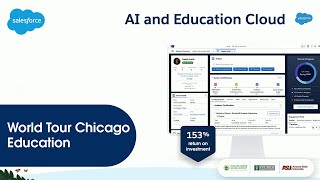
Saadia Seyfeddin from Salesforce shows how AI can personalize learning at scale while keeping data safe. Salesforce is piloting Einstein GPT Skills Generator this spring and releasing AI tools for assessment and mentoring this summer, all built on a trust layer that masks data and blocks toxic content.
Questions this video answers
Saadia Seyfeddin, Product Manager on the Education Cloud team at Salesforce.
World Tour Chicago (video uploaded December 7, 2023).
Over 1 trillion predictions a week.
About 77%.
31 times more likely.
Chapters
Hello, everybody. My name is Saadia Seyfeddin. I'm a product manager on the Education Cloud team and I'm so excited to be here with you all today. Can you guys hear okay? Yeah. Awesome. All right, before we get started, I just want to take a moment and say thank you. I firmly believe that education is a basic right and all of you are a part of making that happen today. So thank you for the often thankless and invisible work that you all do. Thank you for what you do for our students, our faculty and our staff. And of course, thank you so much for joining us here at World Tour Chicago. So today we're going to talk about three main things that are top of mind for so many of us. We're going to talk about the AI revolution and the specific implications on the education community. Then we're going to talk about trusted AI and how we can make sure that we are delivering value in a way that's centers, trust and safety. And then we're going to do a little bit of an innovation sneak peek so that you all can take a look to see what Education Cloud will be delivering in the spring and summer releases next year. All right, we are in an AI revolution. All we need to do is open our LinkedIn profiles and we'll see all of the posts that are related to AI. When ChatGPT was introduced last year, what made this a very different inflection point for technology was that it put AI in the hands of every kind of user. You didn't really need to have a degree in artificial intelligence to be able to use this generative tool. So when I think about the revolution, I think about three underlying fundamental values that are really important to understand that can unlock value for our institutions. So the first is intelligent decision making. We know that our staff and our users are often doing activities that might be repetitive, sometimes mundane, and might prevent them from engaging in the value that they really want to deliver that human one on one interactions with their students or their constituents. So when I think about how AI can help, I think about the ways in which it can take out that burden. It can ease the decision fatigue and provide recommendations and decisions that might help those staff accelerate their work. I also think about intentionality, and when I think about intentionality, it's all really about context. We'll talk a little bit about how Salesforce helps deliver that in the tools that are available to you. But intentionality and context is really what helps the machine provide responses that are accurate and relevant. And then lastly, I think about adaptability and predictability. At the heart of machine learning is pattern recognition. When you provide data and context, you can get responses that are more accurate and relevant as you go on. So the more information you provide, the better the machine learns. It can learn from itself and continue to improve over time. So what does this mean for education? One of the things that I love about being a product manager at Salesforce is our trailblazing customers. It's my job to spend time talking to you and learning from you. And. And there are questions that you all are asking about how this revolution is fundamentally shifting the way that we deliver an education. You all are asking questions like, how are learning methodologies changing because of the tools that students have available today? How are our grading methodologies changing because of the tools that students have today? How are students changing the way that they're thinking about investing in an education? How are students thinking about the skills that they need when they graduate? And as institutions, how can we better prepare them to enter a world that is fundamentally different than the one that we were experiencing yesterday? So we're going to talk a little bit about how you can leverage value and how we are engaging with our customers to help solve some of these problems. But before we do, I want to talk about some of the things that you all are telling us. Over half of you know that you are optimistic about AI, that there is some potential here, and that we are only going to continue to grow. And about 77% of you have identified that there are potential efficiencies that your staff can accomplish with AI assisted tools. And more than half of you are rightfully concerned about data privacy and how AI has the potential to perpetuate bias. When I think about all of these questions, I really just keep coming back to how trust has always been the number one value for Salesforce, and that has not changed with our expansion into generative capabilities. We've been in the AI game for over a decade with Einstein, and Einstein has been providing predictions over the last 10 years. Currently, it provides over 1 trillion predictions a week. And it can predict things like flagging at risk students who need additional support, or even potentially your net revenue targets. Now, to the Einstein portfolio, we're adding generative capabilities. So now you not only get a prediction or information, you can actually create content. So now you can create emails, right, to students that are interested in applying. You can generate more websites that are very specific to a particular student that will be attending your university. You can also create skills and attach them to your courses and your programs. We'll talk a little bit about that today. And you can also assist in career planning and generate career recommendations for students to explore. At the heart of both of the predictive and generative capabilities is the ability to leverage data. And your data needs to be clean and sound and protected in order to leverage AI in a responsible way. So it makes me keep coming back to this question. How can we reap the benefits of generative AI in education while maintaining trust? Like I mentioned, Salesforce has taken a very intentional approach to the way that we are making AI accessible to all of our customers. And I'd love to talk a little bit about that today. I would be remiss if I didn't say that. I really feel that the answer and the tool that can accelerate so many of our customers journeys is Salesforce Education Cloud. With Education Cloud, you can personalize the learner journey at every step of the way. You can drive insights and productivity from unified constituent data. So what does that mean? We work within the lms, we work with assist, we work with alumni data, maybe recruiting and admissions data. How do we unify all of that data to make it one single seamless delivery? And then lastly, we are really focused on how to drive lifelong impact with the number one trusted CRM for education. So at every element of the journey, from a prospect all the way to an alumni, they receive an experience that is particularly tailored to them. So let's talk a little bit about how we do that in a responsible way. So I'd like to talk about the Einstein trust layer now at Salesforce. Trust isn't this. It's not lip service. It's something that we are fundamentally building into the value of the product. So this is not a product, it's not a sku, it's not a feature. This is fundamental to every AI experience that you will have in the CRM. So you can think about the trust layer like a barrier. It's a barrier between your CRM and all of your personal constituent data. So your prospect data, your admissions data, your alumni data. And then on the other side of the trust barrier are the large language models, right, the LLMs that specifically will drive and power the generative and predictive capabilities. There's a few elements of the trust layer that I think are particularly notable. The first is dynamic grounding. I talked earlier about intentionality and context and how that really drives a powerful AI experience. And that's exactly what dynamic grounding is. Dynamic grounding gives you the ability to reference particular objects or fields so that you can provide increased Context in the question that you are asking the prompt. We also practice data masking, which means that any of the personal and private data that lives inside your CRM does not get shared at all. It does not pass into the LLM and it is masked and protected. We look at toxicity in the outputs, we see, is there something wrong here? Is it inaccurate? Is it toxic? Is the tone wrong? And we give you the ability to give that feedback so that we can make sure that we are learning and continuing to improve the machine. And lastly, and I think this is the most important point, we practice zero retention. And what this means is that your data is yours. It does not pass into and get stored inside the LLM. And this is one way in which Salesforce is incredibly different. You can be sure that your data is always protected. And I think this is incredibly important to really engage with as we think about this life cycle. Right? So we have a prospect who interacts with our institution for the first time and then they become an applicant. After that they become an admitted student and then from there they become an enrolled student and then they pass in and they become an alumni. So we have this whole journey and oftentimes the alumni will then end up back as a prospect when they go back and engage with that institution again for maybe a graduate program or a certification. When we think about the investments that we need to make today, I believe that the best way to optimize these investments is to invest in in technology and tools that can help you deliver personalized experiences at scale. So whether you have a few hundred students or a few thousand students, you are able to unlock value at every stage. And when we think about how AI has affected and changed the experience and expectation of learners today, I think this is a point that we really need to think about because I know that it feels very, very confusing to have a different experience at an institution that feels maybe more onerous, maybe a little bit more outdated. But then I open my mobile phone and I open doordash and I'm getting very specific responses and recommendations for food that I'd like to eat. Right? I think that we need to kind of close that divide. And that's really what Salesforce is aiming to do to make sure that our learners are having a unified experience, that their expectations are met. And it's particularly more important at this point in time when enrollment numbers are down and we know that students are asking themselves whether their investment, their couple thousand dollar investment or student debt is worth it when it comes to when they come out and they graduate from school. So we really believe that the way to ensure that every student gets a very personalized and specific, specific experience to them, a positive experience, is to be able to invest. Now, our recent connected student report actually showed us that students who experience belonging and have a very positive experience on campus are 31 times more likely to then become engaged alumni. And those alumni, they go back and they invest in their institution, they invest their dollars, they invest their time. And that's really what helps people empower our institutions and continues. Helps us continue to give back. And so we designed Einstein Copilot to help solve this problem. Like I mentioned, I don't believe you need a PhD in AI to be able to use these incredible tools to deliver value. And that's what Einstein Copilot does. Now, again, going back to what I said, ChatGPT was revolutionary because anybody could use it. You type in a question, you get an answer. The better your question, the better the response. And Einstein Copilot aims to deliver similar experiences where you can use a natural language interface. And that natural language conversational interface helps you not just retrieve information, but actually receive an action. So let's say you're an admissions officer, and you have some students who have applied who've started their application, but they haven't submitted their application yet. And you really want to encourage them to do that. And so instead of having to write singular emails, you can generate a specific email that then references particular elements of each student's profile so that you can deliver a more specific personalized email for that student, make a couple of edits, and then send that off, and you can use Copilot to do that. Now, I want to talk a little bit about how we're using some of this technology within Education Cloud. For those of you that were in attendance at Dreamforce, maybe I can see a few hands, if we have anyone at Dreamforce. All right, cool. Seeing a few hands. I demoed this functionality live. So in the spring, we will have Einstein GPT Skills Generator in pilot. One thing that we heard regularly from our customers was that they're thinking about how they can help their students articulate the value of the degree and the investment that they make at an institution and that they can be better prepared when they are graduating. So we delivered the Einstein Skills Generator, which will empower our customers to create a skills library. And not just create a skills library, but when you are creating a new course or a program, you can use generative capabilities to then use that course to look at any potential skill that could be related to that course or program and then attach those skills to that course or a program so that it shows up in the learner's profile. And when it shows up in the learner's profile, you can now run even more intelligent decision making on it. You can make recommendations on careers, you can make recommendations on internships, you can make recommendations on the right mentors or the co curricular or support programs. So this will be the foundational element that will help us continue to drive more personalized learning. Now I want to show you a couple of things that only you all are seeing because this is brand new. We haven't talked about this yet. These are the features, the AI features that we will be delivering in the summer of next year. So let's imagine that we are admissions staff and we answer inquiries from students on a regular basis. Maybe the questions are about application deadlines, maybe they're about tuition, maybe they're about recommendations, right? And we know that our staff often spend a lot of time having to answer these requests for information. What if you could generate a response to a question quickly? What if you could reference your knowledge articles, you could reference your website or even past information to generate an RFI response and manage those RFIs in a really efficient way? How powerful could it be for admission staff to continue to be able to focus on those one on one interactions rather than having to go through the overhead of being able to answer these one by one? So we'll be delivering the RFI response generator in summer of next year. Then we have our intelligent assessment creator. So now let's pretend that student who submitted the RFI has now become an enrolled student and they have a support program and they want to sign up for this support program and self enroll. So today in education cloud advisors can create those support programs. They can go ahead and a student can go ahead and self enroll. But then there is a number of administrative, a number of administrative tasks that, that our staff have to do. And one of them can be these assessments that they need to create in order to identify whether a student is a good fit for the support program. So in the summer we will be simplifying that assessment creation process by delivering generative capabilities that bring out questions that are really specific to that program that you are creating to minimize that administrative overhead and help our advising staff continue to deliver value and work one on one with students. And now lastly, let's say that student signed up for that support program. They loved it, they graduated, and now they're an alumni. And they are, they want to give back. So they want to be a mentor. Now in the spring we are delivering mentorship capabilities to create a mentor and mentee profile to be able to match mentors and mentees with one another. But in the summer we will be delivering intelligent mentor summaries and what they do is they pull insights across that mentor profile and show them in comparison with other mentors so that you can deliver the best match quickly to your students. Now as I wrap up, I just want to reiterate how important it is for us on the product team to solicit your feedback to learn from you all. So I encourage you all to join the AI for Education Trailblazer community. You'll see us in there sometimes responding to comments and engaging with our customers, and it's the most valuable part of our job. So please do check out our AI for Education group. And lastly, I would just love to encourage all of you in your My Events app to please go ahead and fill out the surveys and let us know what we can be doing better. Thank you all so much for being here. It was wonderful to see all of your faces and I hope you enjoy the rest of World Tour Chicago.









