Levi’s Jen Sey’s Journey From Gymnast to Marketing Genius | Connections Ep 6 | Salesforce
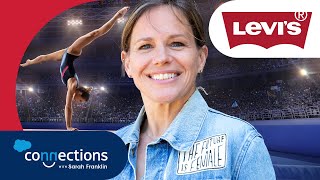
Jen Sey, Levi's global brand president, trained as an elite gymnast for 6-7 hours daily and was a 1986 national champion before leaving before the 1988 Olympics. At Levi's since the 1970s, she rebuilt the brand around music and authentic self-expression as CMO, and is now producing a Netflix documentary about abuse in women's gymnastics.
Questions this video answers
By age 10.
1986 national champion.
About a month before the 1988 Olympic trials.
About 1976.
About 10 pairs.
Chapters
I think it's so important to be just obsessed with the world that we live in. Right. Like, I don't read business books, but I obsessively read books and watch movies. And maybe that's not your thing. Maybe it's music, but, like, how are you gonna figure out how your brand can connect with culture if you don't know what's going on in culture? You're not.
I'm Sarah Franklin, and welcome to Connections, where we hear from some of the most innovative leaders in marketing. My guest today is Jen Se, global brand president at Levi's. Jen's love affair with Levi's started at a gymnastics event in Russia in the mid-80s, and we're here at Levi's Plaza in San Francisco to get the full story. You have a serious job now, but you had a serious job as a kid. What drove you to compete in gymnastics as a young person?
Yeah, I was an elite gymnast as a child. It was utterly unplanned. It was just. I loved the sport, and I had an aptitude and a willingness to work my butt off. By 10, I was training probably six or seven hours a day in the gym, and I was the 1986 national champion. But I was really, at that point, kind of unraveling from the sport. I had a lot of injuries. I had a serious eating disorder, and I ended up retiring or walking away about a month before Olympic trials in 1988. The sport is incredibly cruel, and I don't think I knew that. But as I grew up, I sort of wrestled with the repercussions of that quite a bit. So it was amazing, and it was also really, really brutal. But I think I'm a continuous learner also, and I sort of accept I don't know how to do this thing now, but I can figure it out. And you have to do that in sports. That notion of always learning, I can't do it yet, but I'm going to be able to do it if I just work hard is completely instilled in me from a very young age.
When did your love affair with Levi's begin?
I mean, everyone has a Levi's story. Snoop has a story. Alicia Keys has a story. It's usually the first question I ask anyone we work with.
What's your Levi's story?
Well, I'd worn them since I was a kid. I remember my first pair were baby blue corduroy that I had, and that was in about 1976. But my sort of formative Levi's story was the first Goodwill Games. It was a custom to trade sort of leotards or pins, but I was told, well, you should bring 501s to Moscow if you want to trade with the Russians, who were the very best gymnasts at the time. And so I brought about 10 pairs of very tiny 501s that my mom helped me go get at the mall. And that was like currency.
They wanted those 501s.
Oh, yeah. Levi's are embraced around the world for their American nest. And that's not a sort of flag waving sentiment, but those values of freedom, progress, inclusion, which I think is what the brand is at its best and the country.
You've taken on numerous roles at Levi's. How has that experience helped you as a marketer?
I've been here a long time and I've had a ton of different jobs inside of marketing, but also outside. I led E Commerce for a while. I was in strategy for a few years. I just think it makes you better rounded. You understand the levers that drive the business, how to sort of assess opportunities, and it just kind of expands. Abandoned my notion of how to build the brand and the business.
You learn so much to interact with other people, build a network.
But since I took on the role of the CMO, which was in 2013, the business at that point was really struggling. And so in the early days of me in that role, it was sort of about reconnecting to what made the brand great. And for those that love it, what did they love? Like finding that sort of secret sauce again. And it was very much rooted in this idea of, when I wear my Levi's, I can be my best self. So we needed to be really, really focused on product. As we convinced them that we had great products that they were going to love to wear and they were going to make them look amazing. We shifted a bit more to the values of the brand and the value of authentic self expression, which we conveyed through music, but also the values of how one gives back to the community. And so we'd been running the business for many years in a very principled way. We were the first Fortune 500 company to offer same sex partner benefits. We integrated factories in the south before the law required, but we never talked about it. But the world has changed and people want to know what you stand for.
And do you think that leaning into your values connects you better to your customers?
You do sort of make the choice that some folks are not going to align to this, but I think for younger consumers, for Gen Z and Millennials, they know they have a choice how to spend their money and they would choose to put it towards brands that share their values. It's a balancing act, but I think there are times that we weigh in because we feel it's so important and we choose the harder right over the EAs.
What do marketers need to do today to innovate with their brands?
I think it's so important to be just obsessed with the world that we live in, because essentially we want to make content that intersects with culture in a really relevant way that only your brand can do. So we've done cool stuff with music. I mean, we did make the choice in 2014 that music is our thing. And I often tell people music chose us, we didn't choose it. You know, artists with original voices have worn Levi's since forever. So we've focused on music and that's taken various forms. But the Levi's music project has been a pet project and it seeks to bring music education back to schools and community centers around the world, which is super cool. It takes the company's value, the philanthropy, and marries that with the brand's obsession with music.
Levi's lets them bring their love to the community and give back. And it brings everything that you want to the community.
That's right. And it's not a cookie cutter. I mean, it's really a partnership with the artists to say what is going to be meaningful to you as we think about how do we bring music into these kids lives.
So you're this very creative person, but you've had it bottled up for so long and then you wrote a whole memoir about it. I did. And now everybody knows.
Yes.
How did that change how you showed up at work?
Well, I think I just at that point put my whole self out into the world. And so there was no sense not to be that person all the time. It just freed me. And I think I got better. I became a better leader. I became more empathetic to my team. You're just better when you're your whole self.
And what can other people learn from that?
I just think you've got to find a place where you can be yourself and unleash your full self on the world. You won't be happy otherwise. So take successful out of it. You're not going to be happy. And that's more important.
You produced a documentary with Netflix about abuse in women's gymnastics. What did it feel like to speak up and protect future generations?
The documentary was a turning point because I had actually been speaking up for about 12 years, it was not well received. I was blackballed from the sport. I was called a liar. But over the course of about 12 years, the lens sort of shifted a little bit. People's eyes were open. And so the thing that was so amazing about the film was it just let the sunlight in. Literally, athletes in the sport and athletes just leaving the sport who were still suffering from the abuse saw their experience different and started to speak out. It's just so heartening because now I think it'll change. Once the athletes demand that it changes, that's when it's going to change. The sport was not going to change itself.
What would you say to people that are scared to bring their whole self to work?
Coming up in the business world as a woman well into the 90s, I felt like when I had my children at least, like, I don't want to talk about my kids at work. I'm not going to put pictures up because I don't want anyone to think I'm not completely focused on being here. Because now the notion of bringing your whole self to work is embraced in most workplaces. And I guess what I learned was we were in a transition moment and it was going to be embraced more than I thought it would. You know, some of it was my own hang ups, but I think some of it was actually true. I mean, there were no women in leadership positions, you know, at that point. So if you feel that who you are is not going to be accepted at work, think about, would I be better off somewhere else? But then think about what might it look like and might it be okay? And it's your own hesitation and just try baby steps, you know, a little bit more every day. Use your voice, say what you really think, because you can be that example. And I think if everybody does that, you're just stronger, you're a better team, you trust each other more. You're not leaving half of yourself at home. It's just a more relaxed environment and I think everyone's better are in that situation.
Levi's has supported so many social movements, Black Lives Matter, LGBTQ and voting campaigns. What advice do you give to marketers looking to connect to customers on these social issues?
I think if you just do it in the name of consumer connection and you haven't cleaned up your own house, you're going to be exposed. You have to make sure the inside matches the outside, meaning the inside of the company. Are you living up to those values? I just think it has to be a natural extension of the policies and the values of the company and not a campaign. LGBTQ rights. I'll take that one. We started back in the early 80s. By 1992, we offered same sex partner benefits. These were not campaigns. So when we started Pride campaign at this point, 10 or 12 years ago, and we're one of the first brands to do it, it wasn't trendy, you know, and it was just an extension of the work we'd done in the community and in service to our own employees. So think first about how do you want to treat your employees? What are the issues that matter to them? And then how does that kind of extend from inside?
Levi's is a brand of such historic fabric. What advice do you have for marketers that are looking to connect with their consumers in unique ways?
For me, what I strive to do is kind of get at what the core of the brand is, but continue to express that in ever increasingly more modern ways. That's an idea that's timeless, but then an obsession with culture and how your consumer consumes culture. Music has been incredibly important. We say it's our language of self expression. Music festivals have been really important for us. We go and we do customization of denim at festivals around the world.
Everybody remembers their first concert.
Everyone remembers. What was yours?
Guns n Roses or Def Leppard? One of the two.
That's a good one. I was Eric Clapton. I was 6. My mom took me.
Thrash it in your life.
Crazy.
Very different.
1976.
How do you ensure that brand stays relevant for every generation?
Adopt teenagers, I think, would be the best one. You have one?
We both have them.
Yeah. No, honestly, my kids give me so much insight. I mean, no one hates a CMO more than the one that comes in. Is like, well, my son said this is who we should be working with. But, you know, up until recently, I went to a lot of shows. And when you're in it, you see what kids are doing, what kids are wearing, how they talk to each other. It's not something you can read about. Like, you need to be in it on the ground. And so I just think a cultural obsession is really, really important. Be where they are.
Never miss an episode by subscribing and turning on your notifications. We'll see you next time.









