LT Smooth on Life, Community, and Indigenous Challenges in Hawaii | B-Well Together | Salesforce
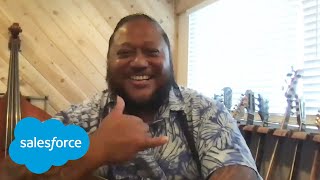
Grammy-nominated singer-songwriter LT Smooth talks with Natalie Harris about growing up in Hawaii, his music career, and his work supporting youth in his community. He shares his challenging past and how he's used his experiences to inspire young people.
Chapters
Aloha, everyone and welcome to be well together. My name is Natalie Harris and I'm filling in for Jody who's taking some much needed time off to be well and recharge. But rest assured, Jody will be back next Tuesday and you'll see that lovely face again bringing all the good news to you. As I mentioned, my name is Natalie Harris and I am the global president of Windforce. It's one of our affinity groups here at Salesforce where we recognize and support indigenous and native cultures worldwide. And today I have the pleasure of introducing someone who really technically needs no introduction. If you've been at Salesforce for 30 seconds, you know exactly who this person is. He is Grammy nominated singer, songwriter LT Smooth. Mahalo for being here.
Lt oh, thank you so much for having me, Natalie. It's such an honor to be here. Thank you.
Absolutely. We're super excited. And my team has just been over the moon wanting to talk to you. Winfor specifically wanting to talk to you. You've been on our dream list forever and so this is a great time to just to really get to know lt the person you know. So many people know you from your performances, from Dreamforce, from World Economic Forum, from the world tours, but we're here to talk about lt, the person. And when I met you at CKO earlier this year, you know, I got a little bit of your story. You know, we were just, you know, you were on my hit list and I was like, I gotta talk to this person, I've gotta meet him. And you shared a little bit of your story and I thought we have got to hear more of it. The world needs to hear more of lt's story. We've heard your voice, we've heard your song, but we certainly want to hear more of your story. So, you know, I'd like to kind of start, I like to frame the conversation a little bit and ask you essentially five types of questions. And so we'll get to those questions, but I want you to be prepared about what we're going to talk about. So your origin story. We all want to know your origin story. There may be some natural assumptions here and we want you to help correct some of those assumptions that we may have. We also want to talk about your music. We love your music. You love your music. And so definitely this is something very important to speak to. And also another thing that's really important is your connection to Salesforce. Like how did you get here? How did you meet Mark? Those questions and what's your connection to your community? And the last question we'll ask you is, will you sing a song for us or two? So without further ado, let's kind of kick it off, right? Let's kick it off with the first type of question, the origin question. I many people assume that you are native Hawaiian, but tell us the truth and tell us about your story and how you got to Hawaii. So tell us where you're from and then how you got to Hawaii.
Well, thank you so much. See, I was born and raised in New Zealand, a place called Auckland and little town Papatoe. And so my mother and my father met in university in Oakland, fell in love and had 11 kids, 10 boys, one girl. And I'm the cutest one out of all of them.
Yes, you are.
But anyway, so my mother is Pat Mori, Pat Samoan, and my father is Irish. So most of you would look at me like, there is no way you're Irish. Well, Unfortunately, I am 50% of it, I guess. My whole name is Leon Simati Malalato Matangalamau, Manga o'. Sullivan. That is my real, real name. And so I just take the smallest names of my. All of my names and then just frame that as Leon to Omata, which is my last name that I use. So the LT are those initials for those names. Smooth was given to me by a professor from New Zealand who watched me play, and he's a guitar professor and just said, oh my gosh, he was just the most smooth guitar player I've ever seen. And I thought to myself, I might put that at the back of my name. And I ended up with that LT Smooth name, my initials and that. But I was born and raised in New Zealand, and so I am a native Kiwi, they call it. But I got part Mori and part Samoa, and I speak fluent of the languages, so I understand the languages very, very well. Unfortunately, there are only a few of us left through all my siblings. And so I'll let you answer that next question because that's where I'm from, New Zealand. So I'm not Hawaiian. And how I became to live in Hawaii is that I married a Hawaiian girl who was born and raised. Yeah, smart of me, isn't it? And I met her in Australia after my sobriety. I was doing a school with a mission organization called Youth with a Mission who teaches kids how to get to know who you are and how to deal with some of the past. It's kind of like rehab, you know, so. And that's where I met my wife that, that I have today.
So beautiful. And how long ago was that that you traveled to Hawaii? Were you. Were you a teenager at that time?
No. So I came here in 2001. So from 2001 till today is how long I've been in Hawaii. And so we were. We were based in Australia, and so we did a school together, and obviously we went apart for a couple of years, and then we kind of met up back up again, and then we fell in love and we got married in New Zealand. And then the reason why we came to Hawaii was my wife's father died from colon cancer, and so my wife did not want to go back to Australia, so she said, can you pack up the house, pack up the business that I was running and just come back here and live here? And I've been here ever since.
Oh, beautiful. And I'm sure you're just a beautiful addition to Hawaii. You're a beautiful addition to Salesforce in general. And it's so wonderful to see that you found a home and your heart there in Hawaii. Now I want to talk a little bit about music, right for you. And so I learned that you discovered music in your teens and you taught yourself how to play 19 different instruments. And that is incredible. And for me, when I thought about that, I thought like, you know, what was the inspiration behind the aspiration, you know, especially as a teen, you know, you're. As a teenager, often our minds are focused on other things, but you were focused on learning the music. And what was the inspiration behind that?
Well, I want to kind of want to kind of put the story a little different because that's not what happened. I grew up in. At nine years old, my father made a decision after living a true life. He was a father, and then he was a gang banger. So he was a leader of a gang called the King Cobras back in New Zealand. And we all growing up, we kind of knew signs. Dad leaves at midnight and comes back in the morning at 6. So we don't know. We keep thinking he's working the railway trains or I don't know. But we finally discovered as he kept coming home drunk and we just saw signs as we were growing up that something wasn't right. So when I turned nine, my dad made a decision to just live one life. Didn't want to put mom through that anymore. And so he decided just to take three of us siblings out of the house with him, threw us in the car, and that was the last time I saw my family. So all three of us boys, and I was nine. So My other siblings were a lot older than I am, just a little bit older. And so we ended up living in the gang's compounds for 10 years of my life. So I didn't know music at all. So music was not even in my part of my growing up. It was around me, and I loved it. But my job in the compound was to smuggle cocaine and heroin and up and down the skirts of New Zealand, from Auckland to Wellington, Wellington to Christchurch, Christchurch back to Auckland, and up in the South Island. And so I know very well New Zealand because of that life. And unfortunately, I have lost my first brother at 13. My brother, one year older than me, decided to join another gang. And so there was a moment where we all had to rumble, meaning we all had to figure out our differences. And so they shut down the road and there was like maybe 80 of us, and he was on the other side. And we didn't really know until we went in it. So the cops were kind of over, you know, we kind of had a lot more. More gang members than cops. So the cops couldn't really stop us, so they just let us battle it out. So whoever was lying on the ground at the end, that was what happened. So that's how my first brother died. And so my father went up to my brother after all those bodies are lying there and just. Just to make. Kicked him in the head just to make sure he was dead. And we left him there lying there that same night. I ended up taking my patch off my jacket and I snuck out of the compound just to go back to their gang and knock on their front door to say, give me my brother's body so that I could bury him. So I did. Wow. L.T.
Wow. This is. Thank you first for sharing that part of yourself. That story is just, you know, it's heartbreaking and it's incredible, your resilience, you know, to see you here just showing so much love and giving so much love, but coming from some dark places, really, you know, in your life. And, you know, we just appreciate you being here and opening up yourself to us and opening up your music to us so very much. And, you know, I want to talk about, you know, maybe a little bit about, you know, about that moment too, in your life where, you know, you've been open about, you know, your struggles with the past and even correct me if I'm wrong about depression as well, too, when you're a young man and, you know, some of it may be coming from the experiences that you had, you know, was that one of the turning points for you when you. When you saw your brother there as a young man, and was that a turning point for you?
It actually got worse because I lost the next one two years after that. And so I buried him next to my other brother in a property. I had no idea who owns it. And then I got caught at the age of 18 and I got served, I got locked up. And so I came out. My father paid the judge in New Zealand to take me out because I was pretty in there for life as a minor, as an underage kid who was involved in murder. I was involved in a sting operation at a young age. So you always got to remember. Now, I started when I was nine, so it's always almost like it didn't matter if you started at 25 and ended up 40 something. I really lived the whole violent life. Fear was something we grew up living through. And so when I got smuggled out, the first thing my father did was he was outside the gate, threw me in the car, said, hey, we got another hit to do, meaning we got another smuggle. And so I did it, and they welcomed me back. And then my father did an operation where he got caught. Finally, he was in for murder as well. So my father went into the same prison I just came out of, and finding out years later, he shared the same cell as I did and died in that cell by hanging himself. So, you know, I think a lot of people have so much stories of their own to say, maybe not as brutal as how I grew up. And people like, I couldn't even see that in you. Well, we try to bury it now because the future is what we're aiming for, not the past. But we learn from the past. My scars will always be my scars, but it won't determine my path going forward. And that's why I love kids, because I've had so much work with kids. In Idaho, as an example, I work seven years in prisons and correction centers showing kids that if you want to go down that path, let me tell you how it's going to end and what it's going to feel like. And then you make a decision after that, because we all have a choice to make. And then decided when my father got locked up. And then I heard through the grapevine, he died. I dropped quarter of a million dollars of cocaine at a bus stop because I was getting ready to do another run. And then I just ran home. I stole a Ford Falcon, and I was good at wiring cars up and stealing cars. And for a young teenager, I kind of lived it already. And then I head home in a place I haven't been. And I didn't even know if my mom still lived in that place. So I rocked up at the house and I knocked on the door and an old lady come out with a baseball bat. And it was my mom. She looked at me, she's like, who are you? What do you want? You know? And I said, mom, it's me. And you can only imagine there's a song I wrote on my album called Little Boy. And it'll tell you everything that happened on that day. We just fell on the ground on the porch and just wept because I haven't even told her anything about what happened to dad or what happened to her sons, let alone what dad did to me for 10 years of his life. Life. And it was just so much hurt and pain that was on that, on that, on that porch that morning. And so my mom said, hey, I'm gonna get you out of here because now I'm. I'm ready. I'm a mock, mock gang member because the drugs have not been delivered. We haven't picked up the packages. And so, yeah, I could almost rewind back on what exactly happened. And so my mother snuggled me out of New Zealand to Australia, Gave me a whole new identity and everything. How I still, from today, I had no idea how they did it. And I did my three year sobriety in a nun convent in Malvern, Melbourne, Australia. It was a friend of hers that was over there, got to the airport in Australia and they. And a lady come up to me and I kind of scared her, you know, like, what the hell do you want with me? And didn't realize that she was a nun. So I did. And I think that's where the music kind of started because there was an organ in the chapel and that's where I felt. And I think now, 10 years of that life and here I am sitting in a place I have no idea, surrounded by women who are nuns and all they want to do is love me. For what reason? But I was so broken. Broken, so broken. Probably £120, little, just broken. I knew all the other side of life, but didn't know what love was. No such thing. I thought my father loved me by raping me and, you know, and making me watch things. And so I thought that was love. So here I am today, you know, 40, 47 years old. See, I don't even know how old I am, 46 or 47. But all I want to do is change lives through music. Or from my, through my life. And that's what I'm doing here in Hawaii. You know, I'm involved in a lot of things like the sex trafficking and the violence, you know, men hitting women on the road or, you know, I'm involved in everything I can to save lives. I use my own property every day I'm out there. I'm trying to build a music school for kids. And mainly what my vision is, is to use music as the niche to bring him in. But really I'm trying to teach them about life. Kids that I want to bring in is the kids that want to fight every day who have a lot of anger, who have a lot of, you know, things that are happening at home that we all can't see. And they come with these baggages and they put up this facade wall because they have to. Well, my job is to break those walls down and just to love them with everything I have, anything I can do to help. And that's what I'm doing every day and feeding them from the crops on my land. I attend Micronesians climbing my tree to get breadfruit off the tree because they're hungry. I'm like, take the whole tree and it's huge. And they did, they put a whole pickup, 250 Ford pickup truck and they loaded it because they wanted to take it home to feed their families, you know, mangoes and whatever it takes. So. And we're all doing our part, but that's my part here. It's what can I do to change the world? I'm changing my community first. It's just what I know I've had a little, had a little bit of a curveball hit me in the last couple of a year, I think. And that was through my 17 year old daughter who was almost going down the same road I started. And it shocked me because, you know, I'm all about saving lives. But there was, I had to stop because I had to look back and my own family member was drowning and I felt, oh my gosh, here I am saving the world, but I can't even save my own daughter who's going down the same direction. So. But she's doing great.
Yes, absolutely.
Thanks to Mark and giving me some, some direction and people that can counsel her and, and I've been reading a lot of books and so I don't know how to read and write. I do now, thanks to my girls who have been teaching me how to write and how to read. And so the, it's, it's, it's been a great journey. So music has really. I didn't realize that I would be a musician today. I really wouldn't have, you know, coming from that life, I thought I'll be a police officer to be able to hold or a social worker or. Or an ultimate fighter because I've this had these hands. I've so like to others fight all my life. You know, I know what a punch is and you know, waking up with bruises and I. It's all I lived through, you know, but I never smiled, ever. Never smiled. My heart was dark. You know, we all put this facade on every day. Sometimes we're hurting. Sometimes we just need to see that hurt in order for us to help. But we have to put on this face for the world.
Absolutely. I'm so sorry to interrupt. You're absolutely right. We all have to cover. Right. We all have to cover. But what I think is so beautiful is that we're seeing, if you will, the B side of your story and of your message. And there's so much to really unpack in your story. And, you know, I'm hoping that be well together team will let us come back again for another session because there's just so much to really talk to you about. You know, I've got questions from my team, burning questions from the team, and still so much of your. Your to tell and to unpack. And you know, the thing that I, that I gathered from you is your love for the youth, right? Because that's where, you know, you were sort of picked up and positioned in the right place. And that's a really important. That's a really important moment in someone's life is right at that pivotal moment of, you know, you know, from a child to becoming an adult. And if you could share, you know, your mantra. Do you have a mantra that you do to kind of lift yourself up out of that or maybe a favorite song that you do to kind of, you know, turn yourself out of that, out of that place and something that you share with the youth, specifically, you.
Know, the youth today are a lot smarter than us. They really are. You know, I love Michelle Obama. Her keynote when she said that we're behind a decade, which is very true. Your great grandfather is learning from the same textbook my kids are learning right now. We're so far behind, you know, they get all the information from social media, you know, and so we're so far behind. But what is real is that when you have kids that are broken and people like me who were broken can relate to it straight away, me and kids get along so fine. Because why? Because I come down to the level that they want me to be at in order for them to open up. I don't open up. I have kids working for me on the property. And so I've been creating all this work for all these teenage kids that have nothing to do. Instead of going on the street, I send them here to cut log right? Or to mow my grass when I don't even have grass, or to cut trees. That I'm just. I'm creating work for kids, teenage kids on my property, so that I can keep them busy and so I can nurture them. And one kid said to me the other day when I was driving him home, because he doesn't drive. He said, I've learned more from you today than I've ever learned in my whole life. And I'm like, why do you say that? He's like, because every time I work with dad or mom, I get yelled at. And every time, you know, I work really hard, and they just pay me five bucks. Wait, you pay me 25 bucks? Like, why? Why are you so nice? I'm saying, well, the question is, why can't I not be nice? Why can't I be nice to you? Why can't I pay you 25 bucks? So you know what you're worth? What is your worth? What are you worth? This is what I think you're worth, because I've seen you work. And so kids need some motivation. They need some role models. They need some ambassadors like you and me. But these kids won't see it unless we get into the grain. You know, we're so busy doing stuff, we forget about the kids that are hurting. And that's the next generation. They're the ones that are taking over after us. So that's what we need to do. That's what I'm doing. I'm walking the line, be able to bring kids on my property. I'm having parents go, do you have work for my son? Even though I don't, I say, oh, there's lots of work. So I try to create work. Like I tell a kid, go vacuum my music room, you know, go restring my guitars, which I already just did a couple of days ago. I mean, I'm trying to create work and then paying them with the wages that sometimes I don't have the money. I create the money. I sell things off so that I can get money to pay for these kids. It's because I'm trying to. Trying to set an example for our next generation and the little. And it's not for everyone in terms of everyone can't do what I'm doing, but I can. If I can do it, I'm gonna do it no matter what. And that's how we reach the young. That's how we reach this next generation. And that's why I love Salesforce. With the platform that they have, they're changing lives. Even if you don't know that you are changing lives, that's all I speak. It's like my bible. Salesforce is my bible, and I read it every day. And I study Salesforce and I study everything that they're doing and so that I can apply. What can I do on my part to be able to be part of this change?
I'm in.
I have all these kids raising their hands. I'm in with you, lt. What do you want me to do? And so then, you know, you have an army going forward. But the key is this, Natalie. Don't leave anyone behind. So even though you're going forward, you always got to keep looking back if anyone's struggling a little bit. And that's your part, to go back and let the kids go forward. And you pick up the one. That's true. Put them on your shoulder and you head forward with them. Because together, well, together, we will do this change successfully.
You know, Absolutely. I think we have to bring you back. I don't know. I'm not making the decision here, but, like, you gotta come back. There's just so much to talk about. And I know, like, folks are like, you know, we also want to hear lt sing a little something for us. But I hear you. Lt, and I hear what you're doing, and I see what you're doing. And we want to continue to connect with you even through Windforce, if we can continue to connect with you to get your message across. We know that you have passion and love for the youth. We have passion and love for the youth. We know that that's where the change is really happening. Right. And we want to connect with you and support you in whatever way we can so you'll be hearing from us again. But we. If you would just. And if you're open to it, sir, Senior, sing us a little something. A little something from your heart to our hearts. And along the lines of the messaging today, this song.
I wrote all my albums. You know, someone asked me when I got nominated for the Grammys in 2007, where'd you write? I said, I wrote everything. In my bathroom, sitting on my toilet with my laptop, writing music, studying, you know, try to figure out. And everything's about my life. And this next song is seasons. Your life, Nellie, is like you go through seasons, like winter and summer. It changes all the time. You wake up in the morning, you're like, I don't want to go to work. Or next day. Oh my gosh, I can't wait to go to work. Or what am I going to wear? I don't want to wear anything. I just want to wear my pajamas. So it's seasons. We all go through seasons every single day. But to be able to go, what is it today? Winter, all cool. Or put my jacket on. But this song talks about seasons. How our lives changes all the time and change is a good day.
Summertime, fall winter time, spring it's the seasons of our lives A joyful love has a day Days passing by Hardships come and go with every fall of snow it's the seasons of our lives Running in the rain as the days passing by Like a wave crashing on the ocean like how life is filled with such emotions Let the wind blow those leaves away Seasons watch them as they change Summertime, fall, wintertime Spring is the season Seasons of our lives A typhoid joy and love as the days passes by Hardships come and go with every fall of snow Seasons of our lives Running in the rain as the days passes by Like a wave crashing on the ocean like our lives filled with such emotion Let the wind blow those leaves away Seasons watch them as they change Seasons watch them as they change.
LT oh, I want to give you a hug. You know, I just want to, like, grab you and hug you. We love you so much. LT from our hearts to yours. We are connected. We are partners. We are here together. And we want you to come back for another session. There's so much to talk about and we want to help you with the journey. We want to help you with all those kids who are like, you got something for us to do. We want to help with that. So you're going to hear from us again. But thank you for joining us again on this Be well Together series. You'll see Jody back next Tuesday. But for all the folks that are joining, check us out on our Winforce chatter page. We've got a bunch of stuff happening for our champion month. And if you want to hear more of lt, Smooth, put that in our chatter page too, because we'll work to get you back here.
You so much for having me.
Thank you, Elsie.
Look forward to the next one. God bless and everyone out there live aloha, Spread aloha and hope to see you again soon. God bless you.
Mahalo. Thank you, sir.









