Main Keynote - World Tour New York | Salesforce
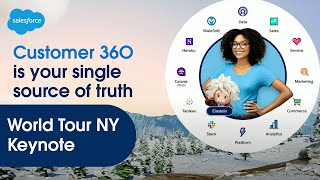
Keynote (Salesforce World Tour New York) presents Salesforce's AI-first strategy centered on the Einstein One platform and Data Cloud, emphasizing trust/ethical use of AI, unified customer 360, and integration with partners (AWS, OpenAI, Anthropic, Cohere). Speakers (Parker Harrod, Patrick Stokes, Parth, Corey Haynes, Avantika Monica) highlighted product launches (Einstein Copilot, Copilot Studio, Data Cloud unstructured/semantic search), demos (KPMG customer story), and scale/impact metrics (revenue projection, usage figures).
Chapters
Calling all trailblazers. Yes, there is magic in the air. Can you feel it? It's everywhere and in everything. And it's available to everyone. We, we are at the dawn of a new era where data, AI, CRM and trust help you connect with customers in a whole new way. So everyone can be an Einstein where you can talk to your CRM and it can talk to you on a single platform with a 360 degree view of every customer. But we have to ask more of AI, don't we? Because if AI is the wild west, who's the sheriff around here? Questions about governance and values, about trust and the safety of our data, about customer success. So AI's purpose is always clear, responsible innovation paired with ethical use. Committed to equality and mindful of our impact. Because when we get this right, and we will, the sky is the limit. We can make a world where AI does what AI does best, so we humans can do what we do best and continue to prove that business is the greatest platform for change. Welcome to the biggest AI event of the year where innovation meets inspiration meets entertainment. So raise your hands in the air because it is going to be uhhuh extraordinaire. Welcome to a whole new Salesforce.
Welcome co founder and CTO Salesforce Parker Harrod.
All right, welcome everyone. Welcome, everyone. It's just a pleasure to be here. You know, I was in Tokyo about three weeks ago and this is way easier because everything was in Japanese three weeks ago. Well, I am so excited to be here. So excited to be in New York City to celebrate the world tour, to celebrate the holidays as well. But first of all, before we start the world tour, we're going to do what we always do. We're going to thank each and every one of you. Because Salesforce, as you know, can never do this without you. Without our trailblazers, without our nonprofits, without our customers, without our partners, our ISVs, all of you are in this with us to really transform how all of us are connecting with our customers in a whole new way. Well, World Tour New York is awesome. It's going, you know, it's just kicking off now. We've got a great customer story about KPMG that we're going to go through in this keynote. But that's not the only story. We have 120 sessions, 20 demos, 60 sponsors. Thank you to all the sponsors who have helped us put on this show and come check out, you know, other keynotes because you're going to hear about Northwell Health and Roku and vibrant and A whole bunch of other awesome things. And also download that events app because there's so much going on, it's hard to navigate. We've got a great application for you to check it out. And there are people online as well. You see everyone in this room. That's awesome. But there are also a bunch of you online. So welcome to everyone online on Salesforce Plus. Well, Salesforce is about 25 years old almost, and we're really proud of what we've done over 25 years. Of course, we're proud that this year we'll predict 34.8 billion in revenue. That's good. We like that. But more important than that is innovation. Most innovative AI companies. We're going to talk a lot about AI today. Philanthropy, giving back. It's not all about doing well, it's also about doing good. Top 100 companies that care. And also about ethics. And ethics. You'll see, actually, this world of AI that we're going into, super important. World's most ethical companies. Awesome. Well, as you know, we got here when we started the company by starting based on a core set of values. So important. We started with Trust in 1999 when I met Mark. We're like, great, let's start this company. Let's get customers to put their data on the Internet. It's going to be awesome. Their customer lists. Some customers like, there is no way I'm putting my customer list on the Internet. I'm much less my credit card number. Now we're putting credit card number everywhere. But people were scared. It was still early. And so we had to get people to trust us. We had to get people to trust us to say, I will run the service on your behalf. Don't worry, I'll make sure that it's available. I'll make sure that it's secure. And all the CIOs in the room know that is a trust relationship. It all begins with trust, and then it follows on with customer success. We want to make sure you're successful with us in every way. And that's more important than innovation. I would love to talk all about innovation. That's what this keynote's about. But customer success is more important. But innovation is really cool. And there's amazing innovation we're going to talk about in this show. And finally, of course, equality. We believe that everyone should be treated equally, regardless of their gender, their background, their financial background, their sexual orientation. Everyone should be created equally. And we all need to come together to work on sustainability because climate change is real and we've got to come together and really work on that and do everything that we can. And so with these values, of course, we believe that business is the greatest platform for change. In 1999, we were in an apartment in Coit Tower in San Francisco. Three of us. Mark lived next door. Conveniently, we were there because Mark wanted us to be close. And we started with this nonprofit model. We built a 501C3 as part of our corporation. Day one, we didn't wait to be successful to give back. It was part of growing the company. It was part of being successful. So as we grew the company, we gave away money. 1% of our equity now 676 million in all time giving. That's pretty cool. Here in New York City, 65 million. We've given away 1% of our time. Our employees were told, hey, take nine days off and go give back wherever you are. When I was in Tokyo, they're giving back in Tokyo, they're giving back in Paris, in London, in Chicago. Here in New York City, 103,000 hours are given back in volunteering. 8.5 million total. And finally, 1% of our product. Are there some nonprofits in the room? Any nonprofits? I know you guys are here, actually, this group right here. So 56,000 nonprofits use our service to do good in the world. And that is so important. We do it. You know, it's free up to a point, and then it's highly, highly discounted. Any money we make there's just pours back into our nonprofit arm. But this group right here, we have the Salesforce nonprofit accelerator. These are our nonprofit AI Trailblazers right here. So big shout out to all of you. Thank you for what you're doing. We're investing in these nonprofits because we believe that AI can also transform the nonprofit space. And if you haven't joined us, if you haven't figured out that actually you can build a better company by giving back while you're building the company by doing well and doing good, go to 1% org pledge1percent.org and join the over 18,000 companies that have also joined us in doing well and doing good and giving back. As you grow the company, it's really, really important. Well, as we've grown the company, you know that for 25 years, our vision has been we want to help you connect with your customers in a whole new way. And we are so proud that we are the number one CRM. A big number one right right up there. Way bigger than. Well, we'll even mention Them, those little competitors that we have out in the world, we don't even talk about them. We are very proud of being number one. We like that. And we are number one based upon the Customer 360, which is your single source of truth. In 1999 it was Salesforce Automation. That was cool. Point click close was our tagline back then. Just surf online Point click close your deals. It's no longer just about point click close. It's about your single source of truth. The full 360. So sales, service, marketing, commerce, analytics to analyze your business and analyze how you're connecting with your customers. The platform to build those additional applications, Slack, which I love to bring all of your employees together and collaborate in the space of work. Of course the new additions which really going to hit hard today, which is everything's powered by data with our data cloud. And the data cloud and data are powering Einstein. All that data is feeding relevancy into the AI and the AI is powering your customer interactions and that data is pouring back in and it's this virtuous cycle of customer success. Well, talking about customer success a couple weeks ago, are there any retailers in the room? Because 29 of the top 30 retailers use Salesforce and they used it during Cyber Week. Now I know that. I think Srini, who runs a product for us is somewhere in the room. He and the whole engineering, he runs technology. Sorry. They get nervous during Cyber Week because there is some serious scale going through our platform at that point. Serious, serious scale. And our customers trust us to be there for them. To power 3.7 billion service cases, 53 billion marketing messages pouring out to drive those consumer businesses delivering 50 million online orders. And of course all powered by AI with 49 billion recommendations. All of that is incredible. And we know that that AI that's powering those recommendations is incredible. But that's just the predictive phase. That's just predictive AI. What's predictive AI? It's machine learning that's taking all the data and creating basically a statistical model and saying this statistically is the best lead for you to go call the next person that you should go call. Because we think you're going to close business if you go and talk to that person now or send this email. Send time optimization. I'm going to send this email at a time when we know that you're likely to open it. Some open in the morning, some open in the afternoon, maybe on the weekends or not on the weekends. Send time optimization. That's predictive and we power 1 trillion transactions a week with that technology. But if any of you were around in February, which we all were, something changed. And what changed was OpenAI suddenly hit this tipping point, and we were like, whoa, what happened? We entered phase wave 2, which is the wave of generative AI. And it's amazing. Like, it's just this magic thing that is incredible that, you know, you can go in and something like a chatgpt or a bard or an anthropic or a cohere, and you can just type what's called a prompt, and this magic response comes back. And we're going to show you how you can take that kind of technology and apply it in the enterprise and how you can generate sales emails, you can generate marketing campaigns. But that's just wave two. It's still going. Because where we're headed, and we have a bunch of research in this space and technology we're building that's coming out is around autonomy. What if that AI combination of generative and predictive altogether could actually do work on your behalf? You have to trust it first, right? Trust is number one. But what if it could do work on your behalf and it could be autonomous and you could have agents in addition to your employees that are doing work on your behalf. That would be pretty awesome. And imagine the productivity gains and this customer success that you will drive with that. And then in the future, and if you're Sam Altman, then it's going to be very soon. If you're others, I'm not sure it's going to be that soon. But we can argue after this keynote, we're going to get to artificial general intelligence, which is these AIs being as smarter, smarter than humans that can operate and do what we do, you know, and help us, you know, be more productive, but actually be artificial general intelligence. So that's kind of this long future that's pretty incredible. But here at Salesforce, we don't want you to wait for all of that. We want in this AI revolution to make sure AI makes that Einstein, makes you and Einstein, that everyone is an Einstein, that all of you can take the power of the data that you have about your customers and what your customers are doing, fuel that AI, and together personalize and create more productive CRM interactions. Sales and service and marketing and commerce, all backed, of course, by trust. And when everyone's in Einstein and you're bringing all that together, the opportunity is incredible. It's incredible. Imagine if you had 30% more time in your day to be, you know, more Productive. Or imagine if your company or your NonProfit or your ISV was 30% more productive, your entire company. Imagine generating 4.4 trillion more in annual GDP, more jobs, you know, and more customer success. That would be awesome. That's what we all want. That's what we all have. Kind of FOMO that we, we're going to dive into this new AI world and it's going to create all of this success and all this productivity. Let's go. Right?
Let's go.
But how many are a little scared, a little worried? I get worried. You know, companies are over here kind of on the cliff about the jump off. They're like, well, let's go. But your Data's disconnected. Your APIs are disconnected. You got a bunch of different apps. They're not connected. You got vendors who don't work with each other that aren't connected. You got low productivity. That is not what you want. That's not the AI experience that you want. But at Salesforce, we want to give that to you. We want to give that to you. Yeah, with a rocket. No, not a rocket. We want to give that to you with the Einstein One platform. And what is the Einstein One platform? Well, it's integrated. It's one platform. I'm going to talk about that in a second. You might think of us as multiple platforms. We've done a lot of acquisitions over the world. One of my main focuses is to make sure we bring all that together, that it's integrated into one platform, that it's AI first, that it's automated, that it's low code, no code, all the way to pro code. It's everything. And that it's completely open. That is our vision. That is our vision. And our vision comes together. So whether you're using sales or service or marketing or commerce, whatever application you're using or you've built applications on our platform, it's all powered by metadata. You've got the data cloud. Not as some separate data cloud. Not off to the side where you're like, I got all my data here, come and get it. No, your data's there. But why do you want to have that data? You want that data to be there to power your CRM interactions, to personalize that marketing email, to personalize that customer service interaction so that agent knows who's. Who he or she is talking to. And you want the AI to be right there too. Not off to the side, not switch over to some other AI interface. You want it to be right there. And the AI needs to have that Data. And you want the AI to do some things for you to make you more productive, to maybe write that email response to a customer or summarize the customer support issue. All of that working together, but powered by metadata. Maybe you don't know what metadata is. Well, I love metadata because when we started the company, we said, we want to build a service on the Internet. So we want to build one set of code. Not we're not shipping software. And you get your version, and I'll ship you a cd, here's your version. And it's all different. No, it's one service, one set of code, one thing. But we had to serve nonprofits, we had to serve high tech companies, we had to serve banks, we had to serve small companies and big companies. How do you solve that problem where you're serving all of these different constituents with one platform? Well, you do it with what's called metadata. We don't write different code for each customer. You just tell us how you want our service to work. You tell us. I want the data model to be a certain way. I need to track in a bank. I need to track bank accounts or insurance company tracks claims, or we even use it for bug tracking at Salesforce. I want to track my bugs. Yes, they're bugs, but we fix them. You want to work on your workflow, you just tell us how your business process should work. You want the user experience to be different, that's fine. Just tell us what you want. Go and point and click and tell us what you want. And that turns into metadata. And that metadata sits in our platform. And then we have this runtime. It just takes it and says, okay, what do you want? Oh, you want the UI to look like this. You want it to be in French, you want it to be in Japanese, Great, no problem. The minute you make that change, the cool thing is, when I was in Tokyo, it would update in Tokyo immediately in Japanese, and it would work here on your iPhone. It would be wherever your employees, your customers are, wherever they're and however they're using Salesforce, it appears everywhere. And then when we do upgrades each year, when we give you new capabilities, you know this, we do all the work to make sure that that runtime, that that platform that interprets all that metadata just makes it all work. And everything that you've done still works, but you get all these new capabilities so that you can have a data model and record types and sharing rules and code dashboards, all that cool stuff, all driven by metadata. And I talked a second ago about Integrating all of our applications. Many of you know and may be customers of products like Exact Target that we bought. I can't remember how long ago, but it feels like a long time ago. Exact Target had a B2B marketing offering inside of it called Pardot. We love Pardot. We bought a company called demandware that does E commerce. We bought a company that does B2B commerce called cloud Craze. And you're all looking at me going, oh, Parker, that's great. But these are different platforms. They're not all metadata driven the same way that the Salesforce platform is. Isn't it one thing? Shouldn't it be one thing? Yes, it should be one thing and it is one thing. We have done that. We've taken all that IP and we have rebuilt it. We've put it together into the Einstein One platform so that whether you're doing sales or service, which you know is all integrated, and the Lightning platform or the Force.com platform or whatever, the Einstein One platform, we'll keep renaming it, Sorry, Patrick Stokes can solve that. It's all running together. But now marketing and commerce are also a core part of that. A core part of that platform. And that platform is AI First. That platform is AI first. And it isn't AI First. Just this year, let's go all the way back to 2014. We created a research group and why did we create a research group? We got a bunch of PhDs and mathematicians. Because when it comes to AI, you don't just hire some programmers, you have to hire data science experts. And they are actually these rockstar, actually mathematicians, which, you know, I stopped doing math in college. I wish I had kept going because linear algebra, by the way, is core to AI. I stopped at linear algebra, but we founded our AI research team in 2014. In 2016, we launched Einstein the Predictive Capabilities, the first wave of AI. And so you could got. You could get lead scoring and send time optimization and case classification using the power of prediction. We knew that trust was really important. So we created the Office of Ethical and Humane Use to make sure as we're going into this new world of AI that we're doing it paying attention to AI and humane use. And then finally this year, when you saw everything changed, we changed too. Every company had to change. And if you haven't changed, we want to help you change. Because the world is going fast in terms of AI and generative AI is going fast. So we pivoted the company and now generative AI is a core part of Salesforce. That's a lot of what we're going to show you today. So all of that AI is powering 1 trillion predictions a week. That's pretty cool. We have 300 patents, research papers. That is awesome. So the Einstein One platform is AI first. It's also automated. Are there any flownatics in the room? You know what a flownatic is if you're a hardcore salesforce person? Yeah. Okay. Thank you to the MVPs, the trailblazers here, the golden hoodie winners. All of you know what a flonatic is. It's a silly term. Our characters are silly. I know, but we're salesforce. That's just who we are. But Flow is amazing. That is our workflow tool, our low code, no code workflow tool that basically makes you more productive. It makes you. The AI is making you 30% more productive right now. The automation's making you more productive, 27% faster automation, 1.2 trillion tasks automated a month that you know your employees don't have to do because flow is doing it for you. That's pretty awesome. And you know that the platform is also available to all of you. All of you. Whether you come into the platform and you're an admin and maybe you don't know how to code yet, that's okay. We actually prefer you don't write any code. You know, the less code you write, the better. The less code our developers write, the better. So we have that no code experience. Okay. No, code's not doing it for you. It's not. It doesn't have enough capabilities. That's okay. Try low code. Okay, that's not doing it for you. You might have to have some hardcore developers write some serious code. That's okay too. We want to be available to all trailblazers, whether you're a no code trailblazer, all the way to a pro code trailblazer. And our platform, of course, is also very open. We have an app exchange that we started many, many years ago where we have ISVs who are building on our platform like Docusign, like Encino and Five Nines. We have technology partners like aws, Google and Alibaba. In the hyperscale world, we have brand new partners which are really important to us in the world of AI, like OpenAI, like anthropic, like Cohere. But I wanna focus on one of these partners right now, just for a moment. And that partner is AWS. In 2018, we made a decision to pivot the company and we built something called Hyperforce. And our first provider was aws. And we've put a lot of our services, or all of our services on aws. Many of you are running on Hyperforce today. It's incredible. And we're using the power of AWS to do that. And we love aws, but we're doing more with aws. So I'm so excited to be talking about the expansion of this partnership we have. Okay, Talking about AI. Amazon has some great AI capabilities. They have something called Bedrock, and they have Bedrock models. So we have expanded the model availability to all of the Bedrock models. Let's say that you've done a lot of work with AWS and you've put a lot of your data. I know a lot of you have done this. You've put a lot of your data on AWS because it's an incredible platform for building applications for managing your data. If your data's on aws, that's great. I'm not gonna come to you and say, hmm, we have a new mousetrap here. It's called Data Cloud. You're gonna have to get rid of all of that data on AWS and you're gonna have to move it into Data Cloud, because we have something better. We actually have our data cloud seamlessly integrated to AWS so that you can actually make the data that's on AWS on whatever database it is. Doesn't matter. It seamlessly integrates and you don't have to copy it. So it basically looks, when you're using Salesforce, like it's part of Data Cloud to power your CRM interactions. And then you can use it for other use cases with your Amazon Services. That's a seamless integration with 0 copy or 0 ETL. And finally, if you've ever heard of the Amazon Marketplace, an incredible place to go find applications and purchase from Amazon. If you have credits on Amazon Marketplace, we now have the ability to let you purchase Salesforce Services on the Amazon Marketplace with your Amazon credits. Well, our platform is coming together. It is integrated. It is AI first automated low code and no code. And it is open. And what's awesome is that it's all there. Data Cloud and Einstein, your application metadata framework. That is our vision of the Einstein one platform. But it's a lot to digest. And it's a lot like, okay, Parker, that's great. So I'm going to go buy a little Salesforce automation, a little data cloud, and I need to talk to someone about Tableau, and I got to think about Slack and, oh, my God, it's just a Lot to figure out. Well, we want to make that easier for you. We want to make it easier. So we're announcing some new bundles, some new offerings. Sales cloud, unlimited plus, if you're using sales cloud for your sellers, it's great. Sales cloud is incredible, but it's a lot better with data cloud, so that's included. It's a lot better with AI. So Einstein's there too. It's a lot better with analytics. Tableau's there. It's a lot better when you want to do collaboration and work together with your sellers in selling. So of course, Slack is included as well. And it's industry specific, so we have offerings for financial services, for manufacturing as well. If you're in customer service and you have a bunch of call center agents or field service agents, no problem. Same idea. Customer service with service cloud is incredible, but it's better with data. With data cloud, it's better with the power of AI. With Einstein, it's better with tableau analytics. It's better with Slack. So we have bundles. Sales Service Cloud, Unlimited+ also in industry verticals, in financial services and in health. Okay, we've taken this journey. There's a lot of technology here. There's a lot to consume. But I want to go back to my values or Salesforce's values for a second. Number one is trust. So as we're entering this AI revolution, as we're entering this new world of data +AI +CRM +trust. It's a trust revolution first and foremost. Like, I'm a little worried. I'm scared. And to tell you more and to go into more detail on what this means, what does it mean to be a trust revolution? I want to welcome Patrick Stokes, head of product marketing at Salesforce. There he is. Patrick, take it away.
Thank you, Parker. Thank you, everybody. Welcome, New York. Welcome to the New York World Tour. We have a lot of beautiful New Yorkers and area people here. We got our MVPs and trailblazers, it looks like here, Golden Hoodie winners. Let's give them a round of applause. Ola, it's good to see you there. Good to see you again. This is my favorite event of the year because this is the one event that I don't have to get on a plane to attend because I live right here in New York. But that's not the real reason. It's my favorite. It's my favorite because we make all these lovely Bay Area people get on a plane and come experience some real weather for once, which I love. You should see all the stupid little jackets they bring that they think is going to be enough. It's. It's never quite enough, but definitely my favorite event. So let's talk about how we're going to solve this trust problem. Let's talk about the trust gap. Let's talk about what it is first. We know every leader of our organizations, every CIO out there, they're trying to figure out how do we leverage the potential of AI, of generative AI, how do we get these promised productivity gains and cost savings gains out of it. And to do that, there's a few problems that we need to work through. One is we need really great data to power all of our AI. And as Parker said, that can be pretty challenging. We've got all these islands of disconnected data. And even if we solve that problem, if we're able to get all of our data together, how do we make sure that the large language models that we need to generate things from aren't stealing all of that data, aren't sucking it all up and maybe answering questions about your business with one of your competitors, but businesses? That would be a really bad thing. And how do we make sure that the large language models aren't lying to us or hallucinating? How do we make sure they're not full of bias and toxicity? And if you think about where a large language model is trained, it's basically trained on the open Internet. And the open Internet is kind of a weird place. So there's definitely going to be some bias and toxicity that we have to deal with. So this is where we started. This is where we set out when we started to approach generative AI, and before we wrote a single line of code, we wanted to take a step back and just sit down and write out what are our tenants, our tenants of trusted and ethical and humane use of AI. And we wanted to start in one very particular place. And that's something Parker talked about earlier, this idea that your data is not our product. It never has been. We never take your data over here and combine it with your data over here and build some additional product on top of that, your data remains within your control. And as we move into this world of generative AI, we wanted to extend that promise and make sure that nobody else is able to take your data as well. And so that's where we started. And to help solve that problem, we had to build a piece of technology. And we call that piece of technology the Einstein trust layer. And this is really critical to understanding how generative AI is going to Work at Salesforce. So we're going to walk, as I walk, we're going to walk you around this little horseshoe. So I want you to start on the top left there on CRM applications and just follow the floating bits and we're going to walk around it here. So it starts in our CRM application, right? We have something we want to generate or we have a question. So imagine a simple button in the application and when we press it, we're going to do something like generate an outbound sales email. Now, to do that, we need a prompt, right? Everything starts with a prompt. And this is just the question or the instructions that we're going to type in to ask the large language model to do that generation. We've all done that with ChatGPT. You go and you type out what you want. Well, if you've done it with ChatGPT, you've probably noticed that the more instruction, the more data that you give it in that prompt, the better the generation. So if you ask it to generate a sales email, it'll do it, but it's not going to be very good. But if you ask it to generate a sales email and you tell it who your customer is and what products they're interested in and what line of business you're in, you're going to get a much better, better generation on the other side. So we need to add business context to that prompt. And that brings us to secure data retrieval and dynamic grounding, which are just fancy ways of saying that we're going to add your business context, the relevant context, into that prompt so that we can send it off to the large language model. Now, before we do that, we need to do something really important. We need to mask some of that data, because it's possible that you've got some PII or really sensitive data in there, things like names, addresses, phone numbers, credit card numbers, Social Security numbers, whatever it is, we want to make sure that we mask all of that so that that doesn't land in the large language model and then we're ready. So at this point, we're going to go hit the model itself. And there's a lot of different ways that we can hit those models. We can travel across the Internet with a secure gateway and hit OpenAI's GPT 3 and a half or 4 model, or we might hit a model that you host within your own trust boundary, within your own infrastructure, like Parker mentioned on something like AWS Bedrock. But in every case, when we send that prompt over to the model, we're Gonna use something called zero retention, which we've gone out and pioneered. And what that means is that we're gonna guarantee for you that the prompt, when it hits that model and gets a generation back, the model, the, the, the owner of the model throws away the prompt. So they're not gonna store it and go use it for their own purposes. They're just gonna throw that away. So at this point, we have our generation and we're ready to start sending it back to the application. But we need to do a few more things. We're going to check it for toxicity. We have models that we've built that will help us go out and determine if these things, if these responses have some toxicity or bias in them. And then we're going to take all sorts of data that we've learned from this trip around, and we're going to add it to the audit trail. Sooner or later, something will probably go wrong, and you're going to want to go and try to figure out what went wrong, do some forensics. And so we're gonna have all of that data available to you in our audit trail, so you can do it. And so finally, our prompt or our generation has come all the way back to our CRM application. So all of this happens on the fly. All of this happens just from the press of that button. And it creates the governance and the separation that you need to separate your data and protect your data from the large language model on the other side. Now, I just said the word data probably 3,000 times, and we'll say it 3,000 more times, because the AI revolution is a data revolution. You cannot have great AI without great data. So how are we going to solve that problem? Well, let's think about the problem for a minute. We have islands of disconnected data. We have data all over the place. We have it in our CRM, we might have it in our erp. We've got it in all sorts of data, different places, but we've also got all sorts of different types of data. So we've got something that we would call structured data, which is data that you would typically find in a database or a spreadsheet. But we've also got something called unstructured data. Now, unstructured data is things like PDFs, knowledge, articles, chat scripts, transcripts, social media content, audio recordings. This is all unstructured data. And actually, unstructured data makes up about 80% of all of your enterprise data. So we want to get access to that data. We'd like to have that data to provide as context for our AI. And then the last problem that you probably have is you probably got a lot of this data. So what we need is a platform that can help you bring all of this data together and organize it and do it at incredible scale. And for that, of course, we have our Einstein 1 data cloud. Now, the Einstein 1 data cloud is our hyperscale data engine. It helps you bring all of this data together and get it connected up to the Einstein platform, provide a single view of your customer. And it does it at absolutely incredible scale. We are right now processing over 2 trillion records per month. Let's take just a beat to look at how it works. So the Einstein one data cloud, it starts over here on the left where we connect all of your data. So obviously your salesforce applications, they're just going to work out of the box. They're already connected up to Data Cloud, but you've got data in all of these other systems. So we were giving you all of the tools, all of the ETL tools that you might need to get that data in, in batch or streaming. But what's also really cool is you can also connect up the investments that maybe you've already made in your enterprise data strategy with things like Snowflake AWS databricks. We have partnerships and connections into these in a format that we call 0ETL, which enables you to effectively, quickly virtually mount tables from those data investments right into Data Cloud without having to physically move the data. But we've got something new for you. We've talked about Data Cloud a little bit. We talked about it at Dreamforce. But since Dreamforce, we've been hard at work and we've just added an all new feature to Data Cloud is now Data Cloud works with unstructured data. This is all new. Now you can connect all of your unstructured data to Data Cloud and we use a vector database to, to effectively index all of that data and make it available for automation, for search, and ultimately for Einstein Copilot, which is really, really awesome. And we're gonna show you what that looks like in a little bit. But before we get to Copilot, I wanna do a little bit of a deep dive on Data Cloud itself and show you really how it works outside of the slides. And to do that, we're gonna welcome a fellow New Yorker parshah up to the stage to show us how that works. Parth.
All right, thanks, Patrick. Now, without data, there is no customer. 360. Whoa. That's a bold statement that I just made. We're going to show you exactly why with our amazing demo drivers, Miles and Rusha. So let's go. This is the Data Cloud Dashboard. It brings in data from all of your different sources into one place so that banks just like this one can unlock better insights and create a unified profile of their customers. Now, for many of us, this dashboard seems like a pipe dream. That's because it's really hard to bring data together. One, data comes in various shapes and sizes, structured and unstructured. And then number two, data's typically locked away in siloed and disconnected systems that are hard for every employee to access. Data Cloud connects and harmonize that data. It's all possible because it's embedded within the Einstein One platform. So the first step is to connect your data and create data streams. User many out of the box connectors for any apps wherever it lives, whether it's Salesforce, data, lake houses, even data warehouses and bring it all together. And it can also be structured or unstructured data. Now, speaking of data warehouses, did you catch Parker mention our most recent partnership with Amazon? Using a process called 0ETL, you can now virtualize that data from Redshift into Data Cloud, act on it, and then send it back to send it back to Amazon Redshift without building those costly or complex data transfer pipelines. This process again, is called 0ETL and it helps us avoid creating more data islands. Pretty cool, right? All right, so now that you've connected your data, the next step is to harmonize that data so that all of your data can speak the same language. Data Cloud looks at every data's attribute as well as schema, then maps it to a common data model and then turns it into a salesforce object, like a contact that you can use anywhere within the Einstein One platform. So let's take a look at how this rich data one, unlocks rich insights using Tableau. Two, creates a better service experience with Service Cloud, and three, improves productivity and collaboration with Slack. So this is Tableau Pulse. It brings analytics to life with data and AI. Now, insights like this are usually hard to get. That's because your data team typically has to get the data, has to clean it, process it, transform it, and then visualize it for you. And by the time you get it, it's typically stale or it's a one size, all, all, one size fits all visualization. But not with Data Cloud and Tableau. Data Cloud brings in that data in real time to Tableau. And then Tableau turns it into contextual insights for every employee that Needs it available right in their dashboard, just like this one. Now, Miles, am I just reading this correctly that the Net Promoter score is down? Do we know why? Can you help us figure that out or can we ask Tableau? Well, if you look at the bottom, there's a couple prompts that Tableau has that can help us dive deeper into why this problem is. Or you can ask Tableau using natural language. In this case, it looks like our chat resolution time is too high. So let's switch over to the service agent experience and see how data and AI can help reduce this time. This is service cloud with a unified customer profile powered by data cloud. And in the middle, what you're seeing is the agent is interacting with the customer. And on the left hand side, the agent has all of the information about the customer, including all of the touch points that the customer has with our company. And so as we go through, what you start noticing is that the agent is finding out that our customer lost the credit card internationally. I've been there before. In fact, it was last month and it was not fun. It's super stressful as a customer. But this is the time, this is a pivotal time for that bank to maintain the customer's loyalty. So let's see what the agent does. So as the agent is interacting with the customer, the agent finds out that unfortunately this is a fraud case and it needs to be escalated. And so the agent looks to the right, looks at the actions and recommendations and starts a case swarm to escalate this. But who do we bring in? What are the experts that need to be in here? Einstein makes a few recommendations, the agent picks a couple of his own and then starts the case form right from within his console. Now, on the back end, Slack brings the case form together along with the right people so they can get started fast. Now, we all know Slack. Slack is a productivity platform where our teams work, they collaborate and decisions are made. But Slack is also intelligent. In this case, the expert here has connected her apps such as marketing, cloud service and so on, so that all of that information is right in her workspace. And she can also build out workflow automations to save her time. Well, looks like she just got added to that swarm channel around the fraud case. I really hope there's some insights into this and context. Otherwise the expert's gonna have to do a lot of digging and the fraud case is gonna be. It's gonna take a long time to solve. But luckily there's three things that the agent or that the expert has. One, an Automated welcome message. Number two, the service case details right in her channel. And then number three, an auto generated canvas with additional insights from the customer. Now on the backend, Data cloud is bringing in all of that data that we harmonize right into the single view. And just like the agent, this expert has all of the information she needs about the case as well as the customer at her fingertips. And like that, the expert solves the case with her friends and teammates and that's it. No more digging, just productivity and collaboration. And just like that, Slack along with AI and data can boost collaboration and productivity. Now going back to what I had said earlier when I started the demo, without data there is no customer 360. But with data Cloud you can connect and harmonize your data, whether that's structured or unstructured, and bring it into the Einstein One platform so you can activate it anywhere across your business. Back to you, Patrick.
All right, thank you, Parth. All right, so we are going to do something that we're not really known for doing. We are so confident that you're going to love Data Cloud that we are going to give it away for free. We are going to give you the ability to turn on Data Cloud, unify up to 10,000 profiles and we're going to give you two tableau free tableau creator licenses to put on top and start exploring your data. All you have to do is take out your phones, I see some of you doing it right now and scan that QR code. And there's another little secret in there as well is when you scan that QR code, you don't even have to talk to your your AE to get this. It's gonna take you right to the website where you can do this all in a self service way. Now fair warning, if you start using Data Cloud and love it, you're probably gonna get a call from your ae, but you don't to get started. All right, so we've talked about how we're solving the trust revolution. We've talked about how we're solving the data revolution. Let's talk about what AI also is, which is a customer revolution. And it's a customer revolution because this has the potential to totally transform your business, to change the way everyone in your organization works. And that's what we have been so hard at work on. Okay, great. I didn't expect the animation. Apologies. That is what we have been so hard at work on. Imagine a world where your salespeople in your organization can get off the phone after calling with a customer, having A conversation with a customer and the entire conversation is automatically summarized for them. Imagine if all of the follow up items are just ticked off for them and they know exactly what they need to follow up on. Imagine a world where your customer service agents, as they're trying to solve a problem with a customer on the other end, they have an AI right there with them in the flow of their work, looking at past cases and bringing the most relevant information right to their fingertips. Imagine a world where your marketers and your commerce folks are able to generate customer segments, generate email campaigns or landing pages, product descriptions, even product images. Or maybe best of all, imagine a world where in a few weeks when we all come back from our holiday break and we load up Slack for the first time, imagine if all of the messages that we miss that are important to us were summarized and put right there in front of us so we don't have to go back and dig our way through Slack and dig our way out of that hole. So we wanted to go even a step further than that. All of those things are possible and we're working on them right now, but we wanted to go quite a bit further. So we did what anybody would do and we just asked Einstein. So we said, how can we connect with our customers in a whole new way? And Einstein had the answer for us. And the answer is Einstein Copilot. Now we are really excited about Einstein Copilot. Einstein Copilot is an entirely new paradigm for Salesforce. An entirely new user interface. It is a fully working generative AI embedded right into the flow of work. Embedded right into all of our best in class applications like sales, cloud service, cloud marketing, commerce and more. And the Einstein Copilot makes everyone, makes every customer Einstein. And it's making incredible customers like KPMG and Einstein too. KPMG is an amazing company. We have been working with them and transforming their front office so that they can modernize governments, public sector organizations, NGOs in over 143 countries around the world. And we're so excited about KPMG. We wanted to take a moment and share their story with you. So let's take a look at the video.
What we knew we needed to get done was to transform how we integrate our capabilities to solve even deeper, even harder, even more complex issues for our clients. Salesforce was there with deep capabilities to be able to help us really find our path around our front office transformation.
KPMG is one of the largest professional services organizations in the world. We have services that consist of audit, tax and advisory.
We operate in 140 countries, 200,000 people strong across the world.
We want all of our partners and our people to be delivering the full suite of our services to our clients. We call it One kpmg. Our systems were siloed and we had a lot of our customer data and information in different places. We figured that there's a better way to do this. We decided to set off in 2020 on a journey to ensure that we had a front office that was fit for a more modern future. We turned to Salesforce Professional Services to work with us. We needed a system that really allowed us to do the kind of things.
That we wanted to do. Salesforce had that in space. KPMG Engage, powered by Salesforce was the way to bring all of that together and deliver it to our people. Our new CRM, it allows us to better serve our clients with richer information and provide better experiences for our partners and our people. The stories that we heard from people engaging were really critical to its 95% uptake.
This is a system that I use every day because this helps people like me really do the right thing by our clients.
The way we've been able to use this single source of truth to now reach them with all the right information at the right time and in a really personalized way. That's been a new thing for kpmg.
As we look into the rich important data that we capture within Salesforce technology, we think that we're going to be more successful in the future in meeting our clients most complex needs. Using Einstein for developers has really helped our team pilot how we develop up code faster. AI is going to be critical for.
Us in our services industry.
You absolutely have to have the very best data to ensure that we capture and understand what our clients needs are. We have multiple member firms marketing solutions and data solutions. Bringing all of this together will take.
The power of data cloud. Kind of work that Salesforce is doing with Einstein and data cloud is all about building trust and having trust in the data. Our transformation has not just helped us, it has helped our clients.
We are able to get them insights faster. We are able to help them figure out their challenges, where to grow and how to do it really well without the technology that we have now. We were reacting to opportunities where now we can bring all of KPMG's capabilities to our clients. It's been amazing to witness that transformation. All right, and now to bring the KPMG story to life and to bring Einstein Copilot to life as well, please welcome my favorite ex new Yorker Corey Haynes. Corey, go a little bit.
Thank you. Thank you, Patrick. Awesome to be here today, and I'm thrilled for two reasons. Number one, as Patrick said, it's good to be back home. Everybody got recognized, but what about Brooklyn in the house? Get some Brooklyn. All right. Good to be back home on Bay Area transplant now. But that's all right. Brooklyn's still in the heart. But the second reason is really to tell the story about KPMG and bring that to life today and really show you how they're leveraging the power of data, AI, CRM, and trust to really deepen their client relationships. But before I go into the visionary demo, I want to give a shout out to my homies, Claire and Jonathan. Thank you. So when you think about kpmg, a global professional services firm, they have partners that every day have to seek new opportunities for their clients. And the only way they can do that by unlocking new insights to figure out what they need to do for those clients. And it all starts right here in the Salesforce homepage. We call it the seller page. And you can see there it's rich with a lot of data, pipeline updates, key metrics, really great information. And Einstein brings that all together. And before this information used to be siloed. I mean, it was just all over the place. But now it's in one view for kpmg. And this is where you're hearing KPMG taking that full opportunity to do a front office transformation and bring insights to those partners. In fact, if you look one of the insights, already, we see a hot client. This is an opportunity for a prospect that's popped up. Well, why is this a hot account? Well, simply because KPMG found out that Cumulus bank hired a new cfo, Claire. And Claire used to work with kpmg. She used their services before. So this is an awesome time to reach out to Cumulus bank because of that connection. And if we look, we can get this information without Data Cloud. As you heard earlier, Data Cloud took that news, brought it to the partner, and now they can act on it quickly. And part of being in a competitive environment is speed. So if we look at Claire's page, we can see some generic information about Cumulus bank and Claire in the blue box. But if we scroll down deeper, we can see that she's actually interacted with with past marketing campaigns. That's some rich data that helps the relationship. And remember, relationships are at the heart of everything that KPMG does. And even the design of the page is centered around relationships. We're even going to take a real relationship map and include that in the page, pulling from data from LinkedIn Sales Navigator and embedding that right into the profile. But look, we even see that she's interested in some of the new regulations that are happening with the cfpb, with open banking and even in Tap to pay. And now you can incorporate that into the conversation. But think about this. All this used to take so much time. Research, putting it together, double checking, cross checking. Now with Einstein, it's all right there. Incredible. Now what's going to happen, the next step, we got to reach out to her, we got to contact her, make an introduction. And the new partner, Jonathan had a relationship with her before, so it's good he knows her from a business standpoint. But he needs to send an email and he's kind of thinking about it. But look, Einstein already drafted the email and the email looks almost perfect. This is not magic, this is the power of data cloud. Being able to take past data from past emails and make them successful, understanding Claire's interest in and incorporating that into the email. And so we're going to see success, no doubt. And even taking semantic search where you could take things like Einstein Copilot and put that information from past transcripts, making the email relevant and more likely to succeed. So let's move forward. The email went through, Claire got it, she liked it, said, let's do a call. Now all of you know, whoever do sales, you just don't pick up the phone and call. Gotta do your research. You got to make sure that this call is going to be successful. You're going to say the right things at the right time. And usually you want to make sure you're doing all the pulling the macroeconomics, what's going on with CFO trends, what's happening here or there. But Einstein is going to do that for you. It's going to put an action plan together and better than the action plan, it's going to give you talking points to know what to say on the call. How great is that? So let's say now the call is going to happen and it's going to start to have the call and now it's going to start transcribing. But of course we got to get client consent, we want to make sure they consent. And it's going to transcribe everything in that phone call, put it in the record and you have all the information there. In fact, there's enhanced workflows where that KPMG has a program called the leader ignite program that Claire as a new executive can do her new plan, they're going to embed that in there as well. And now let's look at the client record. We can see that all of that information has been put in there automatically. We can see about a $10 million account. We can look at there and see some information about the cfo, coo. All that was automatically added to the account. I'm going to pause for a second automatically. If any of you have done a sales opportunity before, this is the part you don't like. But Einstein took care of it for you and automatically put it in there. So you can imagine this data is now with the company at speed. Everybody has the information and we're moving forward. And so now that we've had the call, we've got it transcribed, the client record's updated. Now we have to go through the opportunity and we're going through. And just like any opportunity, we hit an impasse, roadblock, stall. Why? Because more people got involved. We saw the $10 million deal, so this is not going to be one person making this decision. So now that we've had an impasse, what do we do? Well, this is where you see the power of Einstein again, being reactive and proactive. They're going to send a deal support request to rally the team at KPMG around this deal, get all the people who know what's going on to get in on this deal and help it be successful. And success is exactly what happened. The deal closed. Congrats all around. Everybody is slapping backs, having fun, Great job. But look from a sales point perspective, from a salesforce perspective and a partner perspective, they're excited. This changed the game. This made them more productive with speed and with scale. But guess what, Einstein doesn't stop there. How could we tell this story to more people? That was a one on one transaction. This is where you pull in marketing scale the message. With the permission of Cumulus bank, your marketing team can take this story and nail, tell it to thousands of millions of customers and let them know about the success. And that marketer wants to start an email. But look, Einstein already put a first draft together and it's almost perfect. It has pretty much everything you need in there by using the prompt. We know what KPMG style is, we know their tone, their brand and we're putting that in the email for the marketer. And now they're working with Copilot and co creating. Adding a little bit of style added me a little bit of flair. But Guess what? From previous emails, that success is already built in. So we know the right header for the email, we know the right structure, we even know the right imagery because that converted before and we're going to replicate that success over and over again. The DNA is built with success through Copilot, so now we can uncover new opportunities for the business. The email goes out and no doubt more people are coming in and using KPMG services. This is amazing. I appreciate you taking this journey with me to see the power of data, AI, CRM, all on the Einstein One platform. This is helping KPMG not only increase their business, but build trusted productivity in today's competitive world. Thank you so much. Back to you, Patrick.
All right, thank you, Corey. That was awesome. All right, folks, we are in the home stretch. We've got one more thing to talk about. So if you were really paying attention to some of these demos like our Copilot demo there, our Tableau Pulse demo earlier, you may have noticed something a little weird. We were able to ask the AI with really simple questions. We didn't have to provide all of this additional data and context in the question, yet it was still able to give us an answer. We need to talk about how that actually works. And powering all of that is an incredible new tool that we call Einstein Copilot Studio. Now, Einstein Copilot Studio is a brand new component of the Salesforce platform and it's what these awesome folks right here in this front row are going to start getting their hands on really soon. This is how you connect all of your business data and context into this generative AI. It's our prompt builder where you can go and write all of these prompts that are going to get used across the across the platform. It's our action builder where you can create links to the large language model to actually go out and perform actions. Not just answer questions for you, but hit APIs that perform actions. And of course it's our model builder where you can connect all of the different large language models that you need. But there's one more thing that we've added since Dreamforce to this, and we talked about it a little bit earlier, which is this new unstructured data capability provided by Data Cloud. If you recall I mentioned that that is really going to turbocharge our Copilot and that's because now all of this knowledge, all of these PDF articles, social media conversations, all of that is now available to Copilot as well. Copilot can read and understand all of that data and answer questions about it right within the context of your application. And this is an incredible capability because really what it's doing is this is going to remove the need for you to go out and train or fine tune foundational large language models. It's going to enable you to use a foundational model, a foundational large language model off the rack and get started with it right now in a safe and trusted way. So to show you Copilot Studio and to show you this awesome new feature, we need somebody really awesome to do it for us. So please welcome the awesome Avantika Monica.
Awesome. Well, thank you, Patrick. Hello, New York. So glad to be here. Well, I'm super excited that we're combining the power of search with generative AI. Now, you may be wondering, why am I so excited about this? Well, for those of you in the room who use ChatGPT, you probably remember that it was only aware of data up until 2021 because of how resource and time intensive it is to have to continually update and retrain these AI models. But when it comes to your company, your AI certainly can't be time bound like that. So how do you keep your AI up to date and current without having to retrain your models? That's why my team is super excited to bring to you Einstein Copilot Search, allowing you to keep your AI current by dynamically searching through your latest company data. And when we couple this with our copilot, the results are so powerful. Let me show you how. All right, so we're going to head into sales cloud. So here we are. Our sales rep, Kelsey, is going to reach out to her client, Lauren Bailey. She's about to hop on that call to discuss one of her favorite topics of the season, contract renewals. Now, after talking to you all, I know how tedious it is to have to go through all your prior conversations just to prep for these kinds of conversations. Thankfully, Einstein is here to help us out. So at the click of a button, Kelsey is going to ask Einstein any kind of questions about her data, like who's going to be at this update? And there we go. Einstein is able to take this prompt that she sent to a large language model and it's able to give her such a wonderful response because it has access to her business data in her CRM. And thanks to our trust layer, we make sure that we protect and mask any kind of sensitive data in this prompt before it goes to those large language models. Now let's speak data for a second. You heard from Patrick. There's all types of data in your system, both structured and unstructured data like those call transcripts and those emails. And this unstructured data has so much valuable information packed into. Would be a huge miss if Einstein couldn't leverage this data when it was formulating its response. Now, now let's see if Kelsey can ask about any concerns that her client had about contract renewals based on this data. Uh oh, this wasn't a very helpful response, was it? Well, I'm not surprised because we haven't given Einstein the ability to search through this data just yet. Now this is where Einstein copilot search comes into the picture. And personally, what I love about Einstein copilot search is that my team has worked so hard to make this experience extremely straightforward so that you don't have to know any coding or machine learning to set it up. So let's head into data Cloud and show you how to get started. So here we are in data Cloud and as you'll see, we've already connected various sources of data across our enterprise to Salesforce like traditional data, including contacts, leads and accounts from sales Cloud. We even have real time data like our website activity. And finally, we have that unstructured data that we can connect now, like those call transcripts and the emails. Now let's start with our call transcripts and we want to be able to enable search on these call transcripts. So I'm going to go ahead and click into those transcripts and enable semantic search. Now all this means is that we can search through our call transcripts using natural language questions. Now we need to organize this data by creating a search index on it. And we can do this in two simple steps. First, we want to be able to break down this data into manageable pieces and store these chunks of data in data cloud. Now for those of you IT folks in this room, this is our vector database hosted on data cloud. Next, we need to be able to fetch this data or retrieve it in real time as we perform a search based on natural language similarities. And there we go. Just two steps and we have enabled search on our call transcript data. And what's special about this is that this data is updated in one real time. So as new data flows into your system, we make sure that these search results are current with your latest data. All right, so now that we've enabled search, we are ready to integrate this with our Einstein copilot. Now remember I told you every question we asked this copilot is a prompt. And we have our new prompt builder which allows you to Customize the instructions that you give to Einstein. Now, what do we want to do here? When I ask Einstein a question, I want it to take that question and search against my unstructured data, like my call transcripts and my meeting notes. So I'm going to go ahead and insert those search indexes that I made back in data cloud into my PROM template for both my call transcripts and my meeting notes. Now, what's special is that I can even test how this works on a sample input. So let's ask Einstein if he can find any information about contract renewals in our data. So now let's test it out, and we're going to see what Einstein gives us from the search. Now, I want us to zoom in to the bottom left here, because this is a preview of the prompt that's going to be sent to a large language model. Now, as you can see, Einstein, I took that course and it was able to extract excerpts from our call transcripts and our meeting notes that related to contract renewals. And now this is that richly grounded prompt that we are sending to a large language model. And you see the response that we get here on the right. Einstein took that data, was able to summarize that for us and maintain those references to where the data came from. All right, so now that we've created our prompt for our copilot, let's see if Kelsey can ask her question one more time. So here we are back in sales cloud, and Kelsey is going to ask Einstein to find that information for her once again, drum roll, please. And there we go. All right. Look at that. Einstein was able to see. Summarize all that information, and not only summarize it, but also cite where it got that data from in case Kelsey wants to dive deeper. Now, this is the power of search coupled with generative AI. I hope you're able to see why I'm so excited about this, and I hope you are too. All right, well, thank you all so much for following along. We have another session about bringing AI into the flow of work with the Einstein co pilot. And to close us off for the day, I'm going to hand it over to Parker.
Awesome. Thank you, Vantika. That was an amazing demonstration of the power of data, really empowering AI and she talked about prompt engineering, she talked about chunking, she talked about vectorization. I'm like, oh, my God. How do you understand all of that? Well, you understand it because you have trailblazers out there that are going to help you along the way.
Way.
And we need More trailblazers. We have 20 million trailblazers today. Okay, that's really good. We should be very proud of that, right? That is awesome. 2,000 community groups. That's also awesome. Predicting that that'll generate 11.6 million new jobs by 2028. $2 trillion in new revenue by 2028. People like Mike and Margarita and Myra, but it's not enough, right? Vectorization, prompt engineering, all this stuff is all new. And so there are trailblazers out there that know this. I'm sure that some of you in the MVP group are jumping all over it. And here's your experts right here. If you're a customer, come find them. I guarantee you these are the best and brightest that we have, but we need more. We need more. So, obviously, what are you going to do? You're going to go up the trailhead? I'm going to trailhead. Everyone at Salesforce actually is required to be a ranger this year. I'm not a ranger yet. I'm sorry to tell you, but I'm working on it. So I'm gonna get there. I hope you get there. And when you get there, we want you to find new jobs. So we have a Trailblazer marketplace. Find new careers, connect you with our customers. We have new certifications so you can prove that you're an expert in data. You're an expert, expert in AI. So please come online and join us. We need your help. We need more trailblazers. Okay with that? It's been an awesome world tour. We're not done. Please join us on Slack. By the way, we have a cool new app in Slack. So join the world tour New York City on Slack. I'm on there. We want to connect with each and every one of you and it'll continue after the show ends. But the show is not over. Continue your AI journey online at einstein.com, continue your AI and data journey here in the campground with our partners and services. Dive deeper into data cloud. It's free to get started. And with that, I want to thank you. Please go online and give us some feedback and enjoy the rest of the world tour. Sam.









