Making Boss Moves with Sukhinder Singh Cassidy | #BossTalks | Salesforce
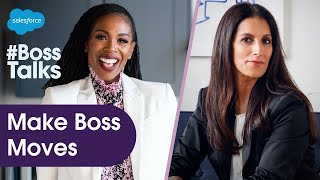
A Salesforce Boss Talks interview with Sukhinder Singh Cassidy about career decision-making and risk-taking. Key messages: reject the "myth of the single choice"—careers are built from many linked micro, medium, and large moves; get into motion and build a portfolio of risks rather than waiting for one perfect move; there are four reasons to take risks (ambition, discovery, learning, avoid harm); practical techniques include pre-morteming failures and fearing both staying still and relying on a single risky bet. Anecdotes include her 1997 move to Silicon Valley; she describes herself as a "net energy transmitter."
Questions this video answers
July 20, 2022.
1997.
A single skill degrades by 50% over a five-year period.
Chapters
I gotta feel like. You gotta feel that this is gonna be good. Say hello.
Hello, everyone, and welcome to Boss Talks, a series featuring candid career advice from some of the best in the business. Today's episode is all about making moves. And our careers are made up of all the small decisions we make every single day. Whether it's where we wanna work, what role we wanna take on, or how we address something with our manager, every small decision matters, and it can be hard to know if you're making the right one. The good news is most of these decisions won't make or break your career. It's called a journey for a reason. And the experiences along the way are often greater than the destination itself. So don't be afraid to just go for it. To help me navigate this topic, I've invited someone who has made some serious boss moves in their career. Sukhinder Singh Cassidy has helped build some of the best known companies, including Google, Amazon, StubHub, and more. She's also the author of Choose Possibility and the founder and chairman of the board list. Sukhinder, welcome to BossDocs.
Well, I'm so happy to be here, Ebony. Thanks for having me.
The way you've just navigated your career is like goals for many of us, so we're here to learn from you. So I want to just jump right into today's topic and ask, what are some of the most memorable experiences and moves you've made in your career? Good, bad, or indifferent? Because they can all be really great learning experiences.
Absolutely. And I think one of the things that's probably most worth appreciating is, you know, not every great move looks great at the moment you make it. And sometimes we go through multiple moves to get the reward we want. And so if you measure it on day one, they may not all look great, but when we hindsight, you know what those moves brought us, we often find it's something pretty magical. So probably one of my earliest and most memorable moves was the move to Silicon Valley. I was living in London at the time and working for BSkyB, a media company. And all of my roommates, I was in my mid-20s, had actually moved back to the States to go to business school, but two of them were California girls. And so I visited one at Stanford Business School. And let me just say, I fell in love with the weather. I fell in love with the esprit de corps around entrepreneurship. And I really wanted to be an entrepreneur, but I didn't know how. And so I upped and moved to California. I wasn't really thinking about what was happening in Silicon Valley at the time other than I wanted to be an entrepreneur. But unbeknownst to me, obviously, 1997 was the start of another really major, I'd say, surge in Internet usage, mainstream Internet usage. And it turns out that moving to Silicon Valley at that time, you have lots of opportunities to succeed, and quite frankly, a lot of opportunities to fail, and it'll still turn out okay. So that's probably one of the most memorable.
So you've written a lot about the myth of the single choice, which is the idea that one decision can make or break our career. And I think you and I are both living proof that that's not true. So what's a more constructive way to think about decision making?
Sure. So, first of all, I think in the book I write a lot about what I call this myth of the single choice. We often think that a single choice will sort of lead us to glory or abject failure. And of course, like popular press, kind of creates myths around the big risks that people take in their careers. Right. So in hindsight, everything boils down to that one big move that somebody made when, if you turned it inside out, you'd find that between any major reward, and I can guarantee, whether you're Jeff Bezos, whether you're Elon Musk, whether you're Sukinder, whether you're Ebony, between us and any major reward is not one move. It's often one choice that leads to another choice that leads to another Choice. It's probably 100 to 1,000 choices you make in order to optimize every move towards this ultimate reward that you once imagined. And so I always say to people, first of all, the most constructive way to think about it is maybe stop subscribing to the myth of the single choice and recognize that between you and what you're ultimately seeking is that big Reward is probably 100 or 1,000 chances to make another move, because all of those link together to get the reward. And so stop overweighting the initial choice. And maybe the most important thing to do is just to get into motion with, you know, a smart choice. But then realize you have many, many, many more moves to make.
I love that. Get into motion. And as you were talking, what I thought was these micro moves, you just have these, like the series of moves that you said could be one, two, a thousand, you know, moves that we make that ultimately lead us to where we want to be, and then we're making moves from there. We're always in motion. Hopefully we're growing and learning and we're always in motion.
You got. And by the way, you hit one other thing, like everybody presumes it's one mighty move, right? You and I both know you can move, you know, you can move 360 degrees all at once, or you can move a degree at a time and you'll still, you know, have pivoted 360 when, when all is said and done. And so I think we often think that every move is of a big size. And I think that moves of our micro sizes, medium sizes, large sizes, right? And you're moving in like their combination steps is sort of my point.
That's. I love that. And you know, so much of navigating our own career is rooted in this risk taking. And for some people, a micro move might be as big as a huge leap for someone. And I know it doesn't come easy to everyone. So tell us some of your tips for building that risk taking muscle so we can get a little bit more comfortable doing that.
Well, first of all, I think we tend to boil risk taking to like, what's the ambition I want to achieve? And what I say to people is often there are four reasons people take risks. Number one, to achieve some ambition. Number two, to discover. So risk taking for discovery is really underutilized and we'll talk about that. Number three is risk taking for learning, right? You and I might say, hey, somebody offered us a career move that looks lateral, but you get to learn a whole new skill. And so, you know, in my career, I've certainly taken a lot of those moves which don't obvious, you know, at first blush seem the obvious move. And then the last reason we take risk is to avoid harm. I mean, think of all the risk taking that happened in Covid when people are literally like, wow, my business cannot go bankrupt. What am I going to do? And people learn their own agility and risk taking maneuvers to avoid stuff serious harm. So there's these four reasons. But if you think about the three of the four for upside, right? Learning, discovery, ambition. So I would say that people find a reason to take a risk today. And that could be as simple as something's bothering you at work and you stay silent about it. It could be as simple as you need more support at home, yet you don't raise the conversation with your boss or your partner. It could be you're thinking about a career move, but you think it's one mighty move. And I'm like, well, what's the Risk taking you could do today for discovery, like what's the thing you're imagining? What's the smallest move you could make today to learn something new and discover what's possible? These are all micro risks you could take today. And again we tend to wait and think like, oh, we're going to pile this all up into one big move we'll make one day. And I'm like, but what if I told you that you could find a reason to take risk today under any of those fears? What little risk would you take today?
I'm sure everyone out here wants you to be their career coach.
Just already these few questions.
Oh, it's awesome. And I really just admire, I think that the theme that I'm getting so far that through line is just get in motion, do something, just be in action.
Yeah. You'll start to make your choices like DNA. Right. And as those choices link, you're either going to come to a small outcome, a bigger outcome, a bigger outcome. Some of those outcomes you may failing outcomes, but it kind of doesn't matter. Right.
It's a certain play, it's the matter. So what techniques do you have for just pushing past that fear to focus on the opportunity itself?
Yeah, you know, you're, well you're, you're hitting the biggest risk. Of course I think there, I think the irony of risk taking is there arguably two big risks in my mind that people fail to estimate. One is the risk of staying still. That is literally doing nothing. And data would tell us that one of the best stats I've seen is from the World Economic Forum that talks about the fact that any of our single skills degrade by 50% over a five year period. So simply by saying skill still you're actually falling behind. Right. So if nothing else, let that remind you that any move is a good move when compared to staying still. Any move. Right. As long as it increases your learning.
But that gave me chills.
Yeah, I know, it's crazy, right? And then the second big risk is taking only one risk. Like literally I'm like, if you think you're going to be a smart risk taker, it's like, it's like learning saying I'm going to be a trader but I'm going to make one trade and that trade better work because that trade is going to make me a millionaire. And I'm like, well the best traders, you know, they build a portfolio of trades and they learn from each trade and they try to get smarter and they know that they just need to build a Winning portfolio. And so I think that, like, part of what keeps us not acting is that we think stability is safe, untrue. And then we also think, like, hey, it's one big move untrue, you know, so that's the. I mean, if you need help getting into action, those are two things that you should fear more than making multiple moves. Fear making no move, and fear putting all your eggs in a single winning move. Because that is the. Like, that's what I call luck. Those are two ways to get yourself in action. And then I think there is more concrete sort of as you're trying to make a decision, also things you can do to get yourself into action. I will say to people, instead of just visualizing the positive, which a lot of people do, they visualize the positive. And I get that. I'm a visualizer, too. I want to, like, imagine what I'm getting, what's going to happen. But if you can't overcome your fear of failure in acting, it doesn't matter if you visualize the positive. And so there I would say to people, try pre morteming the failure. Try literally, you know, pre morteming. The choice you make, it fails, and then what you do. And sometimes pre morteming is a very specific way in which we can realize that if there are multiple choices after a failing choice, you likely have more freedom than you think.
I love that, because most people think about doing a post mortem, but you're getting ahead of it. So you're doing a pre mortem. And it reminds me of something one of my mentors and coaches said to me. She used to tell me, play it through to the end. You know, like, that's the right. Best case, worst case, play it through to the end, right? And you just try to imagine different outcomes. And so I love that. But now I have it. Now I have a term for that. We're going to pre mortem it.
Pre mortem and failure, I think, is a really great technique as opposed to visualizing the positive. That's right. Yeah.
All right, Sukhindra, we've come to my final but favorite question. And that is, what is your superpower?
What is my superpower? I think I'm probably a net energy transmitter, meaning I think I can give people energy and a feeling of momentum and a sense that something is. Something's achievable. So I think I'd like to think that most people, you know, will say an interaction with me can bring them not just insight, but maybe some feeling of possibility and, like, five more things to consider. So I'd like to think I'm the Net Energy Transmitter. Now my husband may not say that because I may pain in his ass but but generally speaking, I think I bring a lot of energy to situations and I hope, I hope I distribute it to the people I work with.
I know for me you've expanded my horizon and the art of what's possible. And I just want to thank you for being so thoughtful and helping us navigate our careers and to make those boss moves that we all want to make. So thank you again for being here today.
Well, thank you for having me. So much fun to see you.
I hope you all enjoy today's conversation. And to watch more episodes of Boss Talks, check out the new Salesforce Plus. To continue boss building, head on over to trailblazer.salesforce.com to join millions of trailblazers who are learning relevant skills, connecting to fellow trailblazers, and giving back with the Trailblazer community. With that, thank you so much for tuning in to Boss Talks and I'll see you all next time.
K.









