Making Friends with Aneel Bhusri - Ep6 | The Inflection Point | Salesforce
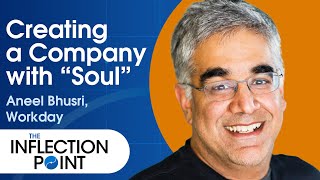
Aneel Bhusri, co-founder and co-CEO of Workday, talks about learning from Dave Duffield, building a values-driven company, and expanding from HR into finance and analytics. Workday interviewed its first 500 employees directly and uses acquisitions like Adaptive Planning and Platfora to grow. Bhusri describes his introverted leadership style and Workday's focus on stakeholder capitalism and diversity.
Chapters
Half of the world's largest companies rely on workday enterprise software. And workday's co founder, co CEO is once again thinking big.
We've got to do the right thing. We've got to create opportunities for those that don't have opportunities.
He wants to deliver more than results for shareholders or even stakeholders. Anil Bouchri is with us today to talk about the future of work and making sure a company has a soul.
That's the way we're going to get through this period of time together.
Let's find out what he means. Hi, Anil, thank you for joining us today.
Thanks, Monica. Great to be with you.
Let's start with the name of this show, the Inflection Point. Do you have one of those moments when everything changed for you?
I do. I was in between years at Stanford Business School and I randomly ran into George still, who's one of my closest friends and mentors at a Burger King. And I said, go see Dave Duffield, a legendary human in the software world and just a great human being. I went and had drinks with Dave. Back then he drank Chardonnay, I drank beers. Now we both drink Chardonnay because I just follow what Dave says. He said after a couple of drinks that, hey, I'm not sure what I'm gonna do with you. Why don't you take a few months off, But I'd like to give you a job and come back and work for me in the fall. And I remember telling my friends what an amazing guy, but HR and accounting software, that seems pretty boring. I'll do this for a couple years and then I'll go to Apple or someplace like that.
Apple was much more cool. Come on.
Exactly. And 20 years later, I'm still doing HR and accounting software.
So you really did have an inflection point.
Yeah. First George and then Dave changed my life.
Well, it's really fascinating that in addition to doing that kind of software, you've also kept this same friendship with Dave. And you all have almost a three decade difference in age. How has it worked so well that this story of your professional life is also a story of friendship?
You know, in some ways I think the age difference made it easier. We're not competing with each other. I knew I couldn't be Dave. And our relationship started out with Dave being my mentor. And over time that grew into friendship. He was one of the best men at my wedding. And our roles have evolved over time. But it's all built on this great friendship which comes from a view of similar values. Dave's one of the kindest, nicest human beings I've ever come across. And he was focused on being a great CEO and creating a company that was a great place to work before it was fashionable.
Exactly. And he cared about values way before people started talking about values and purpose. I mean, he cared about it, like, 30 years ago.
Yeah, exactly. And I've been fortunate to bump into people like Dave in my life that had the right set of values and had a purpose, and then they had their success as opposed to the success driving the need to have a purpose.
And, Neil, not all best friends can work together. And not only just work together, but do it forever.
And.
And then. Is it really true y' all have never had a fight?
We've never had a fight. You can't say that about my wife.
And he can't say that about his wife. But Dave and I have never had a fight. 28 years being together, we solve it.
Over a glass of Chardonnay. And if it takes more than one, we'll keep doing it until we're on the same page. I love Dave like a second father.
Okay, now let's tell our viewers exactly what is workday. I have workday on my laptop right here as a tab. Half of all Fortune 500 companies use Workday. Tell us exactly what workday is for those who happen not to know.
So we started out as a HR software company, and the big shift was that we moved what we had done at PeopleSoft, which was a leading HR software company, moved into the cloud. Oracle bought PeopleSoft, didn't want me and Dave, and we thought, hey, there's this transition happening, so let's take HR into the cloud. And that's expanded over the last 15 years to now include finance. It includes planning on the front end and then analytics on the back end. We're now up to 3,000 customers, 4 billion in revenues, and cranking along, taking customers away from SAP and Oracle.
I know. I see that occasionally when you go on in Kramer and talk about getting Caterpillar. I saw that recently. Is it true that you and Dave came up with the workday on a piece of paper at a diner over breakfast?
Sort of. So I would say that the real story was we were trying to save PeopleSoft during the end of the hostile takeover. And I started working on an idea.
About what would HR and finance look in the cloud. We had the idea. What was on the napkin was the values.
Wow.
How are we going to build this company differently? The tech industry and the Fortune 500 world should be very grateful to me as I convinced Dave he had one more startup left in him. He was 65 at the time. And I said, dave, you got to do this. We can do something really special here, but it won't happen without you. And I knew that it wouldn't happen without him. He's an icon and customers loved him. And he thought about it and he said, I got one more in me. And then he decided to move his whole family down from Nevada back to California for a period of time just to get work day going.
Wow. Now, it's interesting though, that PeopleSoft didn't want either of you after you had done such a great job. And was the hostile takeover really hostile by Larry Ellison?
I would say it's hostile with a capital H. I have a ton of respect for Larry. He's done amazing things in building Oracle, but that was not the future we wanted for PeopleSoft.
But in many ways, I'm grateful to.
Oracle and to Larry.
Workday would have been a lot harder.
To do as part of PeopleSoft versus a brand new startup.
So you're glad that he was so hostile to you?
In hindsight, yes.
In hindsight, yes. At the time it felt like hell, probably. But anyway, now, today let's talk about what workday is doing in the future.
Well, so the first thing is we're trying to underpin everything with machine learning. I'm careful to use the word artificial intelligence because I think that's overstepping it. Machine learning is a way to take advantage of all the data that's captured and help companies make better decisions. We acquired a company called Adaptive Planning, which has been very powerful during this Covid world. And then we acquired another company to help us get going on the analytics side called Platfora, so we can plan, execute, analyze all in one platform. During COVID a company came along called pcon and we recognized that they were really important to the future of hr. Everybody's working remotely. We don't know how our employees are feeling about the company, feeling about their manager, how engaged they are. And this company really came up with a new way of doing employee engagement analysis. So we acquired them.
And then with COVID what have you done to help your customers with that issue?
Many of our customers are using our HR system to track reports around Covid cases. And most recently we came out with a vaccine management system that enables companies to figure out how they can bring employees back in a safe way into the workplace. So we're just trying to support our great customers, many of them are combination of frontline workers and then almost every major pharmaceutical company. Johnson Johnson, AstraZeneca, Pfizer, they're all workday customers and they're saving us. So our job is just to support them as they go through this really challenging time.
That's wonderful. Now let's talk a little bit about your leadership approach. We've talked about how you and Dave are such close friends and you work well together and you were co CEOs now, having watched CEOs my whole life and work with them, this is not usually a formula that works. I mean, most of the time this structure is not popular and it often fails. When you look at how often it's tried, how does it work for you? Are you just such a friendly guy?
Never. I think it's the culture that Dave and I built when we started Workday. So for the first four or five years, he was the sole CEO. We went public, we were co CEOs for five years, and then I was sole CEO for the last eight years up until July. And I would say my favorite time was when Dave and I were co CEOs. Two is better than one. We're best friends. We can divide and conquer. And I think Workday benefited from that model. If you can check your ego at the door, two is better than one. When you can't check your ego at the door, it's complicated. But I really appreciate having a partner in crime.
I think the ego thing is big. Cause CEOs, they're used to like being in charge.
Yes and yes. Yeah, absolutely. And I also say that it helps when your interests are not overlapping where they're really complementary.
You've been described as an optimistic and an introvert. This is what I've read about you. Now, I understand you have to be an optimist to be a startup founder because most startups fail in Silicon Valley. But usually you have to be an extrovert because you have to be the master of an elevator pitch. So how can you be both an introvert and an optimist in Silicon Valley? Or do you dispute those two terms about you?
I'm definitely an optimist. There's no question about it. There's no way to start a company without optimism. And Winston Churchill had a great quote during, you know, during World War II. I choose to be an optimist because basically the other choice is not very good as it relates to being an introvert. Dave and I are both convert introverts. I think it makes us better listeners. My first instinct when I'm sitting Down with someone is to want to listen. I don't feel compelled to talk. And over time, I've learned to conquer my fear of talking and become right on the line of an introvert versus an extrovert. But I really do like to listen.
And Dave also told you somewhere along the way that no one's ever learned anything while talking.
That's exactly it. And I took that to heart. And the way I try to run a meeting is I try to listen and understand where everybody is before I weigh in. Because if you want to drive a group, you want to get them on the same page, you really do have to listen first.
Now, you clearly, when the two of you started workday, you prioritized culture. And did you actually interview your first 500 employees, or is that just a workday myth now?
No, we did. And actually, Dave and I interviewed the first 500, and I went well past 500.
Wow.
And we were interviewing them purely for cultural fit and values alignment, not for whether they had the right marketing skills, the right development skills. We assumed our teams got that right, but we wanted to make sure that they would fit in our value system. It was about having a sense of humor. It was we versus I. It was about the way they talked about their peers at other companies.
And now you don't obviously still interview your employees as they're hired, but do you make sure the people who do it have the same values? How have you passed that along?
Part of the benefit of integrating those first 500 people was we told them, you're cultural carriers now, and you have to make sure that the next 5,000 who come into the company see the world the same way we do. Built around a team, built around ethics, around doing business the right way, giving back to the community. We're now well past that additional 5,000, but those original 500 employees are still scattered all over the company and all over the globe, and they make sure that we're continuing to hire the right.
Way somewhere along the way. Did you actually say culture trumps strategy? Are you that big of a believer in culture?
Oh, yes. Oh, yes.
That sounds crazy to me. What if your strategy was stupid and you just all loved each other? How could that work?
The right culture drives the right strategy. If you have the right culture, they put all their thoughts forward, and you collectively come up with the right strategy. They'll use the culture to figure out what the right next thing is to do and do it.
Interesting. Now, you've benefited, clearly, from Dave being your mentor at the beginning, but do you now, reverse mentor. Explain what that process is, a reverse mentor.
I do. I've had it in a couple areas. I was a deep technologist 20 years ago, but I'm not that close to technology anymore. And so I'll have some of our smart technologists every now and then just mentor me on here's where the technology is, here's where it's going, and here's what we need to do. I say even a finer point on that is what's happened during the last year with social justice. I really wanted to understand the life of a black person at workday or a Latinx person at workday. And so I signed up two individuals, one woman, one man, very well respected and successful executives at workday, just to help me understand what was going on. And it was eye opening because I didn't think about some of the challenges they faced. For the man who's become a very good friend, he talked to me about how he felt safe at work and he felt safe at home, but not anywhere in between. And I thought, my God, we got to fix that. And I really didn't have any insight into that. And so my promise to them is, I'll mentor you on your career, you mentor me on these social issues and make me better so I can make workday better.
And did they view that as a positive for them or did they really view as a way they could be open to you or they're a little bit nervous? I don't know if I should tell them the real truth.
Well, you'd have to ask them. But I think the first three months they were nervous and trying to figure it out. And we're now nine months into it. I think the last three or four months, we've just become friends. It helps me think through these issues in a better way. And hopefully for them, it feels like we really do care. We really want to do the right thing.
That's actually really fortunate for you and your leadership.
It is. It's a gift to me.
Yeah. Now, when Covid first came about, when we all had to change and go remote, you took a step with all your employees to support the workforce. What did you do and why?
We looked at it and said, this could be a long haul. This could be a really difficult time. People are going to lose their jobs. That started happening really quickly. And so let's try to take financial stress out of the lives out of our employees. So we gave every employee a two week bonus. We thought, let's just get ahead of the curve and give them Some comfort that A, we're going to support them and they're going to continue to be employed at workday. But if the B, if there's a family member or a spouse that's being impacted, hopefully this, this helps in a little way to, you know, to get through this really difficult time.
And did you need to bring it up to your board or are you just like, we're doing it, that's it, we're doing it.
Okay.
What about the future? Do you hope that you're back in the office? Are you looking for a hybrid model or eh, we can do this remote.
It's a tricky question these days. First thing I'd say is I personally like to be in the office.
I get energy from being around our employees. I think collaboration, especially on the software development side, does not happen over Zoom. I love Zoom, it's a great product. But.
And you're zooming me from home. You're at home right now, aren't you? I'm at home.
I'm at home. It's Groundhog Day. I'm home once again doing a Zoom call. And also think you can't really have a great culture if everybody is remote.
So it comes back to culture. It's back to culture with you.
It does, yeah.
Now another issue that's very big in the last year is stakeholder capitalism. It's so in vogue that even the Business Roundtable endorsed it last year. So it's no longer just shareholder capitalism, it's stakeholder capitalism. But you have even gone beyond that. You have said a corporation should have a soul.
What I think many of today's current CEOs really believe in that same concept. They might not use the word soul, but if you ask them about that.
They would agree with it. Whether it's Market Salesforce or Doug McMillan at Walmart, Mary Barra at GM or John Donahoe at Nike, they all believe in doing the right things from a stakeholder capitalism perspective and taking care of those people in the world that maybe are left behind. And what I realized is that that's what Dave and I have been practicing for many, many years. We are focused not just on taking care of shareholders. We want to take care of employees, want to take care of customers. Very importantly, we want to take care of the community. And that last piece is where you need a soul. The world's going through a really challenging time with COVID with layoffs, with social and racial justice issues. Corporations are groups of people and they need to step in. And so much of a person's Life today is life at work. We've got to do the right thing. We've got to create opportunities for those that don't have opportunities. We need to step in when there are inequities. We need to say what's right. On topics like immigration, it's really. I think it's incumbent. And I'm so proud of Today's generation of CEOs, because the ones I look up to, they run it from a stakeholder capitalism perspective.
And Neil, they don't say the company should have a soul. You have gone a little bit farther about the soul thing.
I bet they would say that if asked. I just articulated it in a way that I thought about it and Dave thought about it.
It's interesting that this may have shaped your view when you talk about opportunity. Tell me a little bit about that. I think somewhere along the way I read you said talent is everywhere, but opportunity is not. That was a profound statement.
Well, it's not a fair world for everybody. Michael Bush, who's now on our board of directors, who runs a Great Place to Work Institute, he hasn't talked about great places to work. He talks about great places to work for all. And we have to make these work environments work for everyone. And sometimes they might not have gone to the right schools, they might not have had the right training, but there's talent out there, and it's incumbent on us to find that talent and bring them into the workforce. We gotta create opportunities for everybody. And we have a program called Opportunity on Ramps to do that.
Can you also help the companies improve their own diversity and inclusion?
Absolutely. We want to help all of our customers be better on this topic, and our customers want to be better on this topic. And the first thing you need to do to be. To be better is you got to track the data. I'd say the second thing, which is the more complicated part, is you got to share the data externally. If you don't share it, you're really not owning it. And so we shared our data, which was not great, but getting better. Actually getting better pretty rapidly. And I think it's really important that if you want to be better in this topic, measure the data, share the data, improve on the data.
Okay, let's switch from workday for just a sec to Greylock Partners, a famous venture capital firm here in Silicon Valley. You were the managing partner for a while, and there were a couple companies that you actually helped bring to market. Tell us a little bit about that. And how were you so smart to pick those and Pull them out because they're big names.
Today I joined Greylock because I was fascinated with startups. And then as managing partner, my partner Dave Z. Brought two companies to the table. LinkedIn and Facebook. Candidly, I can't say I understood Facebook, but it seemed like a good idea. But I loved LinkedIn. LinkedIn, to me, was the natural extension of where HR was going. And the idea that you would create a network that could be, over time, a recruiting network. And, you know, I love Reid Hoffman, and today he's one of my best friends.
Well, maybe you're all our best friends because you made him rich.
No, I would say he made himself rich. He created an incredible company, and we were just fortunate to be investors.
But you were dead on on LinkedIn and Facebook for sure on the fact that they would grow so big. Now, most people would say you have a dream job. You're a big time tech CEO. I think that you want to be a professional golfer. I see Phil Mickelson wearing a workday shirt every time he's out playing golf. I've seen pictures of you with Steph Curry at a charity golf tournament. Tell me about your real dream job.
Oh, it is definitely to be a professional golfer. I just wish I had that talent.
I love that game. I grew up as a competitive tennis.
Player, and what I'd like to say is I was a really good player £25 and 25 years ago, but I got worse as time went on. And golf's one of those sports you can get better with that age, but most importantly, it's a great way to spend time with friends.
That's wonderful. Now, since you love to play golf with friends, and we are now new friends, aren't we, Anil?
We are.
Okay, so I want to learn to play golf. Okay. I actually have some clubs that I've never used.
I'm not good enough to teach you to play, but I will bring a coach that can teach both of us to play better.
Okay. Listen, I'm really going to play golf with you one of these days.
Let's do this. I'll bring the coach.
Okay, cool. All right.
I'm not that good.
Okay. Thank you so much for joining me today.
Thank you, Monica. It was really a pleasure.
Bye.
Bye.
Next time on the Inflection Point, I'll chat with Dee and Jimmy Haslam, owners of the Cleveland Browns.
Everybody in the country knows how your football team did on Sunday. And when you win, it's the ultimate high.
We lose, it's crickets. Social justice has been the forefront of the national conversation. We've had a lot of conversations with our players now. We should have done it long before these issues.
The platform of an NFL owner is a high one, and it gives you the opportunity to have an impact.









