Managing Anxiety and Sleep
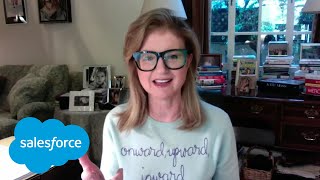
Arianna Huffington shares micro steps to manage anxiety during COVID-19: box breathing, gratitude practices, and a hard cutoff from news before bed. Sleep is foundational to immunity, and small daily habits build resilience when uncertainty feels overwhelming.
Chapters
Today, we are very honored to have the incredibly talented Arianna Huffington with us. You know, I've had the honor of introducing Ariana on multiple occasions and doing a couple of Q and A's with her and I just adore her and I'm really, really thrilled that she could join us today. For those of you who are not familiar with her, she's the founder of Huffington Post, one of the most widely read news blog sites in the world. But more close and near and dear to my heart. That's very impressive, Arianna. But more near and dear to my heart is that in 2016 she launched Thrive Global, which is a corporate and a consumer well being and productivity platform that who we at Salesforce partner with a lot. And their mission is to really just change the way we live and we work and end this kind of delusion that burnout is the only way to get to success. So we have lots of wonderful ways that we are partnering with them and a bright future ahead for Salesforce and Thrive Global. Arianna's offered over 15 books. The most recent one was called the Sleep Revolution, which was a big game changer for me. And she's here today to, to talk to us about managing anxiety, which is something is good for all of us. And with that, Ariana, I turn it over to you.
Thank you so much, Jodi. I am really happy to be here with all of you, even under this very difficult, trying circumstances. I want to make sure I'm looking at the right place. Right now I'm looking at Jodi. Is that where I should be looking, Joy? Or should I be looking more to the right or I think right there.
That's it. You got it right there.
That's great because that's it, right? So I feel that these times are both incredibly trying and so anybody who is going through anxiety, please don't think this is abnormal. It's completely normal. And the first step is to totally acknowledge it, but also that we have opportunities and steps, steps we can take to help us get back to our own center. And really the work that I've been doing in the last few years and that started really with writing the book Thrive. And I want to offer a free PDF to everybody who wants it because Thrive was really about the recognition that we all have in us. This place of peace, strength, wisdom and harmony. Like most of the time we are not there. And especially during a time like this, we are not there more and more because we are legitimately anxious about our health, the health of our loved ones, financial stress, Are we going to have our job? An enormous amount of anxiety provoking triggers, but nevertheless, and I want to start with that because it is the key to dealing with anxiety. We need to realize that according to every religion, every spiritual tradition, every major philosophy, if you don't believe in any religion or spiritual tradition, it doesn't matter. Every philosopher has said the same thing, that that place exists by virtue of our birthright. So the question really in normal times, and even more important in times of crisis like this, is to find the ways to course correct and get back to that place as fast as we can. So it could be almost like an aeroplane. If you talk to any pilot, an airplane flies off course more than it flies on course, but they have an impeccable course correcting mechanism. So it's off course, on course, off course, on course. How can we create that mechanism in ourselves? And it all comes down to micro steps. As Jodi knows, at Thrive, we are obsessed with micro steps because big changes start with tiny little steps. And in the middle of so much that overwhelms us, we need things that can empower us and micro steps can empower us. So everything I'm going to suggest is really tiny. But by doing it regularly, every day, it's to going. Going to really dramatically help with the levels of anxiety. And let me just start by mentioning three of my favorite micro steps. The first that actually you have been mentioning in your social channels, and Mark mentioned it in his tweet, is simply breathing, consciously breathing. I can see Jodi doing it. If we can all do it. Just take a conscious inhale and a conscious long exhale. One more time. Inhale, Exhale, Inhale, exhale. So mindful breathing switches the neural circuitry of the brain that anxiety ramps up. So it's also at the foundation of meditation. And I know meditation is a big part of, of Salesforce. You have meditation rooms. The first time I spoke at Salesforce, I actually sat on the cloud stage and led people to a short meditation. So this is something that's kind of in your DNA culturally. So this is the time to actually practice it. And we even together with Salesforce, launched a podcast for people who still find meditation daunting called Meditative Stories Story that I highly recommend in these times, if you say get into bed and you're having trouble turning off your anxiety to go to sleep, please listen to a meditative story sponsored by Salesforce as it happens, which brings you into meditation through storytelling. Everybody loves stories. We put our children to bed and to sleep by Telling them stories so we can do that for ourselves. A storyteller walks us through a story in their lives. And then there are mindfulness prompts, music sounds that help you relax, get centered, slow down your brain and the anxiety levels and the cortisol levels so that you can sleep or you can do it at any time during the day. I sometimes do it if I got a particularly stressful notification or I got a stressful piece of news again, take a minute either to use your breath or to listen to something that relaxes you and distresses you before you go on. And stress and anxiety become cumulative. That's really what we are trying to avoid, the cumulative nature of stress and anxiety. We are not going to avoid anxiety and stress. These are going to be part of the new normal, but we don't have to live there. We can transcend them. And then this will become an amazing muscle that we have built that will transform our lives when we return to normal times. That's really the extraordinary thing of these times. Everything we should be doing now is something we should have been doing at all times. But now it's not just a nice to do, it's an imperative. I made that sweater that I'm wearing, which actually is the motto of Thrive. And our chief brand officer, who was at the Huffington Post with me for 11 years, Danny Sher, and now with us at Thrive, gave me this sweater as a gift. And it says, onward, upward, inward. So everybody I'm sure here who is listening knows about onward and upward. I'm sure part of why you have successful careers and have gotten where you are at Salesforce is because you have mastered onward and upward. But inward is also incredibly important. And during normal times, it's very hard to prioritize it because we're so incredibly busy and there are so many demands when now we have an opportunity to practice inward. And actually we absolutely have to. We have to in order to protect our sanity and reduce the levels of anxiety that otherwise become another epidemic. We have the physical contagion, but we can also have a mental stress and anxiety contagion if we don't take active steps. So I mentioned micro step number one around breathing. There is actually another breath technique if you are feeling particularly stressed, that, believe it or not, the Navy Seals use it. And it's called box breathing. And it's four to the count of four. One, two, three, four. Exhale. One, two, three, four. Inhale. One, two, three, four. Hold. So it's to the count of four. Inhale to the count of four. Hold your breath to the count of four, exhale. You can either do the very simple breathing that we did at the beginning or do the Navy SEAL box breathing. You can Google it, which has been proven to be particularly important in particularly stressful circumstances. So the second micro step has to do with grounding ourselves in the present moment. Again, everybody talks about that in spiritual traditions. You know, Thich Nhat Hanh and the monastics. When I was at Dreamforce a few months ago, were talking about it constantly. But now we just have to do it. Because if we don't stay in the present and we keep projecting our negative fantasies about the future, our anxiety is going to escalate. So let's ground ourselves in the present moment. One of my favorite quotes is Montaigne, the French philosopher, who said, there were many terrible things in my life, but most of them never happened. So a lot of the negative fantasies we are going through in our heads right now, let's assume for the moment are not going to happen. They are not based on any factual information. We are just negative fantasizing. And the third thing is gratitude. So I did the hand washing challenge, and you can go on my Instagram and see it. And my recommendation is every time we wash our hands for 20 seconds or 40 seconds, as they recommend, please remember during that time three things you are grateful for. You may be stuck at home with your children, and that sometimes, I'm sure, is incredibly overwhelming and difficult as you are trying to work, but it's also a source of gratitude, whatever it is that you feel grateful for. Right now, I'm feeling grateful for my bulletproof coffee. I don't know if anybody else likes bulletproof coffee, but I love it.
And.
I just took a sip of my steaming bulletproof coffee, and right now I'm in the present moment, very grateful for that. And I love working with Jodi, and I'm very grateful to be here with her. So here, three things. My children are here with me. My bulletproof coffee. Jody. Great. Suddenly I've switched from anxiety to gratitude. So I really want to open it up to questions, but I wanted to give you just a quick overview, especially to remember that you have that centered place where anxiety cannot live by virtue of your birthright. It's there. We just have to take a few moments, actually, 60 seconds. Neuroscientists tell us to tap into it. Thank you.
Amazing. Thank you so much for joining us. This is just exactly what my soul needs right now. One of the things that I know that I'm struggling with and That I think many are. I'm watching my family struggle with it is, you know, we feel very compelled to stay on top of the news and to be able to. And to a very real degree, we need to know what's going on. We need to be following the rules, we need to be continuing to check in. Right. And yesterday Parks were open for me. Today they're not open. So being able to understand that is important. But I find that I get very anxious every time after the news and not really knowing how to just divide it and section it off and dip my toe in and get what I need and then kind of get out because it's like a black hole that kind of sucks us in. So I'm curious to have your thoughts around just all of the different media that's spiraling around and how to manage it and how to regulate it.
That is such a great question. The first thing is to have a cutoff point at the end of the day that you stop looking at news and social media so that you can begin the process of transitioning from your day with all its demands to the time to be able to get a good night's sleep and recharge and start again in the morning. There is nothing you need to know at that particular time when you're having dinner with yourself or your family and getting ready to go to sleep. So that's where we need to move to trust that it's okay to have a cutoff point. And that is key because one of the things that we actually can do, and we're going to talk more about that during another conversation we're going to have next week, is things to build our immune system. And foundational to that is sleep. So sleep is no longer just great for our health, for our productivity and all the other things we knew. It is foundational for our immunity. So if we are so anxious because we've just watched something in the news or we just read about a 12 year old in Atlanta, as I just read this morning, who is in a coma with coronavirus, you know, and suddenly your mind goes through all sorts of negative fantasies. I thought children were had immunity, et cetera, et cetera. And we never know all the information, we never know exactly what happened. So we just fill in the blanks. We can't do that as we're getting ready to transition to sleep, because then our sleep will be disturbed. And it's not just that we're going to wake up the next day feeling exhausted. And that makes it much harder to deal with the much more difficult realities of our day of navigating children at home, work, remote, etc, etc, but also we are at this very moment compromising our immune system. So that's what I want to be so clear about. We are ground zero of protecting ourselves from the virus. The people who are most affected and in gravest danger are people with pre existing conditions. And in a sense, exhaustion and sleep deprivation become a pre existing condition that makes us more vulnerable to the virus. So the reason why this cutoff point is so key is to protect our sleep and our immunity.
That is very, very helpful. Thank you for that. Catherine, I think you said that there was a question that had come in. Do you want to throw one out for Arianna, please?
Sure. There's a couple questions that have come in. My college aged daughter is home and I don't want to scare her but she's not taking any of this seriously and it's stressing me out. Should I just let that go and just make sure that she's following social distancing guidelines.
So as long as she's following social distancing guidelines, that means she's taking it seriously, right? So it is absolutely key to have college age children and children of any age that you are not completely in control of, as you are of your school age children, make sure they follow these guidelines. It is imperative. And whatever you need to do to make sure they follow them, you need to do it. If they're under the same roof with you, you need to make it a condition that they need to follow social distancing. They need to find other ways to interact with their friends on FaceTime, on WhatsApp, on any communication method they're using. But no, we cannot be lax about that. It is key and it has been proven to be the only way to flatten the curve. And again, of course, let's help our children with the same tools that we are giving to each other here. The breathing, the gratitude, the being in the present, the cutoff point for social media. I mean they need them as much as we need them and this is the time to give them to them. And we are bringing together a lot of influencers that your daughter may listen to much more than she would listen to me or to you who are saying these things. When I did my hand washing challenge on Instagram, I challenged Selena Gomez to do it next and she did it. And it's worth going to see it. She has over 5 million people who liked it and viewed it. And maybe your daughter loves Selena Gomez. So when she Talks about social distancing or taking precautions she may be more likely to listen to. So let's find the carriers of these messages that different demographics are going to relate to and bring them together.
Great, thank you. How do I balance using technology as a lifeline to connect with loved ones and my need to unplug and be present?
I would say the need to unplug and be present and connect with ourselves. The inward part is the most important part. We have all nailed managing technology and I'm sure there's nobody working at Salesforce who isn't a master at that. So what we need to nail now is the inward part. As one somebody posted on Instagram yesterday, if you can't go outside, go inside. And that's particularly relevant right now. So I would always prioritize that because you can take a few moments to connect with loved ones. But if we're disconnected from ourselves and our own center, it's going to be very hard to navigate the new normal.
The biggest issue I'm dealing with right now is uncertainty. How do you manage all the uncertainty in the world right now?
Yes, absolutely. Uncertainty is the main condition of the times we're living through and it's not going to end anytime soon. But then it helps us realize that uncertainty is really a pre existing condition for life. Even before the coronavirus. Just think of all the things that happened in your life that you would not have predicted good and bad. And in the same way, we need to make a friend of uncertainty and instead of trying to exert control over what's happening, recognize where we have agency, where we have control, which is really about the steps we can take to reduce our anxiety and build our immune system and then trust that there is a kind of blueprint that we're not clear about that will only make sense when we are out of it. You know how often life doesn't make sense as we are looking at it now and as we're living it, but it only makes sense in retrospect. So if we can trust that that will be the case now, but not try to control what's happening right now, we are going to find a lot more peace in us. It's not easy, but with practice, I promise it becomes easier.
Another question. There's feelings of anxiety and being overwhelmed at these times, especially when the kids are at home because all the schools are closed. What kind of tips do you have from any parents who are home? Trying to balance the kids with everything else?
Yes. So we actually have a lot of micro steps for Working from home, which we can send to you. But it's obviously particularly stressful if you have young children out of school, if you're in a more confined space. I mean, I have friends who are both partners working from the same space and with young children. So I think what is so important is as much as possible to set a schedule from the night before, knowing that of course everything is going to change, but at least have some plan and knowing who is the. If there are two partners, sometimes they're single parents who don't have that luxury. So kind of operating within the limits of what we have, to be able to take turns, to be able to occupy them. And it's kind of amazing how children can be occupied with things that are not just video games or iPads. And I post a lot of those things on my Instagram. You can follow them and see, like I posted two twins kind of just playing with each other and their pillows and saying, bugs go away. And children are internalizing what's happening at every age. And so being able to also talk to them when you are not stressed makes a big difference. Answering their questions, have regular conversations, not just one big talk about coronavirus, but regularly allowing them to express themselves. It's kind of an incredible opportunity, and it's challenging and really hard. Trust me, I'm. I'm not minimizing it, but it's an incredible opportunity to move into our unconditional loving and acceptance. And all of us who have a perfectionist tendency need to abandon it. You know, my house has never looked more of a mess. I saw a level of dust suddenly as I was walking by, and I thought, oh, my God, you know, really need to clean up this dust. But at the same time, the only way to manage this with less stress is to prioritize. These are the balls we are not going to let drop. And other balls will drop.
Thank you. I have another question. What has your daily routine been like in quarantine? And what is your advice for people who are hyper extrovert, who feel suffocated being isolated and inside beautiful.
So my personal routine is to kind of, you know, get out of my PJs right away before I start working. Not just when I'm doing Salesforce webinars, but I have so many friends who don't get out of their PJs. And I think it's good to dress as though you're going to work. You know, I would go to my office in a sweater and jeans. I have friends who really dress up you know, even though they're in their home office. Whatever makes you feel. My work day started. Instead of, like, feeling like there is no separation, we need to create some separation even though we are in our home the whole time between our work day and the end of our work day. That's important anyway, because many of us have blurred those connections. But we need to. It's even more important when we are all working from home. And the other question was, there was another question, right, about the extroverted nature.
And like, what are you doing with all this energy and you're cooped up in your house?
So actually, and that may sound paradoxical, whether you're an introvert or an extrovert, this is a good time to learn to go inward, even for five minutes. You know, don't think of it. Oh, do I have to do, like, half an hour meditation? No, just take five minutes to be still and go inward. Don't worry about your mind chattering or anything. It's going to. If you don't want to do it without some help. We've launched Meditative Story in partnership with Salesforce. Highly recommended. I think we're sending some links to your teams. It's really a way to get into a mindful, meditative space through storytelling because we all love stories. So as we are listening to a different story in each podcast, we get mindfulness prompts, sounds, music. It's super calming and relaxing, and it helps us go inward because truly, the only way not just to survive, but to thrive through this period is to tap into that place inside ourselves. Otherwise, truly, we're going to freak out.
So.
Remember. I'm sorry. It's like. It's okay. Hurricane.
Hurricane. No, Find the eye.
Find the eye. Five minutes a day. Remember, we call our micro steps too small to fail.
Too small to fail.
Too small to fail. Like, you can't fail. If five minutes of stillness or meditative story or not being an extrovert is too long. Do it for two minutes. Whatever works for you. And then you begin to build. And then we need to be extroverts digitally. If you are living alone, you know, FaceTime, your friends create. I have a group of girlfriends who are setting up a zoom cocktail hour tonight. You know, kind of get creative. There are so many symphony orchestras and museums who are offering online tours and online concerts, and so arrange to go to that concert digitally with your friends. You know, let's get creative. Let's get imaginative. It's like. It's a little bit like being children and making do with whatever has been given.
Well, and we are now going to be practicing this every morning, every afternoon in these Be well Together series. So I think, you know, one step at a time. I was taking, I was taking a couple of notes while you were speaking and I really loved the three micro steps. Right. Just start with breathing. Remember that negative things don't always happen. What was that quote again? Can you, can you repeat that quote? All the negative things in my life.
Montaigne quote. There were many terrible things in my life, but most of them never happened.
I love this. I love this.
I know we only have three minutes left, Jodi and Catherine and I really wanted to give some resources to people.
Thank you.
At any time.
Thank you.
First of all, thriveglobal.com which is our media platform, that's all we are covering. Secondly, my Instagram is just full of quotes like that, tips, you know, ariana Hough with two Fs. You can go there and there's always going to be something. It could be a joy trigger to some that will make you laugh. But it's all for these times. There are not going to be a lot of glam pictures of me or.
Anyone at this point in time.
Or anyone. Yeah. And tons of stuff in stories about how people are coming together, what people are doing. And also in half an hour we are launching a big campaign together with the Harvard School of Public Health and caa, the Creative Artists Agency for first responders who are the frontline healthcare workers. And we are, we'd love you to go there. It will be first responders first. It will be live in half an hour. And that's where we can also find help for our anxiety, by giving and helping others. And the people who need us most are the frontline health care workers who are really, we call them the first responders of this crisis. And the reason I mention this as not something that you can give to but as a resource for you is because when we give to others, it puts our problems in perspective. So when you read there about the doctors and the nurses sleeping in their cars because they can't go home, not having enough protective gear, putting them at risk for us every day, it definitely helps us put our own problems in perspective. So giving which is another micro step is something we are encouraging everyone to do. And also we have tons of micro steps for the first responders in first responders first sight that you can also use for yourselves.
Amazing, Amazing. Thank you so much for joining us, Arianna. We are so grateful for your time. This has been really, really special. And I think this is an exact reason why we have so much pride in working for Salesforce and being able to tap into luminaries like yourself. So thank you. Thank you.
I want to add one more resource to what we're going to give everyone, which is I had recorded for Audible a parody of Good Night Moon. Anybody who is a parent listening knows, of course, that Good Night Moon is a perennial favorite, but it has a lot of. A lot of psychological truth in it. We are basically helping our children disconnect from their surroundings and their world in order to surrender to sleep. So my parody is called Good Night Smartphone. And people can download it from Audible and listen to it as just a way to slow down and then put their phone away because truly nothing is going to happen between night and morning and creating a transition to sleep. Also, in the morning when we wake up, let's take another micro step, 1 minute, 60 seconds before we go to our phone so that we can almost like prepare ourselves again. Remember what we're grateful for, set our intention for the day, something before we go to the latest news, which may be another 300 cases of coronavirus or the parks are closing or whatever the latest news is, which immediately before we've even touched the ground with our feet, floods us with a cortisol hormone.
We're really looking forward to bringing you even closer into our ohana because you are family and we are all very, very grateful for you. Thank you very much and we will talk to you again soon.
Thank you so much. Thank you.
Bye bye.









