Mastercard's CMO is Redefining Brand Inclusivity | Connections Ep. 25 | Salesforce
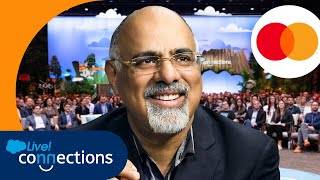
Transcript of a live Connections (Salesforce) interview (July 12, 2022 event) with Raja Rajamaran, Mastercard’s longtime CMO. The conversation covers his personal background (Hyderabad upbringing, chemical engineering), career pivot into marketing, inclusive product design (card notches for visually impaired users), multisensory branding (sound, smell, taste, Priceless Tables), and the role of trust and innovation in modern brand-building.
Chapters
Hey, I'm Sarah Franklin and welcome to a very special live episode of Connections. We are here in Chicago at Connections, the event. And who better to bring on stage than the ever amazing longtime CMO of MasterCard, Raja Rajaman, you ready to do this?
More than.
Let's go.
Let's do it.
Hello, everybody. And most of importantly, welcome Raja here to Connection.
Thank you. Thank you very much.
We'd like to take the show back to People's beginnings. And you grew up in Hyderabad.
Correct.
And your mother always taught you to diversify what you do?
That's true, yes.
Can you share a little bit about that with us?
Yeah. You see, I had a very interesting story in the sense that my mom, she was absolutely brilliant and she would always tell us that we have got so many gifts that we have been given. Don't just be narrow and focus yourself in one. Trying to realize all the gifts. So I was a radio dj. I was also a cricketer. I was also a tennis, table tennis, tennis, chess. And I did not, at the time, really realize what the importance is of doing so many different things. It looks almost like being scatterbrained, but actually it is not. It's fantastic. And you start experiencing different facets, and each sport, each area, it teaches you something different. It builds a different aspect of you. That's what I carried throughout my life. So even for example, as you know, in my career, 50% of the time I have been in marketing, but the other 50%, I was managing P&Ls. And I have moved across multiple industries, multiple geographies, and each time I go to some new place, it's a fantastic learning, but also bring my past learnings to the current role. And that's been invaluable to me.
So something that I don't know, that you know, that we have in common, guess what? I studied in college.
Chemical engineering, too.
Yes.
Oh, wow.
So we share. So we're both chemical engineers.
Yes.
And we're both CMOs.
Yes.
So people ask me all the time, I imagine they ask you, chemical engineering, marketing, how did you make that choice? How did you make that journey that.
Changed such an obvious transition? I wanted to pursue further my studies and I went to do my mba. And when I was doing it, between the first and the second years, I was in an internship and I was supposed to do a project on logistics for a color cosmetics company in India called lacmay. I was sitting in that one of the small cubicles, and my boss was at the next cubicle and he was having conversation with the agency. People. And I was overhearing what was happening because there was no soundproof or anything of that sort. And they were struggling to see. In those days in South India, it used to be very conservative that women of good character do not use color cosmetics.
Oh, wow.
That was a social thing, right? It's very fascinating. If you see, they say if you're putting color cosmetics on you, which means you are trying to draw attention to yourself, and a good girl or a good woman doesn't draw attention. Attention to herself. It was a conservative thinking. So they were trying to see how you can break through that taboo. And they were debating. I listened to it for 15 full minutes, leaving my project alone. I said, why are these guys struggling so much? It's so simple to me. So I just took a piece of paper and I said, heading, Is it bad to look good?
That's a brilliant question, right?
I just put that, and then I wrote it. I created almost like an advertisement on this part. And I went to them and said, hey, do you think this will work for you? They looked, this is brilliant. And at that time, the chairman of that company happened to be visiting Bangalore, which is where I did my project. She saw it and said, this is terrific. They released it as a campaign, and it became a big hit. It won some awards.
You won awards?
Yes, and not me. That company won the awards. But then it gave me such a motivation. I said, maybe I'm actually good at advertising. And then I realized advertising is a part of marketing, so I should become a marketing guy.
Wow, that is an incredible story. And also, I love that your values were at the center there, helping women feel great, feeling beautiful. You've been at MasterCard now for over decades. How do you bring those values into MasterCard, the brand, and keep it fresh and relevant?
It's a privilege to be a CMO because you have got a lot of things at your disposal. You got amazing team, you got resources, you got network, you got a big company supporting you. Most of the times, what I see is a company's marketing is reflective of the. It's a projection of what the CMO wants to see manifest for that company. It's a huge responsibility. And in my case, as I was growing up, my grandmother was blind. And it was the duty of my sister and me to escort her and show her throughout the home to. Even when she's sitting at the table, we had to show her where the glass was, where the plate was, where the items were, the things we take so much for granted. And 2019, there was south by Southwest. That was probably one of the last physical events like this that was happening. I attended that. And I was coming out and somebody in the Treasury Department, finance guy, basically, he came and said, raja, actually I wanted to ask you something. How come we don't have a card for blind people? I said, why did I not think about it before? So when I started looking at it, I went and spoke to a few people who are blind and said, how do you identify your card? How do you know front of the card versus back of the card? How do you know left versus right, upside down versus straight? How do you know which is your debit card, credit card, and how do you know which is your MasterCard versus any other card or which bank's card it is? They don't. They have positions that they tried to reserve, and many times the positions get jumbled in their wallet or in their purse and they actually show it to somebody else. And unfortunately, that somebody else is not always a good person. They quickly take a picture of that and then they get. Their identity gets stolen. We said, we have to fix it. To me, the most simple thing was saying that let's put Braille on it because blind people Braille. And then we discovered that that doesn't work because less than 10% of the people who are blind can read Braille. So what's the solution? It took us two years to solve it. We came with a simple system of notches. So if the notch is to your right, you're holding the card orientation the right way. If it is a semicircle, it means debit card. If it is a half hexagon, it's a credit card. If it is a V, it's a gift card. And if there is a notch, it is a MasterCard. We launched it with a beautiful ad, which I felt very good about, and we got kudos till the time I received emails from some blind people. They said, it appears or it seems that you have produced a brilliant ad. Sadly, I could not see it. So I said, my God, how can you make such fundamentally stupid errors? So we did a completely different ad. For the first time, we used actual commentary of what is on the screen through your voice. So the ad actually is meant for blind people. She feels a half hexagon her credit card. She taps a terminal and takes her latte. Thank you. She steps outside and strides away from us. That's how I have been approaching and connecting the dots to business results at the end of the day. So the point is, you project yourself onto the work that you do. So the values that you have or the problems that you had seen, you try to solve them. So that's how I've been approaching and connecting the dots to business results. At the end of the day, being a force for good, you can also be a force for growth for your company. And it's a happy marriage between the two.
You've been just one of the most innovative CMOs out there. You're on every list and everybody admires you. How do you bring that innovation in every day and how do you do things at a fast pace?
Thank you for your kind words. But you know, it's. I think as the leader of the team, you get disproportionate credit for what is happening in terms of innovation. My first thing is to have the right team in place. People who are unbound in their thinking and who are willing to really go beyond, above and beyond, into everything without any constraints. When I was in Unilever, I was sent to a workshop called Creativity Workshop in Mumbai and it was done by a monk from Tibet and one of the most unbelievable kind of training programs. It didn't feel like a training program, it more felt like a yoga camp. And there was a lot of yoga in it, there was a lot of meditation in it. And he said, I'll sort of break some of the molds of your thinking and constraints. He says, do you think you can leave your body and go out of your body? Well, I'm a chemical engineer like you are. You're a little logical, you say that's all like little. No, you don't believe that kind of nonsense. And I went through that experience along with my peers at the time. It was mind blowing. It frees you from the logical way of thinking. Right? You talk about, it's not logic, it's always magic. So as marketers, we have to try to be magical, not logical, number one. Number two, having the right team. And number three, most importantly, what I find is in this day and age, you can create that magic not just by yourself, but through partnerships. Most of the best innovative ideas that I have ever received were not from my team only, but they were from outside and they were tiny startups, for example. So I keep making it a point to go to Israel, to go to Ireland and Poland and India, talk to those people and actually have like the speed dating with entrepreneurs. That's one of my big things. Every time I go and they come up with brilliant ideas, at least probably 95% of them are not relevant to what I do. But that 5% is so rich, that trip pays for itself a thousand times. But as a cmo, the biggest thing is to evangelize for your team and for your ideas. Once the whole company is behind you and with you, things happen.
So speaking of things happening and ideas, you have this big idea around multisensory sound smell. Explain that to us.
If you ask the most basic question. How do you communicate with somebody? Normally you talk, they listen. When you bring a second dimension when they're looking at you in zoom or in person, it adds a lot more depth and richness to that interaction. The communication is deeper. The point is, if you add more layers of these senses beyond sight and sound, in theory, the communication and the engagement should become much better. The vast majority of the people are blessed with five senses. Why is it that as marketers we only rely on two? So there is one is optimization of the current sense that you are using and adding new senses. So can we add the sense of taste to marketing your product? Can you add the sense of smell to your marketing mix? So we went into, for example, creating what we call as priceless tables. So the first priceless table was on a billboard in Manhattan near Times Square. And we curated a phenomenal dinner there with celebrities and with Michelin starred chefs. And it just got sold out in a minute. The whole experience is uniquely associated with MasterCard because we curated it, we branded it, we had special dishes which were MasterCard dishes. To many it looked like a silly idea. We persisted, we went through it. Now we are at a stage where we are launching restaurants. So what a thousand ads could have done, it's exceeded by the single experience of being at one of these priceless tables. And it's been working. And the proof of the pudding is my budget is much, much, much smaller than any of my competitors. And we started few years back at number 87 in the top 100 brands. Today we are at number 10 globally.
Congratulations.
Thank you. And in the US we are at number eight. And the audio brand that we launched, identity and audio, particularly if you look at something like your smart speakers and wearables, there is not enough visual real estate to manifest your brand. So you need to utilize other media. In this case it is sound. So we launched our sonic brand, which for the 30th in a row has been named the number one audio brand in the world. We started getting into music. We launched our first song in Latin America. It became number one on the charts in 12 countries. Next Fortnite at Cannes, we are releasing our first music album. It's just a very different journey altogether completely. That's what we call multi sensory. And the key thing is it's not obvious. But that's the beauty of it. If it's obvious, everyone would have already done it by now. And if you connect the dots, the impact is disproportionately superior.
What you're doing along that way is also building trust. Everybody trusts when they come to a priceless restaurant, they're going to have a great experience. How important is trust in a brand?
Trust was always important, but now it is vital. There is a complete trust deficit. All around us, the same event as seen in Fox, as seen on cnn. Like they're completely opposite to each other. Ordinary people, they just don't know. They can't trust tv. They can't trust brands. Brands have been practicing deceptive marketing forever, unfortunately. They want transparency. They want to believe you. And if you can provide that kind of a belief and trust, it's going to be game changing.
It's been such a pleasure. The time has just flown talking with you all today. We've had so much fun, right? Yes.
Thank you. Thank you very much, folks.
So Raja, thank you so much for joining us here today on Connections. It's been a pleasure.
Thank you for having me. Much appreciated. Thank you everyone.
Thanks for tuning in. Never miss an episode by subscribing and turning on your notifications. We'll see you next time.









