Noodle.ai CMO’s Journey from Steel-Town Ohio to the AI Frontier | Connections Ep 9 | Salesforce
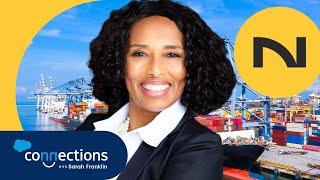
This YouTube interview (Connections Ep. 9) features Gail Moody Bird, CMO of Noodle AI, discussing her journey from Steeltown, Ohio to leading marketing at an AI supply-chain company. She recounts family roots in the Great Migration, education at Spelman College (economics) and Harvard Business School, internships and early retail work (Chase Manhattan, Bloomingdale's), consulting at McKinsey, product marketing at SAP, and her current role shaping how Noodle AI explains complex AI products. The conversation emphasizes translating AI into concrete customer examples (cereal, Lysol, cosmetics), Noodle AI's mission to eliminate waste through 'flow operations' AI, and the importance of representation and navigating double standards in corporate America.
Chapters
One of the pieces that I think is a real magical part of B2B marketing is it's not B2B. It's B2B2C. So when we're selling to Kellogg or Reckitt or Estee Lauder, we're really selling to George or Danielle or Jay. Not to think of them as numbers or leads in a funnel, but individuals. And I think the team has a lot of fun doing.
Hey, I'm Sarah Franklin, and welcome to Connections, where we hear from some of the most innovative leaders in marketing. Gail Moody Bird is the CMO of Noodle AI, but that is just her title. She is so much more than that. Her story starts in Steeltown, Ohio, weaves through Atlanta and Manhattan, and continues right here in the Port of Oakland, where, believe it or not, some of Gail's work at Noodle AI can be seen firsthand. Gail, welcome to Connections.
Thank you so much for having me. I'm so excited to talk to you.
You grew up in Steeltown, Ohio.
I did.
Tell me about your upbringing.
Interesting story. So when I think of myself, I think of myself as a product of the African Diaspora and the Great Migration. So, as you know, the Great Migration happened in the early 19th century, 20th century, where people, African Americans, moved from the south to the North. So all four of my grandparents moved from Mississippi and Georgia to the industrial Northeast. And that was really for better jobs, more opportunity, more economic progress. It was an environment where we were very aware of that history. There is a real sense of black excellence, of high expectations. I attended historically Black college. My parents attended historically black colleges. And now my son is going to do the same thing. And there was always sort of a responsibility to do well, to do better, to move through this economy and find with each generation more and more opportunities.
You got your education at Spelman. What was that like?
So Spelman College in Atlanta was an amazing opportunity. Spike Lee was in my class at Morehouse. Martin Luther King iii, Marty King was also in my class. There was just a sense of possibility that the world was our oyster. And so while I was there, I majored in economics. But because of this sort of this interesting yearning that I developed, I always knew that I was gonna do something bigger and better and different.
A college internship took you to Manhattan. How was that a game changer for you?
Historically black colleges are known to be a great source of talent, and so lots of corporations from New York, other major cities, come to the colleges for recruiting. So I was lucky enough to snab an internship, and it was with Chase Manhattan Bank. Never been to New York. We had a chance to meet David Rockefeller, actually, and I've got a great picture of all of us standing with him because we were there for the summer. We had a chance to talk not only about opportunities in banking, but what it was like to attend an Ivy League business school, to get an mba. And so I found that during that summer, met lots of people and ended up applying to a bunch of business schools, but most notably Harvard Business School, which I was able to attend after that.
It sounds like they were lucky to have you. What was that experience like?
There's sort of this sense of, like, I was in a class with people whose last names were Cabot Lodge. And so generation after generation of people who had attended Harvard who had that as their expectation and sort of were already prepared to have this intergenerational wealth. That's what was new for me, was to understand that this is the way this capitalist society works and that there are opportunities not only to work in businesses, but. But to own them.
So speaking of opportunities, you started in retail, right?
I did.
So what was that opportunity like?
When I was a kid, one of the favorite things that I did with my mom was to go shopping. And actually one of my earliest mentors or role models was a woman who was a black woman who was a buyer at a local department store. So sort of come full circle, go to Harvard Business School, find out that I really love retail and I want to do that for my career. So I leave, do an apprenticeship in retail at Bloomingdale's, and then I moved to McKinsey and become a retail consultant. And so that's when I sort of understood the importance to be really, really focused on serving customers.
You were at SAP for a long time, serving customers there. Share with us that experience.
I was the product marketing person for the SAP Community Network. And I got to know not only what it was like to sell our products, but what it was like to use our products. And so that really put me on a path to understand, to diving into social media, to community, developing relationships, a lot like the trailblazer community that you've actually developed. But we did it there at SAP, and it was something we were really passionate about, but we also learned how to be authentic. We were on the cusp of cloud, social, mobile, all of those things. And that's kind of a. It's really a trait of my career, of working early in technologies and helping to build businesses.
It sounds like you're always on the frontier. How important is that to you? To Be on the frontier of things.
Well, you know, work is kind of boring if things aren't challenging. So one of my first jobs in technology was working with palm computing. It really was showing people a technology that they didn't know they needed something. So lots of marketing challenges there. Moved to SAP, was on the forefront of a couple of different technologies. And now at Noodle AI, my God, the people that we talk to who are now really seeing the benefits of using artificial intelligence to run their supply chains, problem they didn't know they had, solution they didn't know existed. And a technology that's very mysterious and very misunderstood. And so what I love is the challenge of figuring out how do you take something that's very complex and unknown, breaking it down by working with your product people to understand what it does, what the customer pain points are, and then how you solve those pain points using this technology.
Tell us more about Noodle AI and their mission.
We're an enterprise software company. When you think about it in its simplest terms, we just happen to sell a product that's called AI. There's a lot of demonization of AI today, a lot of people who misunderstand it, who think it's the evil empire, but it really is. It's better math.
So you're just such a natural marketer right now. You said this AI, which is people think is complex and all these words like algorithms and things, and you just said it's better math. How is that to be a marketer, to explain such complicated concepts in ways that your mother could understand?
We think about it in terms of customer examples. So one of our customers, for example, makes breakfast cereal. So when people say, what do you do for a living? We make sure that the size and the packaging of the breakfast cereal that you're looking for tomorrow is there on the shelves. And the way we do that is by anticipating your needs, by understanding your behavioral patterns in the past, where you shop, what you do, we take all of those things into consideration and we make sure that that's on the shelves. We did that for the company that produces Lysol. Making sure through the pandemic that all of those household goods as we're on the shelves, we do that for cosmetics companies. Imagine the shifts in demand for cosmetics through the pandemic of completely shutting down people moving to E Commerce, not going outside at all, understanding all of those shifts and then making sure that what it is you're looking for is available is really all that we do.
I need some AI to run my house because I Don't have all the things in my home.
Happy to do that.
Always trying to find locations that are relevant to a guest. And today we chose the Port of Oakland because much of your work at Noodle AI deals with shipping and supply flow. What is so fascinating to you about the global supply chain?
Because of the pandemic, something that people really took for granted. Supply chains have been operating, ports have been open, but nobody really noticed until it became completely just sort of unpredictable. It's what we call a black swan event. It's one of those once in a lifetime events that occurs. And so suddenly people wanted to understand, how do my goods move from place to place? What is it that makes sure that the things that I'm looking for are available? Especially as people are starting to do things like not eat out anymore, but eat at home. What does that mean? What does pantry loading mean? How does a company like Kellogg's or a company like Reckitt anticipate the needs of what's going to be desired? So supply chain suddenly became so topical that I think you remember in the Suez Canal when one of the ships got sideways and was blocking the canal and that meant.
And you couldn't get lumber and so we couldn't do building.
Yes, right, right. Well, that also meant that a lot of food didn't get to the right place. So suddenly everyone shifted to try to understand supply chains. So our mission in life is to use artificial intelligence for manufacturing and supply chain companies to create a world without waste.
And what advice do you have for marketers that are trying to explain their products as so eloquently as you do?
Get to know your product management and your product marketing people. They are the secrets to understanding what. What the product does in such an intimate way that after they've explained it to you using all of that complexity, they'll eventually get to a place, especially with great dialogue of. And this is why it matters. We know at Noodle that we're doing something really special. We can transform the way supply chains operate. We can eliminate waste. We can eliminate all of the wasted human capital that there is in the world of people waiting for machines to start again, people dealing with quality rejects. Work can be much more satisfying. So when we think of our business, we think of something called flow operations. It's really transformative. It's about creating a new category of artificial intelligence. And so every day we talk about not only the grind of the work that we have to do to get leads and put them in Salesforce and move them through the funnel but the people that we're helping. So one of the pieces that I think is a real magical part of B2B marketing that doesn't get discussed much is it's not B2B. It's B2B2C. So when we're selling to Kellogg or Reckitt or Estee Lauder, we're really selling to George or Danielle or Jay, and we're developing relationships with them. So I also instill in my team getting to know the people that we're selling to. Not to think of them as numbers or leads in a funnel, but individuals who are being motivated to think about what it is we do to try our product and to move from prospect to customers. And I think the team has a lot of fun doing that.
What's your experience been like in corporate America?
You know, it's all about representation. I know that a lot of the people that I work with aren't really accustomed to seeing black women in leadership roles. My numbers are a little more carefully watched. And I know that the kind of scrutiny that I'm talking about would be things like having an opinion in a meeting. Now, that opinion coming from me could be characterized as, oh, my God, there she is being the angry black woman, where if it came from a white male might be, my God, he's taking charge. He really has an opinion. We love that. And so being able to internalize and handle that double standard, realize where it's coming from, and understanding that my response to that kind of activity is so important. So how do I keep myself grounded and make sure that my response. Response is the right response? And one that I feel proud of is something I think about every day.
If you were to talk to your grandparents, what would they say about all of your accomplishments?
So my grandparents would say, congratulations, you've done great. But you know what? We expected nothing less.
Never miss an episode by subscribing and turning on your notifications. We'll see you next time.









