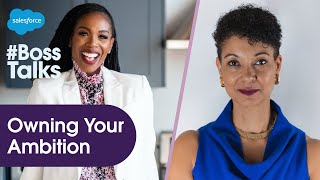
A Salesforce Boss Talks interview (Owning Your Ambition) featuring Shelly Archambeau and host Ebony. Shelly recounts her rise from modest beginnings to CEO of MetricStream and Fortune 500 board member, and offers practical career advice: define success on your own terms; set goals by saying or writing them down; prepare for opportunity by building in-demand skills and the right attitude; avoid unnecessary apologies and use empowering language; build networks by giving help; say no gracefully by offering alternatives; and deliberately develop 'superpowers' like courage and discipline. The episode closes with a call-to-action to Salesforce Plus and Trailblazer community.
Chapters
I got a feeling that you got a feeling that this is gonna be good. Say hello.
Hello, everyone, and welcome to Boss Talks, a series featuring candid career advice from some of the best in the business. Today's episode is all about owning your ambition. And as an ambitious person myself, I've had no shortage of big dreams and bold goals. But over the course of my career, I've had to learn how to channel that ambitious energy to help me find focus and ultimately make progress against what I wanted to achieve. Now, sometimes that meant making a plan and getting things down in writing, and other times that meant saying no and making space for opportunity more closely aligned with my vision and values. Now, that's not always easy, and the path looks different for everyone, but it's yours to own. So today I've invited someone who literally wrote the book on owning your ambition. Shelly Archambeau is a Fortune 500 board member, former CEO and advisor. She's also the author of Unapologetically Ambitious. Shelley, welcome to Boss Talks. Thanks so much, Ebony.
I've been really looking forward to this.
So your book really inspired me and I've shared it with so many people, all of whom were at various stages of life and their careers. Just like the folks tuning in right now, some are just starting out, some are senior executives, and you've been through all of these stages, and you are just life goals for so many of us. So tell us more about your journey.
Oh, goodness, Ebony. So I was a little girl who grew up in very modest means. My father didn't have a college degree. We moved all over the place as he tried to keep improving his lot in life and his roles. And. And I realized early that, you know, the odds really aren't in my favor.
So I.
But at the same time, I had big dreams. I wanted to decided I wanted to run a company one day. And I knew that just doing what everybody else did probably wasn't going to get me there. So I really worked hard to figure out how do I improve my odds? And to me, that was being intentional, setting goals, putting plans a place to go after the goals and making them happen. So I worked my way to Silicon Valley, where after a couple of officer level jobs, I indeed got my opportunity to become CEO of what became MetricStream. I ran that for 15 years, grew it into global market leader, and as you said, now I serve on corporate boards and Advise companies, coach CEOs and try to make an impact in the world and help others reach their aspirations.
I love that and I really love how you've been in the driver's seat of your career and how you've just taken control. So what does it mean to create success really on your own terms?
You know, ebony, a lot of times we can feel that success is what everybody else has. And bottom line is, you have to decide what's important to you and what success is to you, and use that as your metric and your. And your judge. So when I say success on your own terms, whether you want to be a CEO like I wanted to be a CEO, whether you wanted to actually be an expert in a particular arena or be an artist or be whatever it happens to be, you decide what it is that you want to do and to achieve and to impact. And then you can achieve what you want. But don't go after things because you think that's what others expect from you or that's what others want from you.
Now, a big part of being able to own your ambition is being clear about your goals, and this can be a really daunting task. So what's a good first step we can take in setting goals for ourselves?
Most people actually do have something that they are trying to aspire to, trying to create or trying to do. They're just afraid to say it. The first step is to say it, and if you can't say it verbally, write it down. Okay? Write it down. Make it real. So as you think about, you know, the future, you can set a goal. And it doesn't matter if it's 20 years out, five years out, six months out. Just something in the future that you want to do, achieve, or create. Make that your goal, and then write it down. And tell people, you never know who's listening and who might actually have an opportunity that fits what it is that you need. So you want to make sure you communicate.
That's absolutely true. So hope everybody's getting that one down. So put it out there. So, Shelley, having a plan is great, but we all know that things can change at a moment's notice. So what's your advice on preparing for opportunity?
You know, to me, opportunity is when a situation comes along and you have the right skills, attitude, experience, rights take advantage of it. So preparing for opportunity is, number one, building skills that are in demand and required for the area in which you are focused on. But two, it's also having the right attitude. It's being open. It's being open to take risks. It's being open to new ideas or new approaches. Right. So your attitude plays a key role in this. So. And then it's doing your homework. If there's something that you're aspiring to or want to do, make sure you know what's required. I'll give you a real simple example. I started out in sales. Right? Now, you have to understand, it was counterintuitive. I graduated from Wharton. Nobody coming out of Wharton started their career selling computers. But I want it to be a CEO.
And.
And I targeted IBM and I'd done my homework. And every single CEO at IBM started out in sales. So I didn't know what it was about. Sales. It wasn't even that. I said, oh, my God, I love sales. Right?
It wasn't any of that.
I was trying to build skills and get on the path, right, to obviously where I thought the overall objective of becoming CEO would take me. And I'll tell you what, that was the best job I ever had. I still use more of the skills that I learned selling computers today than anything else I've ever done. So do your homework. Understand what skills are required so you can have them ready when the opportunity appears.
So we have a tendency, especially as women, to apologize or hold back from asking for what we want out of the fear of appearing too aggressive. What's your perspective on this?
Oh, my gosh. You know we do. I feel like women have been raised from the cradle, especially women to apologize. I remember my husband would step on my foot and I'd apologize because obviously my foot was in the way, right? That's ridiculous. What I learned is if we keep apologizing, even if it's to create empathy and to be nice and all, people actually think that it is our fault, that we are, like, somehow responsible, so we have to stop doing it because it actually makes us look weak. So instead of apologizing, especially for areas where it wasn't something I actually did wrong, I try to come up with other terms to use. Like, for instance, if you join something and you're a minute late or two, right? You don't have to say I'm sorry. What you can say instead is thank you for your patience.
Right?
So turn things around where you're still acknowledging what's transpired, but you're keeping your power in the dynamic.
So you've said the best way to build a network is by giving. And I love this. What does this mean? And what are your tips for building a strong network?
So I find that when you give to people, right, it creates an environment where people actually get to know you in a very positive light. Because a network is a real relationship. It's not how many people I have in my phone. Right. To me, a network represents the people who will actually do something for you when it's not convenient. Right. That's a network. Right. And the only way you create a network is if you actually have a real relationship where people feel that they are connecting with you in some way, and then they get to know you as a person in the process. So I find rolling up your sleeves and helping others is just a great way to build a network.
Thank you for that. Now, here's an interesting question, and it's my personal question for you. So many of us think that to get ahead, you have to say yes to everything, but there's also something to be said in the art of no. And last year for me was the year of saying no to create more space for the things that I wanted to say yes to. And it's not just saying no to the obvious things, but also those bigger opportunities that maybe a little bit hard to walk away from. For example, maybe that really great opportunity that maybe you just don't have time for. So what are your suggestions for saying no with grace?
This is something that I've absolutely had to learn as well, because I was definitely the person initially in my career was saying yes to everything and totally burned myself out. So, yes, the best way I found to say no is, is by offering another alternative. So if people are asking you to making it up, speak at something you don't have time to speak, you might offer two other people that you think that can do that. Right. If they're asking you to advise them in their overall, I don't know, business, project, etcetera, Then think through. Is there someone else who actually might have a better experience and background to help? So I don't. I try not to just say no. I try to say no and then point them in a direction so that in some way, I've still added value, even though I couldn't personally deliver on the actual request.
All right, Shelly, now it's time for my favorite and final question. So, Shelley, what is your superpower?
Oh, goodness. I actually have two. I would say my superpowers are courageous. And discipline. And here's the interesting thing about my superpowers. A lot of people think you're born with your superpowers. Nobody's born with courage. Mother Nature makes sure of it. We are flight, animals. And discipline. No, I was the absolute procrastinator in terms of growing up. So the key is you can actually decide what you want your superpowers to be and then just work on them. It's just like working out and building muscles.
Thank you so much for all the incredible insight that you shared today and for that boost of confidence. I think we're all leaving this conversation feeling incredibly motivated and inspired.
I'm glad to hear it because I want everyone to own their careers and be able to achieve the aspirations they have for themselves.
Thank you for joining us, Shelly.
Oh, thanks so much for having me. Ebony.
I hope you all enjoy today's conversation. And to watch more episodes of Boss Talks, check out the new Salesforce Plus. To continue boss building, head on over to trailblazer.salesforce.com to join millions of Trailblazers who are learning relevant skills, connecting to fellow Trailblazers, and giving back with the Trailblazer community. With that, thank you for tuning in to Boss Talks and I will see you all next time.