Personal Empowerment: How to Live a Successful Life with Plum Village Monastics | Salesforce
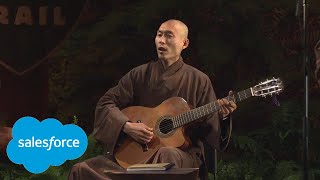
This is a Dreamforce conference session (YouTube video) where Plum Village monastics (named in the session) lead talks and practices on mindfulness, listening, and personal empowerment. Speakers emphasize "heartfulness" (mindfulness rooted in the body/heart), engaged practice in ordinary life, and the importance of listening to self and others; the session includes a short guided body-centered breath meditation and a communal chant to Avalokiteshvara/Kuan Yin. The event context includes audience reactions and references to Dreamforce (2,700 sessions, performances by Metallica and Janet Jackson) and a large Twitter engagement.
Chapters
How are you feeling? Yes, good. Well, I want to tell you that you're looking pretty good on Twitter. There were over 500 tweets out there. That's so great. All those good intentions out in the world. So I picked a few. I'm going to read them to you here. Isabella Burriad says, I'll say goodnight to my electronic devices and screens and work thoughts earlier. Anybody else for that one? Yes. Yes. Robert M. Becker. Inspired to eat more organic, less processed foods to foster better health.
Sounds.
Yeah. Yeah.
Sonya Fitz. Practice daily meditation. Set daily intention. Hug family, get sunshine, eat good food. Let the small stuff go. Can I just get a collective amen? I mean, that is a great one. Okay. God's language is silence. Everything else is a poor translation. Deeply grateful for the opportunity to be guided by Deepak Chopra. Tears flowing from my eyes. An indescribable experience. Eileen Jenna says, what a beautiful morning to remind us all who we really are. We are not business owners or employees, but citizens of the universe and beautiful souls sharing the same air. So lovely. Yeah, you can clap. I like claps. We're all into that.
Okay.
Adrian Augustus just saw Dr. Deepak Chopra live. Setting personal intention to live my life authentically, intentionally, honestly and fiercely like that one. Clara Perez says, everything is built of endless opportunities, including you. Jaron Chu says, wow. Jack Kornfield's guided meditations were the most mind blowing, compassionate, centering and connecting experience I have ever had at a conference. I can't wait to practice this regularly. I hope to see you next year at Dreamforce, man. Jaron, we want to see you next year at Dreamforce too. Heather Geisert. I am ready to grab my own oxygen mask first and not give it to the obnoxious roommate of perfection in my head. And last but not least, Jennifer Johnson DiLoreto definitely going to adopt this tactic of freeing up time and mental space from Arianna Huffington. I have this rule that I can complete a project by dropping it. I love that one. A lot of you actually tweeted about that. Okay, so we have had one heck of a week here, folks. 2,700 sessions. Rocked out with Metallica and Janet Jackson networked our faces off. I am pretty grateful and my heart is really full to be able to close this week with you with the monastics from Plum Village. So in my role, I actually get to partner with the monastics quite a bit because we're really working hard to bring more mindful practices into Salesforce. And these are some of the most loving and wise and kind human beings I have ever met. So they're going to join us today. We're going to be led by Brother Ocean, Sister Reverence, and Sister Dedication. And they are going to share their words of wisdom with us. They're going to lead us on a guided meditation and then we're all going to close with a chant. So please give a really warm welcome to the monastics from Plum Village.
Okay.
So, dear family, it's such a joy for us to be able to be together with you. We've had the opportunity to build community, to build ohana together over the last few days. It's been such a delight walking around, sitting, breathing together with everyone. How are you all doing? Let me ask it again. How are you all doing? Okay. The wonderful Anne Lamotte said in her book Plan B, Further Thoughts on faith. Laughter is carbonated holiness. Many of us who are practicing spirituality, we become a little bit like dried up fruit. But when we practice mindfulness meditation and we enter deeply into our lived experience, we can't help but develop a sense of humor. This morning I woke up really early, even early for a monastic. It was a little bit before three. Asleep in for us monastics is about 5am so I woke up a little bit before three. And as I was sitting this morning, I was remembering being with my teacher, Thich Nhat hanh in the 90s. And we were sitting, waiting for a dharma talk. So we all gathered in the hall and he began offering his. His dharma talk. And suddenly it began to rain. And this is not that unusual for the south of France, around the Bordeaux area, it rains quite often. But for some reason that day he stopped his dharma talk and he said to each one of us, I don't need to say anything. All I need to do is to ask you to go and listen to the rain. So everybody go near a window and sit and listen to the rain. So we all gathered near windows. We all sat looking outside and we listened to the rain. We sat there for a good hour, just listening. Now I realized that my teacher wasn't just asking us to listen to the rain outside as a meditation teacher. He was asking us to listen to our life, to listen to each moment of our daily life, to open a space of availability for each breath, for each step, for each encounter. And that's really the heart of mindfulness practice, to open a space of availability. I was reflecting on this particularly this morning, since it seems quite difficult in our nation and in the world at this time for us to listen. It seems that we've equated Listening with reacting, listening with having to say something back or sometimes say a lot of words but say nothing much. And this morning, very early, I was watching as two courageous women stopped a political leader and said, will you listen to us? Will you listen to us? Will you listen to the women? And I watched and I observed what happened. And I asked myself, are we able to listen? Are we able to listen in order to hear what's being said and what's being left unsaid? Are we listening for ourselves and are we listening for the future generations? I remember one of the great teachers, Audre Lorde. She said that we must commit ourselves to a future that includes each other and that none of us are safe until all of us are. When we think of listening, we think of listening to communities, listening to women, listening to people of color, listening to the LGBTQ community. And this is essential work. And if nothing else, over the last two years, I've realized that for so many years, we've been expecting others to do our work for us. Our political leaders, our spiritual leaders. And the invitation of this moment is for each one of us to do the work. What does it mean to listen? Are we able to listen, first of all, to open a space of availability for what's taking place within us? If we can do that, listen to ourselves, listen to our loved ones, listen to our children, listen to those in our own community, then there's a chance that our political leaders will hear us. We can't expect them to listen if we can't offer that gift to ourselves and to those around. For me, that's the invitation of this moment. I actually, as I sat there this morning, there was a poem that my teacher wrote. Back in the 60s, when Bien Thuy in Vietnam was bombed, and the army leader, the general, said we had to destroy the town in order to save it. He wrote a poem called For Warmth. And I think many of us here in this room and many watching this will resonate with this poem. I hold my face in my two hands. No, I'm not crying. I hold my face in my two hands to keep the loneliness warm. Two hands protecting two hands nourishing two hands preventing my soul from leaving in anger. I invite everybody to find our way back to our body, to the physical sensation of our body in the chair, to the sensation of our in breath and our out breath. And arrive in this moment, we might even open our ears to listen to the sounds that make themselves known to us. And we'll enjoy a sound of the bell. As meditators as Buddhist practitioners, we love questions. In fact, most of the Buddha's teachings came about because somebody asked the Buddha a question. And so as we travel around in this form in robes, we're used to people coming up and saying all kinds of things and asking all kinds of things. And we love that we've had a chance to experience that during this week as well. Not so long ago, I was asked to lead a class on Buddhism at the University of Montana in Missoula. And I was walking along the campus, and a young boy was walking the opposite direction, and he saw me and did a double take. He crossed the road and came right up to me and asked a question that I think many, many of us have. So what's the meaning of life? And I thought to myself, this is a very good question. This is a question that many of us have that brings many of us to spirituality and meditation. And it's the way we normally ask it, isn't it? What's the meaning of life? Good question. Important question. But there's another way, an even more empowering way to ask that question. How do I bring meaning to my life? How can I make this moment the most meaningful moment that I've touched so far, sitting here on the chair? And later, when we walk out of the hall, how can this moment become the happiest moment of our life? This is the orientation of mindfulness. How can I live this moment deeply? Our bodies are great teachers. We don't really need any other teacher. We have all the wisdom that we need right here in our own body. I'd like to do an experiment. I love this. Why don't we imagine that I'm calling your name, and then you say, who, me? And point to yourself. Ready? One, two, three. Let's go. Point to ourselves. All right, now keep your hand there, and let's look around the room. I'm lucky because I'm in the right direction. I can see everybody. Where's everybody pointing? How many people are pointing here? None. That's reassuring. I'm delighted to see nobody's pointing here. All of us, at least those that I can see, are pointing here. Now, this is really important because there's a word that we've used so many times over the past. Mindfulness. Now, in the west, in our modern society, many of us think of mind as being up here. Now, actually, in the Vedic philosophy of the Buddha's time, consciousness was seen to be not in the brain only as we would tend to think of it today. But the basis of consciousness was seen to be the heart. Now, we know nowadays we hear that the heart consists of about 60% neural cells, and there's some debate as to what that means. But instinctively, we know that the center of our being is our heart. The word mindfulness is a translation of the Pali term sati or the Sanskrit word smriti. It's not the original term itself. In many of the Asian languages today, the word for heart, the word for mind, is the same. We need an additional character or an additional word to distinguish if we're talking about mind or we're talking about heart. It's equally valid to translate mindfulness as heartfulness. How does this change the way that we approach the development of presence? When we approach this development of presence with a sense of heartfulness from down here, not from up here, as we develop this quality of presence deeply rooted in every cell of our body, deeply embodied, then what develops is what we call concentration. And this is not some kind of tiring intellectual concentration, but a deep resting with what's there in our body, in our consciousness, that's enlivening. That's wonderful. One of the great teachers in the 9th century said that the aim of mindfulness practice, the aim of meditation practice, is to become a real human being, to be real. That practice is not something that we just do on the cushion and then we get on with the rest of our lives, but bringing this quality of attention to each moment. As practitioners, we want to approach our practice with the energy of transformation rather than transcendence. Very often we think of spirituality as somehow floating on clouds and being a little bit above. But as Jack Kornfield reminded us earlier today, inhabiting our body, inhabiting this moment, is a sacred act, Transformation, not transcendence. There are so many mindfulness practices, so many different ways to cultivate this energy that we call presence, and we look at these practices as medicine. Now, I'm the kind of person that loves Chinese medicine. Any other Chinese medicine lovers here? A few. Great. Yeah, it's good. Oh, it even got a round of applause. I was all of we monastics, we work in our monastery, and we're all on a different rotation each day. So a number of years ago, I was cooking with a friend from Taiwan, and she was drinking some Chinese medicine. I said to her, what are you drinking? It smells delicious. She said, oh, it's called Black Chicken, White Rooster. Would you like some? And I said, sure, I'd love some. So she gave me a bowl, and I took a mouthful. I was enjoying it. And then I asked a Crucial, what's it good for? And she said, women's trouble. And that was an awakening experience for me because that medicine was appropriate for her and her situation. It was not the right medicine for me at that moment in time, although it was delicious. So Buddhism or meditation practice, is about waking up. Let me ask you a question. What do you need to wake up to? What's your situation? The Buddha said something interesting after he woke up. He didn't say, oh, you know what? I'm the only person in the world that can wake up and develop this compassion, this open heart. He said, you know what? Every single living being has this capacity. Every single person, even you, have this capacity, have this open space in the heart, that seed of goodness and spaciousness that each one of us can wake up. But the question we need to ask ourselves is, what do I need to wake up to? If we do that, then our path becomes clear, and each one of us has our own journey to make. Each one of us has a certain thing that we need to wake up to, a call in our heart that we call the heart's longing, this ache. Something that called us to what we call the spiritual life or to mindfulness practice, a journey that we're being called on. So let me ask you. Let's do it as an experiment. Maybe we can close our eyes. If I ask you in this moment to take an in breath and an out breath and to ask, what is it you're looking for? What called you to meditation to develop presence in that deep, longing, aching part of your heart? How would you answer? What's the word that arises? It might be something like happiness. It might be peace. It might be enlightenment. It might be something like, I want to transform my anger. Whatever word or phrase comes up, just allow it to be there. And then I'd like to ask you, what do you mean by that word that came up? Let's say the word happiness came up. When you asked yourself that question. What do you mean by that? We are a few hundred people in this room, and if we had time to go around the room and ask our friends to share, what does happiness mean to you? We would discover that many of us have completely different experiences and ideas of what happiness is. Very often when we ask ourselves a deep question, we stop at the big word. We don't sink down into what we mean by that. What's our lived experience? If we touch our lived experience, we ask ourselves the next, can I touch it? In this moment, our idea of what happiness, what peace, what liberation, whatever word or phrase arose is, can prevent us from touching it.
Now.
The dharma, or practice, is described as being immediately useful and effective. My teacher says, we know that we're practicing meditation correctly if we immediately feel a relief. It's not something that we need to struggle for 10, 20, 30 years, and then somehow, someday we'll get there wherever there is, but we need to be able to touch it right now. To breathe in such a way that this is the most delicious breath we've ever taken, to sit in such a way that this is the happiest moment we've ever experienced.
To walk.
And as a free person, that's somebody that can change the world. The world within and the world around, are they different or are they the same? The core insight of Buddhism is that very often we don't recognize what's already there. And one of the functions of mindfulness, this generating of presence, is the capacity of recognizing, of seeing things clearly. There's a delightful story of the Buddha just after he woke up going into a nearby town on an alms round. So he was walking on alms round, and a townsperson, a young potter, saw the Buddha walking and saw that he was walking mindfully and smiling and quite free and said, so what are you then? And the Buddha said, well, I'm a fully enlightened one. I'm the Buddha. And the potter looked at him and said, whatever, and then walked off. There, right in front of him was the Buddha, that which he was searching for, and he was unable to see it. Would we recognize happiness, peace, joy if it was right there? What would it feel like? So we walk in such a way, we eat in such a way, we breathe in such a way that that which we're looking for is available for us. And that is something that's possible. Engaged practice the practice of my tradition means choosing to use the absolutely ordinary circumstances of our daily life as a practice. When we're caught in traffic, when we're in the checkout line, when we're walking past a homeless person and we don't want to look, each of those moments is a moment for us to be alive, a moment to practice. We don't need anything special. A number of years ago, I was having tea with my teacher, and he said to me, you know what, Brother Phapai? If we're really aware, we're really present, there's nothing that's not a practice. There's nothing that's not a moment to open our heart. There's nothing that's not the Dharma. Not so long ago, I was in Trader Joe's, and I was in the checkout line. There was quite a line behind me, and I was aware of that. But I had accumulated a lot of change. So the checkout person told me the price, and I was counting out the change. It wasn't as if I was counting out 90 pennies, but I was counting a few pennies. There was quite a few. And then the person behind me said, I hate getting caught behind these basic people. I smiled, and that person thought it was an insult. But I thought, what an amazing teaching, because, yes, I'm basic. Basic means uncomplicated. Basic means in and of itself. Why should we be ashamed to be basic? That's exactly what mindfulness is, bringing bare attention to this moment and noticing all the stories we tell ourselves. Now, stories are great. This is how we live our life. But most of the time, we separate bare experience. The touch of this chair, this cushion, the feeling of the cool air, the sound of a voice from interpretation. We mix them together. We tell ourselves stories about things. And it's the stories, the interpretations, that can bring about suffering. Life is very humbling. I had a chance to visit Plum Village after seven years of absence. I went over three years ago to visit Plum Village. And I spent two and a half months in Plum Village. And I enjoyed so much being in the spring. We don't have a lot of spring in Southern California. So I was enjoying the green leaves and the fresh air and especially the grass. There's a pond, a lotus pond, pond in the Upper Hamlet where I was staying. And on that lotus pond, there were some ducks floating around. And I spent many joyful and delightful hours while I was in Upper Hamlet looking at those ducks, thinking things like, isn't nature wonderful? Those ducks are always together. It's just. It's so touching. I would sit there, and at the end of my stay, I was having tea with one of my older brothers, and he said, what do you enjoy the most? I said, the ducks. The ducks on the pond, they just. They must love each other so much. They're always together. It's so beautiful. I love nature. And he started to laugh. Then I said, what's wrong? What's wrong? He said, brother Pho Pai, there's Styrofoam. So we laugh because we all have Styrofoam in our lives. So I'd like to ask each one of us, when we leave this hall this afternoon, to practice looking at those things that we think are real, the Styrofoam in our lives. That we think is real and always ask ourselves, am I sure? Am I sure? And if we ask that honestly, the answer always comes back, no, I'm not sure. There's always something more to learn, something more to discover. Here in Dreamforce, there's a beautiful saying, and I've been so touched by so many things, but especially that saying, blaze your trail, or trailblazers. And every time I see it, I'm reminded of the word in the Buddhist tradition for the spiritual journey, magga, or path. This word in the original language means an ancient overgrown path that we can barely see, we can only see the traces of, and that you have to look very deeply. It's been traveled by ancestors over so many generations, but it's overgrown, and we have to look very, very intently to find it. And when we find it, we discover it. With each step, we create the path, or we recreate the path again and again and again. This journey. I was asked a few years ago to lead a day of mindfulness in the Ojai Foundation. And when I woke up in the morning, there was a little map next to my bed with a beautiful design on there that said gratitude walk. And there were three very powerful words on there. It said, you are here. So I was very enticed by that, and I said, I'm going to do this gratitude walk. It sounds great. So I took the map and I walked outside and began to walk this gratitude walk. And I got completely lost. I had no idea where I was. I turned the map this way and this way and this way. It bear no relationship to where I was. So I walked back the other direction and the same thing. It didn't seem to match the map. So at that moment in time, I wasn't feeling something that I would describe as gratitude. And then I sat down on the steps of the yurt and I looked at the map, and I realized that I was caught in my ideas. I was caught in those three words and the arrow, you are here. Now. That was true for the person who did the map. It was not true for me. What I needed to do was to digest that map. So I looked at the map, I looked at all the sites that were there, and then I put the map on the deck and I began my journey. I took steps, and as I took steps on the path, the path didn't seem to match the map. But I visited all of those places in the order that made sense for me. Each one of us is invited to enter the path at the place where we are to make our Own journey to start where we are in this moment. There's no one size fits all roadmap for the spiritual journey. So don't buy your second hand. I would like to invite you to enter deeply, to sit deeply with your attention in the heart of your life. And in that way, your very life can become your spiritual practice. And that is empowerment. Dear friends, it's such a delight to be together with you. And I'm going to invite Sister True Dedication after a sound of the bell to offer us a body centering practice.
Sam.
As we breathe in, let us be aware that we are breathing in. And as we breathe out.
Let us.
Be aware that we are breathing out. Breathing in and breathing out. Breathing in. Becoming aware that we are alive, full of life. Breathing out. Smiling to life within us and around us. Breathing in. We are aware that we have this precious body. Breathing out. Smiling to our body. Breathing in. Becoming aware of any places of pain in our body. Breathing out. Calming the tension in our body. Breathing in. Connecting to our heart and to our feelings. Breathing out. Listening deeply to our heart, to our feelings. Breathing in. I am in touch with this moment. Breathing out. I know this is a wonderful moment.
Good afternoon, ladies and gentlemen. We from Plum Village are very happy to be here at Dreamforce and to spend this afternoon together with all of you. Now we shall hear a chant. The monastics are going to chant the name of Avalokita, also known as Kuan Yin. Avalokita is a bodhisattva who has the capacity to listen deeply. Deeply. Avalokita is a person who has the capacity to listen to his own suffering inside. And because of that, he could understand the roots of suffering inside of him. And from that understanding, compassion is able to arise. And he experienced transformation and healing by listening to himself. Having understood his own suffering, he was able to look at the people around him and see their suffering and understand them and have compassion for them. Also, Avalokita Svara practiced listening to the suffering of others in order to help them transform and to heal. The monastics are going to chant the name of Avalokiteshvara. And while chanting, they try to touch the suffering inside of them. Because each and every one of us, we all have suffering. The suffering in each of us also reflects the suffering of the world. Because we are part of the world we are all going through, walking through this life together. Many of us do not want to go home to ourselves. We try to run away from ourselves by way of consuming. We consume television, magazines, books, music, even food to try to cover up a Sense of loneliness and suffering and pain and sorrow that lies deep within our heart. The practice recommended by the Buddha is not to run away from suffering, But to come home to yourself, to be able to look at your suffering, to embrace and to hold in order to start the process of healing and transformation, not to be caught and be carried away by consumption. Understanding suffering will allow you, will show you the way of transformation and healing. And during this chant, the monks and nuns, when they chant the first line, they will be in touch with the suffering with inside themselves. And when they chant the second line, they are in contact with the suffering of the people around them. And when they chant the third line, they become aware of the suffering in the world. And through this awareness of the suffering in themselves, in the people around you, around them and in the world, they are able to give rise to compassion, understanding deeply, because they can understand themselves. By chanting with mindfulness, they produce together the energy of mindfulness, concentration and compassion. The energy of mindfulness and peace will be able then to penetrate our body. And then we will suffer less. We allow our heart to open. Compassion is a kind of energy that can be very healing and transforming. If we know how to allow this collective energy of mindfulness and peace to penetrate our body, then we will suffer less. We can release the tension and pain in our body. We can also release the tension and suffering in our heart. There is tension and pain in our body. We know that in our everyday lives we have accumulated so much tension, so much pain, but at the same time, we also accumulated suffering of sorrow and despair. And if we have some pain or sorrow or fear, despair in our heart, we may like to open our heart so that the collective energy of the community can penetrate and help hold this block of pain and sorrow inside of us. In this room, in this auditorium, in this theater, together with the monks and nuns, just say, here is my pain, here is my sorrow. Please hold it with me, and to please transform it with me. So you are not alone, you are not alone. You are facing your fears or facing your sorrow and despair collectively. If we generate this energy of mindfulness and compassion, we can hold each other and to allow our heart as one body to transform and to heal. This is a practice, it is not a prayer. And with every moment of this meditative practice on compassion, being able to listen deeply within yourself, to understand the roots of your suffering and to give rise to compassion for yourself, you'll be able then to give rise to compassion and understanding for another person, whether that person is your spouse, your partner, your boss. Your colleagues, because you're able to understand deeply yourself and to allow yourself to transform and to heal. If we have someone close to us who is sick and he or she is not able to be here this afternoon, we can silently call his or her name and to allow this collective energy in which we generate together while practicing this meditation to penetrate into the cosmos and into them. And even though they are not physically here, they will be able to receive this energy of compassion, and they will feel a lot better. Within a few minutes of listening deeply and looking deeply inside of yourself, allowing yourself to heal the tension in your body and your heart, you will be able to feel a lot better. So let us join in the practice and allow ourselves to be relaxed and allow the collective energy of the community to penetrate into our body, our mind, and our heart. It. Ra. Sam. Ham. Ra. Ra. Sam. J. Ham. Sam ram. Sa.
Wow.
Wow.
I'm not going to try to top any of that, but what I will say is I just want to give such a heartfelt thank you to you for spending your day with us. If we go back to that original thing this morning when we were looking for those sparks of inspiration, I hope you found them. I hope you sing them, I hope you meditate on them. I hope you sleep on them. Not if they're on your phones. Take your phones out of the bedroom. And we will really look forward to seeing you again next year. So thank you for coming. Safe travels, everyone.









