Rags to Riches: Living the American Dream | Frank Slootman - Ep9 | The Inflection Point | Salesforce
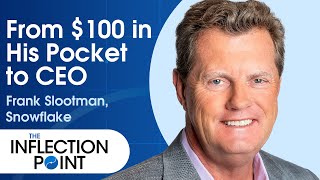
A filmed interview with Frank Slootman (CEO of Snowflake) about his life and career: immigrant origins from the Netherlands, early jobs in the U.S., and a trajectory of turning struggling or early-stage technology companies into market leaders. He discusses his leadership style (operational rigor, focus, quick personnel changes), major career milestones (CEO at Data Domain in 2003, growth at ServiceNow, leading Snowflake to a record software IPO), and the role of Snowflake in enabling digital transformation via a cloud-native data platform.
Questions this video answers
2003
Approximately 66% (interview wording: 'I think').
About 165%.
About $100.
Summer of 1982
Chapters
Frank Slootman doesn't launch companies, but he certainly turns them into successful industry game changers.
I get hired not for people's health, but they need change and they need results.
He focuses on winning.
The only thing that matters is that you win as an institution.
Born in the Netherlands, Frank came to the US with a dream of working at IBM. He was rejected repeatedly, but losing didn't suit him. He went on to become the CEO of Data Domain.
Feel good to be wanted for our teams.
Then he took over ServiceNow, which he dramatically grew in revenue and reach.
The company's now well over $100 billion. So it's become a much larger company than anybody ever envisioned.
And in his latest job as CEO, he set out to take Snowflake public. It became the largest ever software ipo.
What Snowflake does, it powers digital transformation. Everybody talks about it, we do it.
I am pleased to have Frank Slootman CEO of Snowflake on the inflection point. Welcome, Frank, to the Inflection Point.
Good to be here, Monica.
Okay. You know, the name of this show is called the Inflection Point. So my first question to you is, what was your inflection point that moment when everything changed for you?
You know, I thought about that question a little bit because I've had like most people, you know, more than one inflection point. But if I just go all the way back in time, you know, sort of when I was in my mid teens and every summer at age 14, 15, 16, I was doing really dirty jobs, you know, harvesting tulip bulbs, you know, cleaning toilets and factories. And I had, you know, supervisors that were incredibly ill tempered and unreasonable. And I remember complaining about this to my dad one night and he's like, well, you don't get better grades. Those are the kinds of people you'll be working for. And you know, that sort of flipped a rocket fuel in my tank at that point and sort of never looked back from that moment.
That really gets us back to where you started. You were from the Netherlands, outside of Amsterdam. And then with that inflection point, you then were able to shift your sights from cleaning toilets to wanting to come to America and work for IBM. What attracted you to IBM?
They represented the future at that time. You know, we didn't want to go into smokestack industries that were on decline and so on. So that was a reason. A lot of, lot of people out of school went to IBM. They trained people and they really started and advanced their early careers.
Did they say Frank Slootman, he's the young man we want.
That didn't exactly happen. I think I applied at least a half a dozen time and yielded half a dozen rejections. You know, they couldn't pronounce my credentials. They didn't know what to make of it. There were all kinds of factors in play there. And I finally gave up on that strategy. At the time, I was very unhappy with it because I felt I was a worthy candidate. But, you know, I've realized over the decades that they probably did me a favor by not hiring me because it launched me on a profoundly different path.
Exactly. And so let's talk about that path. So you did come to America, of all places, South Bend, Indiana, with like $100. What got you here? What was your first job in the US Of A?
I'd never been to the US Before. Back then, people didn't travel like they do now. And, you know, you took what you could get. So I ended up with Uniroyal, you know, near South Bend, Indiana. They were making a product called Naugahyde, which, you know, people of our generation remember as, you know, artificial leather being used in cars and boats and things of that sort. And I was there for three, four months during the summer of 1982. That was my introduction to America.
And what was that like at Uniroy? I've heard you talk about the importance of elevators. Tell us about elevators.
You may be very talented person, very motivated person, very hardworking person, but if you step into the wrong elevator, it won't matter that much. Some elevators go up, some go down, some. So it's really a combination of picking the right platform in terms of the industry and the company and where you are as well as your individual merit. And, for example, if you spent the last 20 years at Apple or at Amazon, you would have done pretty well.
Exactly. Now, ultimately, you got out of fake leather from that start into computers, and then you really started doing well for several years, Frank, you worked your way up in computer companies, especially focused on fixing train wrecks. When did you realize, frank, I'm really good?
Well, you know, I. I don't really spend any second of the day, you know, worrying about whether I'm any good or not. I worry about whether, you know, I'm getting good results. And hopefully that, that, that speaks for itself. My horseshoe with train wrecks. That was my career strategy because my. My exotic credentials kind of haunted me for the first 10 years or so where people kept looking at me like, God, that guy's a strange animal. He speaks with a fat Accent. What did we do with him? So my career strategy was like, I took jobs that nobody else would touch with a ten foot pole. And I was cocky enough in my early days, I guess I still am to this day, where I thought I could make something out of nothing, lemonade out of lemons, that sort of thing. And I did that for a long time. And I realized in hindsight that was incredibly formative and instructive. I didn't like it at the time. You know, it's not fun running crappy businesses, but you learn so many things about, you know, what ails certain businesses. You know, some things are changeable, some things are not changeable, but they were actually very important lessons for me to learn. It's very hard to learn that lesson when you're in a successful company. You just get swept along with the momentum of, you know, the success.
And then your first job as CEO was in 2003 at Data Domain. Was this a rescue mission also?
Actually, I felt that Data Domain was sort of my first clean deal. I mean, it wasn't a train wreck and it certainly wasn't a rescue mission either. It was a early stage startup. They had no revenue, no customers, so it was unproven. And it had very, very typical crossing the chasm type of problems, which that's sort of the essence in Silicon Valley. Learning to navigate the chasm and getting across it. Most die in the chasm, but many of them linger in the chasm. And Data Domain was definitely a company like that. So it was incredibly instructive for me. And, you know, it was slow going. The first three years at Data Domain, we were sort of scratching the bottom and gradually inching our way forward. And then the thing went vertical and grew at hyperbolic rates. So it was a terrific experience for everybody.
And you took it public on Nasdaq and its shares rose 66%, I think. And then it was bought. Right.
It was a very interesting time because we had two primary competitors, EMC and Network Appliance. And we fought them every single day of the week. We were obsessed with fighting these very large companies that were very successful. And then one day we ended up in a bidding war to be acquired between these two companies. So we were sort of entertainment for Wall street there for about a six week period while this all unfolded. So it's surreal to going from being an absolute nobody to the two biggest company in your world trying to buy the company. So it certainly, you know, made us feel good to be wanted for a change.
Exactly. And then because of that Great success with Data Domain. A lot of software companies came calling. I mean, they were interested in Frank Slootman. Look what he can do. So you go to ServiceNow and I read that you told the employees, we do not come in peace. And tell me what that, what that meant to you.
Well, the thing to realize is that you're not being received, you know, with open arms. Okay.
You're viewed as not you, Frank. They don't say, oh my gosh, look at this great man. Look what he can do.
Yeah. They actually looked at me like, oh, what is up with this guy? And what threat does that company represent to the status quo? So as a startup, you know, you have to have a combat mentality because you're going to fight your way into a world where you know they don't want you. Okay. And they're going to try and kill you in the cradle. That's an expression that they often use in larger companies. They're not going to let you grow up because once you grow up, you become an even bigger threat and you're unstoppable. Right.
So you came to service now more as if you were in the Marine Corps than the Peace Corps. Yep, Got it. So there was a memorable exchange that was written about at, when you were at service. Now, when someone on the board gave you some unsolicited advice, you the new CEO, let me tell you what you should do. How did you respond to that?
I viewed a board as a governance vehicle and that with a fiduciary role to represent shareholders. You know, I need a much less as people that want to sort of, you know, coach me and advise me every step of the way. I've been through many, many wars, you know, and I'm on it 24 7. Right. So I don't need to be lectured by board members on, you know, on what it's like because I'm living it. I mean, you hire me for a reason, just to run the place, right? I don't need to be kept on a short leash. You know, you want me off the leash. In other words, don't be half hearted about it.
So control has been a hallmark of your management style, as evidenced by that exchange. Another hallmark, I think, of your management style is that you are like, call it as I see it, no bs, this is what's happening. But a lot of people, maybe especially in Silicon Valley, aren't used to that. So what is that about you and why do you feel that's necessary to be that way?
Well, probably, you know, a little Bit of my. The way I was brought up, you know, they often say, you know, you can take the boy out of the country, but you can't take the country out of the boy. And that's just. That's just how we are. We're very direct, very grounded, very high clarity of thought. Those are really important things.
When you say you can't take the country out of the boy, do you mean that from the country perspective or culturally or from your family? What do you mean when you say that?
Oh, it's very much the Dutch culture. It's the country, and it's just the way Dutch people are. They will just bore a hole through your head. They are no BS people. High clarity of mind. That is cultural. And you go to Silicon Valley, I've often referred to it as Neverland. A lot of Peter pants flying around their feet. Their feet don't touch the ground. They haven't checked in with reality yet.
Now, this brass tacks approach to leadership does run counter to what a lot of people want, the Peter Pans or what they want you to coach people, be more tolerant. But have you found in your experience that sometimes it's just not going to happen? It's better to pull the plug quickly when you're working with certain people?
Yeah, you know, I've been doing this for a long period of time, and the fastest way to get change in organizations is to change. That may sound harsh to some people, but I get thrown into situations where people. And by the way, you know, I get hired not for people's health, but they need change and they need results and they're looking to optimize the outcome. Right. So I can't mess around. Right. I'm on the clock in a huge way, and we're moving very, very fast to change the trajectory that we're on.
Your methods obviously worked at ServiceNow too, as they did at Data Domain, because you took ServiceNow public on the New.
York Stock Exchange, and ServiceNow was really interesting because we were an underdog for a very long time. Even when we went public, we had like a $2 billion valuation, which at the time was an awful lot of money. And people felt, you know, they really were kind of scratching their head, what are we worth? That kind of money? But the company is now well over $100 billion. Right. So it's become a much larger company than anybody ever envisioned. And it's very satisfying. Every quarter, people were surprised by the growth numbers.
So after your successes, ServiceNow, you, Frank Slootman, retired. What was that What'd you do?
Yeah, you know, I've been under the gun for a very long time. I really feel from the age of six, you know, you get to a point where, you know, you no longer need to be under the gun, and you go. And you also suffer from just combat fatigue mentally. Right. And in hindsight, I realized I didn't know it at the time, but in hindsight, I absolutely knew that. That I was burned out, classically burned out. And in order to sort of recover from that, that just takes time. And. But I did retire with the intention of never taking it home again.
And what did you do in your retirement? You. You still wanted to win. You didn't just say, I'm a different human being. I'm going to lie around at a beach. You went in some real racing of sailboats?
Yeah, racing was already a passion for me, and. But it takes a lot of time, and, you know, well, when you're a sitting CEO, you don't have that much time. So when I was retired, I really ratcheted that up, and it was awesome, you know, because sailing is just like business in many ways, because it's about the talent, it's about the competition, it's about the conditions. But sailing is much more intense because you make a mistake, it's almost immediately obvious that you made one. Right. And you have to recover where you get behind, it's very difficult to catch up. It was a very good proxy for exactly, you know, but it doesn't last. Nothing lasts. Everything changes. Okay? And after a while, you realize, wow, this is the rest of my life, really. And we're very similar to, you know, to the NFL quarterbacks that don't know how to retire. They think they want to retire, and then when they're retired, they're like, God, I missed that action, that split second, you know, and it's very, very addicting for people with the temperament and personalities you know, that we have. So people always say, why did you come out of retirement? I said, look, I didn't really come out of retirement. I work in retirement. There's a difference now.
So then Snowflake came calling, and you just jumped off that yacht. What was it about Snowflake that got you there?
They just confronted me with, hey, would you consider taking the helm at Snowflake? And it just catalyzed me to no end because I knew the company somewhat from the outside, and I thought Snowflake was a very special company in the world of software. When I've lived there literally for decades, it's very rare when you see companies that have been built in such a way that they can really produce step function changes. Most software products are highly incremental. They carry legacy forward. You're almost yawning looking at it. And I had really no energy or inspiration dealing with some of that. Snowflake is different, but at a technical level, it was producing orders of magnitude faster results. Right? I mean, not just 20%. I'm talking about orders of magnitude 10 times, 100 times. Right. So this was revolutionary.
Tell us exactly, Frank, what Snowflake does. This is a broad audience. Not all people are in tech. What does Snowflake do and what was your vision then, when you had this enthusiasm to jump in?
So Snowflake reinvented data management for cloud scale computing. That completely reimagined the notion of a database management system. What Snowflake does, it powers digital transformation. Everybody talks about it. We do it. Data is the beating heart of the modern enterprise and modern institutions and all the disciplines around data science and machine learning and artificial intelligence, they're all powered by Snowflake.
Well, clearly you have sold this vision not only to the company and to customers, because they are believing in Snowflake. And then you went out to the marketplace and had such monster success. You did the largest ever software ipo and it was the fifth largest of all US based tech listings. By the close of Snowflake's first day of trading, the stock shot up 165%. How about that?
Look, you know, I mean, we look at stuff like that over the long haul. You know, performance will always intersect with valuation over the long haul. You know, we don't get fixated on that because it's only distracting to us.
Okay, but did you take a moment to celebrate and, like, get a puppy?
You know, celebrating is one thing that we are not very good at. I'm not a high fiver. I don't do victory laps. That is another Silicon Valley hallmark. We're constantly patting each other on the back. You know, when we came back from the ipo, we were anxious more than anything else because now we have to deliver on these monstrous numbers and these expectations. Right? So that's really more the mindset than, oh, we're so happy. You know, IPOs are really the starting gun. They are not the exit or the end point.
But I did see a puppy in something with you. Is that. That wasn't because you were celebrating Stowflake. You just wanted a puppy.
That's right. It humanizes me. I have lots of dogs, cats, we are big animal welfare people. You will see that if you hang around with me long enough, you'll come across many animals.
You're not just that tough guy every second of the day. Now, as the CEO of Snowflake, you are talking to other CEOs all the time. Is it about digital transformation? What is the topic right now that they are obsessing about and coming to you about?
Yeah, digital transformation obviously is a big topic, especially for older enterprises that are just sort of lagging in the evolution. Right. You see in healthcare, you see it in retail. Industries are changing in profound ways. So. And we keep saying, you know, the future is not going to be the same as the past. Don't steer the ship by its wake because you're going to get caught with your pants down one of these days. I mean, we always say that as a CEO, you're going to be confronted with the need for massive transformation while you are at the helm. The only question is, are you going to recognize it? Are you going to recognize it in time and will you be able to execute on it?
Well, it's clear from all these successes that you have had, all these wins that you have programmed yourself to win, from cleaning toilets to now being a three times successful IPO CEO. What is it about you that gets you to be so operationally focused? What is one of your ingredients?
Well, it starts with having clarity of thought. I mean, people don't hire a CEO for their health, right? They hire them because they need the company to win. Right? It's no different than being a football coach. John Madden once said, the only thing that matters is winning. Because when you win, nobody can hurt you and when you lose, nobody can help you. I often repeat this citation or quotation to other CEOs to help them get clarity about what it is they're supposed to do. Because a lot of them are leaders and appeasers. They want to be in people's good graces. None of that stuff matters.
And you also say, let's narrow the focus, right? And that is important to set your priorities.
Your focus is an important concept because human nature, what it is, people become less and less focused because we pile things on. And we, before you know it, you know, we're a mile wide and an inch deep. We're swimming in glue, we're losing our momentum. We're trying to just check boxes and get things off our desk. I mean, the whole dynamic goes to hell. Right? So computers can operate in parallel really, really. Well, you know, humans cannot. And you know, most people are thinly spread. That's just a natural. And by the way, it's also very difficult to decide what has priority. And this is the reason why people don't do it. I mean, I've been in many board meetings with other companies where people put up a PowerPoint slide. A CEO does, and there's like 15 bullets on there. That means you have no priority. Okay, that's what that means.
So what is your priority?
Well, here's, here's the important thing. And I only have one priority at a time. They do change from time to time. You know, when I, when I, for example, when I, when I first joined Snowflake, I had full priority on getting the right people on the bus, wrong people off the bus. You know, I was very operationally focused for staff and town. Now I'm two years in. We're focused on bringing about the data cloud. That is our core strategy for advancing Snowflake. So data cloud is on the center of my radar screen. I talk about it all day long. Everything that I do and say has the context of advancing our strategy in that regard.
Frank, with all your success, do you see yourself as a visionary or more as the result of all this hard work or some of both?
There's elements of both. In other words, you need to be operationally oriented and focused because no strategy is better than its execution. But the strategic dimension which I think you're, you're representing as being visionary is also incredibly important. If you look at the companies that we've run, you know, we've massively opened, opened up the market opportunity and how people view their companies in terms of the opportunity that it addressed. So there's very much a strategic component to the successes that our companies have had. It's not just hardcore execution.
That's right. Because if you look at those companies, they've been game changing and have opened new areas of business. In a way, yes.
When you look at ServiceNow, it massively changed from what it was when we joined the company versus what it is today. Just absolutely massive.
Okay, well, let's go to something you said. It's never over. It's every interaction, every moment of the day. These situations are in front of you. You need to be willing in terms of mental energy to get after it every single time. So I need to end our chat so you can get after it. So thank you so much. Let's get after it. It's been a fun and lively chat, but now back to work for both of us.
You bet.
Thank you.
Thanks, Monica.
I'd like to take a moment to thank our viewers and our show's guests for making Season one of the Inflection Point a big success. We'll be filming all new episodes this summer and coming back in September for season two. I look forward to seeing you then.









