Representation Matters: Leading the Change in Business and Society | Salesforce
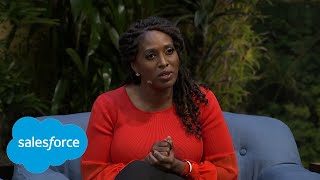
Salesforce panelists Jyoteka Eddy, Shona Hughes, and David Kelly discuss equity work across tech and sports. Eddy advocated for the Supreme Court decision ending juvenile death penalty in Roper v. Simmons. Hughes leads Pep Up Tech and Trailhead access. Kelly describes the Warriors' community commitments around Chase Center.
Chapters
Please welcome to the stage jyotega eddy.
Chief strategy officer, promise.
Shona hughes, co founder, pep up tech. David kelly, chief legal officer, golden state warriors, and rosie rocca, vice president, new business and customer experience.
Welcome. Welcome to our panel, and thank you all for having us. We're thrilled to be here with this red hot and plaid group. Not coordinated, but certainly of the same mind. And I'm thrilled to be talking to them about leading the change and not just business, but in society as well. So we're going to jump right in because I want all that wisdom to come out. And for me, one of the observations that I had about each of your careers is that there is a core theme that weaves through it all, which is advocating for and building equality in society. And so I'd love to have each of you talk a little bit about that, what that means for you and your work today. So why don't we start with David and then we'll go around?
All right.
Well, thank you.
It's a pleasure to be here. Okay. When I think about equality, I think about, for me, someone who's trying to participate and trying to compete. I like to start with a sports analogy. I want just a level playing field. Like, that's if the playing field is level, then I can get in, I can participate, I can compete, and I can get done what I need to get done. So equality, to me, the first step is creating a level playing field. At the same time, when you reach a certain level in your career and you have different influence, it's not just about creating a level playing field, because sports analogy people, some people will come into that level playing field with years of training, with a shooting coach, with great conditioning. And so when you reach a certain level, you start thinking about the game itself and what you can do to influence who, how people are coming to the game. So before they get to the game, what can we do to level that playing field or to create opportunities so that we can come to the game better prepared? So there's always just looking for places where inequality exists and trying to figure out at your career, at your stage of your career, what can you do to impact that?
I love that the playing field is so important in all this and leveling that. What about you, Shauna? What's been your experience?
Same thing. I think what David is saying, in my own terminology, is creating equity. You know, so it's fair for all. But also, you know, when you think about equality, it's fair for everyone. When you think about equity, it's providing what each individual need to really excel at whatever it is that they're trying to do. And for me personally, you know, as I, you know, grew in my career and excelled in my own career, I wanted to make sure that the opportunities that I had were also available for the people that were coming behind me. Being a young African American who didn't have a lot of the opportunities that I would say, a lot of my peers had growing up in the neighborhood that I was in, it was important to me that the people that look like me, that came from where I came from, also had the opportunities placed in front of them as well.
You had a very specific experience here and helping to advocate very strongly for some of these communities. What do you think about this?
I think, much like David and Shana, very similarly, I often, if anyone ever hears me speak, I always say I am from a very small town in South Carolina. The name of my town is Johnsonville. I grew up on a dirt road in a town with 1,000 people. And growing up in a place like that, what I saw was that often that there were many people that are often overlooked, misunderstood. And so my entire life, I've just been really driven to really focus on how I can be a real force for good. So every day I ask myself, anytime I make a decision, a career decision or any type of decision, I ask myself, is this decision going to help move the greater good forward, and how can I be a force for good? And so, for me, throughout my entire career, it's really been focused on whether it's in advocacy or whether it's in politics or whether now in tech. The question is, how do we take whatever the tools that we have at our disposal, and how can we use them to really take the people who have been pushed through the margins and put them back at the center where they belong?
Thank you for sharing all that. I want to stay with you because I read somewhere that you're referred to as the Olivia Pope of Silicon Valley, and she dresses the part, too, and so no scandals. With me, though, I'm curious about that connection between your work in politics and advocacy with the work that you're doing in tech now, especially joining a new company, Promise, which we're all super excited to hear. Tell us a little bit more about that transition and what's helped you.
Yeah, so the whole Olivia Pope, it's kind of. It's funny when people come up to me about it. You know, I love Olivia Pope. I don't know if you're as familiar with the show Scandal, but that's where it came from. But for me, Olivia Pope always wore the white hat, and she always was focused on really fighting for the person that was the underdog. And so, for me, that analogy I take from that analogy, like, how do I always wear the white hat? But most importantly, I think there are a lot. To me, Olivia Pope represents strong black women who don't take no for an answer, who stand their ground and fight the good fight. And for me, I take it as a badge of honor. But also, there are so many Olivia Popes in Silicon Valley, in politics, there are so many amazing black women that are wearing the white hat that's fighting the fight and doing the work. And unfortunately, I think we were having this conversation on the side of the stage. Unfortunately, we don't always see those women. You know, when I was even thinking about coming into tech, I didn't see a representation of myself. So I'm just so honored to be on this stage. And I really thank Salesforce for creating this space and looking in this audience at all of these beautiful black and brown folks here. I think it's important I didn't see a representation of myself, and so I was reluctant. I'm very open in terms of being honest about having imposter syndrome, not thinking that I was, you know, smart enough or good enough to take years of working in politics, whether it's helping, you know, like the president of the United States or lobbying on bills and legislation. Didn't think it was transferable in tech. And I think society will often tell us or lead us to believe that we're not good enough or our skills don't transfer, but in actuality, we're not only good enough, but in most cases, we are better. And so I think that's absolutely imperative. Important. And so when I think about people like Olivia Pope and all the Olivia Pope's that's in this audience and that are in this industry, I just think that it's super important that we always remind ourselves that we are enough and that not only do we belong, but there's a need for people like us in this industry.
Absolutely. Well said. And I'm thrilled that you're joined on stage by another Olivia Pope. And, Shawna, you are a black woman, founder of an amazing organization that has driven change in the lives of so many people. As part of Pep Up Tech, you have also helped to build the Salesforce community. I'd love to hear about your experience in building those communities and why it's so important and how trailhead for Example has also helped on that path.
Yeah, so it hasn't been easy. It's not an easy path. We all know that. It's being persons of color. It's not only a physical fight that you're in, but it's a mental fight, and it can be very taxing. So being able to build communities, I say within a community that's already established, so being able to build a community that represents what the world looks like today is not something that's typical, typically easy, but it's something that is important, and doing that within the salesforce community, starting off just creating a group and bringing others along and showing them the way, I think that, you know, just being authentic about that is very powerful. Being vulnerable, because, again, not seeing yourself, others are like, oh, you know, I don't see myself in this space. And if you put yourself out there, then you allow other people to see themselves, you know, represented by you. So I think that's very important as well, that we tell our stories that way. The people that are coming up behind us can see themselves in us. Also getting support from your allies and the people that are around that support you, that, you know, they don't look like you, but they really want to help, and they're being very intentional about creating those partnerships and those relationships are really important, as well as having a strong and solid foundation. And that's really what salesforce has provided, I would say, for us in our group. You know, I'm a co founder, as you said, and there's three other women of color that helped bring this organization to light. And without the support from our salesforce community, from the mothership, as we like to call salesforce, and the ergs within salesforce, without their partner community, it wouldn't. It wouldn't have come to fruition. And just receiving that support, the support of the trailhead platform, having access to a tool and then being able to teach that to other individuals is very powerful and not having to pay for it. Trailhead is completely free. So you're opening up doors and opportunities to individuals that would have never been available to them before.
I have to say, I'm a big fan of pep Pep tech. And I had a fangirl moment in the back for the first time. I was fanning myself. But, David, you also have many fans in the room. I think I saw one or two warriors hats out there. And so you work for this amazing organization that's a model in many ways in the NBA. And I'm curious about what you think drives that magic for the team.
So at the beginning of the day and at the end of the day, we're a basketball team. And so a lot of what we get and what we use on the business side, we actually learn from a lot of the players. And so the first key that we have is we have humble leadership in Steph Curry. So it helps when you're. When your leader. Not me. Not me. It helps when your leader is humble, when the best person on the court is the most humble person on the court. So we learn that from the team. Steph's approach is a little bit different than Draymond's approach, but they each need each other. And so you also learn the importance of having diverse viewpoints and diverse ways of achieving success as part of a team, and that you need both. And Clay's different than both of them. Right. But the three of them are the foundation to everything that we do on the court. And we take that. We've learned on the business side to take that example from the players and try to implement it on the business side. So when I think about our organization, we try to be collaborative. We try to make space and make voices and allow voices from all different levels of the organization. But I think a lot of that came from the guys that we have on the court, and that's the way that they function.
And just to go a little bit further, I'm curious around how that influences your decision making as an organization, because we've heard a lot about representation, being able to see yourself in the communities and the. The jobs and careers that you want to have, but it's also around making sure that those perspectives work well and picking the causes that you care about.
That's right. Well, okay. So maybe it's kind of fortuitous that we're talking about this today, if you saw the news with respect to the speaker. But one of the proudest decisions that we made as an organization, for me personally, is when we decided that we were not going to go to the White House a couple of years ago.
And.
I'm proud of this decision that was made, but I'm also proud of the way that the decision was made, and it actually came from the players. It was not. There's no way that we, as an organization were going to tell the players to go or not to go. It was a. Look, the only reason that we're, as an organization going is because what you accomplished. So what is it that you want to do? And there may have been certain players who wanted to go there, may have been certain players who definitely were certain players who didn't want to go. But we wanted to create a space where they could have that conversation, where they could talk amongst themselves and decide what it is that they wanted to do. And we were going to support them and back them with respect to whatever it is that they decided. And I'm glad they made the choice that they made. But again, it was allowing different voices, not just allowing Draymond to have the biggest voice, but making sure there was a room where Kavan could have a say, David west could have a say. All of them could have a say in terms of what it is that they were going to do as a group. And so that, I think, is the culture that we take from the players and that decision show the process of the way we make decisions.
Absolutely. And I think it's applicable to all the work that we're all doing in community building and driving causes that we care about. And I think, Jetika, you had a lot of influence on one of these landmark U.S. supreme Court decisions in 2005, which was Roper v. Simmons. You want to tell us a little bit about what the decision was about? How did you help to bring that community to light and to help them accomplish, basically, abolishing the juvenile death penalty in the U.S. yes.
Yeah. Thank you. Thank you. When people ask me often, I say the most important thing I ever did in my career in life. And most people associate me with tech and Silicon Valley now, but I often say the most important thing I ever did in my life was the work that I did, along with a lot of amazing people, to really change the course of what I believe is super important in criminal justice reform is abolishing a juvenile death penalty. At the time, the United States was the last country in the world that would sentence someone who committed a crime under the age of 18 to death. And, you know, I sort of kind of go all the way back to my childhood when I was growing up in that small town in Johnsonville. There was someone from my town that was on death row, and that's how I learned about the death penalty and became just extremely committed to the work to abolish the juvenile death penalty and had incredible opportunity. And the panel before really spoke about mentors and sponsors. And I had sponsors in my life, people like Steve Hawkins and Ben Jealous and others who poured into me and gave me an opportunity to lead. So as a young person at the age of 23, I was able to go in the States, South Dakota, Wyoming, and do international lobbying in the U.N. really to help create a case before the U.S. supreme Court. And we won that. And I think what that showed me was that it's possible at the time, I'll never forget being on a call and the decision was made that they were going to send Jettega me. It's weird to talk to myself in the third person. They were going to send Jotaka to South Dakota. And there was hesitation, and it was, why are we gonna send her? You know, the code. It was like, oh, she black. We can't send her to South Dakota to win. Pass legislation in South Dakota. And it was said, like, if we send Joe Taker, like, we're gonna lose. And so I felt it was a challenge until I went in there and we won. We passed the. We abolished the death penalty in South Dakota, which then led to the United States Supreme Court in a landmark decision. I'll never forget that day when it was abolished. And when I look at, you know, and I've just been so proud looking at the Emmys and the representation and Ava DuVernay and I know Issa Rae is coming up and all of these artists that are telling these important stories. And when I look at stories like when they see us and I think on the impact and you think about that case, those young men at the time that, you know, when there was, you know, you know, someone. I'm not going to say any names, who called for them to have the death penalty. And these were young people. And so for me, the impact to know that today, that never again in this country would anyone who largely was black and brown people, young people that were disproportionately sentenced to death, some of them for crimes that they did not commit, will no longer be subject to the death penalty. To me, it shows, one, that it's possible, two, that a little black girl that grew up on a dirt road in South Carolina can actually indeed do what people think is impossible. But more so than anything, that we can often tap into the humanity of our nation. Because I firmly believe that all of us in this country, everybody who lives in this country, is deserving of the humanity of who we are as people. And so it's a very proud moment for me. And it's often a reminder, even today in tech, that we can do anything. We put our minds to it. We work very hard, and we have working with an amazing group of people that we can really accomplish what people think is the impossible and change the course of the world along the way.
Absolutely. I see that reflected in a lot of the work that's happening in tech today to bring some of these underrepresented groups, all these amazing, talented people into the industry to drive change and innovation. I think, Shauna, you've been doing this a little bit, not a little bit, a whole lot with Pep Up Tech. And I'm curious around. How do you think about those challenges and what's inspired you to really focus on bringing up and lifting these underrepresented groups in a way that's really meaningful for this industry?
Well, number one, we're told a lie. We're told that there's a pipeline problem. And looking at all the black and brown faces here, there is no pipeline problem. That's, That's the, you know, the number one issue. There's always, you know, an excuse to not do something. So what Pep Up Tech has done is we've created a curated pipeline of individuals who are highly skilled and highly educated. So now what's your excuse? What are you going to do now? You know, and it's always a battle again, trying to get people to realize that and to recognize it. And the reason why I'm again, so passionate about it is because I didn't see that for myself and I didn't have hope. And that is what we are trying to do. Provide some hope, infuse some hope back into our communities to show them that there is another way. There is. You do have options. And I think that when you're able to do that and you're able to do that authentically and bring yourself to the table and also bring others with you who look like the students, who look like the individuals that are in our communities, they see it and they're like, oh, I can do that. I can, you know, be that person. You know, I'm smart enough. When you think about the people that are in our communities, I mean, I think about a lot of the, you know, individuals who were drug dealers in our communities. I mean, they ran large organizations dealing, selling drugs. But if, let's say, they were given the opportunity to go to Harvard or to go to Wharton or whatever, they would have been able to use those skills that they naturally have to create Fortune 500 companies.
Absolutely.
But they were never given those opportunities.
I totally agree. And I think it's so important for all of us to know how to participate in some of these community innovation and changes and movements, frankly, across the board here that you're all driving. So I'm curious around. What are your recommendations for us to drive even more for Pep Up Tech? How can we get involved.
Yeah. So we're always looking for mentors for sponsors. Obviously, we're always looking for people who can sponsor a student to, like, go to Dreamforce or. Because that creates pathways and opportunities for them. But we're also looking for, you know, people who can help teach a class. You know, if you have a specific skill set, don't think that it's not something that we need, because we do. You can volunteer, you know, as much as you like, two hours a week or a month, whatever it is. They need you, we need you, as well as donations. So Our program is 100% free to our students, and we all of it is, you know, 100% fundraised by us. So it's important that we support organizations that are bringing up those behind us. That's to. Going. Going to then take care of those behind them. So we need to be cognizant of that and really thinking about what can I contribute to help the cause? So if you go to PepuTech.org you can, you know, sign up to volunteer, you can donate. You know, you can sign up to mentor a student. Whatever you have to give, it's a precious gift, and they will appreciate it.
Thank you. David, you have a different challenge in community building. You just recently moved the entire warriors organization to San Francisco to the new Chase Center. If you haven't been there, please check it out. I'm curious around. What were the issues that you had to take into account to make sure that you were being inclusive of a full community of fans and stakeholders as you were making that decision?
All right, well, so as someone who lives in Oakland and who is staying in Oakland, I had to do what I knew was best for the organization, but do it in a manner that was respectful to the community. That's my home. Not from Oakland, but that's my home. That's where I intend to stay. And so it was. We're moving the team. We're going to play our games here in San Francisco. But the community work that we do in Oakland, we have to redouble that. If we were doing X amount of work now, it has to be 2x. If we were. Because the community demands it, the players demanded it. The front office, you know, a few people may be in the front office, demanded it.
Yep.
And it's. And it's just. And it's the. And it's the right thing to do.
I love it.
And it's. There's a. There's a big difference between Oakland and San Francisco. And we know that there's that narrative of moving the team to San Francisco. And we had to make it clear that, look, if I were, if I owned a business and I was bringing it to the. If I own a sports team, I was bringing it to the Bay Area, I would have created Chase center and I would have put it exactly where it is. Understood. Okay? But that's not the history that we have. So let's deal with the reality of the history. Let's make sure that when we're making that transition, we're doing it in the correct way and that we're not leaving Oakland behind, that we're continuing to be invested in the community in the same way or even more so than we were previously.
That's amazing. And I know we have a few moments left, so I would propose to do a fire round of one sentence advice to this amazing audience here in the theater and those folks who are watching us online. So, David, why don't you start and we'll close off with the ladies in red.
So I'll just.
One of my favorite quotes, and this is when we're talking about imposter syndrome and thinking, wondering whether or not you're good enough. One of my favorite quotes is the people who founded Harvard did not graduate from Harvard. And if you understand that, then you understand a lot of what you need to know about your potential and what it is that you can accomplish.
Absolutely. Thank you for that. It's actually a true story, Shauna.
So I would have to say we rise by lifting others. So don't be a selfish individual.
I love the directness of that. And so true is that we all should carry ourselves forward.
Jatayka. Yeah, I'll close by saying I love it when I'm in a space and I hear us refer to ourselves as kings and queens. It makes me just. It fills me up.
You told me.
Yes, I said. I told her. I said, I love your crown, sister, but I want to leave you with this, is that equally as we are kings and queens, we must be kingdom minded. And we have to think about as we move throughout this world, whether whatever industry in wherever we're at, no matter what space, what position, how big or how small, how can you be kingdom minded and think every single day, how am I about the business of the kingdom? Because what good is a king or a queen if the people in the kingdom are languishing?
And with those amazing words, thank you to our panel. Thank you all.









