Rising Stars of the Cloud at The Cloud 100 2020
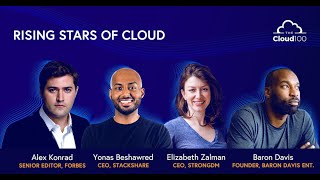
A recorded panel-style conversation (YouTube) titled "Rising Stars of the Cloud at The Cloud 100 2020" (recorded/published around May 27, 2021) hosted by Alex Conrad (Forbes) with founders Jonas Bischoud (StackShare), Liz Zalman (StrongVM / Strong dm), and Baron Davis (Baron Davis Enterprise/Business Inside the Game). Participants describe their companies and missions (developer technology collaboration, infrastructure access auditing, and athlete-focused media/management), motivations for founding startups, leadership during 2020 (COVID-19, racial-justice reckoning), and themes of collaboration, responsibility, and mental resilience for founders.
Questions this video answers
May 27, 2021.
Senior editor at Forbes.
"StrongVM manages and audits access to infrastructure servers, databases, firewalled web apps, kubernetes clusters" (provides remote employee access and auditing).
"The world's first technology decision collaboration platform"; "over half a million software developers use StackShare."
A management factory called "Business Inside the Game."
Chapters
I'm Alex Conrad, a senior editor at Forbes.
Hi, I'm Jonas Bischoud, founder and CEO at stackshare.
Hi, I'm Liz Zalman. I'm the co founder and CEO of Strong dm.
Hi, I'm Baron Davis, founder of Baron Davis Enterprise.
So, Baron, Liz, Jonas, thank you so much for joining this conversation. It's exciting to be with three up and coming entrepreneurs from different backgrounds and very different endeavors. I'd love if we could just hear a little bit about what you're working on in terms of mission and what your company is doing. Why don't we start with Baron? If you could tell us a little bit about what you're doing since being an all star in the NBA and kind of well known, I'd say to a lot of folks for your athletic career.
Yeah, thanks Alex. It's been fun. Life after basketball, I say I use the MBA to get my mba. And so I founded and created a company management factory called Business Inside the Game. And the goal is to create, you know, media events to curate athletes, investors and C suites and bring about the right cohesive network. Very similar to a management factory or a management accelerator.
That's awesome. Liz, if you don't mind telling us a little bit about StrongVM and what your goal is there.
Yeah, I would love to. Thank you. StrongVM manages and audits access to infrastructure servers, databases, firewalled web apps, kubernetes, clusters. Strong provides a way for you to connect remote employees to infrastructure, no matter where it is, and then audit what they're doing once they're in those systems.
Awesome. And Jonas, tell us a little bit about stackshare, hopefully. Sure.
So we're building the world's first technology decision collaboration platform for software developers. And so today, over half a million software developers use stackshare to make technology decisions. We show you what the big companies are actually using and help you decide what you should use. So for example, you can actually see what Forbes is using to powerforbes.com because the VP of Engineering at Forbes actually shared the technology profile. We help you make better decisions by showing you what other people are using and then we actually help you get a handle on what's happening internally.
That's awesome. Well, hopefully the Forbes tech stack measures up to our peers to get into the fun stuff. All three of you are doing something pretty different. But what would you say is driving you to have been gone down the entrepreneurial path in the first place?
I guess I'll go first. I would say I saw a huge Boy, in the market. And as far as NBA players. And I realized that there are so many more athletes that, you know, are successful and have been successful life after basketball. And so at that point just kind of set out to figure out, you know, where. Where there are holes between the NBA, the players, influencers, their managers, you know, and really trying to kind of bridge gaps and fill those holes with solutions.
So, Liz and Jonas, I know your companies are probably a little less NBA focused, but was there similarly a gap that was inspiring you or what was driving each of you to kind of do your own thing?
I don't know, Alex. We actually have one of the major sports leagues as a customer, although it is not the NBA.
Well, we gotta get the NBA.
We gotta get the NBA.
No, Baron, they should be. I gotta tell you, man, like, I can't even imagine when you're playing, you secretly tweak your ankle in practice and you don't want somebody knowing about it. And that that exam goes into a player database. And like, you want to know who has access to it and what they're doing with it when they get it. No, but, Alex, to answer your question, I started my first company because I thought I could do better. I was working for a company that did display advertising on the web, and mobile was just starting. HTML5 had just become a thing. And I said, well, why can't we do that but on smartphones? And so I started a company, raised money and sold it. And then the company that acquired my company was in big data. They were processing hundreds of millions of Mac addresses a day, which is essentially personally identifiable information. And they had a data breach and so strong neon, which actually started to sit there and think from the ground up, what could we actually do to protect ourselves? Ourselves could be employees, ourselves could be companies, ourselves could be player data in a way that sort of moves us forward as technology is progressing.
And Jonas, what about stackshare? What's driving you?
My parents were born and raised in Ethiopia, and so they immigrated maybe 40 years ago. My dad is an entrepreneur, started a bunch of different businesses and so kind of had that in me. And my first job out of college was actually in management consulting and IT strategy. And so I saw how these big Fortune 500 companies were making technology decisions and using Gartner PDF reports, right? And I hated it. I got into startups. I came out here to the Bay Area, started working for early stage startup that had just gone through Y Combinator. They were based in Mountain View. And I saw how the founders would email other founders in their batch and say, hey, we have free credits with this cloud service and that cloud service. Which one should we use? And they did this over email. So I thought, you know, this is pretty messy. There should be a solution for this. And I also wanted to get a handle on all the different cloud technologies and developer tools out there. So for me, it's always been just like being passionate about the problem space and then wanting to finally solve this problem.
So all three of you saw a problem or saw the need for something that wasn't existing and thought, okay, I can be the one to build that. And so I'm curious if you guys started with the idea and then committed to being the entrepreneur or if you were already kind of sure that you want to be an entrepreneur and then the idea presented itself. Jonas, I see you nodding. So you want to start? Maybe?
Sure. Yeah. I think I definitely decided that I wanted to start a company, and I had no idea what that was going to be or when that was going to be. So that was the beginning of it. But then the problem presented itself, and I just fell in love with the entire space. And so that's why I always say is, like, you fall in love with the problem, not the solution, so you can pivot on how you solve it. But if you stick with the problem itself, then you'll never get tired of it. Right. You'll keep thinking of new things. So that's how it happened for me.
Look, I care deeply about the fact that you've got legacy companies that are now moving into the cloud, and you've got multiple data centers you have to manage access to in a fractured workforce. And sort of you need to rethink the security paradigm from the ground up, certainly. And I. I care deeply about protecting Barron's data from bad people or good people. Right. Sometimes people just have accidents when they're at work. I love my product. I almost don't care what it's going to take in order to get it to where it needs to be. Provided that my employees love coming to work, we're honoring the principles that we start with, and we get the result we need. So I'm fond of saying I don't care how we sell the product. If my sales team sells, said to me, liz, you could stand in the middle of Times Square and wave a flag, and if you wave that flag for 24 hours a day, everybody in the world's gonna buy your product. I would wave that flag until I fell over with exhaustion. So I think it's a combination I agree with Jonas. I think you just know that you want to start a company. You know that it's what you want to do deep in your heart. And you get excited about the fact that you have no idea what the day is going to bring. Right? No matter how well planned your day is, when you get up in the morning, you have no idea how it's going to end. And that's what I love most about my job.
Yeah, I would agree with both. I would say, you know, I knew I was a serial entrepreneur because of my ADD from basketball, so. And when I left and became my own agent, I really had to manage myself, right? So I had to get the marketing deals, build a foundation, set up my basketball au. And so that just led me to, like, learn a bunch of stuff, but already be in the entrepreneurial spirit. And so for me, it was, you know, build this. Build this management company to manage myself. And then, you know, build a sports platform where we can allow athletes to have data transparency, but also to own. Own the content that. That they have and own the content that they would generate.
How does that ownership affect all three of you in terms of your motivation? Like, is it when it's your baby or when it's your company, does that just give you an extra gear to kick into, that you can kind of just keep on going and kind of stay motivated? Because I'm sure the grind is considerable.
Alex. Somebody said to me, my CTO said to me, a year and a half ago, we had a. It was a horrible moment. And he said to me, liz, you have peaks and you have valleys, and there is no rule in life that says that every peak or every valley must be followed by. By a peak. You can have 17 valleys in a row. And it's sort of like dating. Like, you think about going out on dates. Sorry, I'm going to give it personal for a second, right? And you date and you date and you date and you date, and you have no idea when it's going to hit. It could take 100 years for it to hit. And then you go on that first day and you're like, damn, I like that person. Like, wow. And so you have to have faith in that process. And I think certainly being a founder means that you are. It's not about what you make. It's not about your equity on the cap table. Like, you are literally putting your life in dollar for dollar, next to your employees, and the only thing you care about is actualizing that and making it come to be. I don't Know if anybody else has a dating story like that, but that's my experience.
I was gonna say, I agree. My founder. Dating, finding the right people. I'm terrible at hiring, so I'm dating and dating and dating and dating and dating. And so it's like, okay, I figured it out. I might. I might as well be independent and let someone else come in and do the dating process. So I totally agree. I totally agree with that, with that metaphor.
I think, you know, when it is your baby, you do tend to put a little more into it. But it also, you know, there's the other side of it, where a lot of the decisions and a lot of things that happen are ultimately on you. So you do feel that responsibility for your employees, for your investors, for everyone that's looking up to you and, like, following your story at the same time, that sort of, like, holds you up because you know that it's not just about you doing your job. There's like, all these dependencies, right? All these people that are depending on you. And so it kind of gives you that extra energy as well, right? To keep going even when you don't want to, because it's not about you anymore.
No, I totally agree. I would say for, you know, our platform, slick sports, lifestyle and culture. We started in the content business, and it was like, well, all the money's gone. All right, where are we going next? We'll go into the publishing business. Oh, all the money is gone. And you constantly. You learn to listen, right? And you learn to be able to be nimble and the pivot. I say set your vision super duper high, because you can always reinvent yourself to get there. And when you get there, it's a great opportunity to reinvent yourself again, right? And so it's like continuing that motivation. Continue to listen, right? But don't be afraid to get knocked down, right? We've had two years of losing streaks, and now all of a sudden, we're like, on. On the up and up, right? And so it's really just when you're losing, understand why. Why you are losing, right? And how close you were to winning. You know what I mean?
So in today's world, with so much going on, what is it like for you to be entrepreneurs and people, you know, in. With responsibility in a very difficult year, but also a year with a lot of introspection and a lot of important, you know, discussions happening?
I think the year. Alex, it's a great question. The year has been. I think it's been fascinating, personally and professionally. So professionally, business is up. This business was designed for Covid. We do remote access to infrastructure. And so as a leader, the way that I think about it is that the team comes from diverse backgrounds, diverse skin colors, different religions, very different politics, different genders across the whole range of the gender spectrum now. And at the end of the day, what we want to honor is that work has to be a safe space. And so work is whatever the employee needs it to be in that moment. That's how I think about honoring 2020 as a leader.
I would say for us, you know, 2020 has definitely been challenging. I think for me, as a leader, listening to. To the people you work with, right? Treating them as human beings, right? Having business conversations. But set aside zoom, time to, like, have open conversations. And so we've been seeing great success in our business because a lot of corporate companies, you know, Fortune 100 to startup companies, have been raising their hands and saying, how can we be more responsible, right? How can we, you know, support, you know, black and brown and women and lgbq? How can we be a part of, you know, a better ecosystem? Because when you start looking at our country, start looking at America, you know, it's a melting pot, right? And for so long, we've been segregated, right? So long we've been, you know, kind of in our own silos as people. Until, you know, the recent pandemic, right, which forced us all to go inside and, you know, do some reflection. And then, you know, with the George, Floyd, and, you know, everything else that's been happening since, you know, everyone has not only, like, does self reflection, but it's been a time of motivation where people want to rally, right? People are raising their hands, they want to do, right. Entrepreneurs are stepping forth and saying, you know what? Like, I was timid about going out and raising money. We need help, right? And so to be in a position where I would say, like, we are the middle manager, right, and we're the bridge, it's been a great position, but a lot of responsibility. And I think for that, it's important to just make sure we all know that even though we're behind these zooms, we can laugh, we can joke, right? And there's still a human side to the work that we're gonna put forth.
Yeah, I guess I'll just start on the business side. You know, when COVID 19 hit for us, fortunately, we were already used to having some of our team members remote, so we were using Zoom, Slack, Google Docs, all of that. And for our actual business, it Actually ended up being pretty positive because everyone is now distributed and has a greater need for collaboration and particularly engineering teams. Right. So the fact that we brought this product to market, you know, that sort of, you know, maps out your tech stack internally and helps your developers talk about these decisions that are being made, just that ended up being really good timing for us. And so it was funny, actually, at the time when I think this was March or April, if you had Googled Zoom versus Google Meet, you'd see Stack Share as the top result. So we saw the business go up and to the right, and then it felt like there was a second pandemic that hit with George Floyd being murdered and Breonna Taylor. And so it really felt like this second wave, particularly for myself as a black founder, I definitely felt it with my peers, with family, with friends. And so I think that what it made me realize was that everyone is going through something, right? And, like, business is one aspect of it, but there's also, like, Baron's saying, there's, like, the human aspect of it where you have to give people time to actually deal with what's going on in not only the world, but their own lives, you know, and so it kind of just caused some reflection, right? And us saying, like, hey, it's okay to step back for a little bit. And even I told my team was like, hey, I need some time to, like, process all this. And I wanted to do some things to help, so I think we all realized that it's okay to do that.
How have you handled pressure? Right? You know, being a black founder in this social justice position, also being a female founder, right, In a time where, you know, females are fighting for, you know, their rights and their power, talk about the pressure, you know, from peers and family to be that leader. And, you know, especially with the companies that you guys are building.
Baron, you're right. It is being a female. Being a female in hardcore security and infrastructure, it is a. It's a tremendous responsibility. I hear it sometimes in interviews with other women and I. And I'm always struck when I hear it because I don't expect it, because I don't see myself that way. I'm a human. I can tell you the way that I've been managing it is I started seeing a therapist because I need somebody to talk to about the pressures. Yeah, Jonas, what you said about I need time as a leader to step back and reflect on what's happening, I think that's it. The only way to process is by being open and honest and talking about the struggles that you are having as a human, as a member of the human race, as a leader.
Yeah, I mean, it's a great question because I think there is a lot of pressure, but at the same time, because of everything that's happening now, I feel like there's just a lot of support for, particularly for black founders right now. I think there's a lot of folks that want to help. There's a lot of new initiatives. And the way that I've always looked at it is that, yeah, there's pressure on me, but also at the same time, I've always felt like whatever stage I get to, I'm not going to be successful in my own view unless I'm bringing other people with me. Right. Other black founders. And so for me, that's been kind of the driving force is like helping other black founders get to the same stage or get past me has always been the goal is like, to me, it wouldn't be a win. Right. If. If Stack Share gets to where it wants to go and IPOs, and then that's it. You know, it's going to take another hundred years for us to really see black founders flourish. So I just try to make sure that I do what I can to help other black entrepreneurs. And I'm sure it's the same for you, Barron, right. Where through all of your endeavors, you've probably done countless things for other black entrepreneurs. And I think that's part of what helps relieve some of that pressure.
Absolutely. Thank you.
Thanks for sharing along those lines, guys. I know we're almost out of time, but I think it's really interesting. For a while, it was sort of like the cult of the startup founder was you kind of took no prisoners. You were a college dropout, you were out to just like conquer the world. And it was kind of very combative, very aggressive. I don't know if it's current events or it's just people being more intentional, but it feels like the current wave of rising entrepreneurs are a bit different, that maybe they're more collaborative. Is that something that resonates with any or all of you? Or kind of. What would be your thoughts on kind of that current vibe among your peers?
I would say now more than ever, I would say my generation or our generation, you know, we're looking to support. Right. You know, we're not. We're looking at a movement. We're thinking differently about government. We're thinking differently about institutions. Institutions. Right. We're thinking differently about media. Right. And security and things like That I would say the generation or a couple generations before that were like, renegades and bullish and just like, you know, disruptive. I think our disruption comes with a feeling of responsibility. Right. So how can you disrupt the current system, Right. And then build a better ecosystem to where you're actually giving to the world? And so the collaboration amongst peers, and even for us, in the case of raising money and partnering, it's been an incredible opportunity for us and something that I feel good about, and I think that it will continue to be embedded in the DNA of these entrepreneurs.
The founders that are coming up now, especially the younger ones, are much more collaborative and much more willing to support each other and open. We're just not gonna. We're not gonna make it if everyone's gonna be out for themselves, you know, and there's so much opportunity out there that it's like, why not support each other? Right?
I do think that there are things that are cutthroat and will remain cutthroat. So if I'm going out for a fundraise at the same time as my two competitors, I mean, my God, it's gonna be a fight to the end. But certainly I think there's such a collaboration without shame, without ego, without pride. And it is beautiful to see how the collective sort of helps us all uplift in whatever way we need in that moment. That is unique, and that didn't exist seven years ago when I was at my last company, for sure.
Well, it's really cool to see this group of rising star entrepreneurs, obviously the ones on our list, but also countless others pulling together and coming up with cool ideas and I think kind of tackling markets where, I think, as you said, Liz, y' all are still very competitive. You're still type A people, but maybe just a little more mindful about how to, like, build a sustainable business. And I think that's really exciting to see. So, you know, from Forbes position and for, I think, all of us with Cloud 100, it's really great to see how you all are building your businesses and how you think about entrepreneurship right now, you know, very important time. So thank you so much.
Thanks for having us.
Thank you, Alex.









