Salesforce Connections 2019 Keynote - Ch. 1: Corporate Narrative | Salesforce
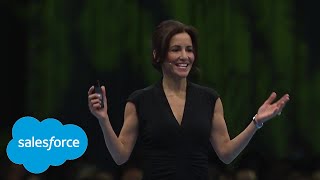
Stephanie Buscemi, Salesforce's CMO, lays out the company's push for a single view of the customer through technology and culture. She walks through State Farm's digital transformation, Salesforce's core values, and the role of AI ethics in building customer trust.
Questions this video answers
Three major releases per year.
Over a couple hundred new features and capabilities per year.
14 million badges.
Over 7 billion predictions.
8,000 customers and prospects across 16 countries.
Chapters
Please welcome chief marketing officer salesforce stephanie buscemi. Hello and welcome to Chicago and welcome to Connections. Thank you all for being here today. It's great to be here with all of you, and I hope you enjoyed the Second City. They've been producing those hometown heroes and comedic legends that we've been hearing about from for years and watching on the big screen. And today they had a little bit of fun at our expense. I don't know if you caught all that, but they were making a little bit of fun about how we talk about making connections now. It's always good to laugh at yourself and have a little bit of fun with that and poking, but we're going to actually get really serious about connections and what we mean about connections here today. What is this conference? Why are we here today? We're here today with all of you to focus on helping you get a single view of your customer. It's not easy to do in this digital world today, and we're going to dive in and unpack that together. So how are we going to do that? Our job here is with all of you today is to focus on how do we inspire you to do this, how do we motivate you, how do we empower you and your teams to go ahead and get to this single view of the customer? We're all on this path together, and we're gonna do that by sharing stories. Your stories. Not our stories, your stories. Stories of trailblazers who are out here in the audience and around the world who are on this path and having success at it. We also have some pretty cool product announcements. The product team's been pretty busy and doing some pretty amazing things. So we have some strategic product announcements that we want to share with all of you, and we're going to share with you with Trailhead new ways to learn new skills that all of you can get. So we're going to have a lot of fun here together over this keynote time. And I want to address one thing we always say to you. It's about customers. It's about customers. It's about connecting with your customers in a whole way. But I want to level set with everyone here that we get it. You don't always say customers. You say patients, you say shoppers, you say fans, you say policyholders. Don't worry, you're at the right event because this is all about creating human connections, meaningful human connections. So you create amazing experiences for whoever your customer is. And that's what we're going to focus on here today. Now, while I'm talking to you. All right now. I want to hear from all of you. We want to hear from all of you. And we're going to take it to Twitter today. That's right. I'm actually going to say, take out your phones. Don't make me regret this. I'm going to ask you to take out your phones and take it to Twitter and join the conversation. Tell us how you feel about what you're seeing out here. And our new announcements. C360 now, customer 360. I've had a few people give us feedback to say all of you giving feedback, saying, Customer360. Careful when you say that, that's hard. That's the holy grail. That is the nirvana. Getting to customer360. And don't wash over that, because that's hard. I know that, and we know that, and we want to acknowledge that with all of you today. I have been in marketing roles for 20 years. All right. I'll be my really authentic self and tell you 25 years. 25 years in different roles that many of you here, I'm sure are doing. And I know stitching together every single touch point to create this delightful customer experience is not easy. But you're going to see how we've been at this at Salesforce for 20 years. This isn't new. This is a journey that we're on together. And before we dive into that, I do want to thank all of you for coming here. It is never lost on us, the amount of time and investment you put being here here today, your time, and as a customer with all of us, we thank you for that. We thank you every day for that. We've done really amazing things together. And I personally want to thank our employees here today. Our employees, while I get to stand here, they have done so much incredible work to make this a great experience for all of you. So I want to give a shout out to them, and I want to give a shout out to our partners out there who really rally together with us to make this happen. So we've done these amazing things together over the last 20 years, and how have we been able to do those things together? How we've been able to have this kind of growth? Well, look what's going on in the world around us. It's about being true to yourself and true to the person you are. And we see when people lose their way on that, bad things happen. So Salesforce 20 years ago went with a core set of values, and we have not wavered from those core set of values ever. We've kept it true to us and those are the bedrock and the foundation of the company. It's how we make big decisions, small decisions, how we interact every single day. And it starts with trust. Because if it's about product availability and trust in the product and putting your data in the cloud, to my one to one verbal commitments to any one of you when I'm talking to you, if I don't have your trust and we don't have your trust, we have absolutely nothing. It's also about customer success. Our business model is built on your success. If you're not gaining value and creating these experiences for your customers, we're not successful. So your success is our success. And we never forget that we're a technology company. It's about us staying out and being leading edge out there, delivering the technology innovation and bringing it to you and making it accessible to you and making it easy to you, easy for you to use. What does that look like? Three major releases per year and in those three releases we always have over a couple hundred new features and capabilities. So that continuous innovation, how do we make those decisions? How do we decide what to put in the product? You help us and if you ever feel your voice isn't being heard, speak up, take it to us. Because you help us prioritize what needs to go in the products. And last, but certainly not least, equality. Now more than ever, businesses have to stand up and take a position and Salesforce always has, on the advancement and equality of every single human being having that right. It's critical to us. So these things have guided us to be able to do good in the world. We believe business is a platform for change. We believe that businesses shouldn't just do well, they should do good. It's our responsibility to give back. As a company, we focus on some key areas that we believe we can influence and one of those is public education. I'm a product of the public education system. My mom says I didn't come out that bad. I think I did okay. I have a 12 year old who's in the public education system and I see what the allotment is per student per year and it doesn't cut it. And so we lean in really hard on public education. All of our executives in the company adopt a school. We put our time, we go to those schools, we meet the leaders at those schools, the people that are running these schools and we talk to them and understand their priorities and what they're doing and help them. Today's no exception being right here in Chicago. We've invested another $1 million in Chicago schools to two key organizations. I see stars. I See Stars goes out into underserved neighborhoods right here in the Chicago area and uncovers talent and gives them skills and training and workforce development to help them secure meaningful jobs. The second organization, Chicago Public Schools. This is our second year. We were here last year and we invested in Chicago Public Schools, and we've done it again. And what we're doing with them is two things. We're focusing on investing in the leaders, the administration and the teachers. We never put enough behind our teachers in our administration. And they're doing God's work. They're building our future. So we invest in them and we invest in the STEM programs, the science and math programs, so that more people can have the skills they need in this fourth industrial revolution. Really exciting. Now, I said to you, we're going to talk about this event being around the customer360 in the single view. But I also promised to talk to you about it through the eyes of trailblazers. Those educators I just talked about, they're trailblazers. They're trailblazers in their space and what they do. What do we mean by this when we talk about trailblazers? I know Second City had a lot of fun with that. They are not the Portland Trailblazers that we are talking about here. We're talking about people who have personally and professionally transformed their careers and their personal lives. They're people who believe in being better and seeing the change that they want to see in the world. They're innovators. They're disruptors. They're shaping their community. And so many of them are right here in the room today. I see so many smiling faces. I see over here, Fawad. I see Elliot. We have so many of our trailblazers here in the room and we're going to start sharing their stories. But I just want to take a minute with Fawad right here. Fawad Ahmad is one of our very special trailblazers who came in for this event today, and he is with State Farm and he leads at State Farm all of their digital experience and customer experience teams. And he's doing some amazing things and he gave us the pleasure of sharing his story. Let's take a look at it and then talk to him live. Can we cue the film?
I don't think anyone is ever a finished product. I guess I'm always looking to develop. And you do that best when you go someplace where you haven't been.
When fawad was offered the position at state Farm, I think the challenge presented itself and it pushed him to step out of his comfort zone.
State farm has historically been a company that promotes and grows from within. I felt the eyeballs on me, for sure. They wanted to see if we could digitally transform the company, and they said, we have to make this work. We are not going to allow this to fail.
It's a difficult position to come into an organization with the strong culture that we have and find the right ways to push.
I think a lot of the questions came and the resistance came for why? Why change? Why? Why are we doing things? I'm doing great. Why would I do something different? We really had a strategy around our transformation. We said, what do we want to be? What do we stand for? And we defined that together, which is we want to be about the customer and the customer experience and being absolutely dominant in that and understanding that salesforce was the system that could be our primary system of engagement across our operations. And those 19,000 agents that are out there with their tens of thousands of team members, that's the very same people who've always worked at State farm with just a little bit of a nudge and a little bit of a help from technology and from our partnership with salesforce. I think you really motivate individuals and teams by taking an interest in their work and making them feel valued. It's really not magic. It's just being strong, being credible, where you know that you've got to find a way to communicate what you believe.
He really brings in a flow philosophy of not just saying but doing.
He promotes empowerment. He wants to make sure that we're empowered to work above our level. Watching people unlock their own potential is the very best part. That's when it becomes really cool. I think that's the moment when you realize everyone is a trailblazer. They want to be.
I don't even know how to put in words how proud of what he's accomplished and accomplished in the face of being the outsider. And I couldn't be more proud.
As a company with salesforce, we're dominating on our experiences. We're ranking number one in how we're dealing with digital. We're starting to see the wins. And the only thing that changed was instead of saying why? You said, why not?
Thank you. Such a powerful story. Can you come on up here and join me? Thank you.
Thank you.
So, two things. One, you have put the customer at the center of everything you do. Talk to us. Why now? Why you think the Customer centricity piece is at this tipping point. Why now?
Yeah, and I think it's always mattered. It's a great question. And all of you are here because you know that customer centricity matters. I'll take our story as to why we were even founded. Our founder GJ Mahurl said, we need to operate fairly and do what's right for the customer. And in our context, what that meant was this notion of, why should a driver, a farmer in central Illinois, pay the exact same rate as somebody who lives in Chicago? That just didn't seem right. And so when GJ shared that opportunity, they said, hey, this is not how we do it. And then State Farm was created, and we thank GJ every single day for that vision. But if you think about everything that came after that, the products that we created, the services that we offer, the trust that people have in us because we keep our promises every single day, it's all for the service of the customer. And. And I think what's changed now? The question you're really kind of asking is, well, customers have more power than they've ever had before because of the technology that's available to them. And what that means is they have choices like they've never had before. They have complete transparency into how we work, and the consequences are immediate. So I think what we have to do is we have to start treating customer experience like a discipline, just like financial discipline, like any business discipline, being regulatory compliant. And what that means is you actually have to understand who you're dealing with, not just what they have with us, but what are their Personas, what are their triggers, what are their journeys, and then actually start to measure, are they satisfied in every interaction? It's not. Okay. It's not enough to have a mobile device and an app that ranks number one if you're messing it up in a contact environment. And so we really have to do the end to end measurement of how those customers are experiencing State Farm or your companies. And. And if you start to do that with persistent teams that are business and technology teams, and you actually have some simple principles around how you want to repeat those questions for yourself. You ask, how can I minimize their effort? How can I anticipate their needs? How can I actually communicate in a more clear way? And what happens over time is satisfaction starts to go up. Those experiences start to get better in every interaction point. And then you layer on top of what we do, we. Which is so essential. Just like healthcare and other industries that are similar, you put lives back together and you actually help them avoid risk. And if you dominate in that experience, I think it's really meaningful.
That's fantastic. I'm a State Farm customer, and I know I usually don't want to call you.
That's fair.
Because if I'm calling you, it was a water leak in a roof or it was a car accident. So you're with people really in the trenches. Right. And have to show up in a big way. I think there were three things you said that I just want to lean in on for everyone in the room, because we're trying to make today as practical as possible. And I've seen it at State Farm, what you do. One is listening to how that company started on the very notion of doing good, that it wasn't fair to the farmers about what to pay. Think about that in your own business. That was something really powerful with State Farm. And also, you've done such a phenomenal job bridging the business and the technology teams. You know, sometimes you hear it's like the IT and the line of business wars, and you have such connectivity between those two teams. Which leads me to my next question.
Sure.
When we went around your organization and asked people about you, very consistently, people said, he's so committed to empowering people. He's so committed to unlocking the potential of everyone in the team. Can you share a little your secret sauce on that? Because you've definitely figured it out.
Well, let me begin with. My wife was very kind in that video about me accomplishing what I did. But it didn't happen on its own. I come into an environment and I get empowered from before I even step in. It's leaders like Duane Farrington, who I work for, our CEO Michael Tipsort, my many peers who all say, we're going to make this work. We're not just trying this to get some software and just see what happens. What that meant was, now I'm in a position where I have to say, okay, what's in the way of us accomplishing those objectives? Is it because to your point, we aren't communicating and translating clearly between ourselves? Are there tools that we don't have available that we should not only to do right for our customers, to actually empower our employees and even attract new ones to say, here's a modern company that uses all the right technology? And I think when you start to see what we do in moments of truth, when there's a catastrophe, we drop our titles. We don't think about what department we're in. We just do what's necessary in that moment. And reminding employees, you can do that all the time. And so our CEO, Dwayne, all of us, what we do is we let employees into our thinking so we share more than ever before the why everybody runs to what and how. And you kind of wait for this list that you're going to get from the C suite and you're just going to execute on that. Well, that does happen. But I think if you understand the context and that's the reason why you work, I think you start to see people kind of do their very best work. And the best part is when you show up and you walk through the cubes and you walk through the meeting rooms and you see people huddled around a table and they're looking at data every single week saying not only I'm thinking about doing something, but I did it. And that I did it faster than I did before and it was with quality. But more importantly, what was the outcome. And they're just oriented around that. And then you realize something special has happened. It's self sustaining and that's just a privilege to be a part of.
It's awesome. You give purpose to what everyone is doing there around the customer and you've given them the tools and empowered a huge organization. Thank you. Congratulations.
Thank you.
Let's give Hawad a round of applause. Thank you. Thank you so much. All right. That is a very inspiring story. I hope you found it as inspiring as I did. Maybe kind of jarring for you. What am I doing? What am I doing in my work? What's my purpose? Am I doing my very best in my organization and how do I get started? And for all of you, leverage trailhead. Trailhead is our way of giving you a fun and easy and free free way to get all kinds of new skills and learning, not just salesforce skills, soft skills, you name it. We looked at the way learning was out there and we said first of all, people have to pay for things and it's not accessible to everyone. And we believe in the equality for all. And so trailhead is as simple as trailhead dot com. Do you have a browser? Go out there. We've lowered the barrier of accessibility, making it available to everyone. And we know we're onto something because we have 14 million badges in of people going out there. Salesforce customers, not salesforce customers. People going out there and getting the resume worthy credentials they need to advance their careers. We wanted to make it approachable. That's why we made it fun. People said this looks like something my kid Plays with. That's right. Learning can be fun. So we have two new trails for you today that I want to make sure that everyone checks out. On Trailhead. There's two new things. One, for all my email marketers out there, the Marketing cloud team has delivered a new email marketing best practices trail, taking all of the inputs from all of you on what's working best in the world of email and how to do that with our messaging. So don't miss that one. And for all of my developers out there, we have a new certification for you on Trailhead, a new developer marketing cloud certification. So go out there and get the skills to help advance you and your organization forward. Now, while I'm inspired by this and our ability to give back and do good with business as a platform for change, I equally relish in the technology innovation that the company is delivering. We have an amazing set of product leaders. I'm staring them down in the second row. We have some product leaders who are so committed to making sure that you can have this single view of the customer and deliver these connected experiences. And we have to do it. The time is now. Because we're all connected. It's already happened. We're not entering the fourth industrial revolution. We are straight up in the midst of it. And so what does that mean? In our personal lives, we're getting these experiences, but then we come into our business life and it doesn't stack up. So I put two fun things here, my two favorites. One, you'll notice Adidas, the app and the sneakers. I love my Adidas sneakers. They are definitely more comfortable than these shoes. And those Adidas sneakers, they have completely transformed the experience as a consumer. They have blurred online, offline. It's one experience for me. And when I go out online, I can personalize. They give me recommendations and it fits. It just works. It's easy. Adidas, now, 60% of their revenue is from their online store. And they are leveraging the power of artificial intelligence. We're all on this journey of AI. 35% of their revenue is attributed to the predictive recommendations. So when you're online and you're buying something and they serve up those additional recommendations and you go, yeah, I'll take me one of those sweatshirts. That's the power of Einstein AI and that is contributing to 35% of the revenue. So we can see the power of AI doing good, giving people what they want, when they want it. Our research team is constantly out around the world talking with all of you. And recently they finished up their Most recent study and they went out to 8,000 customers and prospects across 16 countries to get the gauge. We gauge all the time with you guys. Where are you at on these expectations? And it's through the roof. 78% said, I expect a continuous experience now. There's enough technology out there now that I expect a continuous experience across sales, across service, across marketing. Don't have marketing, send me an email on something I just bought. And by the way, it didn't work and I had to call your service group. Get it together. They want to see all of that. That, my friends, is customer relationship management. So many people think of CRM as just sales. Salesforce has been focused on customer relationship management for 20 years. And yes, when we started we focused on sales. We said, how do we enable salespeople to connect with their customers in a whole new way? Flash forward, my friends. We've been at this for 20 years. Our portfolio has evolved greatly. After starting with sales, we said, let's build a platform, a number one platform as a service and a huge ecosystem of over 4000 partners who build on our platform through the App Exchange. And let's have this be an extendable platform where our customers can get the benefit of our applications, but they also can leverage the partner applications and they can build their own custom applications from there. We entered into service with the number one service cloud solution in the market today. And then we entered into marketing and we did that through an acquisition. We started with Exact Target. How many Exact Target customers do we have here in the house today? There we go. Truth be told, for all those hands that went up, they know the deal. The connections conference actually started. It's the Exact Target team that put it on the map here in Chicago many years ago. From there it goes on. We went into commerce with the acquisition of demandware. Do we have demandware customers here in the room? Oh, nice. We got a good group of them there. So it has evolved. And why, why have we done this? Organic and inorganic together. It's all about customer relationship management. It's all on that path to be able to enable you, to give you the leading innovations in the market and be able to get to that single view of the customer across every touch point. Our solution to you is this. It's the Salesforce Customer360. The Salesforce Customer360 is our solution to you. To give you a single platform to connect across sales, across service, across marketing, commerce, to give you best in class applications in all of those areas and then have a platform underneath a Customer360 platform that gives you all all the critical platform capabilities and services to power those applications and build your own applications. So you have built in mobile AI, Security, Vision, voice, all of that is built right in there. Now I want to take a moment specifically on AI, the topic of AI. I think if I look at all the technology innovations out there and available to us today, I personally would argue this is the most transformative. We went into the area of AI with the idea of IT making every single salesperson, marketer, service agent more effective and more efficient. We see as making everyone better. So what did we do? We didn't create a separate product. What we did was we built artificial intelligence with Einstein into the platform so that you can build your own purpose built AI applications and that so all of our core applications now have AI in them. How we can now with AI make the sales team more productive, make marketers have greater insights and help them automate that next best action on customer journeys. Our approach was to put it inside and abstract the complexity of it. Take away the feeling that you need to have a degree or be a data scientist to do it and you guys are enjoying it to the tune of over 7 billion predictions being done today on the platform. With all of you. Now there's been a lot of conversation out in the world about AI. Is it for good or is it for bad? The conversation really gets to the tension between personalization and privacy. We're ids, we're greedy. We want the personalization but we struggle because we want the privacy too. And that's why we have started an office of ethical and humane use of technology. A fantastic executive has come in to lead that. In the last six months, Paula Goldman. And Paula has rallied together customers, prospects, members throughout our entire community to help establish a set of guiding principles that really ask us those moral questions of how we use our technology, how we build our technology. And I want you to all know that because it's real and it's something. We're all going into unchartered waters here and we have to have deliberate discussions about this up front. But what you need to know, while one might call this a chest pounding slide, the reason you need to know this, we're not changing our course. 20 years of being focused on customer relationship management and it's not just for sales, it's for marketing, it's for service. It's about bringing together every customer touch point. We know the customer360 getting to that is the nirvana. It's the holy grail. And it's not easy to do and we will continue to innovate and bring you things that will help accelerate that. And today is no exception. Many of you may have heard some buzz here that we've signed in a definitive agreement to acquire Tableau. Now, my background is in analytics and bi, so this is a special place for me. This warms my heart. Why? Why bring these two together? Well, let me tell you, these two are peanut butter and jelly. This is the best of two worlds coming together. You're taking the leader in CRM who's been focused on customer engagement and getting to all those touch points, and you're bringing it together with the number one analytics company who has been focused on bringing data into businesses, knowing that data is the fuel for decision making and make it easier for people to get insights from the data to orchestrate those amazing customer journeys. So more to come on that. Any more in a here I might be fired. But more to come on that we're really looking forward to talking to you more about them joining the family and what's to come there. Now, Salesforce is also founded on the principles of being open, having an open platform, being an ecosystem. We know that you work with other technology partners and we know we have to be easy and open to work with all of them. And we work hand in glove with our partner ecosystem to ensure that you have the integrations and the things you need in place. Right here, you're looking at a few of our strategic technology partners. Google, IBM, aws, Apple. I know there's a lot of marketers here in the room. I don't know a marketer who isn't using Google. Let me know how that's working for you. If you're not using Google, I don't know how that's possible. And that's why with folks like Google, we're focused on making sure that we have all the web analytics with them, all the productivity integrations, all the link and capability into the agencies and the media so that you as a marketer can have that seamless experience. And this is what it's come to. This is what we are doing together here every day with all of you at Salesforce. This is just 24 hours running for all the emailers out there. You've got over 4 billion email messages going out through Salesforce every day. For all of our service agents. It's amazing to watch over 42 million service interactions. One of the coolest stories is the Intuit story to see that we powered tax day and maybe made tax day just a smidge less painful for everyone in the world is pretty amazing. And for commerce, all of those commerce sites out there, of all of these customers coming up on almost 1 billion in commerce page views.









