Salesforce Solutions: Financial Services - World Tour New York | Salesforce
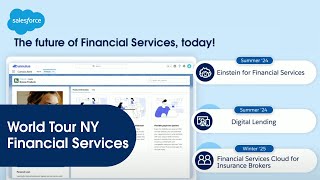
Erin Agrios walks through Salesforce's AI-powered strategy for financial services, including new tools like Prompt Builder and Einstein workflows for transaction disputes. The company is adding 23 calculated insights for personalization and launching Financial Services Cloud Unlimited, a bundled offering designed to reduce costs and scale trusted customer experiences.
Questions this video answers
December 15, 2023.
23 calculated insights.
Coming in spring (spring release).
Financial Services Cloud Unlimited.
Chapters
You. A very warm welcome to our financial services keynote here live from New York City. My name is Erin Agrios. I'm the GM of our financial services business here at Salesforce. And in today's session, we are here to educate you, to motivate you, and to inspire you. But first, as in any good Salesforce presentation, we do want to thank you and sincerely thank you. Thank you for the partnership that you've had with myself and the team throughout this year. I look around, I see a lot of familiar faces, and I think we're creating such an amazing AI Trailblazer community in financial services. We always end our world tour session here in New York every year, and I love this time of year because it gives me a chance to reflect on all the conversations that I've had with you and your peers as we've gone around the globe. So I wanted to spend a couple of minutes and really just talk about some of the themes that are very consistent in all of the conversations that we're having, I think. And it won't be any surprise that there's this heightened sense of urgency when I speak to you about the innovation that you're delivering in your businesses. You're trying to personalize. This experience is kind of rethinking and reimagining the experiences that you're creating for your employees and for your customers. You're thinking about new ways to deliver connected experiences across some of the channels that we're very familiar with, but also some of these new channels that generative AI is really bringing to the forefront. Cost. Even though it's third on the slide here in terms of operational efficiency, it's generally kind of the first thing that I hear from you in terms of how we're trying to manage cost and think more about operational efficiency. And that's driven by kind of this last bucket here, which has everything to do around intelligence and AI. And of course, it would be no surprise here that we are going to talk a little bit more about AI and how we're thinking about that from a financial services lens. Now, as you're trying to innovate quickly in your business, there are barriers. And I was at an AI Trailblazer event yesterday, and I see some familiar faces who were at this event with me. It's the second event we're doing. We're really trying to empower all of you to become AI trusted advisors. So if you want to know a little bit more about what we're doing there, let me know after and I can kind of Guide you how to find out more. But at this event, I was talking to this woman and we were talking about AI and the rapid change of innovation and she was saying to me that, my goodness, it's complex. We have so many systems that are kind of overlapping. And as I think about how to deliver innovation back to my stakeholders quickly, I have to grapple with all these different systems and how do I bring them together? How do I, you know, integrate them or do I not integrate them? And it's a complex kind of architecture and kind of business that we all live in in a very highly regulated industry. So I kind of think about all of the complexity and all of the challenges, but really I think I'm inspired because I think over this year I have seen such a huge shift with all of you and your leaders in terms of how you're thinking about industry specific capabilities. And I think a large driver for that comes with kind of a little bit of a scary space in generative AI. And how is that going to work in a regulated industry? And I think that a lot of you are really leaning into my team and the teams at Salesforce to say, help us understand how she would be thinking about this in a highly regulated industry in a complex environment. And so in a recent study, and I showed this at Dreamforce, but I wanted to show it again here because it's really helpful to kind of think about where your minds are at in terms of how you're thinking about technology and kind of how we can help you deliver some of these capabilities quicker. So this recent study done by Deloitte shows that 92% of leaders are making industry specific decisions based on technology and thinking about how that can help them deliver faster time to value and really reduce that operational complexity in the business. Now that's inspiring for all of us, but it's really inspiring for me. I've spent my career at Salesforce for the last 16 years building industry specific capabilities and working with insurance companies and banks all over the world. I started in Canada, you might hear a little Canadian twang. But we've been spending the last seven years with financial services cloud, really thinking deeply about the industry specific processes that you're all looking to innovate in your business. And so with financial services cloud, we've been able to go very, very deep into some of these industry specific processes and we're going to talk about a little bit more of them shortly in the demo. But we're also infusing AI into all of our applications across the C360 into all of the workflow, all of the automation, and all of the integration that we're delivering based on the conversations, quite frankly, that we are having with all of you and what's important. So when I think about the team and where we're spending our time and the innovation that we're thinking about, as we kind of learn from all of you, it really ladders up to these three buckets. The first is trust. We know that in order to grow your business, you have to deliver trust to your customers. And trust is built in situations like servicing. And so you can see here AI powered transaction disputes. Now, some of you might be thinking, yeah, that makes sense. I kind of see that process in my business. And some of you might be thinking, well, you know, I'm an asset manager, I'm an insurance. Those don't necessarily resonate. I want you to think as we go through some of these examples of how we are thinking about some of these complex service processes that we are injecting AI into and thinking about how we can inject AI into these modern processes to really help you deliver value at a much quicker pace. So our AI powered transaction disputes. I'm going to come back to that because we're going to show an example of how that actually works. The second pillar is around cost building trust with your customers. Sounds expensive, but it doesn't have to be. Some of the things that we're thinking about is how do we deliver more out of the box service processes where you can access large amounts of data and kind of surface that through CRM and offer a new starting point so you're not having to kind of think about these from scratch. The other piece, which is really important from an AI perspective is how do we think about prompts and developing prompts in a very low code, no code fashion. I think when I talk to many of you, some of this can sound a little intimidating, right? Like, how am I going to kind of retrain my business administrators to think about prompts? Do I have prompt engineers? The beautiful thing that happens at Salesforce that I think is so wonderful is that we're really democratizing the technology and delivering some of these. Hard to get your head around capabilities through clicks, not code. And it's been really impressive to see some of the administrators just dive right in and start playing with this in some of the pilots that we have. So Prompt Builder will be live in spring and we're really excited about that. We'll show you how that looks. Now, the last piece of this is scale as I speak to many of you. We're moving over the years from a very face to face industry where you would sit knee to knee with your advisor or your broker or your agent and kind of have these real personal experiences. They know the names of your dogs and cats and your kids and all of that. Right now, as some of these advisors get hundreds of clients, how do you remain personal and impactful and then how do you think about that across digital channels? So we've spent a lot of time with my peers in data cloud and many of you understanding how, how you're thinking about reimagining these personal experiences. And so we talked about this a little at Dreamforce, but again, this idea of personalized financial experiences and personalized financial engagement is something that will really help you think about delivering personalization at scale. And what it really is is the ability for us to take data cloud and all of that real time information and connect that into financial services cloud through insights. We have 23 calculated insights that are coming. We started delivering those already that surface things like income and expenditure information, financial planning information. What's coming in spring, as you can see on the slide, is our financial planning integrations to some of the really key partners. I can't quite say their names yet. We're working on some stuff, but we will let you know as soon as we can do that. But some of the top financial planners now we can integrate seamlessly into that really, really important data and start to surface that in those moments that. All right, so I'm going to take us back to AI transaction disputes. And again for those of you, think about kind of your top service types of processes that customers are calling in all the time about or your employees are trying to trigger. And we're going to show you how that works. I get a lot of questions about one more. I get a lot of questions about how does data cloud work and how do you think about financial services cloud and all of this AI like how does it all work together? Were any of you at the keynote earlier with Parker, Some of you. So he talked about the Einstein One platform and really it's how do we think about bringing together all of this data on one metadata platform? And it really starts with the data sources. And so if you're thinking about transaction disputes as an example. Right. What do you need? Well, you need the transactions and you need data and oftentimes that's spread apart in many different systems, which means that people have to kind of swivel chair to find this information. So now you can Kind of bring all of that data together on one platform and you can start to harmonize that data and then you can layer in the AI over top. And we've created it in such a way that you can either take the prompt builder, which again is coming ga in spring, and the analytics and kind of build some of that yourself. But my team, and we'll show you have delivered prompt templates to help you kind of start quicker and really deliver these service capabilities quicker. So now you've got the AI, we need to ground that data in the information that all of you have as part of financial services cloud in your CRM today, the customer data. Because once you ground that data and that prompt and that rich customer data, it really helps with hallucinations and it really helps you personalize that experience in a much better fashion. And then of course, the holy grail is how do we start to actually action that information, right? Action the data that we're seeing. And you can do so through self service. You can do that through the action launcher. Your agents can go into that service console and start to see this information and you can bring in folks like in this example, your dispute managers. So you're really thinking about the ecosystem that surrounds that process and you're thinking about it from an efficiency perspective. Now as part of all of this, again, it's on one metadata platform, so you're not building stuff over here and trying to integrate it in a way. We've done a lot of that work for you to help you really think about how you can do this at speed. Now I'm excited to announce that as part of our spring release, we are announcing pre built prompts that will sit alongside the transaction dispute process. And we're making heavily investments in the rest of our service processes, which I'll talk about in a little bit around the roadmap. But if you think about how do I think about AI? And again, I get a lot of those questions like how do I think about AI? I've got 755 use cases that people are asking me for. What my team is hyper focused on is giving you a place to start. And so things like transaction disputes will give you an idea of how you can start incorporating that into your capabilities. Now, I think maybe you've heard enough from me in terms of how it works and the theory about it. I do want to invite up on stage Kelly Utley and our lovely demo engineers back here to really walk through the demo of how all of this works.
You keep that. Okay? Hello everyone. Thank You, Erin. And it is fantastic to be here in New York City today. The last time I had the opportunity to do a demo like this, it was at Dreamforce and I showed everyone how purpose built automation in financial services cloud was helping banks and insurance companies to really accelerate their ability to create end to end connected service processes and deploy them quickly. Today we're going to continue that story, but we're going to take a look into the bank's back office to go ahead and see what it looks like when an agent has to process a really complex workflow like a transaction dispute. So allow me to introduce you to Rachel Morris. Rachel Morris is a customer at Cumulus bank and she is super excited. Is it there? Is Rachel there? Okay, cool. Sorry, I can't see her on the monitor here. And she is super excited because she just relocated to New York City city, which is fantastic, except she just got a text on her phone from the bank saying that there's a questionable transaction on her account. She looks at it and sure enough, it's not hers. So she goes ahead and clicks to submit the transaction dispute. However, her anxiety is through the roof. So what do you say we show her how we can quickly go ahead and and get her back into a state of relaxation and be comfortable that her issue is all resolved. Let's go ahead and get that rolling. Basically, when she submitted that case, the bank automatically routed it to their fraud investigation department. When the agent picks up the case, they can have a clear line of sight into everything going on about Rachel, not just this particular issue, but but her entire relationship with Cumulus. Over on the left, the agent has access to CSAT and MPS scores, and those are brought in from data cloud along with her entire service history in the center. The agent does have the deep information they need about this particular issue right here in the dispute record. So this agent has everything they need to go ahead and get started. But I want to call your attention to this clock in the right hand side of the screen. That's the SLA for Rachel's case. And we don't have a lot of time, so we have to get rolling. Now, fortunately, this agent has Einstein copilot to guide them every step of the way. The first thing the agent's going to ask copilot to do is to go ahead and summarize all of the details from Rachel's life at Cumulus. And that's really important because those type of details can help identify when there's trends that might be important to the investigation. Einstein can also provide Guidance like here, it's suggesting that the customer be added to a marketing journey to keep Rachel in the loop along the way as we make progress. So that's great. We have one thing ticked off our list, but that clock is still ticking. And transaction disputes are really tedious to research. They can take hours, if not days. And you might be wondering, how is the agent going to get it done in that short amount of time? Well, if you guessed more Einstein, you would be correct. This time, it's prompt builder. With one click, we can have Einstein go fetch transactions from the core banking platform and populate them here in the prompt so the agent can see them. Now, the agent can go ahead and ask Einstein, using natural language, to organize this a little bit better, filter it so that the really important things rise to the top information like the transaction amount or maybe the average transaction or the locations. All of these things are important to help the the bank understand kind of what's going on there. So, sure enough, Einstein is telling us that there isn't that sure enough, Einstein is telling us that there are, in fact, some things going on here. We understand that. It's telling us that the transaction amount and the average amount, it's telling us that the transaction amount is higher than what Rachel's normal spend is. It's also telling us that she's never even been to those locations where those transactions happened, and she had other valid transactions happening literally here in New York at the same time. So Einstein's determined that there's probably some criminal fraud perhaps that's going on. And so it's going to suggest that the agent go ahead and file a police report. And it's not only making that suggestion, but it's actually providing in the prompt the workflow that the agent kicked off to go ahead and take immediate action and get that rolling. Now, you might be thinking, boy, that was a lot of AI magic happening there, but how is this actually working? So I'm gonna take you behind the scenes and show you a little bit of how that magic is made. This flow is dynamically grounding data from financial services cloud into the prompt templates. Now, it's important to ground the prompts because this is what gives them the context they need to to be able to generate responses that are personalized and accurate and up to date. Like in this example, Einstein's going to go ahead and connect to the core banking platform to pull those transactions back using data cloud, and then it's going to be able to provide instructions. We're going to be able to provide instructions to Einstein to tell it what to do with those transactions. Now the prompt builder can be used to design, test and manage prompts. And this is what it looks like to create a well defined structure for your prompt where it understands perhaps what data you need to bring over from your salesforce Org in merge fields and it can even deal with user inputs. Now what's more is that you can actually review the output and test these things along the way. So in this example, we're going to go ahead and pick an account. It's the rewards card. And we can see that Einstein is generating replies in real time. Now all that's left to do is to activate the prompt and set that agent on their path to success in solving that case in record time. Now I'm going to go ahead and bring someone to the stage who has some actual experience with this and he's a fan favorite. Greg Beltzer from RBC Wealth Management.
Thank you. Thank you Greg.
Welcome.
Is a fan favorite. Thank you.
He is a fan favorite for sure.
Thanks.
So Greg, one of the things that we heard Aaron talk about was that data is really that first stop on your AI journey. And I know you've had some experience with this. Can you tell us a little bit about being a leader in financial services technology? Kind of. What's your perspective on that?
Yeah, I'm going to take you on the road forever. Dime my review. I need your help on that too. So you know, look, you even referenced it in this, so AI is great. We can get to that. That's all we're going to hear about in this conference. But it does start with the data. Right. So when you reference on some of these flows or you're referencing using prompt builder, you're referencing data that's in the org. Right. And so we started our journey with data. Luckily before the pandemic, like most financial services firms, I had data everywhere. Right. So we focused on really getting that data into Salesforce, creating that customer 360, which has really set us up for all the cool things that are coming down the pike right now.
Yeah, that's amazing. That is amazing. That pre thought that you had there.
I knew, I knew all that.
So that's fantastic. What about, you know, you can't talk about AI in financial services without regulations coming up. They're evolving as we speak.
Right.
Trust and safety is top of mind.
Right.
What is the perspective from, you know, where you sit at RBC on that and what do you hear from your peers?
Yeah, I mean it's Pretty common among the peers. And that is we're financial services. We're typically not on the cutting edge. From a technology perspective, we're going to kind of wait mainly because we have regulators that are on top of us. Right. And so we're looking for clarity from the various regulatory agencies of what we can and cannot do and then how we're going to supervise it afterwards. So what I really like about Salesforce and their stance with AI is you're leading with trust, right? I'm wealth management. Trust is paramount to my business. It's why my clients have their assets with us. So having to do AI with trust, almost to me, it's at the beginning and then be able to have the framework where I can go and I can look at the flow, I can see the data that's being referenced. I have that audibility of what's being produced. That's what's going to give confidence to my advisors and therefore to their clients. And getting comfortable with AI that's being helpful to them.
Yeah, that's important to be comfortable and feel like they can understand where those results are driven from and all that good stuff. So I know this might come as a shock, what I'm about to say.
But we can be controversial on stage.
We're going to try.
We're going to try here.
Let's see how we can do so. Traditionally, financial services firms have not necessarily been out in front in adopting emerging technology, which is understandable for those reasons that we just described. Do you think there's anything different this time? You know, once that trust and safety factor, you know, is can that be overcome in such a way where the industry really looks to kind of come and meet this moment and maybe not be so slow in adopting some of these things?
I do, I do think that, and for a few reasons, and that is this is a moment in time. The amount of consumer acceptance around generative AI is something that I've never seen in my career from a technology perspective. I've also seen that within my advisors and my clients as far as a more willing acceptance to use the tools, a curiosity for how it's going to work. And the one thing I think that's different within financial services is we're all under pressure, expense pressure, as Aaron started the conversation of reducing expenses. And there's plenty of examples where we can use AI that you even showed it from more of a service standpoint of reducing the amount of burden from either manual processes that we have today or looking to accelerate that service to get to the answer quicker. We've been using prompt builder. We've been in the way. I'm very fan, I would say that actually Einstein for flow. So I think it's the coolest because every time I try to build a flow, I mess up and have to delete it and start over again. I don't believe that it really is. So what we have seen is, is the technical tools, both flow and developer. Einstein for developer. We've seen the most value with that and that's just helping our staff to be more efficient. Right. So as we build those use cases like you showed up on the stage to start to solve these problems, I think that's the entry point to financial services because that's the one that has the most opportunity, that people are going to feel more comfortable around.
100%. We hear that a lot, that it really is around picking the right use case, getting that experimentation. And really that gives you a nice foundation for when some of the other more complex things are figured out. There you go. There you go.
Fraud is not fun.
I don't know if you know fraud is not fun. We should make that an acronym. We should make that a new acronym. Well, Greg, as always, it was a pleasure. I think Greg's a fan favorite. What do you think? What do you say we give him.
It's hard with headphones. I know. Thank you.
A round of applause. Thank you very much. And now, Erin, all yours.
Thank you very much. So I'm just going to give you a quick overview of the roadmap. We've got a lot of stuff coming, as you can imagine, but I do want to give you the heads up that we are going to have a roadmap session today at 2pm in theater four, where we're going to be able to go through a lot more detail. So what you're going to see from us, I took a couple of the big hitters from our roadmap and kind of put them on the screen here. There's three of them. You're going to see more AI. And I don't know about any of you, but when I hear more AI, I always think more cowbell. I don't know why. Just one of those things, but there's going to be a lot more AI. But again, it's not just AI for the sake of doing AI, it's how do we think about those most impactful use cases in financial services, in insurance and all of the different areas within your businesses. So keep an eye out for that in summer. You'll see A lot more copilot capabilities from an advisory perspective for financial advisors and for our insurance customers as well as in the service space. As we showed, we are announcing digital lending. We've talked a little bit about it, but if you think about lending, there is a lot of opportunity there. When you think about the manual processes and all the paperworks to really modernize that experience and think about end to end processes around kind of those unsecured loans as well as some of those secured loans. This is a huge area of investment for us and we're going to be releasing that throughout the year. And then the last piece is around Financial Services Cloud for the insurance brokerage space. Do we have any insurance brokers in the room? Oh yes, this is for you. So if you think about CRM and bringing all the capabilities to our insurance brokers that also have an agency management system, traditionally on two different platforms, we're bringing those together to help with client acquisition and to help deliver the best customer experience. So really exciting stuff. Now the question that I always get after the keynotes is, well, this is all really fun, but it's really hard to try and it's really hard to buy. So one of the things that we are doing is we are releasing Financial Services Cloud Unlimited. And so if you think about Data Cloud and Einstein and Financial Services Cloud, you know, do I need to go and buy all those things separately? No, we're making it easy for you to say, hey, we want to try transaction disputes. How do we do that? You can start doing that through things like Financial Services Cloud Unlimited for sales and Financial Services Cloud for service, where we're kind of bundling all of this stuff together and so really excited about that. Now I want to say thank you. It's been a wonderful 30 minutes and I really want to thank you again for your partnership. Just a couple of things to take away. We do have a connected Financial Services report which has a lot of the research that I've been talking about around themes and how people are thinking about, you know, leveraging industry specific capabilities. And as I mentioned in Theater four, we're going to do a roadmap session, but there's a whole set of demo stations. I went there at the beginning of the day and checked it out with a team of people who can show you much, much more of this and you can go a lot deeper. So again, thank you for your time today. I look forward to seeing all of you again and have a great rest of your day.









