Seamless Success: How HubSpot Evolved the Post-Sale Process
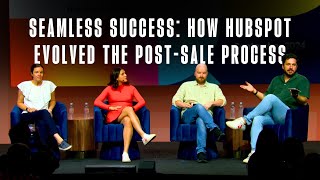
HubSpot leaders discuss how to run post-sales operations after a deal closes. They argue for unifying marketing, sales, and post-sales data in one CRM, prioritizing onboarding early, building health scores, and using AI agents to scale proactive customer success work.
Questions this video answers
October 30, 2024.
Up to 25 times cheaper.
225% more likely.
35%.
75%.
Chapters
All right. Hey everybody. Welcome to seamless how HubSpot evolved the post sale process. So that's what we're going to talk about is the post sales process and running that on HubSpot. I've got a few folks with me here. Let's do intros. I'm Daniel, I'm the Moderator. I'm the CEO of Arrows. We're the number one installed customer success app in HubSpot. We're HubSpot Ventures Portfolio Company. We're a customer onboarding tool. So everything from closed one to go live. We work really closely with Service Hub and Caitlin over here. So check us out. We're going to be around at HubSpot Ventures booth after if you want to come learn more. Peter.
Hi, my name is Peter. I am a rev Hubs manager@pleo IO. It's a Danish fintech. I have 20 plus years experience in SaaS, B2B SaaS, mainly in post sales roles, startups, scale ups, building my own customer success teams, you name it. But moved into operations about four years ago and currently building the best possible commercial tech stack at Leo. So we're looking at marketing, sales, customer success and partnerships. And as you see from my name, I'm not Finnish, but I'm living in Finland in a wonderful old house from 1904 and enjoying remote work.
Daphne.
Hi everyone. My name is Daphne Costa Lopez. I'm global Director of customer success at HubSpot. Big fan of Arrows, Know the journey, know the history, love seeing it becoming the number one app and a big customer success nerd. I write a newsletter called this is Growth. I have a podcast called this Is Growth where I talk about how to build and scale your customer success to.
Hi everybody, my name is Caitlin Simakoski. I have been at HubSpot for six and a half years now and I've been in multiple roles across the company and I am currently focused on Service Hub, on the product marketing team. And I'm thrilled to be here with all of you today to discuss the post sales process. I'll pass it back to Daniel.
All right, so what is the post sales process? What are we really talking about here? And so the conversation we're going to have is mostly around everything from Closed one beyond. Right, that's really what we're talking about. So historically a lot of people think about HubSpot as a marketing and sales platform. Marketing Hub is the big, you know, the big fish here, the big whale. It's been around since the beginning. Dharmesh talked about it, the CRM and Sales Hub has been around almost a decade now. Service Hub is a little newer and we were talking backstage, you know, it's almost as if Service Hub needs to rebrand because it's a lot more fully featured than just a customer service platform. It's actually where you make customers successful. So we're going to talk about that a little bit really quick. If everybody would raise their hands. If you have customer support at your company, let's hope most everybody. All right. No, no, keep them up. Keep them up.
Take them down.
If you have customer success. Or no, keep it up. If you have customer success, take it down. If you do not have customer success, that's great. If you have an operations team that is supporting customer success, keep it up. Hey, that's pretty good. If you have service delivery at your team at some point, still pretty good. And if you have customer marketing or marketing that focuses on the post sales, customer marketing kind of experience, keep it up. It's pretty good. But okay, it looks like operations. We have the first half pretty good. All right, so we're going to start. I don't know who wants to kick us off, but what are the benefits of unifying the post sales process with marketing and sales?
Peter? Right. Well, for me, it's all about removing the friction because you basically close the loop. You intrinsically build this improvement of visibility. You have your existing customer base ready for growth. I mean, for me, it's having everybody in the same environment just helps each other work from the right data, from the same data, from the same KPIs that you can support each other in. You saw the different elements of customer experience. Everybody can actually support each other. When you work in the same environment, it helps. And it also makes sure that customer success or the post sales process has longevity beyond the first 3, 612 months and not just throwing it over the wall and hope for the best. And for me, in HubSpot, that means consolidating things, creating focus in the customer success workspace. We've been working with it for a while already. CRM cards are your best friends. Work with it. There's so many options to build to, to bring that data forward and even into different areas. In HubSpot and then the UI customization, there's so many cool things you can do in the middle panel. We've been highlighting it to a lot of people already, but my colleague sitting over there just built some really cool stuff around CSQLs, helping drive that growth, that retention, the renewals, and making it as simple as possible, working up the same data.
And I'd say on that point, you worked with apps that you do, the UI customization, but you all have built a lot of your own stuff.
Yeah, we build a lot of our own stuff.
Yeah. Daphne.
Yeah, I, I want to build upon what Yamini was saying this morning, which is all of us are here to grow our businesses. And one of my favorite stats about customer success is this one, that it was a Gartner report that talked about how much cheaper it is to actually grow a customer than it is to acquire a new one. We obviously heard from Yamini this morning that the acquisition process is getting harder. So it's every piece of content, every ad that you have, you're having to invest way more in that to get a new customer. And in this Gartner report, what they said is that growing a customer can be up to 25 times cheaper than acquiring a new one. And for me, this is like the most compelling stash on why we should be unifying the processes. Because in HubSpot, we love the flywheel. If you're familiar with the flywheel, it's all about getting a customer, landing that customer, helping them be successful, helping them see value with your product, and then selling more to them. So it's kind of like you earn the opportunity to sell more to your customers when you deliver the first promises that you made. And I think unless you have this really unified, well oiled machine, it's going to be hard for you to convert that customer back into the funnel. So you need marketing to step in to promote new products to your customer. You need to educate your customers, and then you need sales to step in and help you grow those customers and sell more to them. So unless you have all of this as one unified system that's easy for people to use, that's fast for you to go through that process, it's going to be very, very hard for you to really land that strategy of land expo, expand and explode. You have to have that platform to do that.
And I'd probably say more successful customers make it easier to acquire other customers more cheaply.
Yeah, yeah.
Caitlin, you brought some data for us. You want to talk about it?
Yeah. Thank you so much. So we decided, we ran a survey last year and we surveyed service leaders from all around the globe. And we wanted to understand this unification and this integration of tools and data. And what we found was that service teams whose data is integrated with the tools that they use are 225% more likely to say that their customers get a very Personalized experience. Additionally, only 35% of service leaders say that their customer data is fully integrated with their tools. And then lastly, service leaders using HubSpot, 75% saw increased retention. So I think the interesting thing is between the first two data points there where we have service leaders recognizing the need for this, but then we have a gap with those who are actually implementing it.
Yeah, absolutely. So. Oh, I think I'm on the right one. There we go. No, go to the next one. There we are. All right. So Peter, I've got a question for you. We've heard a lot of arrows. Usually when people either move into running success on HubSpot or adopting arrows and really taking a focused approach to improving onboarding, a lot of them say, I wish I had done something sooner. So being somebody who's done this at a pretty large scale company, multiple hundreds of employees, free ipo, et cetera, you've implemented this, you've gone through a bunch of these changes. What would you have done differently if you were starting out now?
If I would be starting out now. Whether or not it's a big or a small, I know a lot of people from small companies here. Get an ops person in place sooner rather than later, especially in customer success. Get a CSM who wants to dig into that machine, who loves the systems part. As in systems, I don't mean tools only, but just the whole thing. Because it helps you to focus on your customer conversations. The earlier the better. And it helps even if it's a small company, because you cannot do everything yourself. You're going to burn out. I did. So that's my biggest recommendation and Daniel's going to love to hear. My next point is nail your onboarding. And it's a bit tongue in cheek, but it really is that because it will help you better understand your customer needs. It will identify gaps between your sales and post sales process and you can actually close that loop easier because you will learn quickly. Even if you're still looking for product market fit, you will learn what makes your customers successful. And then for me also, what is super important. Regardless of your role, talk to the customers. Whether you're a CEO or engineering manager, it doesn't really matter. Talk to your customers both on a proactive and on a reactive basis. Get that input because it's the only way to learn, right? And not just surveys, Talk to them. And for me, this is something we've done in a couple of companies, even to the size of Pleo. We don't do it at Pleo, but in Another role everyone does support, feel that pain. It's so important. You need to learn what they're running into so you can improve things. I love sitting with a developer or a product manager doing support and then realizing, oh wait, yes, this is an actual problem. It's not just you saying it to me. And then last but not least, define what customer success means to you. Customer success is not customer support and vice versa. Which is also why the earlier conversation service hub for me needs to be rebranded. Service is not the same.
I'll work on it.
Different discussion, sorry. But yeah, we'll get there. But my point is if you can make that distinction between what is what, your customers definitely won't be able to do it either. And how does it support your growth? I mean, it's not just churn prevention desperation. It's not just talk to the customer, but have it as that growth engine that you were talking about. And I think that's a bunch of things there to do. So what I would do differently and what I would recommend, I think those.
Are great tips across the board. Daphne, what would you give as advice to CS leaders?
I think everything is a matter of maturity, right. And the advice that I have that would be kind of foundational for every single CS leader out there is to anchor your customer success organization in value. What value do you deliver for your customers? Do you understand what are the use cases that they have? And can you measure those use cases to show that you are actually delivering on your promises? And I think that starting everything with a value definition will help you build a customer success organization that's fit for purpose, that will actually deliver success to your customers. Then the other thing I would say is really important for you to have an understanding of your customer's journey, like what is the path that they are going to walk through? And I think we are kind of at the beginning of infinity when it comes to being able to personalize the journey individually for every single customer, every single user. But even if you can't do that today, like what are those building blocks, those big steps that you can have? The onboarding every single customer that signs a contract, how do we deliver value fast for them, how do we unlock those first use cases that will get them sticky and using and adopting the product. So I think really figuring out like what are those stages that initial adoption, then the usage and later more mature stages of the journey, the renewal process. And then I think you talked a little bit about support and success. Depending on your maturity, you might have somebody that is like A jack of all trades. They're doing every job, they are support, they are successful and sometimes they are product feedback and they're all sorts of things. It gets to a point where you really do have to break it down like what is the reactive work, what is the proactive work so that there's specialization in your org. And then I think my final advice, and I know we're going to talk about this later, is think about AI when you're breaking out your CS function, when you're trying to think about how to become proactive, it's very hard for a CSM to be proactive and look at 200 data points before they prepare for a meeting so that they have the right context to have a value based conversation. So what are the tools that are out there to help those reps have better conversations with your customers without wasting a bunch of time trying to prepare?
Absolutely. I'd say, you know, we've seen this at Arrows where we're fairly small, we're only 10 people, but our first hire was usually success person Shirel there and he handles support for us as well. And you see this at a lot of startups now where, you know, it used to be you'd hire support when you really had the need. And now we're more proactively hiring success people pretty early on to help us be better at servicing customers, getting them to value and then ops people pretty early on as well to support the whole go to market function. So see that pretty commonly. So real quick, before the next question, raise your hand if you've had a bad onboarding experience, product you bought, agents you started working with. Right. You're pretty hyped in the sales process. And then post onboarding you're like, all right, am I going to keep working with them? I might not continue. It's pretty common.
Can I just maybe quick add, how many of you though, who had a bad onboarding experience within the first 90 days thought, nah, we're going to churn.
Yeah, that's pretty common. And your customers are generally feeling the same. So it's a bit of a leading question, but tackling the whole customer journey is pretty challenging. Like you mentioned, you have to start somewhere. You have to kind of pick it apart and put your resources somewhere. What use cases do you recommend teams start with if they're going to start, you know, making an impact on their business or their customer journey?
Yeah, again, back to what I was also talking about earlier. For me, onboarding is the most important one because if you nail that you can add so much valuable feedback to the sales process, making that run easier, making it run faster, smoother, and you will know better what to do further down the line. Also, when you get to the renewal stage, right. Having made all the mistakes in that nail, that first 90 days. Because do people have all the right things in place to become successful in that period of time? Because that's why I was asking my question, because I know from the research that that's where hidden churn lies. You fail early on, you'll never get it back. But you have to realize also it's the tech acumen at a customer. Are they technically capable of implementing it? Do they have the processes in place that they can translate with your tool? Do they have a strategy in place to actually know where they want to go and can they actually report on it? So it's discover, deliver, demonstrate. Those are the things that you need to do. And if you can deliver on all those different pillars and demonstrate how your software makes them successful, how that supports their business goals, that's where you can start with the onboarding phase. And for me, in HubSpot, again, use those CRM cards, build the company data cards, the three panes organizing to your needs, especially the middle one. You can do so many cool things with it. So where do you start with in HubSpot, there. And in general with onboarding.
Yeah. And I'd say to that point, like the, if you treat HubSpot and Service Hub as like the surface area for your visibility into the customer and their relationship and that's where, you know, building custom cards where you're pulling data from your own product or your own databases, it starts to be pretty powerful. And treating that as an extension of the sales and marketing funnel is pretty awesome.
Yeah. And now you can also pull the different data points to different places. So the cross object cards, which I think is also super useful.
Yeah. Daphne.
Yeah. No, I love the onboarding case because I think everybody knows the saying you only get one chance at first impressions. And that's literally what happens with your customers. They, they just signed a contract, they are kind of at the highest high when they sign the contract and then they get to the lowest low, a little bit of the buyer's remorse and you have to mitigate for, for that. I suppose if I was to build upon that and add another, another case to work on, I probably say that I would repeat what I said before about the value piece. Right. It's like really figuring out what is value for your customer, how you measure it. How do you work with product to make sure that you can demonstrate that in a, in a very clear way for your customer and then build the signals inside your system so that if your customer is not going in the right direction, that you're not waiting until three months down the line when you have that next conversation, or worse yet, you're waiting until that renewal conversation, should then say, hey, there's something going wrong here. You want to, you want to learn about those things really early and you want to design interventions. They're going to help me move the customer in the right direction. So I think understanding value, understanding the signals of health for your customer and being able to act on it will be that for me, the next use case where you really, truly become proactive.
Yeah.
Yeah. And I guess I just have to jump in and say that. If you have not visited the demo station yet today for Service Hub, go check out the customer Health Score. It's new, it's amazing, and it is an absolute game changer for doing exactly what Daphne said of identifying these customers at risk before renewal, before they really become like red and at risk, maybe a little bit yellow and a little uncertain, go in there and figure out what they need and actually give them value and then in turn retain them as a customer.
And if people don't know the health scores are part of Service Hub Pro and up, but you can sync thing, we sync product data into HubSpot. I imagine you all do. You can do it as properties, custom events, and you can use most of that stuff, including customer touch points, as a real time score on every company object inside HubSpot. It updates in real time. It's pretty awesome. I'm going to throw you a curve ball, Daphne. I told you I would. Do you have any advice for people if they're setting up health scores? Maybe how they might think about it or where they might start?
Yeah, Health score. It's like one of my hot takes is health scores. I think the problem historically with health scores is that people have gone into dark meeting rooms and they made decisions about what customers care about. Right. And they said, well, here's the top three things that our customers should be doing and this is what's going to tell us that a customer is healthy or unhealthy. And then they set it up and then they never look at it again. And like years go by and you're looking at health at exactly the same way, which isn't data driven. It's not anchored in reality and it's not evolving with your product and your customers. And then what you end up with is what I call watermelon customers. So they look green. So you have a health score and it's green, but when you dive into it, it's red. They're, they're going to cancel. And I've seen so many organizations that design health scores like that. And then what happens is when they look at their churn reports and they want to see like, what are the customers that are leaving and why are they leaving us? It turns out that all those customers have green health scores. So obviously, if your health score is giving you green when a customer isn't healthy, it's not good. So I think for me, if you want a really good health score, you want a health score that's anchored on data. Right. And that is being constituted, continuously updated, that is learning with your business. And you want to experiment with us. Right. You want to see like, okay, if I, if I may, if I do an intervention here in this health score, can I move it forward? And once you, you, you get it right, I think it could be extremely valuable to guide people to spend time with the right customers because this is also about prioritization. Right. It's about figuring out where you need to put resources versus where you can afford to take the foot off the gas a little bit. Because let's face it, we don't have unlimited numbers of systems. I think we're going to get to the world of agents and customer success and we're going to be able to pay attention much more closely to all customers. Yeah, but right now it's hard. So I think a good health score that's designed well and it's anchored in data and, and it's learning that's the key.
Don't make it too complicated, though. I would say at the same time, because you're just going to shoot yourself in the foot and then the score won't make sense. You get the watermelon customers and it won't have any impact on retention. Just like NPS has zero impact on retention. You need the context. Like if you don't know the context within which that business is, is trying to run their business, you won't be able to support them, help them in the best possible way.
Absolutely. All right, so last topic. We have to do it. How do you all think post sales processes and post sales experience is going to be affected by AI or how it might affect your thinking about me?
Back to dapping, I guess I just talked about agents. Well, I think everything is going to Start with Copilot. We saw this morning at the main stage Yamini and we saw Angie, we saw Dharmesh. They're also, they talked about co pilots and agents and I think that is really the first kind of evolution. So we're going to have tools that are going to help us do that prep and that follow up much more easily in customer success as well as in sales. And then I think once we build that confidence and that trust that AI can recommend the right things. I think we're going to start using agents in the space where, like I said, you need to scale your business. How do you help customers of every size, no matter how much they pay you? I think it will be through agents.
Absolutely.
I'm definitely going to build some agents when I come home. I was inspired by the customer briefing one just to get some research to get together on where they are and all that. I think there are some real possibilities there and maybe not so much if you are a CSM with 5,000 customers or something like that, let's say the long tail, then it's not maybe that relevant. But especially if you sit with a bit smaller portfolio, larger customers, I think it's going to make total sense. And I think already it's changing. I mean we see people using call summaries a lot, generating action points. We have our internal setup with an LLM so they can help focus on the right things in the conversation. I'm looking forward to things happening in the customer success workspace, but just in general in HubSpot with guidance helping AI, supporting and making the right decisions and. But we also use it already for a lot of small data management tasks. I'm currently cleaning up addresses thanks to some research with ChatGPT. I mean there are lots of these small things that support everything else, but I think in general also we work across a lot of countries. That means lots of languages, which means our localization team loves AI because it helps translate a lot of content really fast. And yeah, we need to make sure that that is in place. And it's also not just for the content, but it's also for the product. The product itself needs to support all these languages as well. So there are a lot of these different things that can be made easier and simpler thanks to AI.
Our product team's watching, I think and we used AI to help us localize arrows so it's, it's a good use case. Caitlin.
Yeah, no, I was just going to say that I think when you think about AI in the post sales process, we have just anything in the post sales process I guess really is we have how can we at HubSpot help our customers and then how can we help their customers? So I think what you saw today is we're really going to make you so much more efficient, we're going to save you time, but I think the next step is help how are we really going to benefit your end customers? And I see data, I see insights, I see AI really fueling that and helping you have really strategic conversations with your customers to really help them get value out of what you're offering and help them grow. So I'm very bullish on it. What you saw today is like we're just getting started. So use what we have, give us feedback. We're continuing to invest in this and I think we're just going to see it really skyrocket from here.
Yeah. And I'd say on the product side at Arrows too, we approach things kind of like you take, take HubSpot as the source of truth, the surface area for data, for integration. Arrows connects to that very deeply. We can use the data in there if you've consolidated your systems there as a system for pulling insights and actions out of that to inform your onboarding process, your sales rooms, etc. So you know, we're kind of looking at AI as a thing that will help humans be better and more effective at being humans. Like you mentioned, Daphne, it's, it's not to replace that connection but to help people be briefed better to be more effective. And you know, that's how we'd like it, to introduce it into Arrows.
Can I add a point?
Yeah.
I think for the longest time whenever I talk to CS leaders, the, the biggest excuse not to bring AI to the business is data. Always, it's always data. It's like my data isn't clean, is not complete, I don't have everything. So I can't trust AI. And I think on, on top of having now some really cool data enrichment possibilities with AI, you also have a wealth of unstructured data that you've never been able to use before. So conversations that your systems have every single day with your customers that you know, before it took a lot of energy and time to package this all up, bring to product, have those conversations and now you're able to deploy AI even when you don't have the perfect, most squeaky CRM in the world, you can still leverage AI and you can still get value out of it.
Absolutely. The last point on that, I would look at all of these things like the health score, like AI, treat them as iterative processes, onboarding, et cetera. Start, do it simple, iterate on it. That's where you're going to see a lot of great results. All right, final thoughts to wrap it up. So these are kind of the summation of our tips here. I think if you want to take a photo, this might be the good slide to do that. So unify the customer journey in your CRM. Service Hub is now. Don't think of it as a support tool. It is now where you make your customers successful.
It's.
It's really getting very strong there. So think of it as I close my deal in Sales Hub. How do I service my customer and make them successful in Service Hub? Approach that. Attach arrows if you want. Number two, start with onboarding. Retention starts on day one. That's what we like to say. So it's the bridge between sales and post sales. So if you're going to start somewhere with that notion of consolidating the journey, onboarding is a pretty good place to start. And Peter will love this. But operations must come. Cover customer success. It's not really worth having an operations team if they're not thinking about the full customer journey. So you really should make sure they're in the loop there, I'd say. And with that, these are our email addresses for all of us if our heads aren't in the way. Mine and Peter's giant heads. Grab those if you want to find us. We'll probably be over here afterwards too. And then go see Service Hub at the Demo Spot booth. And arrows will be at the HubSpot Ventures booth for the next couple hours if you want to say hi.









