Sellers as Trusted Advisors and More Tips to Maximize Efficiency | Blazing Trails | Salesforce
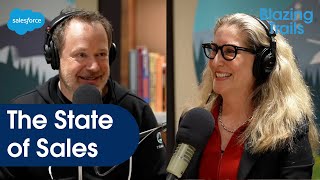
Tiffani Bova discusses Salesforce's State of Sales report. Sellers spend only 28% of their time actually selling, yet 72% expect to miss quota. Customers want trusted advisors, but sellers are drowning in a tech stack of 900 apps with just 27% integrated, leaving room for AI and automation to reclaim lost time.
Questions this video answers
February 28, 2023.
73%.
Nearly 9 out of 10 (approximately 90%).
28%.
72% expect to miss quota.
Chapters
Welcome back to Blazing Trails. I'm Michael Revo, and today we're talking all about the state of sales. In fact, that's the name of our latest sales research. It's the fifth edition of our state of sales report. And here to break it down is Tiffani Bova. Tiffany is the global growth evangelist here at Salesforce and the author of the new book the Experience mindset changing the way you think about growth. In her previous book, growth IQ was a Wall Street Journal bestseller. And she's ranked on the current Thinkers50 list of the world's top management thinkers. And she's not new to podcasts because she has a podcast called what's Next with Tiffany Bova. It's a great show that you should check out all about what's next for companies and individuals as they look to innovate and grow. Okay, let's jump into my conversation with Tiffany Bova.
Well, thank you for having me. I'm thrilled to be here.
Okay, great. So it's time for the State of Sales annual report. Lots of learning. But before we get into the report, I wanted to start with with a quote from Adam Gilbert, who's our executive vice president of sales here at Salesforce. He says the number one piece of advice that I give my team for winning deals is to know your customers challenges. This sounds obvious, right? You should know your customer's challenges.
I hope so.
But how do you keep this type top of mind? What are some techniques to do that, especially now with things changing so much?
Well, I'd start by the obvious. First, you have to be interested in even caring about what your customer's business is. Right? Right. I mean, you have to start there.
Right.
You have to be passionate about what it is that you do and what it is that you're doing. And ultimately, you know, I use this example often that I don't think many companies actually sell what they sell. They sell change.
Right.
And that is hard.
Yeah.
Which means if you show up and lack sort of empathy and understanding, your customers know it right away. That requires sellers and really anybody to stay curious about what they do day in and day out. Right. I mean, be curious about what it is that you do. And I've always lived by this. Become a student of your profession, whatever that is. Right. Always be curious to learn and better yourself. What worked five years ago or even sometimes five days ago is not going to be as effective today or tomorrow or five years from now. So if you're really looking for career traction, always put the customer at the center of what it is you're trying to learn, do and excel with. Because ultimately it's about their success, not always your success.
That's right. And that curiosity and authenticity about that is what really works as much as research we can do. We're going to talk about it, what's changing and the tools and the technology and all of it. It does come back to these real relationships that you can create that are valuable for both parties. And that takes that curiosity, that empathy and that trust to be there.
Absolutely.
Yeah. Yeah, it does. And so I'm glad we started with that because that's really at the heart of it all. But let's get into the report a little bit. So we see that 73% of customers expect companies to understand their unique needs and expectations that showed up in the research. And that nearly nine out of ten are expecting sellers to act as trusted advisors. So this is a through point. How can you be a trusted advisor if you're not careful, curious, if you're not doing the research, if you don't understand the business?
Well, I think there's a few things. The thread between every customer touch point that has an impact on how the customer actually feels about you and your brand.
Yeah.
So if you're disconnected, cross functionally, it shows itself in poor service, a poor buyer journey, a poor support call. You know, all of those things. Right. So first I'd say I'm not a fan of the term breaking down silos. I put that in air quotes. Yeah. I like.
How come you don't. How come you don't like that?
I like building bridges between silos.
Okay. Yeah. Right, Right.
Because you're connecting on the things that are required between the two groups. Right. But everything that finance does doesn't touch everything that sales does.
Right.
There is a thread where those two groups have to touch each other. But do you really want to break down the silos between finance and sales?
Right, Right.
And so more often than not, it's sales, service and marketing. But we always have this sales and marketing need to like each other more.
Yeah.
Right. But then no one sort of mentions customer service.
Yeah.
And those sort of are the three legs to the stool of growth. So cross, functional alignment for me is super critical.
I mean, thinking about this trusted advisor idea and then coupling that with how to create new customers and new opportunities, it seems like there's some really good opportunity there. But a lot of times it's hard to know. So should I become an expert on LinkedIn? Should I be reaching out with advice? Hey, I See, you could use help with this. How do you do that in an authentic kind of organic way as you're trying to build relationships, not assuming you.
Have the answer to everything.
Yeah.
Right. I mean, sometimes going, I don't know, yeah, let me go get that answer for you. Or I know the person you should be speaking to. So you're sort of facilitating collaboration cross functionally, cross organizationally for your customer on their behalf. Right. Putting the right people in front of them.
Yeah.
Which means you really have to start listening well to know what it is that they're asking, actually asking you for. But trusted advisor is like, there's not a course, there's not a certification. Trust is built over time.
Yeah.
But you can lose it very quickly. So if you do things that the customer views as it's self serving, it's about closing business. You're just trying to get it in before the quarter ends or the month ends. You know, you're selling them things they don't need. All of that breaks down trust. Right. So trusted advisor, take those two words separately. Building trust. And how do you become an advisor that your customers look to, to help them solve those problems? Even if it might not be something you can do, then you know, you've raised to the level of they trust you and they view you as an advisor.
And I think there's something you said there about bringing more people into the conversation that's really important. How do you look at that?
I don't always believe more is better.
Yeah.
Right. Because you might overwhelm the customer. Like you've thrown 10 people in front of them and you've checked the boxes. Because then, look, I got all these executives in front of my customer. I am a trusted advisor.
Or when you're in one of these meetings where there's 10 people and you're like, why are there 10 people in this meeting? What does this meeting cost? We've all been there.
The cost of sales is never totally tracked.
Right, Right.
Because if you took those 10 people that had to show up to help close that deal, the deal might not be profitable. Right. But ultimately I want to make sure that when you bring an executive in or a team member in, in a collaborative cell, which is highly valuable, that you're doing it because it has value to the customer, not because you're just trying to do what you've been trained to do. Right. Get more people in front of the customer. Because that's how we close deals. Right. A good seller will go, hold on a second, I've just Put five people in front of them. Putting more in front of them right now I don't think is a good idea. Like I'm listening to them, I'm starting to see that I'm confusing them. I'm putting too much in front of them and it's actually slowing my deal down versus accelerating it.
And then really understanding in your own organization who should be there. So if you're listening to the customer and they have a question about a particular thing that, you know, the expert person, you can just bring in the right person and that, you know, that makes a lot of sense.
And today the benefit is it doesn't always have to be in person.
Right.
It used to be when, you know, long ago when I was selling.
Yeah.
And I would fly across country with six people and all my executives and be there like I was proud. Yeah. It was an expensive long day. Right. I mean, I've done turns from Southern California to Chicago and back in the same day for a meeting at 2pm to 4pm, got back on a plane and flew back. Very expensive day. Now we can create similar kinds of experiences virtually and in this hybrid world. So I think it's an incredible opportunity for salespeople to reimagine what it means to put executives in front of customers.
Absolutely. I mean, that certainly has changed a lot. And it leads to the next theme that I wanted to talk about in the report, which is about efficiency. We're hearing that everywhere, the recent earnings calls, we're going to maximize efficiency from meta to Disney, etc. That's what we're hearing right now. But we learned in the report that sales Reps spend only 28% of their week actually selling and 72% expect to miss quota in prepping for this. We gave me some of those stats too. And I just, I really couldn't believe that 72% expect to miss their quota. So what's going on here?
This is one of those topics I wish we could talk about for hours. Right. Because if I, you know, I grew up as a quota bearing sales rep and sort of worked my way up to the executive ranks and then ran sales service and marketing and then I advised hundreds, if not thousands of companies on strategies on sales transformation and things like that. And I would say to you that this misnomer that technology was going to fix all the ills has shown that that's not correct. We have way more tech than we've ever had before. The tech stack is getting bigger, not smaller.
Yeah. Thousands, thousands and thousands of.
When I started There was a half a dozen Martech products. There's over 9,000 that the analyst community tracks today. We have no shortage of tech.
You've seen that there's a famous graphic where they put every Martech.
Correct. That's the one.
Just the teeny.
That's the one.
It's crazy. Y.
And so I would say to you that, okay, so now we've gone from a half a dozen to 9,000, yet 28% of their time is selling. And another status, 54%, will miss quota in a given year globally.
And has that changed over time?
No, it's remained almost flat. So then you go, look, we've thrown all this new tech at our sellers to help them be more efficient, effective, productive, personalized, you know, not being reactive like, you know, understanding the information. It's very data heavy. Right. But the people and process side is failing us and we're just not keeping up. So efficiency to me means the importance of sales operations in looking for, you know, where there's fat on the bone, right. Where we can get more efficient and effective with what we already have. How do we actually focus on giving more time to sellers? Because it's not one for one. But just imagine if you could give them 10% more time every day to sell. That's going to have an impact on their ability to hit quota.
So does there need to be more space within the idea of what is a selling activity, what is a non selling activity and what that looks like, or how do we adjust the thinking a little bit to get people to focus on what's going to be more effective?
Yeah. And I coined this term many years ago called the seller's dilemma, and it was a play on Clayton Christensen's book, the Innovator's Dilemma.
Yeah.
And as a sales leader, if you're listening to this, you have to have this conflicting priority every day. Hit my numbers, optimize the business. Hit my numbers, optimize the business. If I hit my numbers, I keep my job, right. If I really focus on optimize the business, maybe my numbers dip. I might lose my job.
Right.
So this sort of crisis of prioritization, if you have a small team, grab one.
Yeah.
Watch how long it takes them to create a quote. Watch how long it takes them to actually place an order. Right? Watch how long, you know what I'm saying? And you're going to get a feel like, my God, it took him 15 minutes or 30 minutes or two hours or it took her 19 clicks and three systems and she had to get up to go ask someone else the answer and all of a sudden you start to inefficiency once again, back to the people in process. Not necessarily always tech.
Right.
But another study we did with Mulesoft was the average enterprise has 900 applications or so and I think it's 27% are integrated.
Right.
So who bears the brunt of that? The employees. And let's go back to customer facing and more specifically sellers. Think about how many apps you have to go to to actually do your job every day. Right.
And so when you look at that sales operations function and I guess in partnership really with it, when you think about it, because if the idea is let's look at each task and identify how much we can trim off of each task. And we see this in Service Cloud 2. How many times do I have to spin the chair around, flip to the different screen, whatever it is. And this is the nitty gritty where you get down to how can we shave a minute here, a minute there, a minute there. But then you add that up and do you see that there's really a relationship between that time and that number, that 28% number of selling? Is that what that non sales activity is, is just sort of overhead of managing systems and processes?
Some of it is, yes. Right. But some of it could be automation of like doing that research. So like as a seller is doing research, spending time selling or non selling, you could argue both ways. Right, right. So you go, I'm going to have a meeting with an exec and I want to see what was their last earnings call.
Right.
What was. I want to find their last interview with the executive. Right. You're going to go out and search that. Let's say it takes you 45. Is that wasted time? I don't think it's wasted, I don't. But what if you could automate that research? What if you could feed that into your CRM system so that the sales rep actually didn't have to go externally, they could go to the system. Right. And so there's little things like that, like yes, that information is very important, but does the seller have to go out and get it? Right. Or could we feed it? Right, right. And I think that's where there's a ton of opportunity to remove things that are still very, very important to selling.
Yeah.
And I want to make sure you said something here that I don't want anybody to think that I'm saying watch every minute of every day of a sales rep. Right, right. Because that's not what I'm saying. But let's not manage to efficiency. Let me give an example.
Yeah.
So if you have a call center.
Yeah.
Efficiency would be how many calls can they take in an hour? Right, Right. And then based on that, how many calls do we get? How many heads do we need?
Yeah.
We don't need 20 more heads. Right. Or we can get rid of 20 heads.
Right.
And so every call has to be three minutes, because that's the metric that drives to efficiency. Yet I'm a customer, and I want to be on the phone for 10.
That's right. We've all been there.
We've all been there where we feel.
Like we're racing against the clock.
But the customer service rep in that scenario would get in trouble. Right, Right.
Forgiving good customer service for giving customer service.
So I want efficiency to be part of an overall strategy, not the end goal. Right. Yeah. So if you're a sales manager listening to this or a leader listening to this, do you carve one hour out every day to go walk around your call center? Right. If you're still in person and you've got inside sales reps or ABM reps or SDR reps, whatever you might call them.
Yeah.
Right. In your call center, walking around, watching it happen, asking questions. Right. And not running your business off a spreadsheet, listening into calls and not listening into calls to watch what someone's doing.
Right.
But listening to calls to go, do you have everything you need to be successful? You have to take the time. And so it might not be 50, 50. It probably won't be, but it shouldn't be 99 1. Because then you find yourself with a highly inefficient business that'll take you a long time to fix instead of fixing almost in real time, if you can.
And you've got churn issues there. You've got morale. We talked a little bit in prepping for this about burnout. And what are you seeing right now in the. In the sort of sales ecosystem around burnout and how people are doing?
Yeah, this is. This is sort of a personal story for me because I hope that I would be a better sales manager today than I was when I was a sales manager.
Yeah.
Because I was grinding, you know, it was 12 hours a day.
Yeah.
Five, six days a week. Our leadership, you know, meeting every week, a standing meeting was on a weekend, not even a weekday. Like, it was a grind.
That is. That is pretty rough.
Yep. And. And. And I would say that I then expected the grind downstream.
Right, right, right. That was the culture. And so that's how people operated. Right.
Listen, I'm going to oversimplify here for just a second. The companies do two things. They make stuff and they sell stuff.
Yeah.
And if you're in sales, you're responsible for the revenue of a business.
Yeah.
People's jobs.
Absolutely.
You know, locations, offices, businesses, people's lives. Like, if you're not pulling in the revenue as a salesperson, the company doesn't have the revenue. Especially if you're really small. You know, as you get larger, there's ways, if one person isn't performing, someone else might overcompensate and it makes up for it. But if you only have two or three salespeople and everyone's struggling, it has huge implications to a company. And you take that very personally.
Yeah.
Like, oh, my God, like, if I don't hit my numbers this quarter, you know, Sally, Bob and Jose are going to lose their job.
That's right.
Right. And so, you know, it's a lot of pressure. And so I think that, you know, for leaders, make sure you set the right quota, you give people the right tools and systems and training so that they can be successful and always allow them the opportunity to become that student of their profession. Right. Allow them to learn and stay curious and improve themselves on their own beyond what you do for them, you know, as an employee.
Right. And this is the sort of cycle in the market that we're in right now, it seems like. And so it's a good opportunity to look at what the future can bring and what's next. Which leads to a topic that I wanted to talk about, which is we're hearing so much about generative AI and the impact on specific professions, what it's going to mean for CRM for selling. Right now, only one third of sales organizations are currently using AI. How do you see the growth and the impact? You talked a little bit before about the system being able to pull in data that's relevant for you and not having to do that research and present that to you. That seems like a great use case right there. But what else are you seeing right now with AI and generative AI, what the opportunities are?
I think there's opportunity and I also think there's challenges. If I go back a couple of years, social selling was sort of the hot topic, and everyone was talking about we're just going to socially sell and we can scale the effort with less people and more touches.
I remember that.
I remember that. Right. And I'd say that you could see that not going as well as people expected. Right, right. That sort of impersonal connection, automated with the same message is like, is personalization. When I would get a letter, dear valued customer.
You're right.
Dear Tiffany Bova. Yeah. Dear Tiffany.
Yeah.
That's not personalization. Right. Dear Tiffany, I know you did these three things with us in the last six months. We really think this would be more interesting for you. We were going to consolidate these three things. We're going to write very personalized. Right. Those data points has to come from the system.
Yeah.
So if the system is saying to sellers, these 10 people are more likely to do something with you. Because we've been watching these behaviors in these other thousand customers, and we see when they get to day 90, they're more likely to do this. Right. Or when they've had this for a year, they're more likely to buy that. Instead of, hey, sales rep, go call 100 people. Right. Have a good time.
Yeah.
See what happens. Well, are they warm leads? I don't know. Call 100 people.
Yeah.
Well, marketing says they're hot leads. Sales tries them out. They're not hot leads. Right. Or whatever the scenario may be.
Yeah.
So the sales reps that will win in the future will be those that use this technology, especially AI, better than their competitors. Makes me smarter. I know what to predict, what's next. I understand what they've already done, but that requires something called data. Right. So if data is the new oil, you need the refinery, which is AI. The insights, that's what drives growth and the business. Data, for data sake, does not grow business.
Right.
You need those things to show you the insights so you can act on those insights. Right. But if the data isn't clean, then you have another problem. So that's where AI can also. And automation can really help.
Yeah.
Cleaning the data, capturing the data. Because sales reps do not wake up every day and go, oh, my God, today's such a great day. I get the data. Enter.
Right, Right.
They don't say that.
Right.
So the more you can automate it, the better. Right. And then if you can automate it and the data is clean, the analytics get smarter, the insights get better.
Yeah.
The seller is more prepared. They become that trusted advisor. They're showing up with value, they're staying curious, they're learning. All that happens when those things are connected and working in harmony.
And I think that's on the sort of selling side, but then on the operational side, I think there's going to be some really interesting stuff around.
Okay.
Here's if we take the example of creating a quote. Right. So it takes I think everybody is probably many people have experienced this. The complexity of a quote. It's particular to each particular client. There's a lot of complexity to that. What if we can start using generative AI to say okay, here are the things that we want to do. These are the parameters and it can start to generate a quote that then you can go in and tweak or all kinds of these different processes that are manual right now.
Yeah. Or dynamic pricing in that example you just gave.
Yeah.
Okay. It's looking for supply, demand. It's looking for what's moving, what's not moving. Like dynamic pricing on here's this customer. This is how much share of wallet we have with them. So this is their pricing versus it's standard. And I have 10,000 SKUs and I don't know what what I'm supposed to be quoting. Right, right. That that's where going back to if they're only spending 28% of their time selling and it takes them an hour to do a quote.
Right.
Could we use generative AI to be and help them quote to cash is 10 years old if not older at this point.
Yeah.
But yet we still have and a lot of that is because the SKU catalog is bad data.
Right.
Everybody's a one off. There's exceptions, it's customized and the second you start to get get out of that automation, it adds time to the process.
Well, there's a ton of great information about automation, about what's happening in selling. We've got some exciting stuff happening with generative AI that we're going to be talking about coming up soon at tdx. So there's going to be some interesting stuff. So definitely go out and check out the state of sales report. You can find it in the show notes here or just search it and you'll find it on salesforce.com so Tiffany, thank you so much for joining us today.
Thank you for having me. You know, I could talk all day about sales. One of my favorite topics.
It's great. We don't do it enough. So I appreciate you coming in.
Thanks for having me.
Well, that was Tiffany Bova, the global growth evangelist here at Salesforce and the author of the new book the Experience Mindset changing the way you think about growth. And don't miss her podcast. What's next with Tiffani Bova? Like this episode? Be sure to subscribe to the Blazing Trails podcast wherever you get your podcast or check us out on the Salesforce YouTube channel. Blazing trails is a production of Salesforce Studios, produced by Courtney Elting, edited by Cynthia Chavez, with original music from Andrew Duncan. I'm Michael Revo. Thanks for being with us, and we'll see you next time.









