Sisters First: A Fireside Chat with Jenna Bush Hager and Barbara Pierce Bush | Salesforce
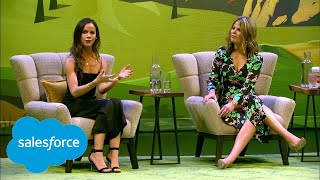
Jenna Bush Hager and Barbara Pierce Bush discuss their memoir Sisters First, sharing stories from growing up in the White House during the 2000 election, 9/11, and the Iraq War. They talk about how those experiences shaped their paths: Jenna as an NBC host and author, Barbara as founder of Global Health Corps.
Chapters
Ladies and gentlemen, please welcome Monica Langley, executive vice president, Global Strategic Affairs, Salesforce.
Welcome to a very fun session today. I'm pleased to introduce you guys to two women who are going to really impress you. They are now best selling authors and not just bestselling authors. Number one best selling authors. And we have with us today Jenna Bush Hager and Barbara Pierce Bush. Please come out, ladies. Hello.
Hi.
Hello.
Hello.
Let's go ahead and be seated and get started.
Hey, everyone.
Hi, everyone.
And I found out back here. I've already talked to them before today, but they are competitive women. They may not be running for office, but I first looked up on the bestseller list and saw they were number two nonfiction. But more importantly, they were number one of all books.
Yes, we were. Of all of hardcover and ebooks together. So we had to correct her on that.
Yeah. So I'm like, okay, straighten me out. So this is super cool that you all are number one best selling authors. Your ideas changed. You're not just the twin daughters of a former president. This is super cool. And the book they have out is called Sisters first. And I've read it and I thought it was a really fun but important book because it talks about your growing up. But all the experiences you had have really not only just shaped your lives, but it shaped all our lives because we have lived through your grandfather and your father's presidency and we see it through your eyes, which is really interesting, I think, for all of us to see. Before we delve into your lives, let's talk a little bit about what you do today. So, Jenna, tell everyone what you do today.
Yes.
Well, they may see you on tv.
But tell them I work for NBC, which is a lot of fun. I was a teacher. I taught in D.C. and West Baltimore and there's no more important job. But one of the things that I don't know if our culture appreciates is how hard it is, particularly in marginalized areas. And I went to a party in New York with Barbara's friends and they said, what do you do? And I said, I teach third grade. And they go, how cute. Somebody was like, that's so cute. And I'm like, no, teaching isn't cute. It's difficult. And I dreamed of my students. And so in B.C. i was on for books that I had written previously on a story, which is a young adult narrative nonfiction about a woman living with HIV AIDS that I met in Latin America. And then two children's books, and they emailed and they said, would you want to work here for probably Two years. And for two years, I was like, no way.
Because you're the one who famously stuck.
Your tongue out at the press.
You made it to Today Show. But when your dad was president, you have a great shot of you sticking your tongue out.
Yeah, that was a really lovely picture. I actually thought the limo was tinted, but anyway, it wasn't. It was not. But it's been a. So I've now worked there for eight years, which I can't believe. And I think it's an amazing privilege to tell the stories of the people that I've met, some who you all know and some who you don't.
One of the books that Jenna wrote with your mom was the Great Big Backyard, which talks about getting the kids out to the national parks and away from their technology.
We love technology here.
I know, but we also love national parks, as you can see, that's one of the.
By all these animals.
And you see behind us that that's one of our themes with trailblazers, which are the people who change their lives and lead their customers to success. And so we're all into national parks here. So that's a great. For your kids.
The hundredth anniversary of the national parks last year. So we decided to write this book to celebrate them, and I think it's really important that we protect them now more than ever.
And my assistant Tato called every bookstore in the city last night to try to get one.
They're wildly pop.
Okay, Barbara, tell us about what you do now.
Yes, I run an organization called Global Health Corps, and we are a nonprofit focused on competitively recruiting young leaders to solve the world's most pressing global health challenges. We work with Salesforce, by the way, so we're thrilled about that. And when we started Global Health Corps about eight years ago, we were inspired by the Teach for America model. And we used that model, but applied it to the field of global health. And what's been interesting, working in global health is usually people will come up to me and say, man, that must be so depressing. And on the flip side, we are so lucky to live in a time where we have the drugs that we need to keep people alive. We have the knowledge and information we need to make sure they can live a dignified life. But if you are poor, you often can't access the health care system that is meant to serve you. So we have the tools we need to solve problems, and. But systems don't necessarily serve those that need them most. So our intervention is great leadership, and we've been lucky to work with about a thousand young leaders over the past few years. And what they do every day is we embed them within healthcare systems and they solve pressing healthcare challenges. And then they go through our curriculum focused on policy change, advocacy and entrepreneurship so that they can make an impact now, but more importantly, they can make an impact throughout their lives. And, and it's been awesome. We added 150 new fellows this year and we received about 12,000 applications for those positions.
12,000 for 150. That's fantastic.
So it certainly makes me hopeful about solving pressing healthcare issues. And I think what I'm more excited about is not what's going on now, but an anecdote that I think really illustrates our model is we partner with Yale University for our training. And one of our fellows named Adonna Chikumwa, who's Nigerian, came. She joined Global Health Corps for her year and when she got there, she said, she stood up and said, it's going to be so convenient when I'm the Minister of Health in Nigeria and Celine is the Minister of Health in Rwanda and Diego is running the Gates foundation because we're all going to know each other. We're going to have a shared vision for what the world can look like and we'll really get work done. And I burst into tears and was like, that's so sweet. And. And then she completed her fellowship, which she did in Newark, New Jersey. She got accepted into Harvard for her PhD. It's being paid for by the Ministry of Health in Nigeria. With the stipulation she returned to work with them. And she's under 30, so I can only imagine what the world will look like in 10 years when there's thousands of Global Health Corps alums that are in positions of power, using them responsibly to serve others.
Well, that's a testament. That's a testament to you, your leadership and your vision to put that organization into place. So we'll get back to this at the end too, but let's start at the beginning.
Oh, oh, oh.
The very beginning.
The very beginning.
Yes.
Here's what I found so interesting that I don't know if everybody knew this, but your parents wanted a baby. Not just babies. They wanted a baby so badly. And your mom was an only child that they had just filled out. They were filling out adoption papers and then you too.
They were thrilled about that till the teenage years. And then they were like, maybe this wasn't what we wanted.
So it was great. Then they got twins.
Yes.
And I guess they've told you about it many times, but they had made a decision that they were going to name you to for. Tell us about that.
Well, they made a decision that they were going to name us for their mothers. I'm named after my mom's mother, Jenna Welch, who's 97 and still lives in Midland, Texas. And I think you can guess who Barbara is named after. The thing is, my mom claims she was like. We would have never named Barbara Barbara Bush if we knew Ganny was going to be famous. Except.
Except suspect. Because our grandmother was already the wife of the vice president when I was born. And usually the next step that you keep your eye on is likely the presidency.
Exactly.
So there were some early clues.
So that's kind of B.S. if you ask me.
Yeah, I don't know why she lied about it. And poor, you know, one Barbara, as y' all know, is a little bit of an older name I think you could do we're going extinct. Yeah, you could do the data, but it's slowly on the downfall, for sure.
Not slowly quickly on the downfall.
Yeah.
But also, imagine being a little girl with the name Barbara Bush when your grandmother is the first lady.
I know there was something called little girl, big name. Yes, that's exactly. And that still haunts you to this day when you show up somewhere as Barbara Bush.
I recently showed up to give a talk about Global Health Corps. I'm excited, and I arrive, and I'm kind of floating around. I'm thinking, the organizer of the talk certainly is gonna find me sort of lurking. And someone comes up and says, oh, are you her intern? And I'm thinking, I don't have an intern here. I don't know. I don't have an intern. They thought my grandmother was coming to give the talk.
A little disappointed, but that was okay.
I mean, I hope I wowed them.
And another thing is, given who you are, you became accidentally famous. I think that's one of the lines that you all say. And so here we have from the very beginning, oh, look at the Jenna.
I mean, I don't know if that's an accident. Yeah, I was just working on my stage presence.
So, Jenna, it's often said that you are the outgoing one and Barbara is the more reserved one. Is that actually true?
Well, in that picture, the answer is yes. Very outgoing. No. Yes and no. I mean, one of the reasons why we wanted to write this book is that now in our world, with the way that things are going, with the rise of social media, it's so much easier to Reduce people to headlines. It's so much simpler to single story somebody to say, oh, you're the loud one. And especially when you're twins. It's like we have to be the inverse of each other. You're the loud one, she's the quiet one. You're the troublemaker. What's the opposite of troublemaker?
Really, really, really good.
You're the really, really good.
And then you all look so different.
Yes. And I think that's.
And everybody's like, even my own mother says they're twins, but they don't look alike. I said, mom, there are fraternal twins. They're not identical twins. Do you know what I mean?
It's like, well, I think we so easily reduce people to just a very simplistic characterization. So people say, now you're the one that.
That's loud.
Right. And your sister's quiet. But meanwhile, my sister started a global health nonprofit and her commute is to Rwanda. I mean, that's not an introvert. And so I think it was fun to write an empowering, although we didn't do it because of this, to write a more nuanced view of ourselves, but also of the people we love. And I do think our country would be less divisive if we could try to understand people more instead of just reading a quick headline.
Now, in 1988, Barbara Bush did become the first lady.
Yes. Not you, the other one.
And by the way, this shows my age. But that was my first presidential campaign. I covered for the Wall Street Journal. I'm very old.
You are.
And then we have. Here is Barbara. This was important to Barbara. It was your first blowout, I believe.
I had a blowout. I mean, if you look closely at my hair, I think I had a blowout.
So you're, like, really stepping it up there.
Although, by the way, mom could have been the one that did the blowout.
I mean. Yeah.
Oh, ok.
So.
But still, it was a blowout.
It doesn't matter who did it.
All right, so this now puts you all firmly into the public eye, really. I mean, you kind of were as kids of a vice, as grandkids of a vice president. But what was it like now suddenly seeing your grandfather, whom you loved, who you would go spend time with at Kennebunkport, now being the president and taking some heat occasionally. So what was that like?
Well, we were seven when our grandfather became president, and our life was a huge juxtaposition. We had an extremely ordinary life. We grew up in Texas. Our grandmother, Jenna, who Jenna mentioned earlier, and our grandfather Harold, they were who we saw all the time because we lived in Midland, Texas, near them. And then on the flip side, our grandfather was vice president and president, which is hugely magnificent. And being in the White House was really so different than anything that we were used to, but our day to day was so ordinary. So that was interesting growing up and kind of trying to figure out that juxtaposition. I, at the beginning, didn't totally get it. I thought that everybody's grandfather was president. I thought that was what you became when you were a grandfather. That we just love grandfather so so much in the United States that they're all president. And I found my journal from first grade. We went to our grandfather's inauguration in D.C. and it's so much fun when you're seven. There's parades and there's balloons and confetti and glitter, and I loved it. And then I was journaling about how excited I was because I was going to get to go to all these another inaugurations. And I went to school and I asked my best friend, Katherine Oliver, when her grandfather's inauguration was. That is when I realized that I would not be going to any other inauguration.
Well, that's not true.
Well, exactly.
That is not a true story.
At the time, we thought that.
Yeah.
And then you went to the White House and you get to go to the bowling alley.
Yes.
And you picked up the phone. I was like, we want a yes.
Well, we went to the bowling alley. Our friends told us about it. We picked up the phone.
There was a phone in the bowling alley. So you're gonna pick it up.
Yeah. Plus, we were seven. So that was when prank calling was really popular. So we picked up and we were like, hello, we're Jenna and Barbara down here. We'd love a peanut butter and jelly sandwich. We thought we could do that. It was the White House, after all. We were bowling, although we didn't know how to bowl. So we just were throwing the ball, and all of a sudden we hear the door open. Really anxious for what a peanut butter and jelly would taste like a presidential PBJ would taste like.
Exactly.
And in walks our grandmother, who is called the enforcer in our family for multiple reasons. And she was like, we heard you ordered a sandwich. Absolutely not. This is not a hotel. This is a temporary home. And you will only eat when it's time to eat. And then, like, slam the door. We never ate that sandwich.
We never got it.
But I'm sure it was delicious.
Incredible.
Now, also, you all saw A cover of your grandfather called a wimp. Mm. How did that affect you?
Well, I was in the first grade, and I knew the word wimp. I mean, think back. That's what kids called kids on the playground. It was very sort of toddler talk. And I could read that word. And I was in the grocery store with my mom. I'll never forget it. And I saw this magazine cover. I think it was a Newsweek with a picture of my grandfather's. It said, the wimp factor. I just read the word wimp and saw it with my grandfather. And I asked my mom, like, what? I don't understand. I mean, we still didn't even know that he was the president. So there was this. You know, we were naive. We were little, which is a good way to see the lens of Washington D.C. politics until it's not. And it broke my heart. And I felt ashamed. For some reason, I felt ashamed that I looked at it. I wanted to cover them all up. I didn't understand because the grandfather that I knew, this was before. Even though I know we're talking about technology in so many ways, this was before technology. So our grandfather wasn't looking at his phone tweeting. He was so present when he was with us. So he was a lovely grandfather. And the man that I knew was anything but a wimp. And so it was hard. I mean, I think that's part of what people don't understand about being the kids of presidents, the true kids, little children, is that the criticism hurts. And especially things that you know. This was a man that fought In World War II, a man who, as I said, was a really present, lovely grandfather. And so the disassociation was difficult. But the other thing is, it teaches you to know people for who they are. And we knew who he was to us, and that was what really mattered.
Then you tried to prove that you yourself weren't a wimp, right on the playground?
I did. I know a sixth grader came up to me, and I was younger and said, well, I bet you can't do an apple flip off the monkey bars. And an apple flip was when you stand on top of the monkey bars and flip off.
That sounds very dangerous.
I can't even do a cartwheel. So the answer is, I should have said was, no, I cannot. But basically, she was like, you know, wimp. And I was like, all right. So I climbed to the top, I stood on the top, and I dove into the ground, and I broke my jaw.
It was so sad. I remember this. We were in kindergarten I was on the playground and I heard my sister screaming. And all these kids came up to me and said, your sister needs you, and she refuses to leave the playground without you. And I went over and she had broken her jaw, and she had a bloody handprint on her matching shirt to mine. And it was the most sad.
Anyway, don't try that at home.
Do not do an apple flow.
And then, Barbara, you had your own injury from a Pearl Jam concert when you.
And guess what?
Eddie Netter. Was it Eddie Vedder. Whatever. Eddie Vedder. Okay. He was here.
I love you so much, you know.
I'm such a proud of it.
Don't y' all love her?
I am. So if I don't look at my card, I won't get it right. Eddie Vedder was here with Mark Benioff. He was here two days ago touring this. He's friends with Mark, our CEO.
Oh, how cool is that?
So he was here. I should have told him that you hurt yourself at.
What did you do?
At a Pearl Jam concert?
This has haunted me my entire life. I'm 35 and it's never gonna go away. We went to a Pearl Jam concert. We were really into Pearl Jam. And who wasn't? Who was not at that time and who isn't still, really? And I was 14. I went crowd surfing, obviously, as a 14 year old. I was about eight.
I mean, not obviously. I didn't go crowd surfing.
I was like a small little middle schooler.
And see, this shows you. I think you're the one.
I was responsible.
Anyway, I went crowd surfing, had a great time, but it's not that much fun, really. Crowd surfing, by the way, in case anyone's not done it. I haven't when they were 14. And anyway, I fell on my back. My mom found out somehow. I'm not totally sure how. And I hear you respect your sister. I mean, someone in our household told her, and I'm pretty sure it wasn't my dad.
He wasn't at the concert.
Anyway, it has haunted me. My mom brings it up every quarter, basically. And, like, I ran a half marathon and I saw her and I was like, I'm kind of soaring. She was like, I know that Pearl Jam concert.
All right, now let's zip ahead. You're in high school and your dad is governor from 95 to 2000. And so suddenly you guys are on, like, the front page of the newspaper, going to the Austin High School.
Yes, the Austin High School.
How was that?
Well, it was fine, actually. I mean, I wrote a very Dramatic journal entry about it because. But we had a very normal high school life. We lived in the governor's mansion, but we could drive our car to Austin High School. Austin still is a great town to go to school in. We could walk to dinner with my parents. So it was normal. And then it wasn't so normal when he decided to run for president.
Okay, let's talk about that. So he comes to you guys and says, I'm going to run for president. And Barbara, what did you say?
I'm ashamed. We just did a public apology to our father three days ago for this. He told us he was going to run for president. We were 16. We burst into tears in unison as twins do on command. Basically, we told him he was gonna lose. That was part of our public apology. And we also told him that he was gonna ruin our lives. And we're ashamed because, of course, he.
Didn'T ruin our lives.
But. And he didn't lose.
No, but it was close. But it was close. I mean, it was. We can't even name, like, a dog Chad, you know?
Exactly. The famous hanging chad.
We can't name anything after. None of these animals are named Chad, are they?
And we don't know if that's an animal or a human over there.
Yeah, that's a strange. But he's cute.
Oh, my goodness. Okay, so, yes, the 2000 election, you didn't know when you all went to bed that night if you had won or lost. No. First score conceded. Then he took it back.
Yes.
I mean, I was covering this campaign, and you all.
Oh, my gosh, how wild.
You all had to go back to school. You had just started your university. You were at Yale. You were at University of Texas. You all went back to your lives. Now, Texas probably was a supporter of your father's, but I know Yale wasn't a supporter of your father's.
Not really. I think I might. I mean, I don't know for sure, but there's a chance. I was the only person on the college campus of Yale that voted for my dad.
I think there's a very good chance of that.
Yeah.
And by the way, Republican. She said that the other day with friends of hers, her roommates, in the audience. I'm like, I'm sure your roommates voted for him. And they were like.
They love Barbara, but not her father.
Yes, maybe.
Well, it was a good.
Her father as a father.
Yes.
I mean, that was what really taught you. And I don't want to speak for you, but to disassociate politics Yes.
I mean, it was an interesting year. It was freshman year of college. We started school in September. The election was in November. I chose to go to a school where I didn't know anyone because I like being out of my comfort zone in that way. I like knowing that I can build a life anywhere. I love that type of. And so I did go away to a school where I didn't know anyone. It's just sort of an awkward time to be meeting people when your dad is the candidate in a presidential election.
Maybe particularly a Republican candidate.
At Yale.
At Yale.
And you have the name Barbara Bush.
And my name was Barbara Bush. So it wasn't like. It was not.
She couldn't escape it. That's a liability.
At Yale, perhaps.
Yeah. So it was interesting. I really quickly had to learn to disassociate politics in my personal life, which is not that easy to do, but I really had no choice. I mean, there were, you know, protests and every. The windows, outside of my windows into the dorm across from me, all had Al Gore posters in them. And they obviously were not personal to me. They were who those students were supporting. But it definitely. I mean, the only way I could really deal with it was disassociation and know that that is who they were supporting. And it was for another person. It was not against my dad, and I really had to think of it in that way, because if not, it would have just been too many small slices about a person that I really know as a dad. I couldn't. It's difficult for us to judge our dad as a president because we can't split apart the 18 years of our life when he was not in politics in that way. And all of our memories are not necessarily debating politics together. They're of a man that loves us deeply and has always allowed us to know that we were loved and therefore be more brave than we probably could have been had we not felt that comfort.
Exactly. Now he's elected finally, after all of that recount in the Supreme Court decision. And so there you are on. I guess that's Air Force One. And so then you all try to lead normal lives. Some people who are maybe so young, they don't remember the news well.
They don't need to. We don't need to rehash it.
So you know where I'm going. Jenna first became famous for Jenna and.
Tonic, which is such a bad headline. If they had done any research at all, they would have known I don't like tonic water, and they would have called me Jenna and Soda chronic is too sweet. But, yes, yes, you were tell. I got in trouble. But the thing is, this is what is unbelievable.
Underage drinking for Jenna.
Okay. Yeah, I was getting there. Okay.
This is the mother of me. My daughter is a freshman out Columbia, so I'm like, on her, don't get.
In trouble for underage drinking. The thing is, if she does, nobody will know.
Exactly.
If your dad is the president, they find out.
Exactly.
We were very naive. And I think, you know, going back to that conversation where he told us he was going to run, we said to him, but, dad, please, the ruin your life part was like, we just want to be normal. We want to have a normal college experience. Give us that. And you know, when you love your child, which now that I have two little girls, I understand what you say is reassurance. Okay, you can be normal. You will be normal. Don't worry about it. Which none of us knew that that's not true. We were naive. Which people are like, well, how could that be? You were the granddaughter of a president. But we lived in suburban Dallas, Texas. Our life was so different than Washington, D.C. and so we acted normal, which got me on the COVID of the National Enquirer and People magazine, the New York Post.
Well, on People magazine, Barbara made it into trouble.
Well, Barbara. So the first time I got into trouble, I was alone. And every article ended with her sister, Barbara attends Yale University.
But as usual, Barbara came out smelling like a rose.
Exactly. Absolutely. And I came out smelling like bourbon. But I called my dad and I said, dad, I'm so sorry. I hope I didn't embarrass you. And he said, no, you know, he interrupted me. He said, I'm sorry I told you that you could lead a normal life. And I was wrong. That was the first time I got in trouble. The second time, he was so thrilled. The second time, I was with Barbara.
Yeah.
And we ordered a margarita.
We went into a restaurant together, ordered a margarita together, got busted within 20 seconds.
But what is really a gift now, in retrospect, is that my parents, everybody else, put us on this level of perfection when we were 19 and 20 years old. But my parents didn't, which is such an amazing gift as children, because we could have never lived up to that level of perfection. We weren't perfect. We aren't perfect. And so allowing your children to be flawed and to make mistakes allows for us to grow and to become our own people and figure out who we are. And for that, we are so grateful.
Now, as your father's presidency Goes on. Then you have 9, 11. Obviously, that affected everyone in the United States and around the world. I was living in New York at the time, and my daughter was three. That was a really big moment for especially those of us in New York. And I remember your father coming in and standing at the World Trade Center, My office at the Wall Street Journal, the windows were blown out because we were at the World Financial Center. And it meant a lot to have him down there. But for you all, tell us what it was like to have your father having to handle the situation. And where were you all at that moment? Because you had to be involved intimately.
Yeah, well, I mean, we went through the day the same way that you did and everyone else did in terms of such surprise and such shock. And people often ask me or say things to us like, man, it must have been so annoying having Secret Service. And we were very prickly when we got Secret Service to begin with, because we were 18 and we wanted to be independent. And we weren't thrilled about guys following us. And yet our Secret Service did a great job at that time. They downsized their teams. They hired younger men and women. They all dressed like they were college kids, except they all had a fanny pack on.
And they pack heat.
They pack heat. Well, that's where the heat was. The heat in the fanny pack.
They pack it in the fanny pack. And they would hang way back. So if any of y' all had seen us, then you wouldn't probably have noticed the Secret Service men. And I say all of this because my relationship with them changed. On 9 11, I was at Yale. It was maybe a week into my sophomore year, and I had a roommate. And we woke up to our clock radio and the news was on, and it said that one of the Twin towers had been hit. And at that point, that's when everyone thought it was just this freak accident. So we were getting ready for class and getting dressed, and then on the radio, it said the second twin tower had been hit. And that's when it was clear it wasn't an accident. So it was real time, the same way it was for y'.
All.
And one second later, Steve, my Secret Service man, showed up at my dorm room door, and we just had to get out of there. They were worried that Jenna or I would be a target because it would be such an easy thing to do to the President of the United States to, you know, create a very complicated situation. And so we left right away to where I didn't even bring my contacts with me. I mean, we Brought nothing. And we went to this sterile office space in New Haven, and then after that, went to a motel off the highway that was just totally nondescript. We needed to be places where no one would assume that we were. And I was with all my Secret Service team. And because we were in Connecticut, they were all out of the New York field office, and their office was in World Trade Center Tower 7. So it wasn't one of the towers that was hit, but it was one of them that fell quickly thereafter. And I was with them, and we were all grieving in the same way. I was. You know, we were all crying. I was try. I was in touch with my sister, in touch with my mom. I was later in touch with my dad when Air Force One landed. And they were doing the same thing. They were all checking on their family members, trying to track down colleagues that they knew had come gone to work that day to make sure that they were okay. And it was such an interesting. It was such a humanizing moment. I mean, I was listening to them as they were whispering to their families, trying to reassure them. And from then on, they really became like my brothers, because you can't see someone hurting alongside you and not see them in a different way. And it was a dreadful day, but it was also really bonding for us. And we ended up going to this motel, and Steve, my main Secret Service man, he had his wife and his daughter come in from New York because he didn't want them to be there without him. He was worried for them. And his daughter was about five and was this really beautiful juxtaposition. She was so excited to have a slumber party with her parents in a hotel. She obviously had no idea what was going on, and she was jumping wildly on the bed. And it was such a stark contrast, obviously, her innocence, really in contrast to what was going on. And they were so sweet. I was by myself in this motel. I didn't bring anything with. And they went and got my roommates and brought them to spend the night with me in my hotel room, which was just such a generous, unnecessary gesture.
How about you, Jenna? Where were you?
Well, I was. Her story is much more interesting because I got taken immediately to a hotel room in Austin, Texas, and I was really by myself for the entire day in a room by myself, not with the Secret Service. We're in a room next door. But Barbara, because they were in an office building, first spent this day. So I was by myself and really wanting to, you know, speak to my family members, although it took a while to do that.
Now later on you all are. Then there's the Iraq war. You're also then seeing your dad. I mean he got a lot of credit for how he handled 9, 11. Then the Iraq war came and he started getting a lot of criticism. And in that instance, I think that you all had to deal with that too as daughters. Was that something you dealt with about the Iraq war? I know you saw a bumper sticker about. Was that, did that deal with the Iraq war or is that just.
Well, that just dealt with him.
Yeah, that just dealt.
There was a bumper sticker that said, somewhere in Texas a village is missing its idiot. And Barbara and I read it. I mean we laughed.
We were like, if we first were.
Like, is that about that? And then we looked at each other.
And we were like, that's mean. And then we looked at each other and burst into laughter.
But well, you know, with the war it was really complicated because. And the war is, you know, obviously. But we, it's too hard for us to judge, as Barbara said, our dad on political decisions. And he wrote us a letter which is in the book about how he knew that this would be one, how hard this was for him, that he knew he would be comforting many a parent and then also that he knew it would be unpopular on college campuses. So it would be hard for us. We try to make our dad laugh. That's our response when he's grumpy and usually it's via making fun of him because he likes self deprecating humor.
So he doesn't mind if you all make fun of him?
No.
I mean probably not if it's funny. If it's funny and probably publicly not as much.
But we try not to make fun. It's light making fun, but.
So it's worked a lot. But there were nights we were in D.C. one summer, I was working on as an internship, starting a charter school with a woman and Barbara was in town and we were sitting down for dinner and we were trying as hard as we could to make him laugh. He was really sullen, really grumpy. He was not talking to us and.
Of course not his natural disposition.
And I think also teenagers can't help but think, well, why is he mad at us? And had nothing to do with us. But it's hard to tell that when you're, you know, more self centered. And so we've tried and we tried. We called him grumpy, we called him an old man. Finally he got up.
We don't know why he wasn't laughing.
Finally. But usually it would work. Finally, he got up, he threw his chair in, and he left. And we looked at our mom and we. I mean, I had tears in my eyes. I remember feeling angry that he wouldn't. That I couldn't. And myself for not being able to break through at him, for getting up and leaving like that. And then my mom told us that a military helicopter had been shot down that day.
That day, he had just found out.
About her, and he had just found out before dinner and that he had seen the casualty list, that he would. Had already called some of the family members of those parents. And I just think now that the looking at the life on his own daughter's faces was too much to bear.
Well, then, Barbara, you had the incident where you confronted a Yale professor. Not confronted. You went and said, I'm not getting a good grade.
Yes.
Which I'm proud of her for.
I'm so proud of myself for doing that. I don't. I mean, go me, really. I.
These are the kind of things we tell our kids.
Yeah, don't do it.
Don't advocate for yourself.
Yes. And by the way, Barbara missed one math SAT problem. Well, she did, and I will stand up for her, but. So she is brilliant. So to be making a bad grade and not doing the work would probably not be fair. Go ahead.
Thank you. I was in a conflict.
You mean you.
You didn't do quite as well on your sat?
Well, not quite as well, but I retook it, and it was just fine.
I. Jenna's promised that she's going to stop bringing up my SATs.
Listen, if I missed one. If I missed one math problem. Problem, I'd have a little pin that was like, I missed one problem 18 years ago.
Anyway, I was in a class at Yale, and I wasn't doing well in the class. And I couldn't figure out why, because I was doing the work and doing the reading. And so it just didn't really make sense to me. So I signed up for office hours, and I went to go meet with my TA to understand what I was doing wrong and how I could do a better job. And I got there, and she said to me, I'll give you an A if you tell your dad. If you convince your dad not to go to war in Iraq. And I was totally shocked. I mean, I was speechless, largely because I knew that I could not change the mind of the United States Congress. And I really do anything. And I was also shocked because I saw my TA as an authority figure and I really Assumed that she saw me as a student and just made the assumption that she would have been above that, really. And I didn't do well in the class, and that is fine. But I mean, those were the kind of moments that were sort of bizarre because I had no power in that situation to do, you know, to do anything to be changed. And when someone is in a position of power and assuming you have power, it was just a really strange experience for me. But I'm fine that I didn't do well in that class, and I learned from it. And that really was the only example of anything like that that I experienced. So it was just one moment, but it was maddening. I mean, I was sweating. I had a sweaty upper lip, and I was very irritated by it. But walk out with my head held high, never walking in.
Now, how did the White House impact you? Both those White House years are over. How did it lead you to be the women you are today?
Well, we wrote two open letters to Malia and Sasha Obama. We showed them around the White House, and we wrote one for the Wall Street Journal and then later for Time magazine. But the reason why is that we saw ourselves so much in them. They were seven when their dad became president. We were seven when our grandfather became president. And we showed them around the White House and saw the awe in their eyes. And we realized after we cried and told him not to, you know, he was going to ruin our life, what an amazing privilege it is to live history. I mean, it really is this incredible opportunity to meet these people that you like, Wendy Kopp and others, who just are changing the world. And so that's why we wrote them letters, because we knew that it's difficult in some ways to be the daughters of presidents. But at the same time, it's this incredible opportunity and our parents were so generous to allow us to travel around the world with them.
Yeah, we really. I mean, that was incredible. And that was a huge gift for us because it opened the world up for us. We were college and right after college, when our dad was president, and that's when you're really thinking about what you want to do and how you fit into the world and what you want your journey to look like. And we really did travel around the world. I went to five continents with my parents, and we traveled across the country with them. And I never would have worked in global health had I not had that type of exposure. I was studying architecture. I always thought since I was little, I would work in architecture or design. And that is what I was doing. And for two weeks of my junior year, summer, I had a summer internship, and I took two weeks off to travel with my parents. And we were traveling for the launch of pepfar, which is the President's Emergency Plan for AIDS Relief. And if y' all pay taxes, then I hope you do. You're responsible for this. So I hope you know that at the time, if you were living on the continent of Africa, no matter how wealthy you were, no matter how well connected you were, if you were HIV positive, you could not get access to of the drugs that you needed to live because pharmaceutical companies wouldn't distribute them there because they didn't believe they could make a profit. And so PEPFAR was and still does, provides free antiretroviral drugs for people that are living in poverty, that are HIV positive. And so I went on this trip, and it's very cliche to say that I traveled and my eyes were opened, but they were. We landed in Uganda, and there were hundreds of people waiting in the streets for drugs that we'd had in the United States for years. And I was 21, and I was furious. I mean, I just could not believe that injustice, that if you lived in the United States, you could live, it would be a chronic illness, and if you lived somewhere else, it was a death sentence. And my mom and I were standing at a clinic, and a Ugandan mother brought her daughter in, and she was little, and she was beautiful, and she dressed her up in her fanciest white and lavender Katangi dress. And we were standing with them. And so I was speaking with the mom, and I said, you know, your daughter's so beautiful. Is she three? And the woman said something like, no, she's seven. She's not little because she's young. She's little because she's sick. And it was just such a stark contrast. I mean, I'm standing with my mom. This little girl is with her mother. She's there to get drugs for the first time. And by no fault of her own, she. I mean, she simply was born in the wrong place at the wrong time. And I was born at the right place at the right time. I was born in the United States. If I was sick, I could have access to what I needed. And I was so angered by that that I quit what I was doing in architecture and pursued global health. And really, the reason that I did was. I mean, it was half anger and then half inspiration, because I couldn't think of anything better than the fact that we didn't need a scientist in a lab somewhere to come up with these drugs. They already existed. We needed to figure out how they could reach people that need them most to live. And flash forward, 15 million people are alive because of PEPFAR, which is remarkable. And we don't read those headlines.
Well, that is a great tribute to you and also your father, who did more in Africa than probably all the candidates, all the presidents combined. Is that right?
That is right. And I hope that continues to be the trend. It's hilarious. Now with Global Health Corps, we have four offices in east and southern Africa and I've met a lot of other George Bush's. Like I was with one of our Global Health Corps fellows and he said, you know, this is my little brother, George Bush Mutariki. And I love that. And obviously, I mean, I think, I think it's largely because of pepfar, which of course my dad was part of. But I really mean this. I mean, I don't think people know that this is a policy that we're all supportive of whether or not we know it, which is really incredible. So I love that there's other George Bushes around because it means that, you know, they're living because of something that is a testament to the United States broadly.
And President Obama continued it. President Obama continued it. And so far the current administration has too. But that is what's, you know, we need to make sure happens that we don't become such isolationists that people around the world are dying and we have the power to do something about it.
Now. Jenna, you didn't start a health care.
A global health care.
No, I know my work is not as.
That is not true. This is not true. But one cool thing that you did is that you're a mom and that's the most important thing potentially in the whole world to your two daughters. And during the White House, you met your husband.
Yeah, I did.
Oh man.
Poor Henry. Oh man is right. The comedic foil in the book is Henry Hager because. And that's my husband. He. We don't tell people. We didn't tell people we met during those days. I don't know why people, our kids. Parents would ask, like friends of our kids. Parents would ask, well now how did you meet? And we'd be like, we met at a bar. And I'm not sure. I know because it's classy.
Yeah.
Because it goes with like my storyline. People would believe it.
Gin and tonics.
Yes, exactly. That really works. But you know, mainly because we didn't want, want our love to be defined by Politics. And also, I think it. We're both interested in politics, but it's changed so much that I don't know if people, you know, it would put us in a sort of single story situation. Oh, well, that's. That's me. That's not my husband. That's not.
But I just put you in the Today show.
Yeah.
Cute.
That's us at the White House. That's my work wife. That's your work wives.
But I'm just putting it on, changing the picture.
Yes. I like it. So, anyway, it is. Henry is great, and my girls are great. And Henry did put up with a lot dating the president's daughter. The second date, his car ran out of gas, and it started slowly, like slow motion, rolling back and hit the Secret Service car. One of our dates, while I was in Africa with my mother, I said, dad, take Henry. You mountain bike. Henry mountain bikes go out. And bike. Henry only owned. He didn't have the proper equipment. He had, like, a Schwinn 10. Although he does mountain bike. And he was. And my dad was just showing off, you know, going as fast as he could.
Also, if you're president, you have an entire fleet of Secret servicemen biking alongside you, and then behind that, Secret Service.
Vehicles also, which make for. Not a peaceful mountain biking situation.
It's not like a tranquil mountain biking situation.
It's horrible.
But what I loved is, is that when he wanted to ask to marry you, he didn't go to your dad first. He went to Barbara first.
He went to Barbara first.
But the thing is the fact that he even mounted. So this mountain biking, his chain fell off. He was going as fast as he could down a hill to catch up, because my dad did not stop to wait. And he was almost there, and his Secret Service door opened on him. Oh, and he threw. He said he flew 20ft in the air. I think it was about 10. But I called, and I was like, dad, how'd it go? He's like, well, Henry's getting some medical care. But it was. He's a pretty good biker. And he did. Henry proposed to Barbara, which is a really good move for now, if any.
Of y' all are dating a twin or sisters. Or sisters.
As a sister.
Yeah.
Because we have to spend more time with Henry than my dad does.
I mean, he got a second wife out of me, really.
Which sounds awesome, but really, it's just two people bossing him around.
That's great. Well, now, then. So there you are with the Today Show. You are at the White House today Show family. I'm sure you boss them around too, when you're in the White House.
Because, you know, I'm like, here, y', all, I'll show you some my secret spots.
Exactly. And here we have Barbara with your.
Global health core group.
With your group. Where are you in that photo?
I'm in Rwanda. And everyone in the photo is a Global Health Corps alum. So they're young, they're out of our year long program, but they're still working in Global Health in the fab.
Now, before we close, I think that it's pretty clear we can all say that the Bush family legacy continues with the two of you. And the one thing that is part of the Bush family legacy is that no matter what the politics, no matter what time period we're in, your family has clearly been devoted to public service and love of country. And I think that we can all agree that these two women are the same. So thank you for that.
Thank you.
And at our company at Salesforce, we also believe in. We're dedicated to public service as well. All employees give back. Our company gives back. And so I think that we adopt schools here. And so you were a teacher, and we're very big into public education and also into health. And so now, you know, a great organization is the Global Health Corps, and we adopt our schools in our local communities.
That's so great.
So we are so gung ho on your causes. And before you go, is there any words of wisdom you should pass on to our Salesforce people and other friends who are at Dreamforce?
Well, I mean, I'm like, what words of wisdom can I find? I think one of the things that's been this gift about this book, and I've sort of already said this, is that we so easily single story people, which is not a.
Not our line, but Chimamamonda Andiche's line.
And it's something that's important to us because now more than ever, listening is really, really important. And people are somehow shocked when we tell them that our parents raised us to have our own opinions. And I think Barbara's.
Yeah, that has been really surprising to people for some reason. And an example of that is I filmed a video for Marriage equality in 2011 in New York, and I didn't think anyone was going to see it.
That was naive.
Again, there's this sort of a naive thread sometimes. I had seen that Whoopi Goldberg had filmed a video for it as well, and it had about 70 views on YouTube. So I was like, okay, I Can film this, and no one's going to see it. I don't know why. It just made me more comfortable thinking that. And then flash forward. It was on the front page of the New York Times the next day, and it was in the back of every single taxi cab in New York City on taxi tv. So a lot of people saw it. And people would come up to me after that and say, thanks for filming that video. That was so brave of you to betray your family like that.
So.
And I was so shocked. I mean, that made my hair stand up when people would say that, because in no way was it a betrayal to my family. I talked to my dad a number of times before doing it about if I should do it, was it the right way to use my voice. And also, this might sound ironic, since we just wrote a book of short stories about our life, but I'm a.
Very private person, and not anymore.
Not anymore.
So I was figuring out what I was comfortable with and what would be the right way to affect change. And my dad had coached me through all of that, and so it was not a betrayal to him. If anything, my parents wanted to raise curious girls that knew it was our responsibility that if we can make an impact and if we can use our voice on something we care about, then you can't just talk about it. You need to do something. And so, if anything, it was actually sort of living out how my parents had raised us. But the perception was that if you have a differing opinion with your parents and everyone here has parents, and I will make an assumption that you probably have differed in opinion on something with your parents, that in any way, that that's a betrayal. And it's not. It's, you know, being your own person, and hopefully you can have a dialogue and listen and therefore both understand each other and why you believe what you do.
And I think dialogue. And then I also think empowering women is more important now than ever. And we. We see that happening. And I think that's because I am the mother of two little hilarious girls. And the other day, Mila, my oldest, said, mommy, Poppy's gonna rule the world. Which made me wanna tear up, because that's. I'm like, the older sister should make the younger sister feel that way.
Very sisters first.
Yeah. That's why we wrote the book. We've had each other to empower each other throughout our whole life. And I thought for a second, and I said, now, you know what, Mila? Poppy could maybe. Maybe Poppy could. She could maybe be president. And Mila goes, but, mommy, presidents are all men. And I took like a deep breath and then I was like. First I was like, Henry, let's get her enrolled in gifted and talented. She is four and she knows that presidents have been all men. And Henry was like, jeanette, she knows two presidents. You know, she also has a current Fascinating. With the current president. I'm not, you know, I don't know why, but she is. She's like, donald Trump, Mommy. Poor Jeb. Anyway, I don't know why.
One of the fun. You recently even called yourself low energy Jenna. I was like, oh, my God. Having covered Donald Trump and how much he said low energy, Jeb.
I know. Well, I had. Sometimes I am low energy, Jenna. I know. I don't know why I say that was the first thing I said.
I know. But listen, we're so appreciative of you two coming to Dreamforce with us. You share a great bond as twins. But also, it's wonderful to hear from the only two people in the whole world who are daughters and granddaughters of presidents. And it's a unique slice of history, and we're really grateful to hear it.
Thank you all.
Thank you all.
Very, very happy. Thank you. Thank.
You.









