The Art of Brevity w/ Axios and Politico Founder Jim VandeHei | Blazing Trails | Salesforce
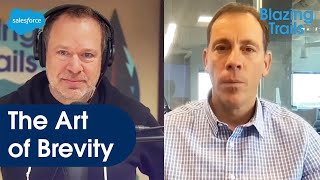
A Salesforce Studios interview with Jim VandeHei (founder/CEO of Axios, co‑founder of Politico) about his book Smart Brevity and the organisational need for concise, audience-centered written communication. VandeHei explains the core tactics (lead with what’s new, explain why it matters, use bullets, write like you speak), argues brevity is essential for remote work and employee alignment, and links the approach to his entrepreneurial work (Politico → Axios → Axios HQ).
Chapters
Welcome back to Blazing Trails. I'm your host, Michael Revo from Salesforce Studios. Well, write less, but say more. That's what my guest today, Jim vandehe, founder and CEO of Axios and co founder of Politico, wants us all to do. We're going to hear all about it in his new book, Smart Brevity. And we want to hear from you. So drop a comment or a like. Your feedback really helps. And now, welcome to the show. Jim.
Great to be here. Thank you for having me.
So tell me a little bit about the origin story and how the book came about.
Yeah. When we started Axios five years ago, we were trying to think about what is the biggest problem that we thought needed to be solved for the news consumer. And what it was to us was there's way too much inefficiency in how news was delivered that if you thought about this moment in time, we're all getting hit with more information from more directions and with more velocity at any point in humanity. And we have less time, therefore, because we have all these distractions. And yet we probably need to know more across more topics to be successful at work and in life. Well, that's a lot. And so we said, okay, how could we solve that problem for the consumer? And we came up with this idea of smart brevity, which is hire really smart reporters, get covering really important topics, but then deliver the information as efficiently as humanly possible.
There's so much written communication, so it's so important. So tell me about this radical change. I mean, it's in Smart Brevity, but what does it really mean in terms of how you need to think about it?
Use the shortest, smartest, most provocative way to make me want to open what you're sending. And then be very clear, very, very succinct about the reason you're writing. Don't hide your insecurities in a vomit of words. Don't meander. Be direct. This is what's new. This is what's important. Then give them the why it matters. Give them context. People are busy. They want to know why you just shared that one piece of information in as few words as possible. And then make anything beneath that stack the most important information first. If you have more than one idea, put it in bullets. The data is irrefutable. People remember things that are broken into bullets much better than they do. If it's just a glob of text and you do just those four simple steps, and there's probably 30 more in the book, you will see A magical difference in people interacting with your content. It seems so simple, but it requires a completely different mindset. And then it requires understanding how to be able to sharpen what you're saying, how to use words that actually matter. And then. And the big trick is writing like you speak, like there's something about our species that when you get behind the keyboard, you suddenly stiffen up and you tighten your collar and you put on a tie and you start to write like you're a poet or you write like you're a professor or you write in a voice of God. Yeah. Nobody speaks that way. And why would anyone want to digest the written word that way? Talk to somebody. The thing I tell reporters, sit down and talk to somebody. Like you're grabbing a beer at a bar. You're going to talk in an excited, direct, enthusiastic, provocative and evocative way. Well, now you got me. And you're going to tell me why you're so excited about what you're saying. But if you think about the difference between that and how you write, that's the Grand Canyon.
That gap sounds really simple, but how do you really understand what the audience wants?
Like, so much of writing is selfish, right? It's either you want to show off on how smart you are or how complex and witty your idea is, or it's selfish because you're hiding your insecurity, the fogginess of your own thinking in a pool of words. Yeah. So if you switch it, instead of, like, I'm writing for this myself, but I'm writing for you, what do you need to know? How can I tell you what you need to know as quickly as possible so I'm not wasting your time? How do I give you the context to understand the importance of what I just told you? How do I give you the power? Decide if you should keep reading or keep consuming or keep listening? And if you do, how do I make every minute worth your while? Remember that. Just think about your brain. How many things are hitting it right now. You probably are already bored by me, and you're thinking about, can I check Tinder or can I check Facebook or can I check Snapchat? Like, that's every. I don't think it personally. That's all of us. It's everybody. You're in competition with the world. You're in competition with all of these alerts, all of these buzzers, all of these beeps, all of these, you got mail. And so you have to understand that it's a war out there, a war for people's attention. And you can't use the same weapons you've been using because they're not effective and it doesn't matter where you are. I've watched it. We've created a software called Axios HQ that helps people, gives them sort of a computer guided way of writing much more effectively. And I've seen it have a magical effect for teachers, for scientists. Oh my God, they're the worst. The only people worse than scientists are people who work at trade associations and think tanks. The only people worse than them are people running businesses who are trying to communicate to their employees and think. An employee would go to an intranet and read 800 words of blather as opposed to just tell me what's new, why does it matter? Let me move on with my day. And if you change that mindset, people will engage with your content, they'll engage with you and they'll remember, like, why are you communicating in the first place? Why are you writing in the first place? Something to tell me that was important. So hit me over the head with what's important.
Yeah, I mean, it's interesting. You've mentioned this emotional component a couple of times. You know, hiding behind, you know, words. How have you seen people overcome that?
They have to make the decision they want to overcome it. Once you can almost anyone who's like read the book or worked for us or used hq, within a week you can see a dramatic difference. And you'll see almost every company who's used a product, their open rate's gone from 20 or 30 to 60 or 70 or 80. Don't use acronyms, don't speak in business. Speak. Speak like a human. Just like, just that change alone. You see it like, why do some politicians do better than others? Because they're more authentic than the phony they're running against, like, authenticity in a business setting, in a school setting, in a work setting, in a journalism setting. It is such a difference maker, I.
Think now with remote work so much. It used to be you could have a conversation. You know, there were lots of different ways to communicate. But now updates on Slack, update by email, whatever it is, is how you're reaching your audience. So talk a little bit about how business leaders should think about how to use newsletters and that kind of communication.
If you run a business and you're not radically changing how you communicate, you're screwed. I'm telling you, you might not be screwed today, you are screwed long term. Because of what you just said, your workforce is now scattered around the country or around the world. You're probably never going to get everybody back into the office space. You've got a base that is looking for purpose and meaning and transparency and direction. And they're dying for you to tell them in a very direct way on a very regular basis, what are we doing, why are we doing it, and why does it matter? And if you're not doing that, you're going to lose them. Stuart Butterfield over at Slack estimates that, like your average employee probably spends half of their day communicating a manager or a leader, 60 to 80% of their time communicating, and yet no one's teaching them how to do it better and, and more effectively and more efficiently. There's going to be a revolution in this space. So think about the emails you send or think about how do I update my staff. I run this entire company on hq, meaning I write a newsletter in hierarchy. Never more than the three minute read. Here are the five most important things happening at Axios. In order. Each item tells you what's new and why it matters to the company and what I need from you. So in three to four minutes on a Sunday, everybody at my company knows exactly what we're doing, why we're doing it. So by the time we meet on Monday morning, we're not looking back, we're only moving forward. Everyone knows where things stand and we do that with every single division. So you get alignment, you get productivity, you get a healthier culture, and then you end up having a bigger profit as a result of that. And so I am convinced that this will be the most seismic change inside companies that we have seen in 20 or 30 years.
And you know, I wanted to ask about your journey as an entrepreneur. I mean, from Politico to Axios to now, the HQ product. You know, now you're in the software business. So I'm just curious, can you tell me a little bit about maybe the origin story with Politico and some of what you've learned in starting companies and building teams and building organizations?
In 2006, it was clear as I was being a journalist and covering the White House and kind of being in the mix in Washington, it was clear that newspapers were in a lot of trouble. The Internet was taken off and it was clear people were going to move away from newspapers to the digital screen. And it was clear that old line media companies weren't going to make that pivot very easily. And so we said, hey man, I remember the conversation actually because Google was buying YouTube at the time. And I walked up to my colleague and I'd never thought of running anything. And I posed a question to him. I said, hey, if Eric Schmidt came to you right now and said, how much would it cost me to take on the Washington Post political franchise? What would that be? And I looked at John Harris, my editor at the time. I said, the truth is not that much. Because of the Internet and because of cable's insatiable appetite for content, we know there's like 12 reporters who actually break news on a regular basis. Let's pay them a bunch of money, put them in one place only, focus on politics and start a company. And we were lucky enough, dumb enough, whatever, to get so excited about that idea that from the moment we thought about that idea to launching Politico was about six months I had to learn how to run a company, and I was terrible at it at the beginning. I had no idea what I was doing. I was all energy, all like, go, go, go. And I drive people nuts. People were quitting. It was just too much. I had to learn, okay, how do you create a culture? How do you hire the right type of people? How do you structure a company? And little by little, we got pretty good at it. And that lasted 10 years. Politico just sold for a billion dollars about a year ago. It's a very successful company, arguably the most successful transaction of the digital era for new media properties.
It's amazing. And it's funny, because that origin story at Politico is kind of a smart brevity story. It's looking at this big, complex world and saying, you know what? There's really like 12 people that are doing this. And if I just eliminate all this other stuff and bring that together, it's. We got it right there. So it's. It's a very similar story of sort of cutting everything out of the way.
And looking forward is very smart. Like, it's. It's something people miss. Like, I just got off a call with someone about the same topic. They're trying to figure out what to do with their career. I'm like, simplify, simplify, simplify. Everybody makes everything so complex. Like, just break it down. Like, what is the one thing I want to do? How am I going to do it better? What is the easiest, most intuitive way to do it? Don't do things just because other people have done it a certain way. Like, people way over complicate life. They way overthink things. I think the more you can simplify everything, from your processes to your idea to how you communicate, the easier life is, the faster the speed you can move at.
All right, well, looping back to Smart Brevity, any final words of advice for folks about how they can use smart Brevity, how they should think about this? And of course, I encourage everybody. I got an early copy of the book and got to check it out. There's great stuff in there, great exercises, and it really teaches you how to do it. But any final advice on that?
Yeah, I mean, I think if you're in any position where you communicate one to many, it's just a game changer. Like, we don't have many years on this earth and you might as well be as effective as you possibly can and do as much as you possibly can. I think this is like a weapon for being able to do it.
Okay, Jim, thank you so much for joining us today.
Interesting conversation. I appreciate it.
Well, that was Jim Vande Hei, the founder and CEO of Axios, co founder of Politico and author of Smart Brevity. So please drop a comment or a like on this video. We want to hear from you, and it helps make the show better. And if you made it this far, you should definitely subscribe to our YouTube channel right here somewhere. Hit that subscribe button for more great ideas from Salesforce. I'm Michael Revo.
Thanks for joining us today and we'll see you next time.









