The Cloud 100 2022: Cloud 100 CEOs on Leading in a Downturn | Salesforce Ventures
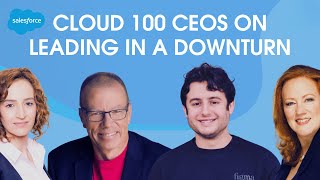
Dylan Field, Einat Guez, Amit Bendav, and Bernadette Nixon discuss how to lead startups through downturns. They cover hard trade-offs, product-led growth, and why customer obsession and community matter more when money tightens. The core advice: conserve cash, prioritize ruthlessly, and double down on what works.
Chapters
My name is Dylan Field, CEO and co founder of Figma.
My name is Einat Ghez, CEO and co founder, Papaya Global.
Hi, I'm Amit Bendav, CEO and co founder of GONG IO.
Hi, I'm Bernadette Nixon, CEO of Algolia. Hi everyone. It's great to be here today for Cloud 120 and for this conversation. So it's certainly, if you look at 2022, it's certainly been a crucible year for all cloud companies. And I also think for leaders and teams to showcase their potential and the vision and what lies ahead. I think that's so crucial for teams in this climate. So why don't we jump in with our first question? So certainly We've all been SaaS leaders in Bull markets and bear markets, but it was interesting to share how some of our priorities are shifting as we take a look at these headwinds. So maybe Inet, could you start us off? How are things shifting for you guys?
Yeah, so 2022 is an interesting year, obviously after quite few years that each one of them has been interesting by herself. But I think that my kind of three rules for this year is first, be very fragmentic, second, be very brave. Right? Because I mean, at the end of the day the decision that I take and each one of us are taking our own decisions will impact our company. So be brave, be willing to stand behind them. And the third is what I call the trolley exercise. So I mean, we all start when we want to kind of travel and we all start with quite a lot of things that we want to package. But if we want to fit to a carry on, we need to assure that we can take everything that is essential and critical and fit the luggage. So it's kind of the same currently. I mean, it's making again, like critical decisions, trying to invest in the future from one hand, but also reduce the cost of everything that is not super critical for the business.
Yeah, Bernadette, I mean, I think there's early stage issues that we all face and one of them is certainly category creation and it's really convincing a market that they need the problem, the solution to the problem that you're selling. So I'm curious for you, looking back, what's something that you feel you got right from the very start and also what's something that you got completely wrong?
There are definitely examples in both categories.
I think probably for all of us.
Yeah, exactly. So from our perspective at Algolia, from day one we focused on being a horizontal API product and Platform and in the early days when Nicholas Desange and Julien LeMoyne, our two co founders, were incubating the idea and as part of the accelerator that they were part of, there were a lot of naysayers. People were giving them advice, you know, what you need to pick a vertical. And everybody was saying, go for E commerce. But they stuck to their guns and they stuck with building out a horizontal API first platform that was focused on delivering a great developer experience. And it was a crucial decision for the company. And what it enabled us to do was to have really crystal clear positioning as a developer platform, API first and really search as a service. So API and search as a service were both very well known and understood by the developer community and then became more broadly known and understood. So that's one of the things that we believe we got really right from the beginning. Now the flip side of that coin is that we went up market. So a lot of companies that start with a product led growth motion sometimes take a while to go upmarket and start a salesforce. We went there pretty early and that was really good for us for the market that we're in. However, we forgot one thing. We forgot that pricing was actually part of our product. And so we conflated this notion of pricing being part of our product and having to gate certain features that had applicability for all customers. But we put them and pigeonholed them just in these enterprise plans to justify a price point. And that did a couple of things. Number one, it slowed down our feedback loop from the market and secondarily it kind of stifled our plg, our product led growth business for a little while we solved it, but it was definitely something we'd advise people not to do based upon our own experience.
Yeah, I think the transition from bottoms up and product led growth into sales is always can be very fraught. And a lot of companies have difficulty navigating those waters. So I don't think you're alone.
Yep, I think you're right.
I think from my perspective, maybe I'll share our first few years because I came from a very bootstrap and kind of operational background. And when we started the company we knew exactly what is the pain that we are solving. And we were growing aside our customers from day one. But from the other hand, when we were speaking with investors, we had really hard times to convince them that this is a real problem and a real need. And I think that the main thing is that they went and asked the CEOs of the company, do you have any issues with your global payroll. And they said, no, everything is great, I don't have any issues at all. And they came back and like, I mean, I don't see the problem. I mean everything is going very smoothly. And I was constantly telling them, you're not asking the right person, right? I mean the people that are working behind the scenes to make it happen, I mean those are the ones that you should ask. And I think for us the first three years was really years of very rapid growth without getting, I would say the market support from investor side. But I think in reality, I mean sometimes you are just coming from the industry and you know things a bit before the investors understand the market or the problems. So this is a good advice for me for everyone else that is kind of expert in this domain. I mean if you feel that there is a real problem, if you are coming from the field, don't give up.
One thing that I think worked for us, that we had very shallow technology. We didn't develop a lot of the technology. Almost duct taped something that looked like a product. We almost faked it. And we did have, it was working. But we gathered together whatever we could find on the Internet, components that we could put together and we charged early. And again we didn't need the money. We just wanted to know that we have something that people are willing to pay for. So that was a good decision. In hindsight, just duct tape something, don't sweat the technology too much. See what people want and need and are willing to pay for and then you can build it.
So Amit, a question to you. So what are the lessons that you can share with early founder, early startup founders trying to currently start their own companies on cloud side for them to be successful.
This would be my fourth downturn. 2000, 2008, 2020 and 2022. It's helpful to think in terms of your mission for decades. This is a natural cycle that happens every now and then every few years. It could be now it's like every two years but it could be like every eight or 10 years and not worry about it too much. Of course make sure that you have cash, right? Cash is. Without cash it's a lot harder. But assume that you have that. So focus on the mission, the value to create for customers. Make sure that the value proposition is in line with what's top of mind. Put people right now it's more maybe on efficiency and do more with less versus like grow some of the things that we've seen like about a year ago you worked on a product for two years just to launch a beta, and then like a couple more years to actually start charging and selling and you're growing. Tell us about your thinking and your learning from that experience.
Yeah, so many thoughts. And by the way, I'll just start by saying there's lots of ways to start up. And so I don't think that there's like one right path and tons of respect for what you're doing and you. And so nothing here should be taken as like a counterpoint to that for us. We started in August 2012, kind of figured out what we're doing around June 2013, launched our closed beta, December 2015. Our GA release October 2016, didn't make our first dollar until summer 2017. And so it's quite the journey. And I think I'd probably advise people to not do that and to make money faster and to get the thing out there faster. For us, it took a long time because we were building something that had a big moat. It was something technologically that hadn't been done before. And I'm excited and glad that we have that moat. But in contrast, when we started working on FigJam, our second product, which we launched in April of 2021, FigJam's a whiteboarding product for ideation, brainstorming. And we were hearing a lot of need for that during the pandemic. And so it was something we talked a lot about with the team, was, hey, we, we got to get this out there before the pandemic ends because we need to help our users now. And I think that that urgency really translated into a fast development cycle, ended up being probably like eight months or so to build that, in contrast to five years and then another year from there to monetize it, or actually a little bit less, like eight, nine months or so to monetize. And so I'm glad we're moving faster now. And I try to instill that in the rest of the team too, that perfect is the enemy of the good and just getting it out there. The beautiful thing about software is that you can keep improving it. We're not shipping couches or chairs or you put out there once and then you're stuck with it forever. And so I feel very lucky to work in bits, not atoms.
Love that.
You know, on the topic of go to market engines and pricing, I'm curious if anyone has lessons selling into this increasingly hybrid world that we're in now.
I think for me, selling remotely on a hybrid world means two things. First, making things very, very eas. So try to create a very transparent, very easy pricing. I think that when you are over complicated at pricing, when it takes a lot of stages to get to a price proposal, you actually lose your audience. And also, I mean eventually, I mean it takes more time to go from just the prospect to the onboarding stage. But I think that the second thing which is much more important is, is that you have to assure that you sell the product by the product. And I think I have two great examples here, Figma and Gong, which we use internally in papaya. And I think that if you have someone that loves the product when they see it, they are the buyer, they want to make it happen, they are your ambassador to assure that you are getting in, that you are going to all of the barriers. It can be legal, it can be pricing and so on. So don't sell over a presentation, sell over the product, assure that people can see the product, can touch the product. I mean be proud of the product. I think, I mean for me if I go to a sales call and I see a presentation or PowerPoint, I mean the first reaction is kind of stepping backwards because I lose kind of the trust that I have. I want to see the product, I want to understand what is it for me.
Yeah. So I joined Algolia back in May of 2020, so in the first wave of the pandemic really. And so the beauty of an API first platform is it can solve many different search use cases, for example for our customers. But I felt that we needed to get to repeatability one use case at a time. And that's often a challenge that any platform out there will face. I know I faced that challenge back going back to 2010, last 12 years, only having experience with platforms. So we followed that philosophy and obviously given the time with COVID and everything, it was a no brainer to pick B2C E Commerce. So we instantiated that with a sales play. It became a cross functional effort. It has to become a cross functional effort in order to be successful and it's given us great results. So now we keep going with that and we've got a cadence every quarter so it works really, really well for us. I've got a question for the group. Every SaaS company, it's in our DNA to be customer obsessed. I'd love to hear from some of you on how that manifests itself in your go to market strategies.
I think it's worth thinking outside of go to market as it's traditionally defined for this one. For example, in the early days of figma. I tried to encourage our support team to think themselves as marketing. I was like, hey, if something's written into you and they have a very long ticket full of feedback, build a relationship. You're basically our evangelist right now. And a lot of those people that then had all that feedback later on became evangelists. Of course some of them became trolls as well. So ignoring the trolls there. But for the most part it was very helpful. Just deeply engage with customers and really build up community. And I think you can build a community in lots of ways, not just through go to market and marketing. Right.
We, we call it at Gong. We call it. We're not saying we're obsessed. We want raving fans, right. And we said there we don't want happy customers. That's kind of the table stakes. We want like raving fans. And. And this is the marketing, right? The understanding. No, not just doing it at first it's fun, but we're doing it actually because this is the marketing. We believe that the mess marketing is like customer spreading the gospel.
Right.
We're, we're a new thing, a new category. The world doesn't even know we exist, doesn't know why you need something like gog. And we wanted to rely on raving fans which right away we extend both to employees. We want like candidates which are prospective employees, employees, customers and prospective customers. Everybody that has interaction with customers want like to rave about the company. And when we succeed that's what we celebrate and that is our best marketing.
I will say for product led growth companies and companies with self serve, it's so important to deeply understand all the mechanics of how it works and to also understand what metrics will affect other metrics down the road. Because it's very possible to miss over here and then three months later you're missing over here and it's actually just one miss. And so really being hardcore about that and tracking everything and then being super diligent with your team if you have a miss, I think is super important.
Yeah. So I'd like to ask the group as the CEO of a global HR and payroll platform, I can't help myself and ask you and wonder what is for your in your perspective, best place to work means currently in these days, what makes it a great company for employees to work? What benefits matters? I'd be very happy to hear your perspective.
You know, I think especially on a call like this where we're across the world and in very different areas of technology, I think it's important to note that there is Such a thing as like culture, market fit in terms of company culture and how that matches to the market you're serving. I don't think that there's one answer to this question. And I think for Figma, for example, some of the things we think a lot about or how do you create a playful spirit when you come to work, how do you have fun and make it a really enjoyable experience to be here so we can all be creative together. And so we do things like maker weeks where we have the entire company gather and come together for a week to really be innovative. Other companies probably would really not have that same reaction to those things or they might be annoyed if that was the approach and culture that they experienced. And so I think there's lots of different ways to work together as a company and again not just one way to start up. Right.
I think it's like, it's easy to state, it's not always easy to practice, but what you try first. People want like a sense of purpose, right? That they believe in what the company does, they have room for growth, they are trusted, they have freedom to operate. They have the right environment and set up and, and they can shine and blossom. This is like, and work feels more like joy than a chore. Now you gotta make sure that you have the right team in place, the right infrastructure and really a good cause that everybody rallies around. But it boils down to this purpose, empowerment and self fulfillment.
I often think in pictures. So I have a triangle in my head right now. So the three layers and I look at the bottom layer as the table stakes. Yes, that's comp and benefits, rewards, but that's not what, it's just what it says. It's table stakes. It's not what you're going to differentiate on. You differentiate on, in my opinion, your employee value proposition, which is some of the things like Amit was saying, it's sort of your values, it's really your contract with, not financial, physical, legal contracts. It's your commitment to your employees as to what your environment and their environment is going to be like to work in, whether it's physical or virtual or hybrid or whatever. But it's governed a lot by your values and care and humility and trust and things like that that are specific to each of us. And then on top going to the purpose element that's unique and that's, you know, we actually simplify it because I could never get my head around vision, mission, purpose, it was all too much. So we said it's the one thing for all of us. Our goal, for example, is powering discovery. Our vision, our mission. We're doing it today. There's so much more that we want to do. And yes, it is our reason for being. So that's how I think of it, is table stakes. But then differentiate on the employee value proposition, your vision and you know, people can buy into it and relate to it and join or choose not to. And that's okay.
I heard something nice recently that actually a successful company, you take this triangle and it should be upside down because leadership should be kind of on the bottom of it and when if you're building the company successfully. So actually, I mean, the leadership is just kind of the point that holds it, but the whole our team is the one that really creates the value and can grow and blossom, as Amit said. So, yeah, I really agree to that.
Inet, I know that you're really passionate about social impact and just generally doing good in the world. And I'd love to hear more about what informed those viewpoints, how they manifest for your company, but also what you think the role of capitalism is and should every company be participating in this sort of social impact and what are the bounds of that?
Yeah, so it's really one of the topics that I'm really passionate about because I think that as CEOs, as founders, companies, we have a rare opportunity not only to create great businesses, but also to leave a mark in the world. And I also always want to be in a place where I can come home at the end of the day and tell my kids that I contribute a bit to a better world for them. And for us. In Papaya, it's really kind of see how we bring more and more people from different backgrounds, from different kind of places to be part of this journey.
It's interesting. I mean, I think when you look at some of your core values sort of guide how you look at these things. Care is one of our core values. And we support many different and diverse, both social and humanitarian causes. And we do that employee driven through a matching program, charitable matching program, which is good. But I think now we're sort of being more intentional about how we go about leaving a mark, a positive mark on the world. And so we're taking what we focused on historically around a carbon offset program that was very loosely sort of administered and really now doubling down, I should say, on becoming net zero. We're exploring the idea of becoming net zero by 2030 and doing it in such a way that it is provable, it's permanent and you can validate it.
I'm grateful that we have inspiration. There's CEOs like Bernadette and Ennat that provide inspiration to new generations generation. They can see themselves and also with the underrepresented representative minorities. So we're pretty active in dozens of ways and I think that every company that does that makes this world slightly better and if we all do it, it'll be a lot better.
The other thing that we started to do that I'm really excited about is more unique to figma is figma and Chromebook. We just did a partnership with Chromebook where any school district in the United States and hopefully even more broad than that later on can just press a button and then deploy figma to all the Chromebooks in the district. I'm really excited to see how this impacts high schoolers and kids that are on the younger side as they go and grow into their careers. I certainly didn't know that design was a viable career option when I was in high school or middle school. I hope that the next generation can actually see that as a great path for forward, especially as we have so few designers in the world and it's such a huge demand I think across all of our companies to find and attract more designers right now.
So question to the group. There is an old cliche that the best tech companies have started in days like this over downturn of the markets. So if you need to currently give your best advice to early start startup founders about where they need to put their best efforts, what are the areas that they need to kind of double down, what would it be?
I think it's a lot of the same lessons that we've had in the past with addition of be really constrained on your cash. Don't assume that if you raise, you're gonna be able to raise again. And I think by being conservative like that, you'll build an efficient and focused business that's very on mission and targeted and that's I think a really good predictor of success later on as well as you scale your business and grow. So if you're listening in your early stage, best of luck. We're all rooting for you. Right?
I agree. I mean you need to watch the cash, but hopefully you have enough customers have needs like everybody have needs, right? They're different. Find them and you can succeed in a big way.
You hear a lot of talk of the moment as well with regards to you've got to ruthlessly prioritize. That's the name of the game. It's not as easy as it sounds. It's easy to say it. It's not quite as easy to do it. And so what's interesting is I think that the flaw in that notion of ruthlessly prioritizing is that that's a very one dimensional. People typically think of that in terms of a list. It doesn't give you a lot of options to think in a multidimensional way. So I think you need at least two axes. What's the effort it's going to take and what's the impact it's going to have and plot and figure out which ones you're not even going to bother with right now. So I think there's a lot of lip service to ruthless prioritization. I think we need to talk about the fact that it's not not that easy in reality when you get a group of people because of the competing vantage points that they may have. So I think having a framework that helps you with that is sort of a step in the right direction and I think that's going to be really important moving forward.
I would just add to this that I think I would double down in everything that beat the metrics. So take the metrics and understand how do you beat them and double down there. So, so it can be, I mean, the cost of customer acquisition, that should be super efficient. It can be eventually the ARR, it can be any metrics that matters in the business. But assure that you have all of the efforts and that you can double down and eventually be the best in class.
Thanks all for this awesome conversation. Really good to see y'. All. Congrats again on the Cloud 100. Hope you're all well.
Great seeing everyone and looking forward to next time.
Thanks everyone. It's been pleasure to meet you all. Congrats on Cloud100 and looking forward to meet you again.
Love the conversation today. Thanks very much indeed. And congrats on Cloud 100 again.









