The Fourth Industrial Revolution Panel at Davos 2019 | Salesforce
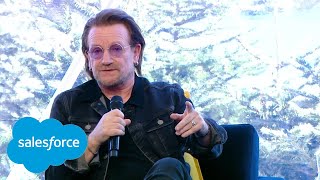
Will.i.am, Jane Goodall, Bono, and others debate AI's impact on jobs and climate at Davos 2019. Christiana Figueres calls for cutting emissions from 40 to 20 gigatons yearly by 2030. Jane Goodall's Roots & Shoots program operates in 80 countries, pairing youth activism with local conservation.
Questions this video answers
About 80 countries.
About 10,000 residents.
Reduce greenhouse gas emissions from about 40 gigatons/year to 20 gigatons/year (50% cut).
"Idality is I am my data" — emphasizing personal data (locations, steps, consumption, facial data) as part of identity.
16 years old.
Chapters
So thank you everybody for being here. We're so grateful to all of you for coming and having lunch with us today. And we've got a fantastic panel. It's been an amazing Davos so far. I especially want to thank our World Economic Forum team, especially the center for the Fourth Industrial Revolution. As you can see, we're featuring the Friends of Ocean Action here at the lunch today. Friends of Ocean Action is an initiative that started about a year ago at the World Economic Forum. It's managed and run by the World Economic Forum. And Klaus Schwab really had an incredible vision that the World Economic Forum could have a powerful multi stakeholder dialogue to improve the oceans. And we were so fortunate last year to have the great Prime Minister of Canada, Justin Trudeau, here, who got in contact the information about the Friends of Ocean Action and for the first time, and this was aligned with him chairing the G7 in June this year, which they did a phenomenal job of in Canada, prioritizing the oceans. So thank you to your whole team and thank you for supporting and caring about the oceans. And Canada has been a tremendous leader for us. So thank you very much. Well, we have a fantastic panel today, and we're going to do something that we do every year here at this panel, which is to take a look at some of the issues, concerns that we have here at the World Economic Forum and what we as a community can do to improve them. And we have been doing this panel now for about five years, and we have seen some amazing discussions and a lot of amazing action as well. And I'm really looking forward to the discussion today because we have some true heroes up on the panel and a couple of people who are true heroes of mine. Well, our first panelist I want to introduce you to has been at every single one of our lunches. And I would say that his predictions and the level of accuracy that he has talking about the future is unparalleled compared to any other panelists that we've had. It's been amazing. The exact specific indication, including where we are today on privacy and the individuality of data. Tremendous technologist and visionary. Also a tremendous philanthropist and a tremendous artist as well. So please welcome Will. I am. Thanks. I care very deeply about the oceans and the health of the oceans and whether it's the issues associated with the ocean that are directly linked to the environment, which is that, as you know, it's getting warmer on our planet and that has a direct implication to the ocean because it means that there's more acidification in the ocean. We've seen that incredible research done. We have the chief United nations envoy of the oceans here, Peter Thompson, right over here. Thank you, Peter, for caring so much about the oceans, leading SDG 14 and helping us to remember the care and health of the ocean as we move forward. And every time I say oceans, this next panelist looks in my eyes very deeply and says, forests, don't forget about the forests. And I'll say, but you know about that there's going to be more than more plastic in the ocean than fish by 2050. And also that we need to focus on things like overfishing and coral bleaching. And she says, forests, do not forget about the forests. And I said, well, what do you mean? Well, we're deforesting still at one acre every single second. That was an incredible statistic to hear that at a time when we need the forest more than ever to mitigate climate change. I had an opportunity to speak with the president, new president of Brazil, about that very issue. But my comments and my discussion were directly inspired by somebody who, who has probably done more for our planet than almost anyone I can imagine. And please welcome Jane Goodall. Well, we celebrated the birthday of, of Red here three years ago. It has done more for supporting the health and well being of individuals with HIV AIDS as well as its work with the Global Fund than perhaps anybody else. As well as passionately focusing on the reduction of debt in developing countries. When I think about artists who have deeply committed themselves to really improving the state of the world, the very motto that this conference is built on, well, every one, not only in his industry, but my industry, looks to him as the role model of not only taking your career and being a master at what you do in your day to day work, but also remembering everybody else on the planet. So please welcome Bono. As I kind of look across the world and as we've looked at this panel, we wanted to go east to Asia. And when I think about some of the great leaders in Asia, it became clear to me that one of the most important topics, especially in Japan, is the care of the elderly and the care of those who have come before us and those who are gracing us with their age and their experience and their wisdom and taking care of them. And a visionary in elder care and a visionary in providing very core services to the families of Japan and throughout Asia. Please welcome my good friend, Sakuruta San. I also want to finally introduce a woman who has probably done more for the climate and more for the planet's health. Than anyone that I can imagine. Everybody knows the role of the climate agreement in Paris and how it's absolutely critical in getting us to meet our emissions targets. And we can see already examples of that across the world and how that is a critical imperative for each and every one of us, as well as the direct implications that it has for other critical parts of our ecosystem, including the oceans and the forests, and the person who single handedly led that. Please welcome Christiana Figueres. Well, let's begin this discussion. And in every year we take this discussion and it's very simple. You know, these are individuals who I've been able to look to, but really the world has been able to look to for their vision. They're not only masters in their own fields, but they're people who have had a tremendous vision that's been incredibly accurate for the entire planet. And that's where I really want to turn this discussion. I'm going to really ask them to take into consideration everything that's in their hearts and everything in their minds and to look into the future. That is, where will we be five years from now? What is our kind of short term agenda? Another way to think of it is what is the marching orders for everybody in this room for the next five years? What is it that we can do with our own businesses or governments or NGOs or nonprofits that are represented here? What can we do to improve the state of the world? This is the question for the first round. Then we'll jump to. Now let's take a slightly longer view. 10 years. Over the next decade we will look at, because of course, we always overestimate what we can do in a year. We underestimate what we can do in a decade. And then we'll answer, we'll go through again. But let's talk about the short term. Let's talk about in the next five years. What is it that we should be focused on right now to improve the state of the world? What is it that we all can do today? What is our greatest feeling, our insight, our notion? What is it? I think the Japanese word is ishii. What is it? That is our clear insight of the light that will take us forward. How do we bring that light into the next five years? So I would like to just start out with Will. And Will, can you guide us? And we have a clock right there. And if you could do it in three minutes, where the world will be over five, the next five years. Thank you.
There's time out there.
So five years from now we're going to start to see the beginning of job displacement in a real way because of AI and autonomous machines. So the stockers put everything in the boxes and supermarkets, self driving cars.
Call.
Centers, a lot of people without jobs and reskilling companies gonna start have to reskilling the folks that are gonna lose jobs onto other ones. And all the while governments are still not going to invest in hi, which is human intelligence. Machines will get smarter and smarter people will just stay like this. And that said on the mountain today, this whole week, AI has been the topic, environment's been the topic. And we never talked about people and how we educate folks and prepare them. So hopefully we could wake up before that. But it's going to be a rude awakening. And this time we wake up, we ain't going to be the only smart. Humanity is not going to be the only thing smart on the planet. And that's a, that's a freaky one. And that's not like some sci fi thing. That's sci fact, right? Big companies will continue to grow bigger and more powerful than governments with no regulations on the tools that they deploy, deployed, no responsibility to educate in a way that they should. So five years from now is going to be, you know, hopefully a revolution because every time kingdoms get more powerful, democracy rings. Just like the French happened in France, happened in America. And data democracy will be the thing that people are going to be fighting.
For.
Five years from now.
45 seconds left. You've been talking for the last five years about iDadity, our own individual pursuit and control of our own data and not giving it to companies who have been misusing it and could just monetizing it and turning it into their business model without us knowing and then lying about it. You are the first person to really bring that forward as a major issue. Is it connected to that?
Yeah. Idality is I am my data. I am not my birth certificate. That's just the day I was born. But I am who I know where I go. I am what I eat, what I like, I'm what I say I am my steps. I am not only what I consume, what I put in my body, but what I watch. And all that stuff is for sale. If I was super poor, like I was super poor back in the day, I could sell my blood, but I can't sell my data because somebody else is. I own my songs, but I don't own my facial math. That's freaking freaky actually that none of us own our face math. Me and Bono own our songs. That's some giggle. You could giggle at that, but it's something that we should all be concerned about.
Okay, thank you for that. We're going to come back to that. Jane, you have helped us to understand the forests. You have helped to understand the chimpanzees, you've helped us to understand the animals of the forest. And you have brought us a tremendous message about the environment. Can you help us to understand what is it that we need to do over the next five years? How should we be thinking about what's happening to nature?
Do I need the mic? Well, where we will be in five years if we carry on with business as usual is not somewhere where I particularly want to be. Because if we carry on with business as usual, if we don't get together and make the kind of change that we can, whether it's with up to date technology, it and so on, or with our own human cells, with our own human hearts and brains working together, because I truly believe unless brain and heart work in harmony, we can never attain our true human potential, which is huge. So we mustn't carry on with business as usual because if we do, in five years, the hurricanes will be worse and more frequent, the tornadoes will be worse and more frequent, the flooding, the droughts. You know, I'm traveling around the world 300 days a year all over. And I've seen what's happened already with climate change. Parts of Australia, it hasn't rained for seven years, they've killed their livestock because they can't give them food and water. And I've been in places where hurricanes have, have completely wrought havoc, usually with the poor communities. And so what must we do to prevent this kind of scenario? We've got to get together. It's big. Business has got to start asking itself, could we perform better for the health of the environment, for the future of the planet? Governments must move away from the country corruption that we so often see, a mixture of corruption with governments and business. And I think as individuals we must all realize that each one of us makes a difference every day and that the small choices we make, what we eat, what we wear, what we buy, we need to start asking ethical questions. And it may seem not very important if I make a change, but if billions of people are making ethical choices each day, we're going to move into the kind of world that we'll be less ashamed to leave to our children. And that's why I'm working so much to develop our youth program around the world. It's now in about 80 countries. And this is young people choosing projects themselves to make the world a better place for animals, people and the environment. Because we're all interlinked. If we go on destroying the environment, it's not just the natural world we're destroying, it's our own future. Many of you here have children or grandchildren. What do you think about a future if we carry on with business as usual? So I'm not in business, I'm not in government, but I think I know what we need to do to make this a better world in five years. And that's to realize each and every day each one of us makes some impact on the planet. And we get to choose. What sort of difference will we make. Thank you.
Well, Bono, talking about someone making an impact, I think that you've shown us how to create NGOs, non profits, how to bundle the work of business together on important causes. And you've also shown us how to do truth to power, to talk to people who don't always agree with each other, but yet bringing each other together as one. What is your vision for the next five years?
There was a joke last night between Jane and Mark, something to do with chimpanzees and a gorilla. And we sort of made a joke about mark being the 600 pound gorilla. And I woke up this morning and I thought that's kind of a compliment because you are sort of a 600 pound gorilla, a kind of bodyguard. The person you want in your corner if you, if you're an activist or if you, you know, in the red campaign. I just want to. I just want to give it up for the 600 million.
Now.
On the subject of species, I would say that in five years, just.
Thank you. It's one of the nicest things everyone has ever said about me. Very grateful for your commentary. You're welcome.
There's more coming.
You're a poet and you know it.
But on the subject of species, I think businesses like species, if they don't evolve to changing circumstances, will become extinct. Even giant companies will become extinct if they don't evolve to changing environments, if they don't adapt. And you know, size isn't everything now, as Dr. Ruth used to say, no, size, it isn't matter in this. It's agility and our ability to adapt, our ability to adapt to changing circumstances. So I can see a change on the street, on the high street, in shopping malls. Consumers are waking up to the power they have in their pocket. And they realize there's political power in their pocket. They vote when they make a purchase and they can put you out of business. They can put me out of business. It'll affect artists, It'll affect everybody. And, you know, we have to decide are we firefighters or arsonists? And I know which I want to be. But in the end, it is our audience, it is the consumer, and they will make or break us based on our ability to respond to the challenges Will and Jane have just put to us. But it's very exciting on another level because companies like Salesforce can get behind Red, which buys AIDS drugs for people who can't afford them. And a simple purchase, a. A beautiful object like that can actually just turn a life right side up. And that's something to encourage us today that we can use not just your philanthropy budgets, but your actual marketing departments and indeed the very objects you make.
All right, well, thank you so much, Bono. I really appreciate everything that you're doing. Well, science is marching forward and we're seeing lives longer than ever before. Aging is becoming more and more of a problem. We're seeing incredible advancements in life extension, and we're seeing huge advancements in the biotechnologies, whether it's basic work in genes and genetic engineering. We've also seen tremendous advancements just in the past 18 months in STEM cells. So we all have the good fortune to be able to live on this planet so much longer. It's definitely a reason we want this planet to be as beautiful as we can keep it. And Sakura san, you have been a huge visionary in showing us how to take care of each other. Can you tell us your vision for the next five years?
Thank you very much for the question, which is not easy to answer, but very, very profound. But before answering to your question, let me just review the industrial revolution we had before. 1, 2, 3, 4 or 5. Second. So we are now in the fourth industrial revolution. If I can be very simplistic. The first industry revolution that took place about, say BC 2000 created agriculture that could be described as a solution to hunger of human being. Second, in distribution, that took place about 200 years ago, started by invention of steam engine and that could be described as a solution to muscle. For third one took place 20 years ago by the invention of Internet that provided solution to time constraints and geographical distance. Now, in the midst of faulting distribution, what it is, it is, I would say, the challenge to human brain. Luckily, this is not a challenge to human being itself. But we have to be careful or we have to be very encouraged by this phenomenon. Because this fourth industrial revolution is so different from the one we had last three. If we don't deal with these great things rightly, that will ruin our future, if not five years. So my suggestion to you that we should encourage technology as much as possible and regulation should be always technology neutral. But at the same time we should enhance our wisdom that we could find or that we have accumulated in the history or found in liberal arts. So my suggestion to you is that yes, five years time, we should enhance our technology as much as possible, but empowered by our wisdom which you found in liberal arts. Thank you.
Well, Christiana, you have really now seen and talk with everyone who could make a difference in improving our planet. So we signed this amazing Paris agreement with your leadership and your vision and your motivation. Now, where are we going with it for the next five years?
Well, you know, Mark, what I find is fascinating and actually quite thrilling is that when we think about the future, five years or 10 years, we tend to forget that this is the moment of choice in which we're choosing what we're going to have as a result of the next 2, 3, 5, 10 or 50 years. And we tend to step in there almost as a default. This is the moment of choice on climate as well as on everything that we have spoken about here. And five years from now, here's my decarbonization will have been completely normalized because that's the only thing that we can do. Frankly, we don't have an option if that's not what we're doing. The oceans stand no chance. The forests stand no chance. The chimpanzees and the gorillas stand no chance. And the glaciers stand no chance. And most importantly, human beings, in particular the vulnerable people who are not at this table today, they stand no chance. Furthermore, the two stakeholders who are least responsible for this problem, which are the vulnerable people and future generations represented by one person here today, they stand no chance. So do we actually have another option? One we don't. We don't need any more science. We understand the science. We understand the problem. We don't need to understand the problem anymore. We don't need to admire the problem anymore. That is one piece. We understand that. But we also know that this is a race. It is a race between the increasing speed and intensity of climate disasters that has already been said to you by Jane. But it's also a race against ourselves, against what we know we can do. Because we know that we can bring the solution. We can know that we can step with courage and conviction and determination into the solution. Space and be able five years from now to prohibit me from having to say, well these are the five companies, these are, these are the five countries that are doing the same thing. We have to have that so normalized that we can no longer use our fingers and our toes or anything else to say who's actually doing the job because we don't have another option. Let us just remember that. And let's remember that we actually as human beings, if we look into ourselves, we know that not only do we want to do the right thing, we, we can do the right thing. And here's the thing, we are going to do the right thing.
Well, I'd like to now go Fast forward to 10 years and I was just looking at what you were all saying and I was trying to how would I synthesize this? And it seems though we've been talking now for several years now about the fourth Industrial Revolution. But it sure does sound like a shift is happening in all of us and that we're entering the fifth Industrial Revolution. But this revolution will be quite different from the previous four. And the fifth Industrial Revolution will be about the planet and taking care of the planet and saving the planet and planetary care. And it'll be led by, by youth and incredibly enlightened and well educated youth with these incredible new ideas that are coming out of their minds that they were born with and that these youth who are coming into their own all over the world, they're going to be enabled by many of the technologies that we've seen created in the fourth Industrial Revolution, especially AI data centricity. But a new generation is coming to save us. When you look out 10 years from now, a decade from now, will what is it that you see happening? What do you see as the fifth Industrial Revolution and the next wave for our world?
So 10 years from now.
What had.
To have happened for us to have like an awesome living experience and balance? China America relations have to be collaborative and the ping pong back and forth should be inspirational and problem solving. New jobs would have been created.
And.
Those jobs would have came from Africa. Around AI there's going to be new jobs that we can't even imagine now, right? I have a career because of little things Edison was messing around with. The kind of musician I am couldn't have existed in 1819. The computer is my tool. That's my instrument. A DP these guys, that career he has, he wouldn't have had that in 1819. Think about all the careers that came because of technology, but somebody had to dream it up. So we would have dreamt up new jobs. And those jobs that we would dreamt up are to service the planet and humanity. We can't out logic a computer, we're going to realize that. But we can. A computer will never out heart us, will never out love us. So we are going to enter a human age and that age will have deemed us inhumane. Just like what came after the Dark ages. Those guys were like, that's some dark age shit. That was the dark Ages.
What were they thinking?
You know what I'm saying? If you were living in dark ages, you didn't know you was living in a dark age. Like, yo, I can't wait to get about this age. That's not what you were thinking in the dark age. So 10 years from now, because it's going to go so fast, technology is going to move so fast. Telcos, we will value their product more, think about what they provide for us that we really don't value. The connectivity, the high demand. Those guys are left behind. But 10 years from now that we will have a different relationship with the telco provider. And somebody has to dream up a whole new way to create with AI, because everything else just monitoring. We don't look at it as the creative community is not looking at it as a tool to create. And 10 years from now is gonna be awesome. To your point, we have no other choice, right? Because it could be the most turbulent times. We don't, it doesn't have to be, you know, what we experience in the forties with that world war or the twenties with that world war. We don't have to do that. So the using my optimism, and to be optimistic, you have to use your optics and see it and take advantage of that opportunity and materialize that. So 10 years gonna be fresh, five years is gonna be bumpy. But what come out of it.
Thank you. Jane, where do you see us a decade from now? How do you see that shift that you articulated from five years of individual action and everybody doing something to improve the state of the world and the planet to getting to 10 years to this new place? How do you see that?
Okay, well, if we all come on to the summons now, in the next five years will realize that we play a role. And if as technology continues to advance, I mean, you know, for me, I'm 85 and for me the most amazing thing is to look up at the moon and think that somebody walked there. Everything that's happening now to me was science fiction when I grew up. And as this technology develops, as we go into artificial intelligence as robots take over more and more of what human beings are doing. Now there is a big danger in my mind and I think what's really important is to realize that we mustn't allow a disconnect to happen between the human clever brain, which, which is what distinguishes more than anything else from the other animals, and the human heart, love and compassion. And I spend most of my life working on our program for youth, for young people. And you mentioned young people, Mark. To me, that is the future. It's their future that we've compromised. We haven't just compromised their future, we've been stealing it. And as I said, anyone who has children or grandchildren, we have to be sure that in 10 years we have addressed our onslaught on the planet. We know a lot now about how to save forests and how to clean up the ocean. We have a program in Africa. The only way that we can save the African forests where we work is by getting the local people who live there to be on our side and by using technology. It's a marriage between conservation and technology. By using technology where villagers who can't even read or write can use smartphones, gis, gps, they can go into their forest and they can record anything that's been going on illegally or signs of chimpanzees or leopards or whatever it happens to be. And they're very proud of this. So we're doing this in six different African countries. That's why the Gombe chimps are still there. If we hadn't been there, they would have gone because we've got to eliminate poverty. If you're really poor, you're going to cut down the large trees because you have to grow food in order to survive. And technology isn't really helping them there. If you're in an urban area, you have to buy the very cheapest food. You can't ask, did it harm the environment? Was it cruel to animals? Because you've got to live, so you've got to buy the cheapest. So in 10 years time, I think we will have moved towards solving poverty in many parts of the world. I think our youth program, roots in shoots, will be in almost every country. It's nearly 80 now. And I am determined that the forests will still survive. Therefore, in 10 years time, and I hope everybody agrees with me, the forests will be there because they are one third of the solution to absorbing carbon dioxide from the atmosphere, not releasing it into the atmosphere. And they, along with the oceans, which we have to clean up and technology can Certainly help there, but it's us. It's got to be our passion, our heart, our brains working together. And then in 10 years I'll be happy to die and leave the world for my grandchildren.
Well, Bono, as we think about 10 years and we think about youth, there's a lot of people who are in this room who have a lot of access to very powerful people, to CEOs, to presidents of countries, to world leaders, to many of the people who are making the decisions and policies and even creating new technologies. The last generation and you've shown us true truth to power is extremely important in the last five years and going forward into the next five years, where are we going to be in the next 10 years?
I just want to say how cool this 85 year old going on 18, youthful spirit. You're just the most cool woman ever. I just want to say amazing.
And.
And while we're at it, just on the subject of coolness, I mean we are all overheating here. And Will I am is in his winter wear. That's how cool he is. Well, in 2029 we'll find out where we are on the Sustainable Development Goals, the global goals that 193 countries signed up to. And I would say that the proving ground of the Sustainable Development Goals is likely to be Africa, actually, both environmentally, because you know, in terms of forestry, in terms of, you know, the precious ecosystem across the continent, this magnificent continent. And, and I think also Africa presents great opportunity. In 10 years time you have this demographic bulge, you know, a youth bulge. I think by 2050, 1/3 of the world's youth will be on that continent. You think of the excitement of that, you know, and all the people, you know, code writers and you know, just on everyone, fashion, science, everything and two and a half billion people. So this continent in 10 years time, I can just imagine is just getting into the swing of things. Or not. And the, or not is the bit I'm interested in because we've just seen what happens to the European Union when a conflict in a country. What's the Syrian population? Was it 10 or 20? I'm not sure. Anyone know 10? Something like that. And you've seen what the refugee crisis brought to Europe, the confusion brought to Europe, political instabilities, governments wanting to leave Europe. I mean the unmanaged migration debate has made profound change already in Europe. So what do we want to see on this continent? Well, we want to see successful, extraordinary economies. And there's one showing promise. And I just think we should gather around Those showing promise. And I think it could be a very exciting future. It's in Europe where we are, you know, it's our next door neighborhood continent. And if, you know, if things go wrong, you know, if God forbid, something happened to Nigeria, I mean the stated, by the way, purpose of the extremists and Boko Haram is to destabilize what they call green zones, gray zones rather where Christian and Muslims are totally at home with each other. So you see in northern Nigeria, you see in the north, you see the fallout from this and else places. If Nigeria were to implode, Europe is on a going concern. And so we've got to be excited about what's happening across the way from this, by the way, China, you know, everyone's talking about China as the, as the, it's the Chinese century. Well, you know, ask the Chinese because they're all coming to Africa and I'm very excited about that. And I think the demographic bulge can be a demographic dividend. That's what I think in 10 years.
Well, I think the powerful thing that what you said actually, because I went back and looked at what you said three years ago and that was really before we got into the heat of Syria and the tremendous exodus. And what you said was that the crisis in Europe, and this was before Brexit, you said that Europe needs to be a feeling and not just a thought. And that for you America was a feeling and that was an example of where Europe needed to get to. And if Europe couldn't do that, you predicted that there would be a Brexit before we had the word. And that you saw, you can go on YouTube and see that. That was very much your vision. And you're kind of coming back again to the importance of that.
Yeah, it's a wild romantic notion, Europe. The idea of all these tongues, different tongues, but speaking with the same voice. It's extraordinary idea.
Europe.
And it's not cold concept.
It is.
I mean look at Brussels and it looks like this bureaucracy. But I think we should be really excited about what we can be as Europeans. And you think, by the way, in America they had Hollywood mythologizing America. You had musicians mythologizing America, blues guys, you know, everything from Yu to Springsteen. I mean the mythologizing of America and then Hollywood and you know, the American dream. And then we look, well, what do we have in Europe? Oh, there's no mythologizing of Europe. Where is it? Where are the artists? Where are the. And so there are a few. And we dared to drop the European flag on the last U2 tour. And we opened them as well. I could just say this because I'm going on. I'll just finish by saying we opened our show in silence with all the cities of Europe that we were going to play on our tour in 1945. In ruins, in the rubble. It doesn't sound like a great night out, does it? But it was just a moment of meditation to realize that's why we came up with Europe. That's where all these institutions were invented was to keep us in peace so that those world wars would not happen. So be very, very suspect of people who tried to break us up. And that's. I'll leave it at that. Sorry for over talking.
Thank you very much. Well, Sakuruta san, can we look out 10 years, right?
20, 29 won't come straight away. There may be gradual change from now on to the next 10 years. Since I'm a businessman, I may want to explain the direction going forward. How to make my business going forward. You know, Insurance. When do you need insurance? Insurance comes in when something you want, something unwanted unfortunately takes place. Fire, injury, traffic, accident, liability, death. Who wants to think about this? But our industry has been there for almost two, three centuries. Why? Because it is needed. But in the age of fourth industrial revolution, could we continue to be the same? Is my question. Could we continue to be the last resort? Just paying insurance, just being a risk financer? Is that all right? No, that's not the question I want to answer. I've been asking the same question to myself repeatedly. They came up with the idea we should. We should be the solution provider. What solution provider for security, health and well being of customers, people around the world. In the age of fourth industrial revolution, with the enormous incredible technologies becoming available to us, it is possible for us to be a provider, solution provider for that well being society. That's what I want. For instance, one of the biggest business I have is the nursing care business. Taking care of about 10,000 inmates there in Japan. Almost all 80 years old above. And lack of people, I mean people who can take care of the inmates. But with this great technology, AI and robotics collaborating excellent each other, we can let the people, people who helps the inmates concentrate on what only people can do. This is a great demonstration. Division of labor between machine and people. That point is that people should always come first. So lastly I would like to tell you I am very much interested in three things elements to make this great business successful. 1. AI and data. Data, real data, not easily available from cyber world. Real data, second genome, genome technology and analysis. And lastly, this is most important. It's the people. It is only people who can create additional value supported by great technologies. So again, my point is that technology and people with wisdom should go in tandem each other. Thank you.
Thank you very much, Christiana.
10 years. For me, that means 2030, because I always put in a little extra effort there. So by 2030, here's the very good news. By 2030, because of the choices that we are intending intentionally making in 2019 and 20, only because of those intentional choices, we will have been able to align policy, finance, and technology to be able to stand to our responsibility and say we have actually brought greenhouse gas emissions from 40 gigatons a year to 20, cut by 50% in 10 years. Because that is what science demands. And it may seem like a huge homework piece right now from where we are, but that is where we need to be, and that is completely possible. And because we will have taken off the table the huge threat of climate change, we will then have enabled the achievement of all the Sustainable Development Goals who have targets for 2030. So just think of the world that we are already creating today through our intentional choices. Just think of what that means in terms of nature, in terms of women's empowerment, in terms of the kinds of cities that we want to live in, in terms of the transportation that we are creating for ourselves, in terms of every single human endeavor. And we will have done that because we will have learned that despite the fact that for. For our little limited intellectual capacity, we had to chunk them all out into 17 different squares with different colors and a little circle, actually they are all completely interconnected. And when we work on one, we work on all of them, because they are all mutually reinforcing. So that is a very important lesson that we will have not just learned, but demonstrated by then, that we do not work in isolation of each other. We do not work in different sectors, in silos. We actually work together. That is the measurable progress. I'm actually more excited about the progress that we will have done that is not so easily physically measurable, and that is, by then we will be well established into the Anthropocene, the new geological era, the that we have already started. In this geological era, we as human beings, we're no longer visitors. We're no longer guests in the Garden of Eden that Sir David Admiral spoke a few days ago. We're now the owners. We are the ones who are calling all the shots. We human beings are now calling all the shots for the first time in the history of the world. Well, what is exciting about that is that by 2030, we will have understood a, that what that means is that we stand up to our responsibility of working in a collaborative way with each other across silos, across nations, across passports, across sectors, and truly understand that it is only by working together that we can create a better world. And we will have truly understood that we human beings have not just the responsibility, but perhaps even more excitingly, the huge capacity to stand up to being responsible in the Anthropocene era.
Thank you so much. Well, when Sakurada san was speaking and again, when you're speaking just reminds me that technology and all this is not good or bad. It's what we're going to do with it that matters. And it also, I was reminded because every year we're here and the sun shifts during the panel and it gets very hot up here. And it reminds me that the light is on us. But I continue to believe so strongly that and always think about, well, where is this messiah who's going to come and help us and think about the youth. And there's two young people here I'd like to address, and one of them is right here and 29 years old. How old are you now? 30. All right. And you're going to play for us tonight, Lucas Nelson. Can you give us your insight and your vision? Tell us from your perspective, you know, what you see as you're traveling around the world and maybe give it to us in one minute.
Sure.
The best concept that I heard from the entire panel, which was a fantastic, incredible panel, I was enraptured the entire time, was marrying technology and wisdom. And I think that happiness and wisdom should be the ultimate goal of humanity, not success. I think happiness and wisdom should be our ultimate goal, period.
That's right.
And so wisdom, any action taken with wisdom will produce happiness. So let's just all get wise. How's that for a minute?
Great.
Okay.
Thank you. Lucas and Greta, how old are you now? Are you 15 or 16?
16.
Would you like to stand up and just say a few words about what you think for the.
We are facing an existential crisis, the biggest crisis humanity has ever faced and yet no one talks about it. And some people say that the climate crisis is something that we all have created, but that is not true. Because if everyone is guilty, then no one is to blame and someone is to blame. Some people, some companies, some decision makers in particular, have known exactly what priceless values they have been sacrificing to continue making unimaginable amounts of money. And I think many of you here today belong to that group of people.
And.
The future of humankind rests firmly in your hands.
Thank you very much. Thank you very much, everybody, for coming. We love having with you, and we're looking forward to spending more time with you over the next two days. And we'll look forward to seeing you again soon. And if you're coming to San Francisco, please come and see us. We'd love to see you. Thanks so much.









