The Future of Automotive Industry: EV, Customization, Profits, & More! | Blazing Trails | Salesforce
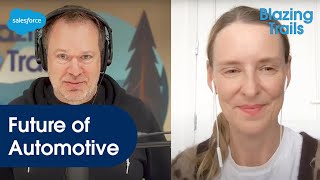
A Salesforce Studios Blazing Trails interview discussing the automotive industry’s digital transformation: shift from product- to customer-centric models, electrification, data-driven customer journeys, and the launch of Salesforce Automotive Cloud to help manufacturers, dealers, and finance partners unify data and personalize experiences. Guests include Harold Krueger (former BMW CEO) and Jessica Goettner (Salesforce VP).
Questions this video answers
Harold Krueger — former chairman and CEO of BMW and member of the Salesforce Advisory Board; Jessica Goettner — Vice President of Strategic Customers at Salesforce (auto industry).
California will not permit the sale of new gas-powered cars by 2035.
Chapters
Welcome back to Blazing Trails. I'm your host, Michael Revo from Salesforce Studios. The automotive industry is in the midst of a historical digital transformation. Today's vehicles are computers on wheels, and customers who used to shop exclusively in the showroom can complete transactions online. And now companies must navigate this uncertain terrain while balancing profitability with research and development and environmental initiatives. So to understand how companies will navigate this and talk about the launch of Salesforce's automotive cloud, I'm joined by my guest today. Harold Krueger is the former chairman and CEO of BMW and a member of the Salesforce Advisory board. And Jessica Goettner is vice president of strategic customers at Salesforce focused on the auto industry. Welcome to the show, Harold and Jessica.
Thanks for having us. It's a pleasure to be here. Early morning here in San Francisco, Harold.
I wanted to kick it off with you and talk about the major shifts that are driving change in the relationship between customers and the automotive industry. Give us a state of the industry.
Right now that's probably first of all, one of the most exciting times in the automotive industry ever since many, many years, or for the last 10 years at least, we have a couple of shifts. There's not just one shift only. There's a digital transformation. There's a transformation from combustion engines to electric vehicles. So maybe first of all, starting with the digitalization in terms of, in automotive, we have been always very product orientated, very product driven. We like products, we like to drive sheer driving pleasure. And now we need to focus much more on the customer side, on the moving from car centric to customer centricity. And this is a big game changer in terms of understanding the customer in detail, knowing what he or she would like to have. So that's the one change. The other one is a much more personalized experience. There are so many touch points in the customer journey where you interact with a customer and you interact with a brand. And also the brand management is now a lot of the brand management is done in digital channels. Then from a consumer model more to the focus on the customer, really. And then for sure, the sustainability, the climate change, the combustion engine as something which will be maybe transitioned to completely electric vehicles in the future. It's a major change as well. So customer side, consumer side, technology side, data business, and then geostrategic challenges as well as supply restrictions. So there's a lot of things going on, I would say, but it's the most exciting time ever I had in my life.
Yeah, it's fantastic. I mean, Jessica, you've Been working closely in the industry for a long time and working on this launch of automotive cloud. Can you tell me a little bit maybe digging into this relationship between consumers and car companies and how that's changing?
Yeah, if we look back, the car companies have been in reality selling their cars to dealers and the dealers hold the relationship to the customer. And if you ask everyone, by the way, answers, up until now, we own the customer. But to be honest, the customer is the one who has the choice. And I think that is exactly what is happening right now. This choice of the customer is driving that change quite fast. So if we're looking what is really happening, we all have been through a major pandemic right now. So everyone was ordering T shirts and technology and solar panels for houses from the couch. And of course everyone wants to do the same now for cars. So customers want it simple and they want to have that comfort of shopping a car from the couch because they have learned that it's possible.
And Harold, what's the impact on the sort of go to market strategy for auto companies now with this shift? What sort of adjustments do they need to make to reach these customers and create the experience that they want?
It's a real transformation, as Jessica described it. It's not something which you just move on and continue what you did and adjust and flexible. It's a major transformation and change. Why? Many automotive companies have done the dealer business in terms of a wholesale company. So they were selling the cars to the dealers. The dealer had the direct contact with the customer, the channels. And besides some own retail big outlet stores which many OEMs have in big cities like New York or San Francisco or other parts of the world. But the retail orientation is a completely different interaction and data set and knowledge and how to do retail compared how to do wholesale. First step, second one is what do you do with the data? How do you make sure that you have a perfect brand image, a perfect customer journey at all touch points so controlling. Then the digital journey, the journey where you have all touch points if it's after sales, if it's new car sales, if it's the used car market. So there are several touch points where the customer would like to have a sequence, seamless experience, everything mobile, everything available at every time. So and before it was going into a dealership, shopping a car, taking the car and getting out again and driving home. And that is significant. So data, business data driven business data decision making and turning all touch points into a huge brand experience into a very satisfying customer journey that you're creating fans of the brand, really fans of the product.
That's a huge challenge when you think about that. It's true not just in the automotive industry, this is true across the board where companies, the relationship between the dealer, so to speak, or the retailers and the manufacturers is changing so much. Can you talk about maybe Jessica, can you talk about how that relationship is changing and what that data circle looks like between the manufacturer and the dealer and the customer and how Salesforce is thinking about that?
I tried to break that down and make it a little bit more simple because in reality that process is tremendously complex because there's so many stakeholders involved in meeting the customer along that journey. So maybe breaking it down into the shopping, the owning and maybe the loyalty part and thinking about renewing maybe that brand loyalty, how Harold has just phrased it, if we just think about the consideration phase, there are many things that really play into that for a customer. A car is the second most valuable item in most of the families. So after the house, there's a car. So price and what the family situation is is really playing into that decision making process. And if we think about data, that was the second question. It must be easy and convenient for the customer to either be able to check it mobile or have a really good and customized experience on the configurator to really change on the go based on the customer's preferences. And ideally, once it's handed over either to an agent, which is the new direct sales model, or to a dealer, that dealer shouldn't start from scratch. They should know what Harold or I, if we are buying a new car, have been interested in. And ideally, if I had been interested in a silver convertible, they know already about it. But the reality, as I said, is complex. There are rights and rules and responsibilities to hand over that data. I as a customer have to give my consent. And all that has to be managed across. In the reality today, different systems, it's not yet a single source of truth. What that does to a customer is it breaks the experience and that means it's getting complex and maybe frustrating. So those brands who can get their act together across all those stages and across all those data sources they have and make it easy for me and they make me feel welcome, they win me over. Maybe it's not the price alone that makes the race in the future.
Yeah. And maybe building on this, Michael, to give you one example, what is in the future in demand in Europe you have a lot of cars being ordered and delivered with special options. Customers go into the dealership and would like to order the car. They sign the contract, they are happy and then it takes five to six, seven, eight weeks, sometimes longer until the car is delivered. And you can offer to customers, for example, transparency on the manufacturing process. Where is your car? Is it already painted in the body and the paint shop? Is it already at the assembly? Is it finishing the final assembly line and all that information. If you personalize this journey, if you send a picture out of the car leaving the assembly line and going on truck for transportation, this is something where the customer is excited about and has transparency on the supply chain and where his or her car is coming and arriving quite soon. So these touch points, for example, in loyalizing the customer, exciting the customers, is possible in a digital, totally connected world where you use the data and then can maybe give a very valid forecast. Your car will arrive via shipment in three days and it's at the dealer for delivery on Sunday or on Monday next week. And this type of relationship even establish a personal relationship between the brand, the oem, the automotive industry and the customer.
Jessica, talk to me a little bit about that in terms of how you see manufacturers building in this relationship in newer cars and electric cars as they're going to be here in California by 2035. You're not going to be able to buy a gas powered car. So what's that going to do to the customer relationship and expectation?
I think you're absolutely right. Those cars won't be in the workshop that much. So what do you do to keep the relationship up? So, so you have to be able to personalize. What does that mean? You have to understand what the customer wants on the one hand side, but even more importantly, you have to understand what is in the vehicle the customer drives, what's up there? Which kind of subscription services is the customer using? Is he a long haul driver? Does he use the city? Where and when does he charge? Oh, is he driving the weekend off the state? Does he know which charging infrastructure he or she can use? Do we want to pre inform a customer about that? Is that a service that a customer would appreciate? Those kind of personalized interactions? Because you do understand customer behavior and you understand what kind of journey the vehicle is going through. And combining that intelligently, maybe even with artificial intelligence to help the to streamline those interactions not too much, but also enough in the right channel at the right time. This is I think, the discipline that everyone needs in the future to build meaningful relationships with their customers because they have to be built new with those cars to come.
Yeah, So I mean this is really part of where automotive cloud fits in our new product. And so you've been working on this with industry, with our own teams and the development of the product. So tell me a little bit about what you've learned and some of those learnings and what we're building to help with this transformation.
I think you wrapped it up nicely already. We are not doing this alone. We might have excellent software engineers within Salesforce, but what we want to do here is build a product for the customer, but together with the experts from the industry. So we have been working super closely with those manufacturers around the world because Harold pointed it out earlier. There are regional differences in the buying behavior, in the ownership expectations and also in what's needed. But we didn't stop there. It wasn't just the auto carmaker. We went down the path with the captive finances to understand how their process is changing, what kind of a role they're taking on. And we also made sure that we really did understand understand what the dealer's future role and current role is, what they struggle, what they would need from us. So the product we're bringing to market is a product we have co created and what we are doing here is we're just launching here. So what our vision about that product is that we will learn together and we want to have it designed for and with the industry because with all those things in front of them, talent research, new education, new workshops, new technologies, new customer expectations, change to a new sales model. We thought we have to do one thing, we have to make it hassle free and easy with a data model that suits the industry and that's scalable and really helping them to make their business easier for them.
Michael and from my perspective, to sum it up, it's about a win win partnership with a system partner. Win win partnership with system partners, which are huge strategic partners. You drive together innovations, you challenge each other, you try to create a win win for both partners. You invest into strategic frameworks and learn from each other. And learning quickly at speed is a competitive advantage. And that's how I see it really in creating and designing, creating value for our customers in a win win partnership, driving innovations and making their businesses more successful and more profitable and more customer orientated. That's what we are targeting.
Harold, I'd love your example of informing the customer during this period where they're going to get annoyed waiting for their car. But instead you turn that into kind of a delightful experience. What are some of the other use cases that we're Thinking about with, with.
Automotive cloud, just one example in the past we had, as I mentioned before, data silos from financial services, new car sales and after sales. And assuming, for example, the idea the customer, he or she comes up to after sales to service a car, you should know from one single source of truth. Maybe if the car is in the workshop for one day, what test drive you can offer for that one day to have a new customer experience. And maybe adjusting already the new car which you offer for test drive to your personal needs, liking this color, this leather interior, this special options, this seat adjustment. And if you would have one single source of truth across all three divisions, you could make maybe the perfect offer for the test drive. And maybe the next car, new car sales would be driven by this one and he or she would buy it. So just combining these ones and going across these three silos which exist in the present as well as in the past, this is also a benefit for new business models.
And just that idea of making it easy for all those different people who are interacting with the customer along the way. Can you talk to me a little bit about this growth mindset and some of the techniques, the leadership that you've thought about in running a big organization to move forward and win?
That's a very good question. And it's a permanent leadership task. I call it the magic triangle. Yeah, it's one, it's having a clear strategy with clear focus and priorities and execution, execution of the strategy. The second point, equally important, they are not in an order. They are all three equally important. It's people, It's a people business. Leading people, leading teams. Explaining the vision, explaining, explaining the targets. You need to identify clear targets where you measure success on if you fail. So clear targets, getting people aligned, explaining the transformation, explaining what do they need to expect, how they are supported. But it's a people business, definitely leading people, leading human beings to be successful. And the third one, you need also to focus on operational excellence. Because the small quick steps, this big transformation we talked about in the US is not something which you can do with one step. You need to put slice the elephant into pieces, into four to six months success stories and adjustments and flexibility. And then something happens which you didn't expect as we experienced all with COVID or with a geostrategic situation. So putting it into slices. So it's a magic triangle of strategy, people and operational excellence. And It's a permanent 24 hour task I would call it, but it's also a nice one because you're leading people you're leading to the future. You're excited about the future and you have always in many, many companies, great people who can do the job and they would like to win.
I just want to thank you both for being here today. Jessica, thanks for joining us.
Thank you, Michael.
Okay, wonderful. And Harald, thank you for joining us today.
No, thank you very much, Michael. And next time we are driving together car and you know which one Y.
Absolutely. That would be amazing. I bet you you can get some pretty special vehicles that you might have access to that I don't. So I'll take you up on that if we're in person. That was Harold Krueger, former chairman and CEO of BMW and a member of the Salesforce Advisory board. And Jessica Goettner, vice president of strategic customers at Salesforce focused on the auto industry. So to learn more about Salesforce, head over to salesforce.com customer360 and be sure to subscribe to Blazing Trails on your favor favorite podcast app or on our YouTube channel where our interviews are now on video.









