The Future of Brand and Fashion: A Fireside Chat with John Varvatos | Salesforce
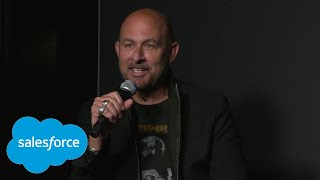
A recorded fireside chat hosted by Salesforce during New York Fashion Week (Sept 11, 2019) featuring John Varvatos with moderator Shannon Duffy and Salesforce SVP John Strang. Varvatos recounts rescuing the former CBGB venue and turning it into a combined retail/music space, explains music as a core influence on his brand identity, tells the origin story of the boxer-brief from his time at Calvin Klein, and discusses risk-taking, technology's role in brand evolution, and philanthropy. The event is livestreamed (large online audience) and framed by Salesforce as part of its engagement with retail and fashion partners.
Questions this video answers
Over 250,000 people online (host said 'over 250,000 people that are watching us online right now').
Over 150 artists performed there over the last 11–12 years (speaker said 'over 150 artists perform here over the last 11 or 12 years').
Around 2000 (speaker: 'when I started the company in 2000').
1990 (speaker: 'I joined Calvin Klein in 1990').
Chapters
Good evening. Welcome on behalf of Salesforce. My name is John Strang and I am the senior vice president General manager for the retail and consumer goods industry. We are fired up to be here tonight. I mean, here, like, look at this place. Isn't this incredible? Let's hear it for this place. We are super appreciative for being allowed to be here. John Varvatos and the whole team setting this all up has been amazing. And we, Salesforce, are super excited to be here for a whole bunch of reasons. One, just being here. Two is the whole New York Fashion Week. This is kind of the.
Yeah, Woo hoo.
This is cool kids club. This is our first but definitely not our last splash event. We are super excited to be here because of you, because of our retail and fashion partners. So thank you, thank you for being here, being a part of it. New York Fashion Week, what an iconic event. It's one of those things that I think has always been looked to as a place where top designers would unveil product and really be able to tell their story. But increasingly it's changing. And we saw this this year as we started seeing great brands begin to tell their story not just in the context of a Runway show or presentation, but they're actually doing it in the context of See now, Buy now, right as Ralph Lauren started, as you saw that come with Tommy Hilfiger or the way in which they're starting to take a look at it in a little different context, AR VR. Right. Augmented reality. So as they're walking down the Runway to be able to see it from a whole other dimension, or Rebecca Minkoff, who's doing something with actually Internet of things IoT technologies to be able to get after it, or some of the ones that are near and dear to our heart in terms of getting after rag and bone, doing amazing stuff with artificial intelligence and actually vision search, being able to really take that to the next level and personalize at scale. As we're seeing these happen, you realize the evolution that's going on from an industry standpoint. And as that evolution happens, we want to be there with you. We don't design leather jackets or cool shoes. That's not what we do. But we do do this. We do the technology, we do try to enable you as our partners to really be able to take it to that next level, as does our host here tonight. From overall kickoff, I want to get out of the way here and turn this over to obviously an icon and John Varvatus, international fashion designer, and Shannon Duffy, who's The SVP of product marketing for Salesforce. So please give him a nice, warm welcome.
Hello, everyone. Thank you so much for coming. It's great to see you all. And I also want to give a shout out to the over 250,000 people that are watching us online right now.
Crazy shit. Crazy, right?
I know. We're like, people want to see. All right. So I just have to stop and hopefully those of you online can see this. This is an incredible space. The former cb. How do I say it? Cb.
Cbgb.
Cbgb. Which is a New York landmark, an iconic space, and I'm overwhelmed with how gorgeous it is and how sort of the ethos of the punk rock bands from the past just come through. But I believe there's a story about how you took a risk and you saved this place and made it into the John Varvatis story. Do you want to tell us a little bit about that?
Sure.
I guess it's about 11 years ago, maybe 12 years ago, I came over to the neighborhood to meet with someone who was trying to get me to do a club with them. Not in this space. And this was the former home of CBGB's Music Club that had been here for, I guess around 40 years, 35 years, and had been closed for over 2 years when I came upon the club, I had gone. I started going to CBs in the 70s when I late 70s, when I was in college in Michigan. And I drive over with friends for the weekend. And it was a very different neighborhood than it is today. There were cars burning at the end of the block and graffiti everywhere, every subway. The city was really under siege at that time, which I felt was exciting. I loved all the grit. But here we are 11, 12 years ago, and I was in the neighborhood and the gentleman that I was with said that he had taken a 30 year lease on this building. And I asked him what he was planning on doing with it, and he said he was talking with one of the big drugstore groups. I'm trying not to mention any names, but it was Duane Reade. And also a restaurant group and then one of the big banks, bank of America. And I thought really that something as iconic what this space represented to the world and to so many hundreds of thousands, probably millions of people over time that had gone to shows, thousands and thousands of shows there over the years was going to turn into something like that. So I asked if I could walk into the space. And when I walked in, there was no lights on. So he had to scramble to find the. There was A box up at the front. And one light bulb at the front was hanging there. And there was one in the back, just raw lights hanging. No track light like this or anything. And smelled terrible in here.
Smells much better now.
Yeah. We walked through, and when we got to the basement, the stairway. I noticed that there was quite a bit of sewage floating around in the basement level. So that's why it smelled so bad. And then I thought I saw Cujo running by and. But long story short, that night I went home and I thought about this place. And I thought, like, how does that turn into a bank or a drugstore? You know? And on the other end, you know, turning it into a fashion store is at the right thing as well. But what I thought we could do with this space that night I kind of laid in bed and thought about it was, could we keep this space? Could we keep the music alive in the Bowery? Could we keep the soul of it? We weren't trying to make it CBGB's. That was never an intent in my mind, but that was really it. So that night, I kind of came to the conclusion that there was something there. I talked to him. I can make this story very short. I talked to my team. I brought them down here on a field trip. They all walked around, held their nose, and didn't really think it was a very good idea. The neighborhood at that point in time, this is 11, 12 years ago. Was what they considered underdeveloped. There wasn't any retail over here. The new museum hadn't opened up. The Bowery Hotel had just opened up. And there was no. There was nothing happening here during the day. But I kind of felt like we needed to do something different. My team was trying to get me to open up another store. We had one in soho here. And they were trying to get me to open up another one over on the. On the west side. And I wasn't interested in the Meatpacking district. I felt like it was something that everybody was going to do. And. And now when I look at it today, I'm glad we didn't do it. Because it's not successful over there at this point in time. But it was one of those things that I made the kind of. I had to make the decision myself because the team didn't support me. That this was the right thing to do and that we could create something. And I think they didn't support me because they couldn't see through my words what we could create here. Because it didn't look like this. It was Very dark and dreary and smelly when we walked in here. But I knew that there was a soul here. And we tried to keep as much of the heart and soul of what was here along the way. And we've done. We've had over 150 artists perform here over the last 11 or 12 years, which has been really exciting. And some of the most iconic artists in history have performed here, like Guns N Roses and Kiss and Gary Clark Jr. From New Artists to iconic artists. And they all felt like something was still, still brewing, that the walls were still talking to them. So, yeah, I guess it was a risk, but it was one that we luckily paid off for us.
Yeah, it's amazing. It's definitely a risk. And we call that salesforce being a trailblazer. And I think it definitely paid off. So talk to me a little bit more about music and how that's influenced your design, your partnerships, clearly in this space.
You know, when I started the company in 2000, so we're approaching our 20 year anniversary right now, I never thought about music being an integral part of the brand at all. It was an integral part of my life. It was my family of music. Those were the things that were most important to me. And that was probably the way it was since I was a young kid. And as a kid, it was even sometimes more important to me than when you lose sight of things in my family. But once I got the brand going, I mean, first of all, there was a part of my own DNA and my soul that was connected with music. And so there was those. That was the inspiration for a lot of what I did. But I didn't think about it when I was just doing it. It was things that I that had inspired me over the years that were part of my design process on the early days. But I guess around 2005, I was thinking about our advertising that we had been doing and we had won awards for what I would describe as kind of beautiful, romantic advertising. But when I picked up like a Vogue magazine or at the time of GQ or whatever, I saw a lot of beautiful, romantic advertising. And I thought, like what? We need to stand out and separate ourselves. We need to own something. And the one thing that I knew for the first four or five years of our business is that a lot of musicians loved what we did. And so I decided to take a stand and kind of own a space where we would take iconic artists that were rebels because I felt like what we were doing was rebellious and that they were rebels in their Own genre, some of them created genres. People like Iggy Pop, who there was really. There wasn't really punk before Iggy. He's the Godfather, for sure. Or Alice Cooper was a shock, you know, was a shock rock kind of guy. There were. Every one of them was, you know, every. Every artist that we had was a rebel in their own spirit. And so from that point in time, it became part of our DNA. And we've done some amazing campaigns over the years. Every year, we do multiple campaigns with artists. And the unusual thing is that we don't pay millions of dollars to have these artists be in our campaigns. They really want to be in the campaign. And it really becomes a mutual. Both a mutual benefit, but also a mutual admiration society on both sides of it. That really makes it exciting.
And so your brand is so strong. Like, when I think of your brand, I think of sort of this rocker, amazing music vibe. You've also worked for some amazing brands and built brands for folks like Calvin Klein. How do you keep brands relevant? Like, what's your inspiration for that?
Well, I think part of that has to be in your makeup, for sure, where you're never satisfied. Because I think if you're satisfied and you stop and you think everything's good, you're going to get lost. Especially in today's world, everything's moving so quickly. When I think back 20 years ago, when we started, you know, there wasn't E Commerce. Just think about that. So in 2000, there wasn't really any E commerce of any consequence. I mean, there really. There wasn't. There was no fashion brands online. So and the communication, you know, when we would do a Runway show in 2000 through, I'm going to say until, you know, I have an iPhone in my pocket until that came out. And what is it, 10 years ago, how many years ago? 10 years ago, until this thing changed the world, you know, we would. We would load up videos online of our shows and we'd edit them and load them up. And now before we can even do that, everybody, there's thousands and tens of thousands in the first hour of posts already from our Runway shows and reposts and all that type of thing. And somebody asked me today about how our brand was doing in Middle east versus New York. And I said, you know, it's almost the same everywhere in the world today because everything is instantaneous at this moment. And everything's changed so much so that the information, the way we all gather information, the way we get information has changed so much. And I think that that's probably the thing that drives me the most, is never standing still, loving change. Like, I work with so many people. Some of them love change, and some of them just look at me when I come in the room like, oh, my God, what's gonna happen now? Type of thing. Because I think change is what's exciting, you know? And I, you know, I have three children. One of them doesn't like change at all, and the other two like change. The one that doesn't like change is, you know, that's just part of his DNA for sure, the comfort level of the security of the things being consistent in that. But I find, like, in fashion, it's moving so quickly. We need to move. And I like the idea of constantly shaking shit up. I guess I like it.
So technology, you mentioned sort of technology. So technology is driving a lot of this change. So what are your thoughts on how brands can harness. Harness technology, how they can use it to really build their brand?
It's funny from a designer point of view, what, even 10 years ago, when you would talk to people about technology, what their perspective was on it, because we were very analog at the time. If, you know, music at all, there's analog and digital, and we were very analog. We were still very vinyl, although vinyls come back in a strong way, and no one really wanted to change. Change that much or accept those type of things. And it's funny that I look at your question in a way today and say that whole aspect of it's become a sexy part of what we do. If anybody ever would have talked about the way we communicate or the whole science of our business as being sexy. But it really is, because if you use it the right way, it's a really dynamic force in terms of what you do. It's not just gathering information. It's really all about your messaging.
It's definitely connecting with customers. Right. In a completely different way. Yeah. Okay, so you mentioned sexy, and I just have to say that when I was preparing for this, I found out that you created the most iconic piece of menswear ever, like, in the history of menswear. And that is the boxer brief. Right. And you may or may not have done a campaign with Mark Wahlberg that might have been.
It's called Marky Mark.
Yeah, Marky Mark back then. So I just. Can you tell us the backstory of that, please?
It's, you know, it's a. It's a story that's, you know, gone through a lot of changes over time. I don't even know what the real story is. But the real story, as I remember it, was that I was at Calvin Klein in the early 90s when I joined Calvin Klein in 1990, and he wanted to take. He's another guy who loves change. And he hired me to take over his men's business and kind of recreate men's for him. So he basically shut down everything that he was doing in menswear except for underwear. And his underwear business was very small. It had gone from a growth period in the probably, I guess in the 80s, early 80s to mid-80s, to be a big business to. It had. As the rest of his business had shrunk a lot. And so he came and he said, first thing I want you to do is to start a collection business, a designer business again. I want to be at the top end of the business in men's. So we started Calvin Klein Collection, and then at the same time, we started something called ck. So that was a baby that I kind of got my arms around as well. And then he wanted a lot, and he wanted us also to kind of reinvent the underwear. And nothing happens on your own. I'm working with a team of people. We're in a fitting. I collected a bunch of vintage long johns and things for little details, waistband details, stitching details and that. And we had a fit model, and we had those things on. And I'm like, let's cut the legs off of it and just see what the way it looks. And let's cut it off even shorter. Let's look at it. Because we were down at the knee, and all of a sudden you're like, there's something there. There could be something there. So we made a prototype. Needed some corrections. We made another prototype, and it was. It felt like there was something unbelievable in front of us. And we asked Calvin to come into the meeting, and he got very excited about it, unbelievably excited about it for many, many reasons. And he had a friend of his in the office that day that was David Geffen, who was very connected. He's a music mogul, very connected in Hollywood and that type of thing. And because of music. He suggested that this was an unbelievable idea that we had and that we should talk to Marky Mark, Mark Wahlberg about. He was in the Funky Bunch. I bet you very many of you can't tell us what the big songs were, though.
Good Vibrations.
Okay, there you go. That's funky of you and that. Long story short, he came in. He was a kid, kind of a. I'd hate to say it because I know him, but pimple face kind of kid and he was only 6, 17 years old and he came in and put those boxer briefs on. And the next thing is kind of history after that. I mean, we shot him and we flew banners across the Hamptons with him up on the banners with airplanes pulling them and he was in every magazine. And all of a sudden this little $30 million business a couple years later was a $300 million business and today's a multi billion dollar business just in the underwear.
So.
And I think a lot of that was kind of spawned from that moment in time.
Yeah, I mean, I think it's amazing because you took a risk and I mean you've changed everything from my 8 year old son to my 50 year old husband. I mean, everyone wears boxer briefs.
The guys here are wearing boxer briefs.
Don't be shy.
Oh, look at that. Let's see the ones that aren't. Pull your pants on, I want to see what you're wearing.
What's truly amazing about this, John, from the boxer brief to saving this historic amazing place, is your ability to be a trailblazer and take risks. And so what advice would you give for someone who may be timid or maybe looking to make big moves like you have in your career?
I don't know. You know, I think that, you know, the one thing I've always said, I use the term be a sponge. I feel like when I first got into this business I wanted to be a sponge about everything. I wanted to know about everything. I wanted to be involved in everything. And you know, like everybody, you, if you don't push yourself out in front sometime, which I was at the time was a super. I would consider myself quite shy, but I knew that I wanted to really learn and I think so it's starting with that. And I think that in today's world, if you don't take risk, you don't win. I think that's. If you think of the biggest. Forget about what genre you're in. You don't have to be in fashion, whatever you do. The biggest winners out there and what I call the rebels. You know, it's interesting, about three years ago we. Instead of doing, when you talk about Fashion Week, instead of doing a show during Fashion Week, we decided to do something really left field. And we boarded up the whole front of this store and we put spray painted post no bills on it. And down the front of it we dropped a 40 foot banner that was about 25ft wide, about the width of the store that said rock is dead with a big question mark on it. And you know, the next day everybody, the New York Post, everybody thought we closed our store, like, you know, after a certain amount of time, like rock is dead, like it doesn't work anymore. But it was really a call to arms for me to say, like, where's the rebels today out there, you know, in the world? Where's the Steve Jobs? Where's the. It doesn't have to be rock and rollers, rock and roll. You know, rock for me has always been about rebels. It doesn't matter if it's a music thing. It's more about that spirit. And you know, that day, I, you know, I. It was really telling the story of, you know, pushing the walls out, being a rebel, doing something different. So we, we turned this into what we call JV's fun house. And we, we took everything out of here. We created multiple worlds all over the store with multiple music sections. And it was one of the most talked about shows we've ever done and probably one of the most heralded shows of that season. And it wasn't a Runway show at all. It was an experiential adventure through here. But more than anything, it was celebrating the opportunity to be a rebel, to push the walls out. So for me, we were challenging people to do that because I've been thinking about it since that period of time and it was just prior to the. At the time there was. In the running for the office at the time was Trump, Bernie Sanders and Hillary Clinton. So they were the three kind of going down to the finals there, because this was January of or February, early February of three years ago, I guess.
Right.
And I was inside asking myself, like, who are those rebels? Like, I don't see it in those three people. Even though there might be things I like about individuals, I don't see them as being that rebel spirit that we really need that are gonna excuse my expression, but I use it all the time, shake shit up and make a difference out there. So I think part of it has to be within you and you have to release it. And part of it is you have to dig deep within yourself. Like I did when I was that shy kid, even when I was in my later 20s. And I decided that I had to if I was going to be successful. I had to kind of reinvent my thought process. Not myself as a person, but my thought process and how I approached everything. And I think that it's hard to give someone the direction without you looking at yourself in the mirror. And I think that. That what you really have to do is you have to look at yourself in the mirror and say, what do I want to be? What do I want to say? And am I really saying it? Am I really doing it? Because I think, you know, when I left Ralph Lauren in 1999, it took me about five months to actually leave. I told him I was going to leave, and he didn't really take it seriously. And I love the guy. So it was really. It was like leaving your parents or something. It was really a difficult thing. And finally I sat down in his office and. And I said, we have to. We have to come up with a date. I have to. I have to get going here. And he said, okay, if. I'll let. I'll let you go. I'll give you my blessing if you can tell me that you really believe in your heart of hearts that you really have something new to say. And I didn't have long to think about it. And I said, you know, you've given me another five months to really realize that I. I really do have something. But I clearly said. I clearly believed in my heart and soul. And you have to know and believe it or have. Or to. Your question about risk or you have to be willing to take that risk to do it. And probably the thing as my mentor, Ralph being one of my mentors, that I probably enjoy the most is when I see him and he tells me, you're doing it. And I know what he means by it. He means that he said that I'm doing what I said I was going to do. I'm not doing Ralph Junior. I don't have. This doesn't look anything like Ralph Lauren. Like, I had a vision to do something on my own, and I'm doing it. And I think that that's. And I will tell you that in this period of time over the last 19 years, there's a. I call it the never ending winding river. Because there's lots of ups and downs and successes and failures along the way. But you keep driving, you keep paddling, whatever it is, swimming, whatever you're doing. And in this world, that changes daily, too. So I think it's really about always being. You know, just setting a course. And probably that course could be. How I describe it sometime, is that I always knew I wanted to go to California. This isn't necessarily the truth, but just as a kind of a spirit. I never knew that I was going to have to go up through Canada, then down through the south and wind around like I thought it was a clear. You took Route 66 all the way there. In business, I never really realized that it would take you through so many twists and turns and they're still twisting and turning. And you know what? Most of it I love, that's great.
And I love the risk taking. It's really, it comes through in the brand in a really powerful way. So last question for you. At Salesforce, we believe businesses platform of change. We believe in philanthropy, we believe in taking risks. And I know you have some similarities there. Can you talk to us a little bit about that?
In which one of those? All of those. Yeah, you know, sure. Business of change. I mean, I think again as we said earlier, if we're standing still with our business or we think that the consumer, both your past, present and future, think the way you thought when you started your business or the way you even thought yesterday. If you get yourself locked into getting comfortable with something, you're in the wrong place because everything's moving so quickly today. So the change part we've talked about and I love that aspect of it, I think there's the philanthropy part of it is something that I think is something I grew up with. I, I grew up in a very humble way in Detroit. We didn't even know what fashion was in Detroit. I mean I got my clothes, I'm not exaggerating all the way through the time I was into junior high at Sears, so we didn't really know. My parents bought my clothes at Sears so we didn't really have any money. There was seven of us in a little 8, 900 square foot house with one bathroom. So we didn't know from that. But the one thing I knew from my parents is they always cared about other people. And I saw it with my grandfather who came over in the first world war and didn't speak English but came to America and immediately he signed up for the US army and went back to fight for the US in the first world war in Germany. And he spoke no English or anything. But long story short, when he came back, he knew how to speak English, he knew how to read, he kind of self taught. But he was sending money back to his whatever little he could make. He was sending back to his family in Greece which where he was from because he had come over from Greece. And so my parents always told me that story and my parents always worked with people who needed things with it, whether it was, you know, it doesn't, wasn't always a charity, but it could be like working with mentally retarded children, whatever it is as we knew when we were kids, we were always knowing that we had to. We weren't being forced to it, but we were always being exposed to giving back and doing different things. So I think part of it is in your upbringing, for sure. And a great thing I can say about my company is that it's part of the DNA and soul of our organization that they love that we get involved in giving back in many different ways and we constantly looking at those things and it's part of our daily existence, I guess, is that, you know, just like you receive a paycheck and everybody works hard to get that, we also think about what, you know, what can we do in communities that we have stores in, including New York, that type of thing to give back to the community.
Thank you, John. This has been amazing. Thank you for letting us into your home, your store.
You're welcome anytime.
This might have been one of the coolest things I've ever done in my career. So thank you for making my Tuesday night. Thank you for everyone watching online and for those of you in the room, the bar is still open. Please enjoy this amazing space and thank you all for coming.
Yes. And thanks to Salesforce for bringing this into our space here. We don't do this really. We don't really bring things like this into here. We do our own parties, but we usually don't join somebody else in their event. And I think that there's something, you know, they help us power our site and our communication to our customer, which I find it's everything today, that communication level. And I felt like it would be an interesting way to kind of share our thoughts together on that. So thank you guys.









