The Future of Generative AI ft. Anthropic, Cohere, & Salesforce | Part 2
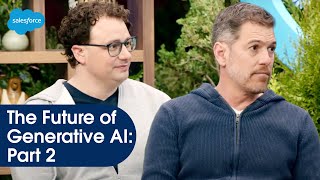
Clara Shy from Salesforce talks with Martin Kahn at Cohere and Dario Amadai at Anthropic about the future of generative AI. Anthropic focuses on safety and reducing hallucinations through Constitutional AI. Cohere emphasizes enterprise performance and combining retrieval with generation so AI answers questions accurately about private company data.
Chapters
You.
It's great to be back with all of you. I'm Clara Shy, CEO of Service Cloud. I'm here at the Trailblazer DX event in San Francisco with Martin Kahn from Cohere and Dario Amadai from Anthropic. Welcome and congratulations on the Salesforce Ventures Generative AI Fund investment that we announced yesterday. Welcome to the ecosystem and to the community.
Thank you.
Thank you, Clara.
So I have a few questions for you. You know, we announced Einstein GPT yesterday as combining our proprietary Salesforce AI models with an ecosystem of vetted Generative AI partners, of which both of your companies have developed some of the leading solutions on the market. Could you share what are the most important considerations as you've built your foundational models? And how are you each thinking about how to differentiate your offering in this space? Dario, maybe you want to start and then we can go to Martin.
Yeah. So I think both on the side of us as builders and on the side of the developers who are developing on top, on the side of customers, things around reliability, safety and trust are often paramount. We're at the point where these models, as the world has seen, are very capable. But the concern is, are they predictable? Do they do what people expect them to do? And there are a few different areas. One is there's this problem of hallucinations where models will sometimes just make things up out of whole cloth. One of the things we've worked on a lot is reducing that problem and making models more reliable. Another problem is making sure that what models say is safe. They don't say something that's unsafe or embarrassing. So we work very hard to reduce that on the model side. And then it's important to do that on the side of the application as well. And then in terms of transparency and predictability, we have a method called Constitutional AI where you can write a series of rules that you want your AI to follow and then train it to follow those rules, which is more predictable than previous, previous methods for training these models. And so we found both on our side and on the customer side, that those things help to integrate applications and give enterprises more confidence that the model, as powerful as it is, will also do what they expect and want it to to do.
Thank you for that, Martin.
Yeah, I think that's.
Those are.
Those are great points, Daria, that you made. I think at Cohere, we are very, very focused on how these incredible models, technologies can enable every developer, every enterprise to create real business value. So we've spent a lot of time that's certainly Where I've been spending a lot of my time understanding what business leaders, enterprises, what they really, really need and some of the things that we found. First of all of course is performance. I think there's a very small number of companies in the world that have the capabilities. Two of the independent ones are here to create a real large language model capability. Most are captive to big tech companies. Having an independent company that is able to have performance that's at the top of the charts is important. Stanford Helm In a recent evaluation, our base models outperformed all others that are publicly available.
Outperformed in what dimension? I'm curious?
The Stanford Helm results, that's the sort of the. I think there's 57 different dimensions that are measured and it's sort of a compound rating that then all the different models are run through to have a sort of consistent comparison across them all. Obviously how they perform in enterprise is more important. The second though is cloud agnosticity. We're available on GCP, we're now on AWS, SageMaker, we're in discussions with every other cloud provider to be available on all clouds, including on PREM and bpc. We think it's important we hear from enterprises that the models go where the data is and where they're comfortable having the data and not the other way around of bring your data to my models. And that's something that we have heard is very, very important indeed. And I think the third is that the team that they work with is not only the best modeling team and can build incredible models that are very important, but also has a team that understands how to deploy this kind of technology at massive scale in the most demanding, in the most advanced and sophisticated enterprises in the world. So we've got our engineering team, product business people who really understand how to build and run multi billion dollar businesses, which is ultimately what our enterprise customers are doing. And we want to know what they need to deploy these at scale, not just as a demo or in a lab.
Well, and on that note, this week we've been talking about Einstein GPT, including Einstein GPT for sales, helping salespeople compose email drafts to send to prospects. Einstein GPT for service to help agents more quickly and accurately respond to inbound chats and emails around support issues as well as Einstein GPT for marketing to dynamically generate landing pages, both the text and the images that if we focus on those CRM use cases. I'm curious what excites you most about CRM combining with generative AI Dario?
Yeah, I mean I think it's the creativity, right. And for many of these applications, it's valuable to have an application where you can have a human in the loop. So using these models, where you can have the model generate some ideas, human may or may not like it. They can generate again. So, you know, having the models serve as thought partners for the, you know, whether they're generating marketing copy or sales or anything like that.
I like that metaphor of having a thought partner, you know, a friend who's, who's there to work with you. And of course, you know, we believe very strongly in human in the loop, both for the accuracy and safety aspects, but also to help with the ongoing reinforcement, learning from human feedback. So that's terrific. Martin.
Yeah, I think this is an incredibly exciting field. I think I would say that this is maybe we haven't seen something like this since 2007 when the iPhone came out, before that, maybe 93 when Mosaic browser came out, that this conversational way of interacting with computers is really the way that consumers and employees will demand to interface with the Internet, with their employer, with their service providers. We do talk a lot about generative AI, and many of the use cases you mentioned are about generative. One of the areas that we are equally or sometimes even more excited about is on the embedding side. And so embeddings is another type of model that enables, enables semantic search, contextual search or classification across an enormous corpus where you, you know, similar to what you're used to in Google on the open Internet, we've cohere has a semantic or, sorry, an embeddings model that enables that kind of semantic contextual search across 109 languages. And some of the applications there we're hearing from enterprise customers in the C suite are really exciting. So in your CRM example, imagine if you could say what's the latest state of our relationship with Company X? It can go and look for different chat records through video chat, transcripts from customer call or CRM databases, or Slack channels where it's been discussed. And maybe someone in Japan has been discussing, in a Japanese Slack channel, someone in Germany has been discussing that all of that information is able to be found and retrieved, summarized, and then used to make better decisions. And I think that when you think about the quite challenging state of enterprise search inside an enterprise compared to what we're used to out in the public Internet with Google, Bing and others, the breakthrough there and the value that can create for enterprises is going to be absolutely immense. And so we are bringing together the embeddings semantic search together with the generative models to enable conversational search again across 100 aligned languages, all different alphabets, et cetera. And that's really exciting to business leaders.
It's just incredible. And we're going to hear more from our Tableau team on that very soon. There's tremendous potential and we think about these large proprietary, business outcome focused data sets that live inside of every enterprise and just being able to bring that together in a secure and ethically responsible way, it is really exciting. Okay, so we're at this conference this week with lots of trailblazer developers from all around the world. What do you think is the biggest opportunity for every developer watching this? Maybe we'll start with you, Martin.
Well, I think I would start with thinking about embeddings and some of the capabilities and applications of those alongside Generative. A lot of the buzz has come around copywriting or summarization. So those things which are really quite exciting, chatbots, the sort of virtual agents and so on, I think combining those capabilities is where it gets really, really exciting, especially for some of the global companies that you count as many of.
Your for understanding as well as for output.
Exactly. And I think if you. The interface, I think we do agree that is going to be a conversational interface. You want to say find me the you know what's the contract expiry of company X and you want to make sure that that information is correct. The base model itself may not know that a new contract renewal or extension was signed three days ago because it was trained a week ago, a month ago, two months ago. That's where you want to make sure that the language model will actually use search and retrieval capabilities or retrieval augmented generation to go and get the right data. So for us, safety is also about preventing misinformation and making sure that the right information is being found in whatever language it may be retrieved and then used to provide the answer to the question, to the command that was given. So I think for developers to think about how do I bring these together? That's where there's just some really, really breakthrough, groundbreaking innovations that we believe is going to be the future of how I will interact with my company going forward, you with yours, through the enormous knowledge base internally and ultimately be able to take action on that externally and how customers will be able to also interact with their service providers. So that would be my first. The second point that I would say is you mentioned data on data. We think data protection is extremely important for enterprise enterprises. Don't want to be wedded to one cloud. They don't want to have to ship their data to someone else to do something and then give them the results. They want to make sure that the data residency, the location, if it's in their vpc, it's protected, it is safe. None of the competitors get access to it. Base models aren't trained on their data and then to the benefit of other people. And that's something that we've been putting a huge amount of thought to. And really, one of the core tenants of how we serve enterprise, that's a.
Big part of what's made Salesforce successful, also makes complete sense. Dario, what is your message to the millions of developers out there?
Yeah, so I'll give kind of a broad message and maybe a more specific answer. So, I mean, I think the broad message is, you know, we're seeing across customers that for every one application of a model that anthropic deploys, there's 100 where the model could be applied, but no one has applied it yet. Maybe within the same company, within many different companies, but we see lots of cases of models being used for something relatively narrow. And if the right people talk to the right people, it could be used for something much broader. So there's this very large overhang, which is a very exciting time for developers because it's a time to hunt for and find those opportunities. So there's, you know, I can't think of a. I can't think of a more exciting time when there's more overhang in the technology, even if its capabilities never improved and they're improving very, very, very, very rapidly. So I can't think of a more exciting time for people developing on top of these technologies. My more specific answers, I mean, one is just, just in agreement with Martin. I think the whole idea, you know, when you look at conversational agents, they're trained on a lot of general data, but they don't know the data of your specific organization. Right. I would love to be able to say in Slack or something, say, you know, Claude or, you know, whatever, whatever other model, you know, summarize, summarize. You know, these 10 documents that, you know, that my company wrote, you know, look, look over and answer this natural language question about, you know, what are the company's policies on X, Y and Z? And I don't, I don't know where. I don't know where they are. So I think there's, there's so much potential to kind of build into those, those private sources of data and data lakes and of Course, the developers not retaining that data is also, is also, is also very important. I specifically wanted to say developers should also look for, you know, applications that really concretely make people's lives better. You know, something I'm really excited about is in the biomedical and medical record space, right, there's so much unstructured medical data. People have been trying to read it with NLP for so long. But you know, this new generation of models offers a new opportunity to do that. I think customer, customer service is another area like that. We're working with a company called Robin AI that works on reading legal contracts and helping people to understand legal contracts and so things that concretely make people's lives better. There's so many opportunities for things like that.
I love that. I mean, of course the baseline is to do no harm, but there's such an opportunity for us to do better than that and not only do no harm, but actually think about some of humanity's biggest challenges and problems and challenge ourselves to use these latest technologies and AI to solve them. I love that. All right, so we have just a couple minutes left. Let me close with this question. It's been top of mind in the news, I think probably overblown, but there's, there's kernels of, of concern here that we want to be thoughtful about. Kind of to your point, generative AI advances are playing out amid an ongoing concern, pre existing concern that AI will affect jobs. How do you think about this issue of AI and jobs, Martin?
Yeah, I think actually it comes back to the point you made before this. And Darya, your point about making people's lives better and easier. The analogy I use is when, unfortunately I think I am old enough to remember this, but when spreadsheet programs came out, bankers didn't lose their jobs. When word processing technology came out, writers didn't lose their jobs. What it enabled them to do was get rid of some of the lower value add parts of what they do and really focus on the higher value added parts. And that's what I think we can do here as well by finding information more quickly, by summarizing things, pulling things together and being able to focus on the higher order parts of our jobs. I think it'll be a really fantastic transformation evolution that will enable us to do better work and do it in.
A better way so we'll all up level. So in that example that you gave, what, what those bankers had to do was they had to learn how to use Excel and learn all those macros. What is the key skill that today's knowledge workers need to learn.
Well, I think going forward, one of our co founders had this quote where the programming language of the future is going to be English or going to be language if it's English for me or it's Korean for someone else, that you can actually just use language to interact with computers. And so I think it's more thinking about what is the problem you want to solve, what, what is the value that solving this problem will create and then how to use these tools, these applications that are being developed by companies like ours, working with companies like yours to then do the higher order up leveling to solve even bigger and better problems.
Well, Martin, Dario, thank you both so much for being with us. I'm so excited about partnering with both of your companies and look forward to a successful future together with our customers and developers.
Likewise. Thanks for having us.
Thanks for having us.









