The Future of Generative AI ft. OpenAI & Salesforce | Part 1
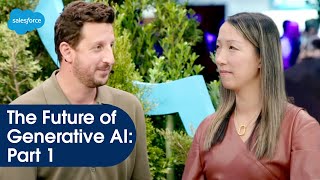
Zach Kass from OpenAI talks about the partnership with Salesforce on Einstein GPT. They cover how AI augments work like contract review and cooking, why rapid model updates create trust challenges, and how customer service productivity could shift.
Chapters
Well, hi everyone, it is so exciting to be here with you from Trailblazer dx, our event in San Francisco. I'm here today with Zach Kass, he is the head of Go to market at OpenAI. As you may have heard, we announced a partnership with OpenAI yesterday as our initial launch partner in the Einstein GPT ecosystem. Now of course, ChatGPT has become a household name since its launch in late November. Even my 85 year old neighbor knows about ChatGPT. Zach, I just want to take a step back and you think about all these waves of technology disruption that have happened every five or 10 years, whether it's mobile or the rise of Internet search or it's cloud computing. Do you see any parallels about where we are today with AI with what happened in the past?
Yeah, I think obviously yes, anytime the paradigm shifts, people will draw comparisons to another time that the paradigm shifted. And I think it's pretty natural at this point to say let's look back at cloud, let's look back at the Internet, let's look back at the iPhone. I think the trap obviously is that you can do too much of that and then the square peg and the round hole situation comes up. But what we're seeing at least on the customer side, is that people are treating this like the advent of a paradigm shifting technology and companies big and small are rebuilding their roadmap sort of overnight to incorporate this technology, I think in a lot of ways like they did when the cloud came about.
Well, you're building out this huge ecosystem of your own. What is the coolest thing you've seen so far other than Einstein GPT?
Yeah, well, so I'll say, I think there are two things that are happening that are very magical sort of broadly with OpenAI. The first is augmentation. So this idea that people who are doing their jobs are suddenly able to do their jobs more effectively without the pain that comes from their job. And if you and I were, to be honest, there's a lot of our job day to day that we just don't like. And it's associated with the TPS report style work that just exists in our lives. And we're seeing a lot of companies start to automate that work out of their employees lives and that's really exciting. Examples of this include companies like Ironclad who are building contract management software and sort of magically helping lawyers identify problem problematic statements in contracts and actually prompting them with suggestions for opposing counsel, which lets the lawyers, instead of spending their day just poring through rote Documents actually start to really focus on the critical thinking and look on the ChatGPT side. I am blown away by the number of people who walk up to me at this point in airports practically to tell me about how it's changed their life. And recently I met a chef who said that he was struggling to make ends meet last year because the amount of work it took to actually build his business was so great compared to the amount of time he actually spent cooking. And he said, Look, ChatGPT actually changed my life because when a client emails me now and says, these are the things I want, instead of me spending four hours putting together a menu, I can put ingredients into ChatGPT along with some dietary restrictions, and then send them back what ends up being a beautiful menu that the client can sort of fiddle with on their own. And he was like, look, I can run a business again.
That's awesome.
It's amazing when that happens.
Yeah, that is. I love that story. Now, I also want to ask on the other side of this, I mean, we've all heard about when things go wrong. We heard about Sydney, what scares you about generative AI?
So I'll start by saying I think the Sydney example and examples like IT are actually really important moments where the market, the public gets to see how well aligned the institutions are that are building this technology. And the response from Microsoft was swift and impressive. And I think it should not go lost on anyone. How quickly Microsoft responded to what they identified was really bizarre behavior in the model. That being said, it's a really good thing that Twitter exists because we're basically, no one is going to be able to hide behind this technology. If something weird is happening, the world is going to know about it. And I think thanks to OpenAI's iterative approach to deployment, thanks to our partnership with Microsoft, what we're going to see is a lot of actors have to sort of update their models in real time based on feedback from the public. Admittedly, I think trust and safety and responsible deployment of AI remains the most important thing that OpenAI can think about. And frankly, it's sort of front and center for even our customers. There's work that we say no to because it doesn't actually suit us.
Can you share an example?
Well, I'm sure you can guess of enterprises who we might not be able to work with, but in the case of a business like Salesforce, you are so interested in making sure that the models behave appropriately. You're a perfectly aligned actor. And I think as long as we continue to partner with companies that want to deploy this technology safely and responsibly, we will iteratively introduce the world to what's really a really magical technology. And then as long as we identify the things that aren't working fast and update them quickly, like what happened with Bing, I mean I think that's the most effective way to roll this technology out.
Well and of course I think that was the excitement around yesterday. And I mean that's also the difference between Bing and the consumer world. And there's just much more risks when it's an open ended consumer use case for versus a very business specific use case that we talked about with Einstein GPT. So let's drill into that. I mean, you know I'm very passionate about customer service and I know you are too. How do you see our partnership and generative AI more broadly changing the customer service and support industry?
Well, so when you came, when we met two years ago and what service cloud has sort of imagined the world looking like, I think is like fast happening and a world in which agents, support agents, service people, can access a much richer catalog of information about a client or a customer, suddenly that customer's experience improves massively. And so ultimately I think what we're about to see is both the improvement of quality of life in a support agent or in someone in the field who suddenly has better access to information, better suggestions of how to manage complex situations. Because everything happens in the margins, right. 90% of calls are fine. And then you experience one and you're like what do I do here? And to be able to help those agents in real time is going to be really powerful. And then you're going to see all these companies start to report massive improvements in their NPS score and they're going to point back to Einstein GPT and say look, this experience is making our customers lives better and our employees lives better. And I think it's going to be pretty magical.
It's really about boosting the customer service agents productivity and then also delivering a better tailored experience for customers. Yeah, that makes, I'm very excited about that too. I really share that enthusiasm. As you continue to evolve GPT 3.5 and the highly anticipated next versions of that, what are the most important considerations? To the extent that you can share that, that you and the team are.
Looking into trust and safety and alignment remain probably the A1 and A2.
What does alignment mean?
Yeah, alignment is a technical scientific term, but it's this idea that the model is aligned to the interests of a human and it's one thing for a robot to complete a task, but it's another thing for a robot to complete a task in such a way that doesn't violate laws. It doesn't make either of us, you know, uncomfortable or, you know, doesn't. Doesn't harm something in the process. And so, you know, everything we do comes from that place. Obviously, OpenAI is also interested in a multimodal future. And you'll start seeing us actually start, you know, building models that, that, that can do a lot more things that humans can do.
Such as?
Well, you can imagine a world where, you know, not only can a model draw an image, but maybe it can interpret that image as well. You can imagine a world where a model can not only hear someone talk, but also respond as well.
Very, very interesting. Well, thank you, Zach, so much for joining us. For those of you who missed it, we announced Einstein GPT yesterday. My favorite product, of course I'm biased, is Einstein GPT for service. Combining ecosystem of partners, including OpenAI, with Salesforce's proprietary AI models to help agents respond to customer issues much more quickly and service teams to learn and get smarter with every interaction. Thank you so much for joining us.
Thanks so much, Clara. We're so excited for this.









