The Future of Travel & Hospitality Industry w/ Marriott President | Blazing Trails | Salesforce
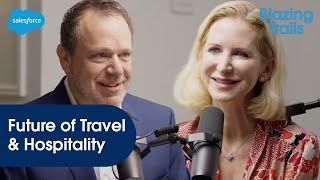
Interview with Stephanie Linartz, President of Marriott International, about the travel industry’s rebound after COVID-19, Marriott’s digital transformation centered on the Marriott Bonvoy loyalty platform, sustainability and procurement efforts to reduce emissions and food waste, and the Bridging the Gap program to increase diverse hotel ownership. Linartz gives concrete metrics on the pandemic impact and recovery, describes technology and data use (mobile check‑in, two‑way chat via Salesforce) to personalize guest experiences, and summarizes corporate targets and incentives (net‑zero by 2050; $50M program funding).
Chapters
Don't wait to book that holiday travel because Stephanie Linarz, the president of Marriott International, says that travel is back and it's busier than ever. I'm Michael Revo, host of Blazing Trails, and I sat down with Stephanie at the Fortune Most Powerful Women's Summit this year and started out by asking her, what's the state of the travel industry?
All right, Stephanie, thanks so much for joining us.
Thanks for having me, Michael. Great to be here.
What's happening right now in the travel industry? What are you seeing?
So a little bit about Marriott. So we are across many segments and in many parts of the world. And when I think about what happened to travel in 2020, it was quite devastating. I mean, the sector business was just wiped out overnight. In the second quarter of 2020, Marriott's business was down over 90% globally. In an instant, 25% of our hotels were completely shuttered and closed. 80 plus percent of our associates were either laid furloughed. I mean, it was absolutely devastating, very, very difficult times for anyone in the travel tourism service sector. But that was then. And as we Fast forward to 2022 and even beginning in the latter part of 20 and into 21, but certainly in this year 2022, travel has come roaring back. As a matter of fact, in the second quarter of this year, 2022, so just two years later, Marriott had one of the best quarters the company has ever had. So all around the world, with a few exceptions like China and Japan, our hotels are full, our occupancy levels are nearing 2019 levels, which was a peak, rates are actually above 2019 levels. And across all business segments, leisure has certainly exploded. But also business travel has come back in a big way. Groups and meetings. So it is really amazing to see the resilience of travel. And I think it just underscores the point that human beings need to be together and as cool as zoom and teams and all these tools are that we've all gotten so familiar with and thank God we had them during the pandemic in particular, it doesn't replace meeting with people face to face, it simply doesn't. So things are very, very bright right now. And yeah, so it's really good to see so most importantly, so many of our people, not just in my company but across the sector, back to work.
Yeah, absolutely. I mean, so take me back to that time when you had this huge disruption, this huge change. So, you know, when you wake up each morning at that time, how do you think about how to manage that situation, how to keep your team motivated how to help the organization. Tell me about that.
We really, in those early days were just focused on doing what we could to help the communities in which our hotels did business and the people who were traveling be safe and secure. We also, you know, use the opportunity to kind of supercharge some of our technology efforts and to double down in investing, which may sound strange in the middle of a pandemic when times were quite dire, but it was a really, we rolled out mobile check in and checkout at an even faster clip because people didn't want to go to the front desk and see people. They wanted to do everything on their phone. And if they ordered room service, they wanted to do it via the app, the Marriott Bonvoy app, not calling and having a human being come to their door. So we actually supercharged our investment in technology at the very same time.
Yeah, I mean, it's interesting you talk about that because, you know, I was in prepping for the interview, I saw you say that Bonvoy is really at the heart of your strategy right now in this digital transformation and what that's going to mean for employee experience, for customer experience. Tell me a little bit about what you're doing there.
So Marriott Bonvoy, as I mentioned, is our loyalty platform member. Thank you.
Our viewers and listeners are as well.
And thanks to everyone listening for your business and loyalty. We're very grateful. So we have 170 million members globally and growing, and it really is the heart of our customer strategy. With 30 brands, it's a lot for people to absorb 30 different brands. Again, I mentioned everything from Ritz Carlton to, you know, a Fairfield Inn or a Moxie at the less expensive end of the spectrum.
Right.
But I often think about Marriott Bonvoy as the vessel for all of our brands. It's the way we pull them together for our consumers. And we've also, over the past number of years, been building out other adjacent businesses that are part of Bonvoy. So, for example, in 2019, we launched our Homes and Villas by Marriott International Premium Luxury home rental product. 90% of the people who are using our, you know, mini version of Airbnb or vrbo, if you will, are our Bonvoy members. And so it's a way to both earn points and redeem points. So the theory being give us all of your hotel business stay at a Ritz Carlton or St. Regis for your, you know, romantic weekend with your significant other or special event, and perhaps you're staying at a courtyard for your child's, you know, soccer Tournament, to use just one example. So you're giving us all your hotel business, but then you take those points and you redeem for a fabulous villa in Tuscany. Through homes and villas, we're building out a lot of different travel and travel related offerings for our consumers, all connected through Marriott Bonvoy. So again, it's the vessel or it's the connective tissue of the way we bring all of our offerings to our consumers.
And you know, we think a lot about at Salesforce this relationship with the customer. Right. That's at the core of Salesforce's business. And so what are you learning about customers? How are you using that data? How are you with this now with this very direct connection And I think it's so interesting that your business is at the intersection of both the IRL in real life experiences at all the properties and then this digital experience as well. How are you learning about customers and using that information?
So when you stay in our properties and particularly if you're a Marriott Bonvoy member and you've shared your data with us, everything is always done with permission from the consumer. You've shared the data with us about your preferences, you only like feather pillows, you like this kind of, you know, cappuccino, you like, et cetera, et cetera. When you share that data with us, we should be able to have it in the hands of a front desk associate or someone in one of our restaurants so that they can. Because we know you, right, we can deliver a highly personalized experience and often surprise and delight you. Right, with something that, you know, maybe you didn't anticipate we were going to have waiting for you in your room. And you know, I mentioned earlier the Marriott Bonvoy app. This idea of using the, the app to interact with the hotel. Besides mobile check in and mobile checkout and F and B ordering on your phone, we also allow two way chat, again enabled by our partnership with Salesforce, so that before you're even coming to our property, you can, you know, perhaps text the concierge and you know, ask for some help with some, you know, restaurant reservations. It's again, just one example, but I do think it's the mix of digital and physical coming together to enhance the guest experience is where the magic happens. So it's both are equally important. I always, I like the expression high tech and high touch. They're not mutually exclusive. I think they're inextricably linked.
Yeah, I mean the idea is really to make that so seamless where those experiences feel the same whether it's physical or digital.
Yeah, I couldn't agree more. I always say data driven, tech enabled, human centered.
So I want to get back to brand, which we've been talking about a lot. And with 30 brands and 8100 hotels, how do you look at sort of keeping those brands true to each of their values to not confusing that and look at the brand strategy of how you're going to market with such a big portfolio.
Again, in terms of brands and our business, it's really three things. It's first of all the physical product. Right. Each brand has a very distinct design aesthetic. Right. And on the luxury end, each hotel is a little bit more bespoke and design for the location. Some of our lower tier brands, like a Courtyard by Marriott or in a loft by a loft property would have a more common approach from a design perspective across the country or the globe. But so the physical manifestation. And so for example, Ritz Carlton and St. Regis in many ways play in the same space, but they have some very distinct things. That comes to part two of the brand position, which is about the programming and the servicing. The depth and breadth of brands is really important. And size and scale matters in today's day and age. Right, because size and scale gives us the ability to invest more in technology, amongst other things, and to grow. So I really am excited about all of our brands. I think they're all great, of course, we love all our children and they're all an important part of Bonvoy.
I mean, I'm just trying to imagine. So let's say you're doing a review of the brands. I mean, do you go into a big conference room and look at all the different brands and get a sense of, okay, how are they all playing together? It's sort of, you know, at the scale of the business you're operating, not only from a brand perspective, but across the board. How are you able to get a great view of what's going on?
Well, we look at a lot of data. You know, we do a lot of site visits and actually look at the data, look at the physical product, but we look at a lot of data. You know, we have a very robust guest satisfaction survey. And I say survey in quotes because we do have, you know, an online survey, but we also do mystery shops and we do a lot of kind of looking at what people are saying about our brands and social Media, of course, TripAdvisor, our own website, et cetera, to name just a few. I mean, there's a million different ways we gain insights On Instagram, et cetera, you know, on what people are saying about our hotels and how they're experiencing them. So we, you know, when we're kind of looking at how we're doing, like how our brands are performing, what's resonating, what's not resonating, we look at a host of different data points to kind of figure out how to tweak things if need be. We do a lot of experimentation and innovation. We just opened a fantastic new corporate headquarters in Bethesda, Maryland, and we have thousands of square feet of innovation space where we will. It's physical space where we will build out sample rooms, for example, and we will experiment with. If you move the wall, we'll build a hotel room out of foam core. And we'll say if we move the wall six inches this way, it feels differently. So we experiment at our innovation lab and at our hotel next to see how can we tweak the brand, how can we change the brand, how can we test something? Live in the wild, if you will.
Right.
There's nothing like real live guest feedback, you know, when people can tell us, you know, it sounds so small, but things like, are the. Are the plugs in the right space? Right. You know, I mean, it's the, you know, the details matter.
Yeah.
And so we do. We do a lot of nitty gritty, detailed work to make sure that our hotels are terrific.
Yeah, I love that. I mean, as part of my career, I worked as an interaction designer. It was in digital space, not physical as much, but it's. All those details do matter. They add up.
For sure. They do.
Changing topics a little bit to sustainability. We did an episode a while back with Denise Naguib, who's fabulous. Sustainability.
Yeah, she's on my team. She's a wonderful, wonderful executive and very committed to this space.
And we had a great conversation and one of the really interesting things we talked about was in the procurement process. So this is sort of behind the scenes, and it was such an interesting idea to me of how this can drive so much change, that as a consumer, you're not really seeing this is all happening behind the scenes. Tell me a little bit more about how you're approaching that.
Well, certainly. I mean, you know, Marriott has always had a core value that we need to be good global citizens and contributors to the communities in which we do business. And part of that is really caring about the environment. You know, we are very committed. We signed up for net zero emissions by 2050 or sooner. We're doing a ton of things in our hotels to make sure that we hit those goals. A big part of the problem is food waste. You know, 50% of the garbage in a hotel is food waste. That is a major contributor to greenhouse gases.
Right. As you back out that whole process to create that food.
Well, we're also. It gets back to data tech, and we're kind of using data and technology to say what's selling on buffets. Right. Only put out what people are buying. Right. Composting, like where we've. We have a whole host of tools to help the hotels get a handle on food waste. When we roll those out to our hotels, we see their food waste go down by 50%. So that's one example.
And that's a win for them, I'm assuming, in terms of their cost.
It's a win on multiple fronts. Right. But Denise, I know, talked a lot about the RFP process, and I believe what she was referring to is when we go out to our big Corpor corporate accounts every year, Salesforce, for example, or Accenture or Deloitte or McKinsey or BCG or whomever. Right. Our customers want to give their business to. To companies that are hitting goals that tie to their goals. Right. So they are demanding that we're able to tell them what the environmental impact of the. Their employees stays are at our hotels. So we have to be able to track it. Right, Right. And so Denise is talking about a lot of the tools that our hotels are using to track the data that's necessary for us to give to our corporate clients so that they pick our hotels. And I do believe that both consumers and associates are going to continue to care about this more and more. I believe consumers are increasingly going to vote with their wallet. They're going to give their business to customers or, pardon me, to partners, to companies that care about this. And associates want to work for companies that care about this.
Right. And I think that measurement story, you know, if you can't measure it, you can't act on it. So that measurement story, what gets measured gets done. Exactly. And when every company needs to have that measurement and share that data, that's where you can really get that snowball effect of everybody acting on it.
Absolutely. And so I'm quite. I'm quite optimistic, as hard as it's going to be. And I know some days it feels like, you know, two steps forward and three back, but increasingly I feel like it's three steps forward and only one back. Right. In terms of, like, moving the ball down the field and making progress. In this area. So Marriott International is very committed to do our part to, again, help save our beautiful earth.
Yeah, absolutely. Okay. The last thing I wanted to chat about is the Bridging the Gap program that I read about, which is really looking to address barriers to entry and hotel ownership for historically underrepresented groups. Tell me a little bit more about this effort.
Right. Of course, we're very focused on diverse associates, focused on getting diverse customers into our hotels. But we need diverse owners and franchisees too. So we launched a program called Bridging the Gap to bridge the gap. And we have at this point dedicated $50 million in incentives and we'll invest more as the program, you know, continues to roll out and grow. And that means that without getting into the weeds too much, if you're going to want to do a hotel deal with us, Marriott will give you, you know, 500k or a million dollars in seed money towards the deal, or we'll help you with deal terms to make them more amenable, to help you get off the ground. Really important too. We can do our small part, but our CFO and our team is also working with the banks and the financial institutions to get the debt lined up. Right. Right. So it's not just Marriott giving you some seed money. You gotta have the financial institutions helping you to get that all sorted out for your deal.
Okay. I said that was the last question. But as we were talking, I had one more, which is that we're talking about capital, we're talking about growth. What do things look like? It's so uncertain right now. Are you seeing that change or. I mean, it's early days here a little bit. But what is it?
I think it is early days. You know, we are, everyone is talking about the outlook, what's going to happen later this year and next year. The R word. Right. You know, but so far, honestly, in our data and our bookings, we're not seeing a slowdown.
Yeah.
You know, I do think there's a couple important things to think about on the, on the positive side, even as if, you know, if you have the view, things are going to get tougher on the economic front, you know, unemployment said an all time low. There still is quite a bit of pent up demand for travel which I think is going to be around for a while. And savings, there's still a lot of savings from COVID But I think it gets back to the fundamental idea. People love travel.
Yeah.
People love to be with other people. And, and I'm super bullish that no matter what, that is going to continue to be a part of our lives. And again, I often say to my team if the bounce back from COVID does improve how resilient the travel industry is, I'm not quite sure what does.
Right, right. It's a big bounce back for sure.
Really, really quite positive. And again, most importantly to me the part that I'm most excited about is to see people working back in our hotels again, you know, back at work serving our customers and it's been great.
Well, this has been super interesting. I'm caught up a little bit on the travel business so thank you so much for joining us.
Thank you for having me Michael. It's been great. Appreciate it.
That was Stephanie Linartz, president of Marriott International. To hear and see more Blazing trails.
Interviews, be sure to subscribe right here.
On our Salesforce YouTube channel. I'm Michael Revo. Hope to see you next time.









