The Next Generation of Leaders with Dr. Valerie Smith - Ep2 | The Inflection Point | Salesforce
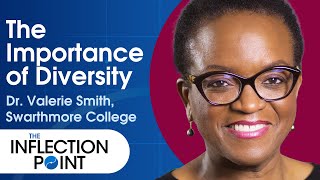
A recorded interview (The Inflection Point) between host Monica and Dr. Valerie Smith, president of Swarthmore College. Dr. Smith discusses her background (parents from segregated Charleston, raised in Brooklyn), formative influences (mentors, study abroad at Oxford), scholarship on Toni Morrison, leadership at Swarthmore since 2015 (diversity initiatives, need-blind admissions, emergency funds, "dinner with strangers"), civic engagement programs (voter-registration efforts, Tri-College collaborations, prison-education courses), and perspectives on racial injustice and the value of liberal arts education in preparing students for an uncertain, divided world.
Chapters
She's the eldest daughter of a schoolteacher and a biology professor.
We loved public libraries, loved museums.
Education is in her DNA.
It's sort of a family story.
Today, Dr. Valerie Smith is the president of Swarthmore College, ranked in the top three best liberal arts colleges in the nation by U.S. news & World Report.
Would I really say no to an opportunity like that?
At Swarthmore, she is attracting more low income and first generation students, innovating the curriculum and increasing diversity.
Their voices, their ideas, their perspectives are being heard.
Val is a renowned scholar of African American studies. Particularly relevant today as this country addresses issues of systemic racism and social justice.
We probably will have to change the rules.
I'm pleased to have the opportunity to talk with Val today. Val, it's a pleasure to welcome you to the inflection point.
Thank you, Monica. I'm so delighted to have this chance to speak with you today.
I wish we weren't here together on Zoom, but rather I would do your preferred form of meeting, a walking meeting. I know. And you really like to walk during your meetings?
Yes, I do. I really enjoy them. I find that I think more clearly when I'm moving, and I find that it's easier to engage with people when we're walking together, sort of side by side. So when I can do that, I enjoy it.
We call this show the Inflection point, because I find that everybody has some moment in their lives where they were changed, and it affects them from then on. What's that moment been for you, Val?
Well, you know, Monica, I feel as if I've had a number of them, but I think the most significant one was the moment when I made the decision in college to spend my junior year studying abroad in Oxford. And it was actually the first time that I had left the country. And it was actually the first time anyone in my family had left the country, except for my father's time in Europe during World War II. In fact, I had never been on an airplane even. But I'm sure I was more afraid than I allowed myself to believe. But I was struck by how quickly I made myself at home. And it taught me how adaptable I could be. And I think that it has given me the courage to make a number of other unanticipated decisions subsequently.
Okay, let's begin at your beginning. Your parents were both educators. They were born and raised in Charleston, South Carolina, and it was during Jim Crow segregation, and they went to segregated schools. Right. And what did they tell you about that time and experience? And how did their growing up affect you.
One of the lessons for me that stands out from the way they talked about that period in their lives is that even though they went to segregated schools that I'm sure had limited resources, they had really inspired dedicated teachers. So they came from families in which neither of their parents had finished middle school, but they both went to historically black colleges. And then as part of that sort of mid century wave of black migration, they migrated from South Carolina to New York, which is where they married and raised their family.
And so that's where you were born. When they went to New York and you were raised in Brooklyn. What was your childhood like in Brooklyn?
It was wonderful. I loved growing up in Brooklyn. And as you can well imagine, this was certainly before Brooklyn was fashionable in any way, but I loved it. I grew up in Bed Stuy and Williamsburg and was sort of early on introduced to a broad cultural diversity of people, of food, of talent and so on. And so it was a pretty exciting and wonderful place to grow up. I mean, that's sort of what I thought the world was. And so as I traveled to other parts of the country and discovered that that was pretty unusual.
It's such a rich cultural experience for you. But at the same time, you are very big on mentors. And I think it began because you had a great mentor in elementary school.
Yes, I did. And certainly before I knew the word or understood the concept, I benefited from extraordinary mentorship. So when I was a child in Brooklyn, my family and I attended Concord Baptist Church, which is a historically black historic congregation. We had an extraordinary pastor. His name was Gardner C. Taylor. His wife, Laura Scott Taylor, was the founder and principal of the elementary school that I attended. And she was that transformative mentor for me. She was elegant, she was brilliant, she was hard working, she was deeply spiritual. She was Phi Beta Kappa graduate of Oberlin, and she and I bonded. And she founded this school in Bed Stuy because she appreciated that this community lacked rigorous educational opportunities for young children. And she appreciated the importance of that strong foundation.
Did your parents then, because they're both educators, your parents were. And this mentor of yours is an. Did all of this kind of bake into you that that's what you wanted to be one day?
One would think so. You know, there's a way in which there's a kind of combination of purpose and serendipity that unfolds in my life, I think so. In other words, I loved literature. I just loved reading. But I don't know that I fully imagined or anticipated what my career would look like. And I think I was probably on the job market for the first time, looking at jobs and thinking about my career. And all of a sudden I thought, oh, my goodness, I'm following in my father's footsteps. I mean, it was kind of late in the day to realize that. And then the narrative began to make sense. And so I can certainly tell a story of how that purpose unfolded. But I have to admit that I kind of realized after the fact that that's what I was doing.
It's interesting, too, because as a child growing up, a book was my best friend. Do you know what I mean? I would love the bookmobile. Used to come to town in Knoxville, Tennessee. I would run to the bookmobile. I had to go pick out a book for the week or several books. It's just part of our DNA. And you then went on, though you didn't just teach, you actually wrote three books. I have one of them here. And you are something of an expert on Toni Morrison. And she was your colleague when you were at Princeton. She won a Pulitzer Prize, the Nobel Prize. And I did read some of the reviews that came out when your book was written, and they said this was a scholarly book, but written for a general audience. A fresh and insightful work. And it's based on your knowledge of Morrison's writings and your relationship with her as a colleague. Tell us a little bit about this book.
The book really grew out of my appreciation of Morrison's truly extraordinary talent. One of the things that I love so much about her work is that she is somebody who possesses the ability to bring profound historical knowledge to beautifully crafted narratives. But the books are so often about the impact of those historical processes and moments of social change on the lives of people who are often left behind or left out of historical accounts. And she also challenges us in terms of her knowledge of and ability to capture the breadth and depth of the movements through which we live. She was also an extraordinarily gifted teacher. As her colleague, I was able to observe the seriousness with which she approached her own teaching and just the impact she had on the lives of the young people with whom she worked.
Now, let's talk about today. Before you became the president of Swarthmore, you were a dean at Princeton. But when you came To Swarthmore in 2015, you gave an inaugural address that said something along the lines of, in college and life, diversity makes us better. How have you tried to put that into practice in your tenure as the president at Swarthmore?
So we have made extraordinary efforts to attract A broadly diverse constituency of students, students who represent all parts of the country, who come from all over the world, and students from a full range of. Of socioeconomic backgrounds. One of the ways in which we do that is by offering need blind admissions, which means that students are admitted to Swarthmore without regard to their financial need. And we only determine the financial aid package and assign a financial aid package to students after they've already been admitted. Secondly, we have made a commitment to ensuring that students from under resourced backgrounds have access to emergency funds should they need them. So if, for example, they arrive on campus and don't have winter clothing, we can make sure that they have that if they have to go home for a family emergency, there is emergency funding to support that. So these are all ways in which we try to make the experience more inclusive.
You've been president since 2015 and you've kind of fine tuned your leadership style. But one very cool thing about what you've done as a leader at Swarthmore is something that sounds very mysterious. Dinner with strangers.
So this is an idea that I was first introduced to when I was a faculty member at ucla. And the concept is that I or someone, some other member of the college community, will host a dinner. And we invite other people, generally from the college, but sometimes from the surrounding community, people who represent lots of different constituent groups to come together around a dinner table, meet each other and get to talk. So it's funny that you described it as sort of mysterious, because it's interesting to me that my guests often are a little nervous about who an escapron.
I can see why. Dinner with strangers and they don't know who's coming.
Right, exactly right. But then it's just wonderful to watch the chemistry unfold as they discover each other. And I just think it's a wonderful way of building connections among folks to help reinforce our understanding of what it means to be a community, of putting people in conversation with folks whose paths would not ordinarily cross theirs.
It sounds cool. And still mysterious, by the way. All right. As the president of one of the nation's top liberal arts colleges, you obviously believe in this model of education. But beyond the education itself, how does this prepare students for the kind of environment we're living in right now? Whether it's the deep divide, political, racial, otherwise in this country, the threats to our democracy, the need for innovation on climate, on other issues. How do you think this liberal arts education is a benefit to your students?
I firmly believe that the fundamental principles of a liberal arts education can really help benefit our nation and our global community in a variety of ways. Number one, it prepares students for the challenges of an uncertain world. I also think the liberal arts cultivates critical thinking, the ability to distinguish fact from fiction.
To mark strong, that's important. And also what you said about a very uncertain time we're living in, that's true, right?
And also it cultivates as well a respect for science and an appreciation of the meaning and usefulness of scientific evidence as we seek to make sense of our world. Part of the reason our institutions, an institution like Swarthmore, is committed to diversity and inclusion is because we believe we are preparing students to live and work and learn in a world that is populated by people who are very different from themselves racially, ethnically, politically, religiously. They need the capacity for empathy, the ability to listen deeply to the perspectives and the points of view of people with whom they may not agree, in order to be able to solve the challenges that face us. And, frankly, for us to create a more perfect union, we cannot continue down the path where we are. Where we are so deeply divided from each other, we are unable really to work together.
With Swarthmore, located just outside of Philadelphia, in the last year, you had a black man shot by police, and you are an expert and a scholar on African American studies. So I'd love to get your perspective on the issue of racial injustice, comparing it to the civil rights era versus where we are today. Have we made progress? Where are we?
I think it's very complex, Monica. There are ways in which we can see a positive, forward moving trajectory from the Jim Crow era through the civil rights era to the present. But at the same token, we also appreciate that we are seeing levels of inequality across virtually every metric, increasing across health care, across education, across housing. So while we can trace a forward moving path, we can also see that we have certain persistent problems that we have not yet been able to address and solve as a nation. For example, we are now seeing repeatedly efforts to invalidate the votes of so many people, including black people, yet again, and recognizing that that fight and that struggle remains with us. Right? And so I just think there's so much the past can teach us, but that we can never be complacent and believe that these issues are solved or resolved.
During this past election, in fact, Swarthmore came up with a real program to engage your students, to get them to take part in the democracy. And their most important thing in a democracy is to vote. Tell me what you all did at Swarthmore.
Sure. So, first of all, one thing we did is we recognized several years ago that our students were underrepresented in the roles of registered voters. And so we needed to start building that foundation in the off years, knowing that it would matter so much in the presidential election as well. So we wanted, first of all, to make sure that our students were educated about the value value of local elections and why their vote counts, even in the off years. So we've been doing things like getting students to register to vote when they arrive on campus during first year student orientation and subsequently finding plenty of other opportunities to make sure students are educated about where and how to register. Now, in the context of the pandemic, when we have about half of our students living elsewhere, we also needed to educate them about how to register and within their own home states.
Now, you have an important role right now, not just leading your campus and running this body of students and faculty, but when you assume the role at Swarthmore, you also assumed an important post for your region. Did you realize that when you took over? And why do you think it is that you are looked at as a leader for a whole community beyond the campus borders?
I did not appreciate that that would be the case when I took this role, but I am humbled and honored to find that that has turned out to be the case during this moment. Certainly in recent years, we have seen the convergence of multiple crises, and one of the crises has been a crisis of leadership. I have found that as president of an esteemed institution of higher learning, people in our community and beyond have turned to Swarthmore and schools like it for leadership, for a voice of what it means to live and work and serve in an ethical and principled way.
I think you couldn't have said that better. There are so many, so much evidence in polls showing that there is a crisis of leadership. And to have a top educator's voice right now is something that is a crucial input, I think, to people who are like, wondering, where are our leaders and what are they saying? But to get into the region and get into the spirit of leading your region, you are also getting very involved in in the Philly community and even went to a Phillies game right to. You're also having the students around their mentor in the community.
Swarthmore is part of a Tri College consortium along with Haverford of Bryn Mawr, which offers team taught courses that bring Haverford, Bryn Mawr and Swarthmore students together to study in Philly to use the city as a backdrop, as a canvas for understanding Issues, problems, challenges. So that has been, I think, a really exciting way of getting our students more involved in the city. Another program I'm really excited to talk about is a prison education program located at the State Correctional Institution in Chester, Pennsylvania. This class is taught half incarcerated students, half Swarthmore students. They work together for a semester, they read together, they share projects, and then they, at the end of the semester, will talk about what each group has learned from the class, from each other, from the association. I had the benefit of sitting in on the final class shortly after I arrived at Swarthmore. And I was almost moved to tears to hear some of the men say that this was the most rewarding academic experience they had had in their entire lives. So the idea that they had that experience while they were incarcerated speaks volumes about the failures of the educational system in so many ways. But it also says something about our commitment to partnerships in the region.
Now, as we wrap up, Val, I want to look to the future with you because you have the privilege and the responsibility to turn out some of the best and brightest of the next generation. So I would love for you to tell us, what do you see in this new generation?
What I see is intellectual curiosity. I see a capacity for innovation. There's that kind of can do spirit that so many of our students have. That is, for me, a complete joy and delight. I see often a profound spirit of empathy. I think that's something we really need to cultivate even more. I feel a lot of hope and confidence when I look at the next generation.
And that's why you come to work every day as the president of Swarthmore?
Absolutely, yes.
Thank you so much for joining us, Val. It's been a pleasure to hear your transformation yourself and how you're transforming a new generation at Swarthmore. Thank you so much.
Well, thank you, Monica. It was a pleasure to speak with you.
Join me. Next time on the Inflection Point. I'll chat with Jim Cramer of cnbc.
I mean, I was just gonna be.
A schmo, and somehow I had a shovel.
I crave attention, and I need you to tell me that you love me.
You do have a little crazy in you. It wasn't just Gene Hackman who told you to be crazy.
I'm not gonna disagree with that. Nor is my pharmacist. I'm a deeply flawed guy, Monica, but in the end, I'm quite positive about the country.









