Tiny Mic at Formula1 Miami
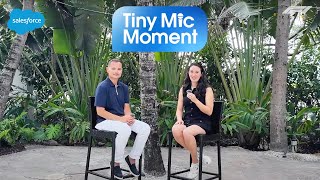
Ivy Wright and Bill Patterson from Salesforce talk AI strategy at the Formula 1 Miami race. They cover Agent Force, reskilling employees, and Data Cloud, plus how F1's real-time decision-making shapes their approach to AI adoption.
Chapters
Treat it like a day one every day the next great ideas are to come because we're going to enter with more curiosity and more exploration about what this technology could do for us.
Hi, everyone, my name is Ivy Wright with Salesforce and today I am joined.
By Bill Patterson, executive vice president and corporate strategy of Salesforce.
And we are coming at you live today from Miami, Florida. We are here for the F1 Miami race. You got to go to the track today. What was that like?
It was incredible. When you see the drivers that are just such incredible athletes and how they are putting their full body on the line behind these incredible muscle machines, my mind was blown. And as the cars went by, I just realized I am a terrible driver. Like I couldn't do any of that.
Oh my gosh. I know. We had an event last night which you and I were both at.
Yeah.
And they have simulators there. And I'm always like, I'm not doing this. I have played Mario Kart with my son. I am not. This is not my skill set. So, Bill, you own corporate strategy for Salesforce. I would love to know how you think about and combine like tried and true methods with new innovation, new tech. How do you make that powerful combination when you are thinking about your vision?
Yeah, well, I think first it starts with the vision. It's not about using technology for the sake of using technology. We use technology to help us achieve the visions that we're sort of putting ourselves into the world to sort of see and understand. And so my team, we do is we kind of sit and debate like where do we want to go? Where do we want to sort of take the company, take the technology, take the innovation for our markets. And sometimes this technology sort of folds into. Into view things like generative AI, when we were sort of first doing our forecasting was not even on the radar for many companies.
Oh, wow.
And it just became something that became so clear and so real that when you can use this technology to help, you know, inspire great interact or great communication, it became such a great answer for us to invest in. My team sort of looks at first the long view and then we sort of break that into short term horizons. And this horizon is right in front of us and it's one that we're capitalizing on totally.
We've been hearing so much about now is the time to experiment. So I would love to hear too if there's any experiments that your team is doing with AI agents.
Yes, we're using the tool every day. We use agent force to help us get data from all of our sales and customer interactions. We use partners like Google and Gemini to help sort of like, maybe ask questions and query ideas against. We use it this year to write our V2 mom, which is how we set our priorities for the year. And one of my favorite use cases is we wrote our strategy document down, said, you know, how are we going to kind of take on sort of this opportunity? What decisions do we need to make? What choices do we need to make? And then we asked the models to grade us. And our first strategy wasn't so good. And so we got graded very poorly. But what the AI was able to do is systematically break down our strategy into moments that, you know, it said, you know, this. Try to go deeper here, try and understand and probe for more clarity on this point. And it just became this constant, almost like colleague that we were interacting with to help enrich our strategy. So it was a real fun use case. Our team loved it. And I won't tell you the grade that we got now, but we feel pretty good about it.
I feel like it was probably a solid a.
Probably. I think it was actually a plus, to be honest.
Another thing that I have been hearing at events recently is about really investing in your team, training your team, getting them ready for kind of this new reality of work where we are fully working with digital labor, we're working with these AI agents. They're on our team. How are you thinking about that for your team? How are you getting them ready and making sure that they thrive in this new world of work?
Well, I think we've gone through moments of uncertainty and maybe moments of maybe seeking permission to use these tools at work that I think has been one of the areas that I've had to open up as a leader for our team. Just saying, hey, it's okay. In fact, I want you to use these tools really to, like I said, experiment and explore what they can do for you. And so I think the first time that, like, our team members open up the tool, it was like a little bit of guilt. Should we be using this? Is this cheating? Yeah, no, it's actually, you know, the. It's not so much the answer, it's the questions that you're asking it that really become the power and become the dynamic that you're sort of probing into, that these tools, like, enrich your own ideas with. And so we went through permission, we went through sort of acceptance, and now we sort of expect it. In fact, if you. You can see even team members in our meetings now when they don't have the tools they're like looking for like, almost like their safety blanket. So it's a real evolution for how we have to bring this into work in a safe and secure manner. I think it's also one that, you know, you can just see like when you give permission, the creativity starts to truly come through. And that's what I've enjoyed most, is seeing kind of that the evolution of team members on their journey for using these tools really to, you know, create better work product for our customers.
Yeah, totally. I know. One of my CMOs that I was talking with recently was saying that they made AI the default browser so their whole team just has to use it now. Yeah, which at first was like very like shocking for them, but then like the usage was just through the roof. They all understand it.
I just think this is such an incredible time for us to utilize these new tools for good.
Totally. How do you think that work is going to change in the next year or two? What do you see coming down the pipeline for your team?
Yeah, it's too early, I think, for us to sort of forecast way into the future for what, how much does work sort of change? I think I measure change in sort of smaller increments. I definitely see productivity increasing, you know, I definitely see maybe jobs sort of shifting a little bit, you know, for these moments. I've been fortunate enough in my career to see, you know, when technology comes in to the workplace, new kind of jobs get created. Like it wasn't too long ago there was no such thing called a social media manager, you know, in the, in marketing. And so when social media kind of entered into the fold, new jobs sort of arose. And so I think we're going to see new job types come into the workplace. I think jobs like, you know, training agents or being an agent sort of supervisor is a role that we're going to see enter into a lot of organizations. I do think when we see how works that are changed on a day to day basis, just like you had Google, you're going to be using AI models to sort of enrich your own ideas and not necessarily seeking information from others, it's going to bring out the best of what you can do.
Yeah, I can't wait for that. Bill, are there any new ideas that you've gotten from Formula One Miami, especially around AI?
Yeah, I was amazed with just this real time nature to how data is being generated at, you know, every moment, every tire, every turn, every technique is backed with data here. And so the ability for teams to Tap into this data in such a real time way to make decisions about when should we bring the driver in for the next pit is incredible. And these seconds matter like milliseconds matter. And so when you think about how data becomes the foundations for decisions, how getting access to that data in real time and putting it into a decisioning platform like an agent force, can help organizations with. This is the powerful moment that I think we need to be inspired by. Because when I travel around the world and meet with customers globally, they don't have access that data as ubiquitously as they might like. And so what I'm really sort of inspired by is how do we make every company in the world, every company on the planet, embrace their data just like they do here in Formula One?
Yeah. The other thing I'm hearing so much about though, is that it's this volume of data. It is so much data. And I know, like the companies that do have access to that, that's such a hurdle too, is like, I have so much data. What do I do with it now? What is your answer to that?
We're generating data almost as if it just like we generate oxygen. And I think that one of the things that organizations need to have is great strategies for managing that data. The volume, the velocity, the veracity of that data is really something that, you know, we've never seen before. This is why in this moment, technologies like data Cloud have been built for this moment to help organizations truly get a better handle on their data. Both, you know, structured data, which might come from streams and feeds of, from cars or even unstructured data, which is your documents, your communications, they need to be harmonized in new ways so that we can actually make better decisions. That I think is this moment. And I think that, you know, the AI is only as good as the data you feed it. And so this is why I think it's such a great symbiotic relationship between data cloud and agent Force.
I'd love to know also what has been inspiring you lately. It can be something from Formula One Miami. It can be something from work.
Well, you know, in this hyper moment in the explosion of technology, what I am so motivated by is how it's making us more humane. And I think that one of the customers that we spent a lot of time with at Salesforce is the Big Brother, Big Sister organization of America. And you would think that AI, you know, it's not always natural for how would that, you know, kind of infuse that relationship? Well, now what Big Brother, Big Sister America is doing is using agent Force, using Salesforce, using what they call their matching process to really link big brothers and little brothers like never before. Having better stories around interests or demographics or maybe areas of special care and need. They can actually match people together in new ways that I think is really enriching kind of the human spirit. I'm just so moved by stories like that. And there are thousands of them from customers that we're helping with today with these great technologies that I think are going to make us just better, you know, at being humane. And that's what really motivates me.
I love that, too. I feel like there is this kind of moment of where we're making more connections and community. And it's funny because it's like AI and tech that's doing that, which is kind of the opposite, I think, of what people expected.
Right. I think it's just. It's an incredible tool. It's a gift, I think, for all of us, you know, to live and work in this time, to use this tool. What separates us from the tool is that we have the ability to put our human spirit and human ideas behind it, to really, you know, kind of like you said, you know, create better community, create advocacy, create greater connection. And I think that is why I'm so proud to work at Salesforce, because that's what we stand for.
Me too. This is the dream team. Yeah. All right, Bill, on the flip side of this, though, what is keeping you up at night? What is stressing you out? What are you worried about right now?
Well, you know, I just got back from a visit to a few customers in Europe who maybe are a little bit more worried about what does AI do for their workforce and workforce complexion for the future. So I hosted a roundtable of leaders and executives who were really worried about the downside of what AI could do for jobs and labor. And it wasn't so much about the jobs and labor going away. It was the fear of jobs and labor going away that they're really, really worried about. Because, I mean, every day they're entertaining questions from longstanding professionals like, will I have a job? What will my work look like? Will it be fulfilling? And so I think part of the other kind of elements of creating such great opportunity, we also have to manage this new technology with care. And I think that that is what keeps me up at night. I have two teens are entering college. They ask me, like, dad, you know what should I go study? And my first answer is, boy, I really don't know. I don't know what labor will look like in five years from now. And so I'm encouraging them a little bit more on the humanities side of things just to get to the understanding of deeper meaning and deeper connection and deeper understanding of content. Because I do think that is going to be what separates us for the next labor that we're going to enter with.
Totally. I had such an aha moment the other day. I was talking with one of our C suite leaders and he was saying, you know, once these agents come in and they optimize everything, one thing that's going to happen is if your team doesn't need this much staff, you can actually take some of those staff, retrain them and go to a team that is struggling.
Yeah.
And it just was something that was like, duh, why didn't I think of that? Like, and I think we're going to see more of that restructuring, reskilling. And that's like such a great way.
To think about that for sure. The most important, you know, kind of word and reskill is skill. You need to have the skills to, to be dynamic and be adaptive and, and sort of to plot the journey as opposed to sort of follow the journey from here. And that's why, you know, we're really excited to see our trailblazers take on this new technology and bring it into the workplaces so they can do that experimentation and, and bring it in to sort of define what their futures look like.
Oh, totally. Do you have a favorite Salesforce tool, AI resource?
It starts, it ends, and it continues with Trailhead. Trailhead is absolutely my favorite Salesforce resource. I was not an expert in generative AI, so I went to Trailhead to take classes to learn, to challenge my sort of understanding, to get hands on with the tools, to learn how they work. And that is absolutely, you know, a super power, if you will. And I do think that this is where, you know, we need to bring more people into this ecosystem, into technology. I think that, you know, opening up access, opening up information, understanding enrichment. This is sort of the moment that we're in. And I do think Trailhead is always my favorite resource in these moments.
What's your best advice for leaders getting started or moving to a new part of their journey with AI right now?
Yeah. I think today what I'd really say is every day is day one with this great new information, great new technology, great new sort of comprehension and understanding of this technology. Treat it like a day one every day. Because I think that not only are the models updating almost weekly, daily if you will. But I do think that Day one really allows us to bring curiosity into our workplaces. How might we use this technology, technology for good? How might we have put it into action to really enrich the lives of our employees? How might we bring it in to really enrich the experiences we have with our customers? I think that every day that when we sort of challenge ourselves on how we can embrace this like never before, that is truly, I think, what is inspiring. And I think the great next great ideas are to come because we're going to enter with more curiosity and more sort of exploration about what this technology could do for us.









