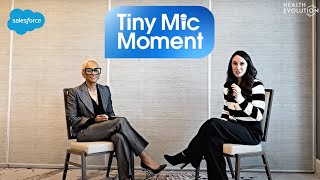
Lashonda Anderson Williams from Salesforce argues healthcare leaders should treat AI as a toolkit, not a threat. She stresses building inclusive governance teams and designing technology that doesn't worsen health disparities. AI can reduce clinician burnout and expand care access if built thoughtfully.
Chapters
Create a governance team. And when I say governance, it really is about bringing all stakeholders along, being inclusive in the designing of your strategy.
Hi everyone, my name is Ivy Wright. I am on the exec partnerships and content team here at Salesforce and I am joined today by Lashonda Anderson Williams and and we are coming to you live today from sunny Southern California at the Health Evolution Summit. Ta da. What do leaders need to be doing now to stay ahead of the AI curve?
It is a curve because there's always things happening today that we are not anticipating tomorrow to stay ahead and to really participate. It's about embracing the technology, embracing AI for what it is. It's a toolkit. It is about understanding how to put governance around these new technologies. We had a conversation earlier today in our Brass TAC session that personify the large gap of where people are today. We have people who are well down the path and then we also have people who are still trying to figure out where do they start. Embracing the technology is the first sort of iteration of acknowledging what it's capable of doing and then putting governance around. What does it mean for care, what does it mean for patients, what does it mean for consumers? And what does it mean for your healthcare professionals?
One of our attendees said they're like little LEGO bricks with AI and it's not just one product, but it's little bricks that you can stack.
Absolutely.
I was also curious if you were surprised by any of the new ideas shared here today. Was there anything that's going to inspire you?
Everyone is trying to figure out how to partner together to make this a place where health care and innovation can accelerate the outcome of care, the care continuum, and really bridge the gap where we've got a lot of disparities and that is the thing that keeps me up at night. We have an incredible opportunity to use things like Agent Force to help create more personalized, predictable outcomes and experiences. But we have to be responsible and thoughtful about how we design our technology to make sure that not widening the gap of disparities that exist today.
How do you see AI place in the continuum of care and really making that better than what it is today?
Salesforce does an incredible job with health Cloud. I think our start in the industry is already revolutionizing how our customers begin to see their customers, their patients, their members getting better care and really being more frictionless in the system when you add Agent Force on top of that. But companies like Resaena, I think Agent Force and Health Cloud with our customers are going to transform how we think about what's possible? Doctors and clinicians. Physicians, they come into the industry because they want to improve care. And I think the thing that AgentForce and HealthCloud will do is it's going to give the clinical and medical professionals more time to do what they love, which is spending more time with patients.
That's something I feel like we heard a lot about today. In particular healthcare burnout. There are more people leaving health care than coming into health.
Yes, I mentioned that because my oldest daughter is in medical school. There is no question it's been happening the last several years. We have more people exiting than entering. And one of the reasons it is is because of burnout. The type of opportunity that we have to bring Agent Force to this industry to accelerate access to care, to accelerate how care is actually delivered for all. Not just in the large metropolitan cities, but in the rural areas where there's a community of people who are underserved.
I am dying to know if you have a favorite resource from Salesforce that leaders should be taking a look at right now that could help them in their AI journ.
Agent Force. I mean, what we have been able to put in the hands of our customers is an innovative way for our healthcare and life sciences customers to really think about what the transformation needs to look like. So AgentForce and Health Cloud and AgentForce Life Sciences Cloud. I love all the clouds, but that's my favorite. Second is our AI research, Salesforce Research. They are doing incredible work understanding the trends and bringing insights across a broad spectrum of the industry. So if you've not checked out the white papers they're putting out, I encourage you to look at that and then trailhead like that's where you get on the ground training. And it's an opportunity for our customers, ourselves as employees, our trailblazers looking at all of the content we have to help arm you and prepare you for how to embrace it and how to actually begin to harness the power of AI and specifically Agent Force.
Awesome. Is there one piece of advice that you could give leaders right now as they're thinking about AI planning their journey, setting up their tools, what would you tell them?
My one piece of advice would be is to create a governance team. And when I say governance, it really is about bringing all stakeholders along, being inclusive in the designing of your strategy, how you think about the right use cases, but more importantly, how are you going to bring value back to your organization? Let's not forget your internal stakeholders because as exciting as AI is, we also want to make sure that we are using it in an ethical way, and we're not adding to more disparate gaps in terms of those who have access to the technology and those who don't.