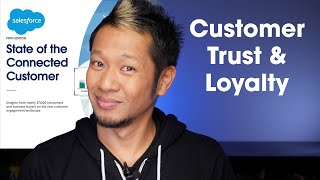
A short video (hosted by Brian Tong) summarizing key findings from Salesforce’s State of the Connected Customer report about the importance of trust in business. It highlights survey-based evidence that customers increasingly value honesty, transparency, responsible data use, personalization balanced with privacy, and clearly stated company values as drivers of trust and purchase decisions.
Chapters
What's up, everybody? Brian Tong here. And this might be the first time that you see me or seen some of my other videos, but when I'm talking to you in a video, I am here to build trust with you. Because trust is really at the heart of every relationship, whether it's personal or for business. And right now, it's no secret that our society is in a crisis of trust. Whether it's political strife, misinformation, or the feeling of stress all around us, that just makes us less confident to trust what's happening in our digital and physical lives. Now, I could jump into a lot of reasons that got us to this point, but what I'm here to talk to you about is how business can navigate this tricky dynamic and ultimately win trust. Now, right now, businesses have a golden opportunity and an obligation to earn customer trust. And it's not just me saying that. It's based on data. Because trust is at the center of the latest edition of Salesforce's State of the Connected Customer Report. Not familiar with the report? Hey, no worries. It's basically a massive collection of insights from around 17,000 consumers and business buyers in 29 different countries. The survey ran through February 2020. So the data here is really fresh and extensive. And if you want to check it out for free, you can click on the info card popping up on the screen right now. There's a ton in there that I'm not going to cover here. And while you're at it, make sure to subscribe to this channel and turn on your notifications so you won't miss all the good stuff that we're putting out here and more videos like this. So let's get back to trust. And why do businesses today have to care so much about trust? And what is the state of customer trust? The latest Edelman Trust barometer found that trust in institutions like government and media is falling. Businesses remain the most trusted institution based on their methodology. And the state of the connected customer confirms that same thing, that trust in business is on an upward trajectory. Now, 52% of customers say that they generally trust companies today. That's up from 48% who said so in 2020. Now, if we dive a little deeper, there are even more encouraging trends in the various pillars of customer trust. Things are moving in a positive direction. 77% of customers are trusting companies that to make honest claims about their products and services. That is up from 68% in 2020. And that seems so obvious, but not all companies do that. Another big jump. 75% of customers trust companies to act with customers best interest in mind. And that's a 10 percentage point increase from 2020. Now you can look at all the other pillars here, but it's clear what matters to customers. They want companies to be honest and truthful and act in their interests. And now that list of trends is important because according to State of the connected customer report, 88% of survey respondents say trust becomes more important in times of change. And 71% say digitization, which in non tech terms means converting our data, information and assets from physical to digital makes trust even more important. So how can companies earn customer trust? Well, don't get too confident about that 52% trusting business stat that we mentioned earlier. Don't just assume that everything is going good. Because even if trust in business is on the right path, there's still a whole lot of room for improvement. Because that means in the report, nearly half of the survey respondents, or 48% of them, do not generally trust business. So how can businesses win them over? Well, the Salesforce survey asked and came out with a list of the top actions that build customer trust. 1. Communicating honestly and and transparently, using customer information responsibly and treating people like people, not numbers. Huh? Would you believe that? Now these might seem obvious, but they aren't until a report like this puts it right in front of your face. What about the role of data and how it plays into digital transformation? Like how does that factor into customer trust? Well, we talked about the top three factors that build trust and it kind of really fizzled down and congealed into these two ideas. And using customer data to treat customers as individuals and respect customer privacy at the same time. I know it's a tricky balance. And customers, they're so nuanced that even they don't expect a one size fits all engagement. 56% of customers expect all offers that they receive from companies to always be personalized. And that's up from 52% in 2020 survey. Now, how many times have you unsubscribed to a mailing list that you've had for a long time and because they threw a few curveballs that weren't really relevant to you at all? I mean, that's how easy it is to lose someone, especially me. And if you're a large company, it's not easy to give someone that one on one level of attention that they like. It's really near impossible. But it's not totally impossible. It just requires artificial intelligence or AI to help businesses make the right connections. And data points to bring relevant engagements to them. Now, a separate Salesforce study found that 64% of marketing organizations are are using AI to engage customers today. And it's an important part of bringing value. But the idea of AI, or even hearing it can make people feel uncertain about it. More people are open to the use of AI in 2022 versus 2020. And we're more comfortable with AI and machine learning because it's really helped benefit us for things like, let's say, curating our favorite Spotify playlist. It can help give us the best directions in Google Maps or recommends what type of outfits will look good on us based on previous buying habits, like this little hoodie like thanks AI. But then there's also an increasing concern about the unethical use of artificial intelligence. People are worried about how much data are these companies going to use and if they're just using the necessary info in order for the results to be effective for the business and the customer. Now, the biggest challenge is how can companies earn trust by overcoming the personalization versus privacy paradox? And it's all about how companies go about doing it. And companies need to consider a few factors. Are companies using only the data that's needed to provide the experience customers expect? Most survey respondents believe companies go overboard with the data that they collect. Are companies being transparent about what information they use and how they use it for these experiences? Again, respondents still believe companies fall short here. And finally, are companies giving the customer agency over if and how they ultimately use this data in the first place? Consent forward Customer engagement strategies are now becoming more of the norm. And this type of approach is actually now mandated in certain regions. For example, the General Data Protection Regulation, or GDPR for short, is a European Union law. But even if a customer doesn't live in a jurisdiction with these requirements, they have expectations for consent forward customer engagement. And I actively feel comfortable with certain companies using my data, but others, I don't want them to have anything to do with it. If I could. Okay, something just got in my throat there. It just came out of nowhere. There's also another way to earn trust, and that's through your company's values. People align with companies they trust and companies that align with what they believe in. So make those values clear and easy to find. In the state of the connected customer report, nearly 9 in 10 survey respondents expect companies to clearly state their values. Let me say that again. Nearly nine in ten survey respondents expect companies to clearly state their values. Nearly nine in 10. That's 90%. Now, customers are sending a pretty clear message. And so am I saying that three times, but you know, there's always a but only 50% believe companies generally do this, and this is a huge disconnect that we have to address. Or will never win trust and will never succeed. Simply put, a company's stated values dictate whether customers will buy from them in the first place. In fact, 66% of survey respondents say they've stopped buying from a company due to values. That's up from 62% in 2020. So companies can't stay on the sidelines of societal issues if they want customers to continue to support them. Customers take everything into account for from the treatment of employees to protecting the environment and its future when deciding whether or not to buy. And that's a trend that is very apparent among millennials who are savvier than ever. So that's the state of the customer trust right now and what businesses can do to improve their standing with customers. There are just so many things that you can pull from the Salesforce State of the Connected Customer Report that you can go to right here and dig deeper for yourself by clicking the link on the screen. Plus, you know, it looks real nice and fancy too. And don't forget to subscribe to the channel and turn on your notifications to get the latest videos from Salesforce when they drop. Thanks so much for watching and I'll see you on the next one.