Trust Is the Currency of Business: A Fireside Chat with the CEOs of Uber & Salesforce | Salesforce
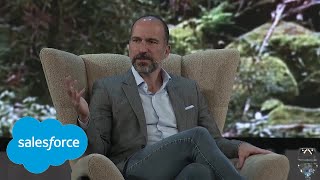
Transcript of a Salesforce-hosted fireside chat (Dreamforce) between Dara Khosrowshahi (CEO of Uber) and a Salesforce host. Dara discusses his immigrant background, leadership style (inclusive, outsider perspective), mentorship (Barry Diller), and company vision: transforming Uber from a rideshare business into an "operating system for your everyday life" — a mobility-on-demand and local commerce platform (rides, bikes/scooters, transit partners, Eats → broader local delivery). He emphasizes culture change, trust, privacy, safety (in‑app 911, ride tracking, audio recording pilots, ML alerts), sustainability goals (London electrification by 2025 pilot; long‑term shared, electric, autonomous fleet target), and social impacts (transportation deserts, voucher programs).
Questions this video answers
On the eve of the Iranian Revolution in 1978 (he was nine years old).
About 15 million rides a day.
Over four and a half million drivers and couriers.
Uber moves more people as a company than all of the airlines in the world move people on a daily basis.
He projected up to an 80% reduction in emissions and a 90% reduction in the number of cars on the road.
Chapters
All right. Good afternoon, everybody. How is Dreamforce going? Pretty good. I don't know if everybody had an opportunity, whether it was live or in person, to see President Obama this morning, but hopefully that was good. Certainly some great words of wisdom. It has been an action packed week and hopefully we're being good hosts and hostesses and everybody's having a great time. So I want to recognize we have some future Executive Summit and youth organizations in the Bay Area in the room. If you're part of those organizations, could you stand up so we can give you a round of applause? I think we have some here. So thank you. Since you represent our future. So thank you. Okay, so I am very excited about our next guest. I think you're going to find him to be. Well, I don't want to give it away, but he's a super smart guy and a good human being and a great leader. And it's kind of interesting because it's not very often that a company actually becomes a verb, and this company has certainly become a verb. So Dara Khosrowshawi is the CEO of Uber. How many of you are Uber customers? Okay. When Dara comes in, you can all raise your hand and it's an amazing company. It's actually an incredible technology company and Dara has done some incredible things. And I think you're going to enjoy talking with him. So please join me in welcoming Dara to the stage.
Thank you.
Thanks for coming. All right, I have a very important question, please. And I've always wanted to ask you this question, but I never had the courage to do it until right now. Uh, oh, you know that Uber rating that you have as a customer?
Yes, of course.
How do I get mine higher?
Just tip more generously. Seriously, it's all about, it's actually the, we display the tips to our drivers afterwards after they rate you, because we, we don't want that to affect your rating. It's just being nice to the other person and respecting them.
Okay, I'm doing something.
It's. Yeah, well, you might be on the phone too much. One of the tricks, tricks of the trade is when I get on my phone and I'm taking an Uber ride, I ask permission of the driver, I say, do you mind if I make a call? And that has helped my Uber rating move up a little bit. I don't know if it's directly affecting it, but that was a great tip that I heard from a driver.
Ask your drivers, what's your, what's your Uber rating? I want to know.
It's I've got some work to do. 478.
Okay.
What's yours?
It's a little bit higher than that.
So.
I think I'm four, eight, five.
But you know what? All right, well, then you've got to tell me what to do.
No, I'll tell you what I do. I get in and I start playing music.
Nice.
Yeah. And I say, you know, what's your favorite band or who's your favorite artist? And if I don't like it, I don't play their music. I play my music.
That's very cool.
And they're always very, very nice to me because they start singing.
My cousin is a four nine nine, and whenever she finishes a ride, she goes five stars. And then she leaves. And it just works. It's like, you know, it's like a Jedi mind trick on Uber.
Well, I take Uber home every day and do the five star thing.
Yes.
And if I don't get to a four nine five, I'm going to say, I know your CEO. I'll tell you what he said. Anyway, thanks for joining us.
Happy to do.
All right. Lots of good stuff. So you actually have a really cool story about how you came to the United States that I would love the audience to hear. So you want to share that?
Sure. So my family left Iran upon the eve of the Iranian Revolution in 1978 when I was nine years old. And we left Iran because we had to, because our family certainly wasn't welcome in the country anymore. And we had to flee the country to be safe. And we were lucky enough to come to the US when the US Welcomed immigrants. Certainly times have changed. And I had an uncle who lived in the US who had married an American woman and lived in the US and we came to the US US and stayed with them. And, you know, my family lost everything in Iran, but we were lucky enough to come to the States. And this is a country where you can rebuild. And we were lucky enough to get a great education and, you know, the rest is history. But this is a. I don't think people understand. Americans don't understand in many ways just how good we have it. You know, the idea that, for example, with my father and mother, everything that they work for just was taken away from them. You know, that is a completely foreign concept unless you're a billionaire and Elizabeth Warren wins. But it's. It was a joke.
That's why I laugh.
The whole idea of being in a country with rule of law, where you're safe, where you're sound and hard work can get you somewhere. It is so precious. And it's something that I always hold to be precious because I've experienced the opposite and certainly my parents have.
Yeah. So not many people have gone through that experience, just as you suggest. I think we are in this country not to make any. Turn this into a political conversation, but there are many things that we can always do better. There is a long list of what can we do in this country to make it a better country. This is why our company and certainly the things that you've done at Uber, we're trying to impact the world. We think business is a great platform for change. But sometimes I think we should just take a step back and say we should be grateful.
This is a good place.
It's a good place. But okay, now we have work to do. You know what I mean? But. But it's a powerful story that you have and it's influenced your leadership and how you lead your company. So do you want to share your leadership style on that?
I think that it's affected me in a lot of ways, but one is that I came to this place with a view of an outsider. And I think that until you're on the outside, you can't really understand what it feels like to be an outsider, what it feels like to be different. And Uber is such a global company. We have so many different views and so many different countries in which we operate and so many leaders who come with different backgrounds. And it's easy to say that you're going to be an inclusive culture, you're going to be an inclusive company, you're going to be an inclusive leadership team. But I think that when you have been excluded and you've had to make your way in, I think the influence that it's had on me as a leader is always to really notice in a meeting when someone isn't being included, to invite people into the conversation, to invite different points of view into a conversation. And listen, I think it makes for a better and engaged workforce. But it's actually very much in my interest as a leader. I think one of, one of the universal laws of life as a manager is the higher up you move in a company, the less you really know what's going on. Right. And especially when you become a senior year vice president or CEO, the information that actually gets to you becomes filtered through multiple layers. And every time it gets filtered through these layers, you lose some of the fidelity, you lose the real stuff. And you almost have this group that not for good or bad, Reasons they want to control the information that gets to you. So you start losing touch with actually the heart of the company and the people who are doing the real work at the company as well. So for me, it's been a little bit of a design spec, coming as an outsider, understanding what it feels like, working hard to now be where I am. My bringing in the voice of the outsider, one, I think creates a better culture of inclusivity within the company. But second, allows me to hear these diverse voices, which allows me to understand what's actually going on in the company so that I don't get surprised or I don't get hit by the side, et cetera. So it actually works both ways. Helps me and I think makes the company a better, better company and a better place to work.
So it's, in a sense, it's building a culture of leadership within the company.
Absolutely. And I think people confuse leadership and management. Management is a contract based on where you are in an organizational chart. Right. I'm your manager because I have that title. I'm up here in the organizational chart, et cetera. And management is a skill. Management is about the brain. Right. But leadership is actually anyone at the company can lead. You can lead to me, the person who works in a green light hub. These are physical places that we have where drivers come if they have issues with their car, etc. You know, our green light hub worker who works his or her ass off to help our drivers. Those are leaders at our company. So I think that part of this view of kind of an outsider understanding what it's like to be outside, etcetera, is I'm always wanting to put our company in a position where anyone can lead. And leadership is actually different from management. And people feel empowered and they feel like they can make a difference. And it's very important, I think, that our managers, our managers are there to serve their teams. Their teams aren't there to serve them. The higher up you go at a company, the more of service you have to be. And then you let leadership happen at all levels of the company.
Yeah, I think that's a great message. I'm listening to this and I'm thinking about what Obama said this morning about identifying leaders and the leaders. Leaders like you create multiple waves, multiple levels of leadership as part of that culture and that process. And reminded me, I was as I'm listening to you, and I was listening to him about this book that this historian Doris Kearns Goodwin wrote about Lincoln called A Team of Rivals, which is essentially how Lincoln assembled his cabinet with people who are equal to or better than him, even though they were rivals during the presidential campaign. So imagine that happening today. That was a joke. So anyway, it probably wouldn't happen. But it's this culture of leadership that you're talking about. So you've had a lot of influences in your life. You've had an interesting journey. You've had mentors that I think would be really interesting. Do you stay in touch with your mentors?
Who are your mentors? Definitely. I'd say the. The most impactful mentor for me, certainly in my professional career, is Barry Diller. He was a media titan. He moved from the media business to the commerce business and really made an extraordinary adjustment. I worked with him for him for over 20 years. We stay in touch. I'm still on his board, on the Expedia board where I used to work. And it's been an extraordinary relationship. And for me, he's been an extraordinary mentor. And for me, what was interesting about Barry as a mentor is that he was the one who was always pushing you to go further. And there's studies that show that really you learn by doing as a person. There's some learning that you can get by reading, et cetera, by being trained. But the greatest learning that you have in life is actually doing. That's how you learn. And Barry would and continues to take people who don't have experience in a certain sector, throw them into the deep end, and then let them learn to swim. Because the best way to learn to swim is actually make them swim.
Right.
So it's been a great relationship for many, many years.
So it's hard to believe this, but uber is actually 10 years old.
Yes, it is.
I keep thinking of, wow, it's only been around for a couple years, but. And you've been the CEO for over two years.
Yes.
And this is your company and you have our company.
But I'm.
Okay, well, very much of you, but you are one of the leaders of your company. To our last conversation. So you have a vision for the company and where the company's going to be and the Uber that you want it to become. So nobody's heard this before, so here's your chance to tell everybody.
So where we want to take Uber is Uber started as a ride. As a ride hailing company, essentially. You know, a black car hailing company. Right. And the way that we're thinking about Uber going forward is to make this transition from a rideshare company to really a mobility on demand company. Right. Which is, anyway, our Job is actually to get you from point A to point B in a city, in a town, etc. And more and more we want to give you, we want to open up our system. Just like salesforce has built out this open platform essentially for companies, we want to build out an open transportation platform for transportation providers to essentially put their services into our platform and make that transition from being a rideshare business to a mobility on demand service as well. So, you know, transit providers, taxi companies, lime bikes and scooters, our own bikes and scooters, basically we want to have any way for any transportation method, whether it's ours or third parties to come into this app. And at the same time, we're looking to drive this transportation, this transition of our eats business, which is about food, et cetera, food, Anything you want fast to be about essentially powering all local commerce. You think about a restaurant and a restaurant delivery restaurant is a box with probably 30 SKUs of inventory. It's hot inventory that has to get to your home very, very quickly. But you could extend that definition to be anything. And for example, we bought a company called corner shop, which powers grocery stores and getting groceries, small corner shop grocery stores to your home. So essentially we have these two big platforms. One is making the transition from rideshare to mobility on demand. The other one is making a transition from food to essentially anything that you want in your life at home. And you put that under umbrella. Anywhere you want to go in your city, anything that you want from your city, we will either get you there or we'll get it to you. And that vision is one that we call essentially the operating system for your everyday life. So we want to power your life. You want to go from A to B. You want to get anything you want in the city, we want to power that and we want to become that trusted partner for you every day to make life easier for you and essentially give you your time back.
So I love the concept of painting it as the operating system for your life because it is a mobile world. People move, people want to be able to move in intelligent and safe ways. And that's really your concept.
Absolutely. And you really do. The fascinating part of our company is that we are building technology and ours is a tech enabled company out there. But it's not technology that just lives in the digital sphere. It's actually technology that combines the digital and the physical. Right. And the physical world. Physical world's a mess. Right. For us, everything that you have to do in order to push a button and have A car show up within five minutes, push a button and have your Big Mac show up within 30 minutes, et cetera. Everything that you have to build in order to make that experience predictable, repeatable, and within a trusted ecosystem of services of riders and drivers and restaurants, et cetera. That technology challenge of almost digitizing the physical world is incredibly challenging, but it's really, really rewarding as well.
So shifting gears here a little bit, you know, the good news is that congratulations, you're a verb. Right. We talked about that before you came out. But you know the importance of culture and in your business, for whatever reason, Uber seems to be a target. People have their comments about target, about Uber, and you know, you could use the expression lightning rod if you want, but I know that when you came on as the CEO, a big focus area for you was culture.
Yeah.
And your leadership of culture. And so how do you focus on culture of trust, which is so important given how people sometimes probably unfairly view Uber?
I mean, listen, the, the, I think that is an unfair affair. Our company, you talked about our company being 10 years old, right. And our company has. The growth of this company in 10 years and how we have been a part of this changing ecosystem of cities all over the world has been pretty extraordinary. And I do think that we went through this stage of, listen, we were the rebels, right? We were the pirates, we were the change agents. We were going against like taxi interests, et cetera, and that building something truly from the ground up against kind of this structured interest that didn't want things to change, that required a certain almost rebellious behavior.
Right.
It's that Apple rebellious hired army kind of early days. And I think that the business grew so fast that we moved from rebel to incumbent and we didn't even know it. Right. And once you do become a service, a company that's a multi billion dollar business, we do 15 million rides a day now. Right. And once you get of size, how you act, the responsibility that you have in terms of communication, transparency to your drivers, to your riders, to the cities in which you operate, to the governments with which you work, et cetera, that that responsibility becomes really significant. And the fact is we had to catch up to that realization because we just grew too fast.
Yeah.
So I think some of the, you know, are being a lightning rod, et cetera, you know, that's deserved. And it wasn't because I think we were, that there were people who didn't have the best intentions. We just grew up too fast. And sometimes that happens as a company and now as a Company, we are making that shift. Right. We do understand that there are stakeholders. We're a company that we've got over four and a half million drivers and couriers who are on our system who depend on us sometimes in some countries for full time work, more often in the US for part time work for earnings. And they're on the system because they value the flexibility, but they also value the earnings as well. There's a deep responsibility there to these four and a half million users of our platform. There's a deep responsibility that we have to our riders. There's a real responsibility that we have to our cities and the changing traffic flows, et cetera. And we are now working very, very hard to pay back some of the debt that occurred and really becoming a trusted partner. And I think that you lose trust much more quickly than you can gain it back. And I think it's hard work to get it back. But I will tell you that the people who work at this company are determined for Uber to be seen as what we truly think we are, which is a company that is responsible and a company that truly is going to improve the lives of all stakeholders that we're responsible to.
And you know, we were talking backstage about improving the lives and that with that many people. I mean, you're a large city, right. When you think about four and a half million people who are part of your network. Yeah. The volume of people who go through the Uber system on a daily basis, it's incredible.
We move more people as a company than all of the airlines in the world move people on a daily basis.
Yeah. So I don't think people realize that. And so there is a responsibility, right.
Huge.
To your employees, to the people in the network, to your passengers. I know you are passionate about this, super passionate about privacy and safety. So you should share that passion with this audience.
Yeah. I think certainly on the privacy front, it is incredibly important to get us, for us to get it right, which is we have location information, real time location information and identity. And listen, that is precious cargo that belongs to the user, for the user. So one of our core ethos is we will use that information. If we, if we see that you're taking Ubers and you know, going home every day after, after work, we will, you know, your home will come up as the top destination, etc.
Right.
But we're essentially going to use your data to serve you versus to serve ourselves. I think that's incredibly important for us. And then for us, safety now is a huge priority for the company. We're making enormous investments in safety now, both for the driver and for the rider as well. I think a lot of people think about rider safety, but driver safety is just as important. There are two people on a car, and things can go wrong. For example, in the past two years, we have been by far the leader in terms of developing our safety ecosystem. So having a 911 button in the app right there on the map, essentially, you can now text A911, and if you text A911, your location will be transmitted live. The make and model of your car will be transmitted live. You can. Now, with my daughter, I can track her rides now. So I know when she gets picked up, when she gets dropped off. I promised her that I wouldn't criticize the time in which she gets picked up and dropped off. So it's an agreement there. But I know that she's safe, and that's a big deal for us as well. We are now developing technology, and there's a pilot that we have in Brazil, for example, that, based on permission, will take an audio recording of your ride, and I'll ask permission for the driver and the rider for the audio recording. And the goal there is if something goes wrong, first of all, if you have ill intent, people who have ill intent usually look for dark corners to kind of ply their trade. We want to light everything up in an Uber. We want to shine light upon your ride so that someone who has ill intent hopefully doesn't do anything or go someplace else. So that feature, for example, to record your ride, you can't access the recording. But if something happens, if an incident happens, it can go to us and we can do something about it. If you start and end at a trip, if you say you're going home, we know how long the trip is going to take. We know the route that you're supposed to take. If for some reason the car stops in the middle of your route, we now have ML algorithms that will reach out to you and say, keith, is everything okay? So these are all investments that we made on the safety front. They're very, very significant. And it is making sure, because we do 50 million rides a day, we want to make sure that the one in a million doesn't happen anymore.
It sounds like if you think about core values of the company, trust is certainly could be your number one value. Enormous privacy, core value, safety. Absolutely core value. So this feature where you can actually track where people are going. I'm going to tell you a story. So this is my other personal story. So my 24 year old is using Uber and she has my wife's account. And it's one o' clock in the morning and we're watching on the phone as it says Bridget is going to Joe's Pub. Bridget is going to Ralph's bar. So she was going on a bar crawl, right, whatever those things are. And we just watched the whole thing. So thank you for that, we really appreciate it.
Perfectly safe.
And she got home. So thank you, thank you for that. But it's actually kind of cool functionality anyway. Sustainability.
So sustainability for us is another passion, which is, you know, we're in the transportation business, but we want to make sure that our transportation is as sustainable as possible. One area that we're very excited about is actually London. So in London we are collecting a fee for every ride that's happening now. That fee goes into an account that our drivers can use in order to purchase electric vehicles to drive environmental sustainability in London. So by 2025 we are going to be all electric in London and we're hoping that that can become a model for other countries as well. And we're essentially using our revenue to go out and fund a much more sustainable way method of transportation as well. But the future that we see is it's got to be shared and we think sharing is absolutely going to increase sustainability. It's got to be shared, it's got to be electric and eventually it will be autonomous because autonomous will be safer some period of time forward here. So I think by 2050 for us, we think that a shared electric and an autonomous fleet can reduce emissions by 80% and actually reduce the number of cars that we have on the road by 90%.
Wow.
There's no. If you look at a car right now, the utilization of the average car that people own is 5%, right? So it's 5% utilization, 95% of the time car's not used. You think about all of the parking, et cetera that's required in the cities, all of this infrastructure that is not serving people, but it's actually serving these cars that are utilized 5% of time. That is not something that makes sense for society and for us driving that utilization and essentially removing the need for car ownership is something that we think is great for the individual, but it's also going to be great for the cities in which we operate.
So Uber does a lot of things for a lot of different organizations and cities. And you know, these are stories that have come out and they will come out one that you and I somewhat got involved in was with Carnegie Mellon and the city of Pittsburgh. They're like any city. Pittsburgh is not unlike any other city. There are some pretty bad areas that are underserved. There's no transportation, no public transportation. When I use the word bad, I mean bad in the sense that the city is not doing the job that it should to take care of those areas and to help them out. And Uber did something really cool where people who are living in this area, they can't find work because there are no jobs in that particular section of the city. But they could go with your help because Uber provided vouchers to travel to other areas to find jobs. And magically, what happened to that area? The economy got better, health got better, crime went down. It was all goodness. But this is something that you do.
Every city has its transportation deserts, we say, or transit deserts in these cities. And listen, they tend to be not in city centers, right? You and I are lucky enough to live in city centers where there's plenty of access to transportation of all kinds, buses, transit, et cetera. But not everyone is that lucky. So Uber, systematically, in general, we are growing much faster in these transportation deserts, and we are actively going out and working with different cities to have voucher programs, etc. So that you can provide. Transportation represents freedom, transportation represents opportunity, and we want to be an active participant and making sure that opportunity is available for everybody. The unfortunate byproduct of some of the things going on in cities, for example, in New York City, is that New York City has put some legislation together that essentially limits the number, the amount of drivers that we can have at one time, which increases prices for a service. And also, if you limit the amount of Uber supplies, all of the cars then go to the center of the cities, because that's where you've got the greatest number of hails, the greatest number of rides, et cetera. So actually, some of the difficulty that we're having in kind of talking to our constituencies, like New York City, to serve the whole city, but then serve our drivers as well, is that if you actually restrict the number of drivers out there, the drivers go to the middle of the city, and the people who live in the city outskirts, the people who can't afford higher rates actually are the ones who are hurt the most. So we want to make sure, again, you talk about kind of stakeholder capitalism, right? We're a company, ultimately, we have to make money, et cetera. But there are so many stakeholders to serve here. And these cities, they're living organisms, and we have to make sure that as we go forward and work with our cities, we don't decrease our availability of transportation and mobility to these neighborhoods who need it most.
Which is a great story. And this sounds like a perfect example of where the public sector and the private sector can work together.
Absolutely.
To do the right thing.
Absolutely.
And everybody benefits. Absolutely.
And actually, for example, we're now working with a lot of transit providers on taking, on providing bike rides, scooter rides, sometimes Ubers to a transit hub so that then someone can take the rest of their ride using transit as well.
Very cool. All right, so you've run two digital first companies, right. You did the Expedia thing, you did the Uber thing. You see the future. What's the future? What's the next generation of companies?
I can tell you what's going to happen tomorrow, but I can't tell you much beyond that.
Well, we'll take it.
You know, I think. Listen, for me, what's fascinating and it's a challenge, you and I were talking about this backstage, is that companies like ours, digital companies, but especially like Uber, that's digital, but working in the physical world as well, we really have to make sure that we are building services that do serve all of our stakeholders out there. And I think that the success of some technology companies have been too focused in areas like San Francisco. It's the success and the capital and all the fruits of these labors have been too restricted, it's been too small a population. And we have to make sure that as we win, our stakeholders win. And that takes a lot of effort, it takes a lot of dialogue. And ultimately I think that for the next generation technology company to succeed, all of the stakeholders and societies around them have to succeed as well. I mean, that's a must have for us going forward. And it's easier, frankly said than done.
I think that's a great message for everybody. So we've got a lot of young people who are aspiring CEOs in the audience. So do you have any advice?
You know you're going to have to give them advice as well. I'd say the one thing that I keep telling young people are actually don't over plan your life. All of us have biases. And when you make these long term plans, listen, the world now is changing so fast that I think one of the greatest determinants of success is going to be actually how quickly you can react to the changes rather than having a plan and then blindly following that plan. So one thing I would tell young people is actually don't over plan because when you over plan, and I've seen people make mistakes all the time. You know, I've got to be VP by X age or I've got to make X amount of money by Y age. I've got to have this title, I'm looking for a title, etc. That creates a biased view of your future that very often is going to prevent you from seeing the opportunity right next to you that's staring at you in the face because you want to go there. So keep your head on a swivel, look for opportunity. And the other thing that I tell you that's really served me through my whole life is I've always focused on whom I'm going to work for rather than what I'm going to do by focusing on whom I'm going to work for. So many things change in life, but what I've seen is unchanging, is great people stay great. And my going and working for great people has allowed me one. Sometimes they succeed. So I get to kind of bask in their success as well. I get to ride on their wake and then I learn from them and I can kind of create my own wake as well. So don't over plan. Focus on whom you're going to work for rather than what you're going to do. Those would be my two pieces of advice. What about you?
I think that's great advice. I mean, we could talk about this all night. I would give two pieces. One is follow your passion and understand what your true north is, and follow that. And typically your gut is right, your instincts are good, and if you stay true to that, it will bring you down to the right path. So I think following your passion is really important, whatever that passion is. The other is when you do become CEOs, because you will become CEOs, is that when you create that company, create a culture based on very strong values. Because no matter what happens in that company, as long as you stick to those values, whenever things hit a rocky patch, and trust me, they will, because every company hits a rocky patch, you can grind, everything can be grounded back into those core values. So I think follow your passions, understand who you are, your true north, and then establish those values for your company. And I think that makes a huge difference.
That's good advice.
So, my friend, final thoughts for this group.
Final thoughts is do what he said.
All right, Dara, thanks for being with us.
Really. Thank you very much.
Thank you. All right, everybody have a great dream for us. We got a few more days left of this. So have some fun and learn. Okay? Take care. Bye. Bye.









