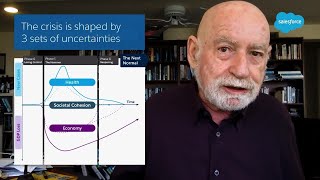
Peter Schwartz breaks down the unprecedented uncertainties driving the COVID-19 crisis across health, economics, and society. He maps a 6-9 month cycle of rising cases, suppression, and economic shutdown, and identifies three core unknowns: how the virus spreads and mutates, whether stimulus can sustain economies, and whether people will comply with restrictions or turn to social unrest.
Chapters
I've been doing this for 50 years and I have never seen greater uncertainty than we're seeing right now. You know, I've been through financial crises, wars, oil crises, the birth of the Internet, all of those things. And we have never seen greater uncertainty because of the fact that we have a health crisis, an economic crisis, a social and even a political crisis going on in parallel. And this has created maximum uncertainty. So in fact, we have turned to looking at the near term. In fact, it may be true that the short term uncertainty is even greater than the long term. And so we've been looking at, for Salesforce, our customers and our society, our stakeholders more broadly, what might happen over the next six to nine months. How might the pandemic, the economy, society, all interact together to create the world that we will inhabit over the next six to nine months? So we basically developed a framework that looks like this. The upper half of this graph talks about what's happening with the pandemic, namely what's happening with the number of new cases. And in nearly every case, every situation, what we saw was a dramatic increase. Then people began to take it seriously and began to try and take measures to suppress it. And we saw a decline in, in most places. We'll talk about what we mean by most places in a moment. And the consequence of the efforts to suppress it, namely a universal shutdown for almost everybody, created a massive economic crisis. And so governments began to respond, to try and action, to take action in that regard, namely to try and provide money to the system, not really stimulus, but to cover the economic losses, to put money in people's hands, to put money in business hands. So that's the kind of basic framework we began with. And in fact, my good friend Martin Wolf at the Financial Times, he's the economics editor there, said that in a war, governments spend freely. And indeed, this is very much like a war. The scale of impact is like that. And so they have to get together and prevent the massive disaster. Think big, act now together. And a few countries have done that, but sadly, most of the world has not done that. And in fact, what we see is the economic consequences of that. These are the economic forecasts for many of the key countries in the world. This is the worst recession we've ever experienced. Nearly all of them were looking at growth in varying degrees, say last October, that was the forecast. Then the pandemic hit and the first forecasts were bad for most of those countries. That's the kind of lighter purple line there. But the most recent forecasts in June were catastrophic. And so what we're looking at is a massive recession and maybe even a depression worldwide. What makes this unique is that it's simultaneously happening everywhere. In most recessions, there's a disruption in the United States or Europe or developing countries and so on. This is different. It's impacted everybody everywhere almost simultaneously. And that is unique. So it's interacting on an extremely large scale. So as we went forward, what we looked at were three fundamental sets of uncertainties. The first, in many ways most important is what's happening with the health crisis. And that is shaping the behavior of what we call the hammer, the period where you have to slap things down. And so important questions are really the dynamics of the virus itself. There are things we don't fully understand about how it spreads. Secondly, the question of the vaccine. How soon will we get one and whether we get one, Will there be mutations, Will immunity develop, and so on. So there are still big uncertainties with respect to the dynamics of the health crisis and frankly, our resources to deal with it. The second big uncertainty is the economy. How effective are the economic measures that are being taken to support the economy? Will they continue? You know, in the US we had a very large scale and actually pretty effective stimulus in the first wave. Now the second is hung up. And the question is, will Congress in the United States pass the necessary bills to provide support into the third and fourth quarters of this year? And similar questions are being raised elsewhere as well. How much support do their economies need? So that's the second uncertainty. And then the third uncertainty is about society. How does society respond to this? I mean, first of all, we had just the question of would people behave appropriately, maintain social distancing, wear masks and so on. Now, in much of the world, that behavior was just fine. But in the United States, where we have a kind of culture of anti authoritarianism, a large part of the public, even without the kind of political dimension pushed back on the restrictions, then you add the political dimension to it and it becomes even more dramatic in terms of the internal tensions over that. To which we then add the crisis of the Black Lives Matter movement following the murder of George Floyd and continuing issues that have now spread social disruption not just in the United States, but around the world in terms of concerns about racism and exclusion. So what we now have is a perfect witch's brew of a health crisis, an economic crisis, a social crisis, and even a leadership crisis in many places, especially in the United States. So that's what we're seeing. You know, we've gone through the first phase, where we lost control. Most places we're coming out of the hammer. And then the next phase is what reopening begins to look like. So we're going to talk about how all that.