Welcome to the AI Enterprise | Salesforce World Tour London 2024
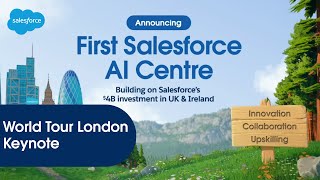
Keynote-style session from Salesforce World Tour London (June 2024) presenting Salesforce's vision for the 'AI enterprise.' Speakers (Zara Barilulumi, Justin Wilson, Kent Pacman, Jocelyn Zanasi, Taxina Iamano and others) emphasize that data is the fuel for trusted enterprise AI and introduce product capabilities: Einstein One platform, Data Cloud (now on Hyperforce UK), a new Data Cloud Vector database, 200 new Data Cloud connectors, Proactive Asset Management, and Einstein Copilot (now GA) across Salesforce apps and Tableau. A customer case (Aston Martin) demonstrated unifying CRM + telematics in Data Cloud, building 2M+ unified profiles, personalized campaigns, Slack Record Channels, and Copilot-driven automation (RAG, flows, Copilot builder). Company-level stats announced: $38B revenue target, $4B UK investment pledge, philanthropic and volunteer figures, and market impact estimates (IDC).
Questions this video answers
$38 billion
$4 billion
Over 250 petabytes
Data Cloud Vector database
200
Chapters
Artificial intelligence remains the talk of the town in 2024, after the boom in 23.
But in terms of how to use it in your everyday working life, I.
Think a lot of people are still trying to figure that out. As the sun sets on all the hype and the reality of AI starts to crystallize, the question remains, how do we build the AI enterprise?
The customer is changing the way they want things served up to them. So we had to think differently and.
Have one 360 view under one single.
Pane of glass so we can personalize every customer experience, creating long lasting relationships. Data is the fuel that powers AI.
In fact, the quality of the input will absolutely determine the quality of the output.
Now if I might be so bold, Unified data, that's as good as gold.
It is all about data.
Quite an important asset. At the same time, it's indeed a big challenge.
We've been able to unify our customer data across all parts of the business.
Which were traditionally siloed. I needed a trusted source to secure.
My data and data cloud is that.
Perfect product to take that journey with me.
I want to know what people are doing with my data, don't you?
With Salesforce, we can trust our AI without risking our customer data. Collaborative AI you can trust. Not nice to have.
It's a must Slack helps my team.
Be more agile and productive by enabling.
Seamless communication between all of us at any given time.
What the Einstein One platform does is collaborate with the advisor, bringing the human touch to every interaction that we can with our customers.
It'll take their keywords and automatically give me service replies.
Over here on the right.
It's like a helping hand trapped Insights are now set free, unlocked with AI. They are ours to see.
Tableau has been an incredible tool for us to be able to scale. It allows us to surface insights and moments that matter.
Tableau Pulse has been a real game changer for us. That's really revolutionized how we think about a digital journey and as a result.
We'Ve seen a better experience for our customers.
Your own trusted AI, a helpful copilot at your side. Einstein Copilot helps the team go from idea into execution really quickly. We can now create meaningful automated recommendations.
For our customers faster and at scale.
We were able to close student support.
Cases 65 days faster.
Hundreds of hours of manual work taken.
Out of our ecosystems across every part of the business. We're exceeding the expectation of the customer. We're exceeding the expectation of profitability.
We gonna break a record.
The fun, the effects, the return.
3 2, 1.
Magic has happened along the way.
Far greater than I ever thought.
Now that's how we ride into the sunrise of the AI enterprise.
Mm.
Giddy up.
Please welcome CEO UK and Ireland Salesforce Zara Barilulumi cbe.
Good morning. Good morning. Anybody else got goosebumps from that wonderful choir? Just me. No. Aren't they magnificent? Absolutely glorious. Good morning and welcome. Welcome to World Tour London. I love the energy in the room. I can feel it. I hope those of you that are tuning in online and watching this, I hope you can sense the buzz in the room and how wonderful to be here in London town. Yes, yes. My hometown. Our hometown, and actually one of the world's most AI relevant cities. It's one of the world's most AI connected cities and we've done pretty well in the uk. We've progressed very well in terms of digital transformation and AI. We're not doing too badly. But today. But today we are here to share with you what it takes to become an AI enterprise. And hopefully, along the way, we can motivate you, we can educate you and we can inspire you. But first of all, before we get into any of that, what am I going to do? I'm going to thank you. Thank you to all of you, our wonderful customers, our employees, our partners, our sponsors, our community members, and, of course, our most valuable persons. I can see a few of you there in MVP camp need a bit more energy than that, fellas. Come on, guys. Yes. Yes. Good morning to you. Thank you to all of you. You are the reason that we are here today. And we've got a fabulous show in store for you now. Globally, we continue to deliver great value across our customers, our partners, our communities, our employees. And we are on Track to deliver $38 billion worth of revenue this year. And whether you are investing in us with your businesses or with your careers, we appreciate you and we will continue to drive IMPACT together. Now, I have a very exciting announcement. So exciting, in fact, I had to bring my parents here to listen to it. So their mum and dad are here with me in the audience. I'm really, really pumped about this because it's a first of its kind. Now, last year, you will remember, I hope, that we pledged as Salesforce. Oh, you've got a picture of Mum and Dad, have you? Hey, I brought Einstein with me. The real Einstein. Look, have you seen. Last year we made a very big commitment, renewed our commitment because the UK is so important. We pledged $4 billion worth of investment over the next five years. And this year Building upon that commitment and to continue to reiterate how important this market is for us as Salesforce we are opening, Salesforce has decided to open right here in London, our first AI center. I'm so excited. Isn't that amazing, folks? That's incredible. I couldn't be more excited. And the reason that is fabulous is because it will foster really important collaboration across AI experts, industry experts, our customers, our partners. But crucially, it will provide critical upskilling opportunities. And you know how passionately we feel. In fact, this investment is an example of how we have remained rooted in our core values that have guided us so well for the last 25 trust, customer success, innovation, equality, and sustainability. And they remain important to me personally. They are more important than ever to us at Salesforce because as AI innovation evolves, we enterprises need to ensure that we are introducing technology that is trusted and safe and inclusive. So you can be rest assured that we will remain true to our values. It will be at the heart of our AI strategy and it will be at the heart of everything that we do. And I think we've all got a responsibility to ensure that technology that we introduce is trusted. We have our 1, 1, 1 model, and that's why this is so important to us. Off the back of our values, we give 1% of our time, 1% of our product and 1% of our equity to nonprofits and NGOs and globally to date. My goodness, what extraordinary outcomes we have achieved together. So we have invested 708 million in terms of grants to nonprofits and NGOs. We have our wonderful employees globally. They have volunteered a whopping 8.9 million hours. Thank you. And then I want more claps in a minute when I give you some more stats. And actually, 59,000, 59,000 nonprofits and higher education institutions run on our software for free now. Local. Thank you. Locally, and a bit closer to home, we have invested £27 million in grants and our fabulous employees, my wonderful team, UKI, which I'm incredibly proud of, they have racked up a brilliant 824,000 volunteering hours. So thank you to them. I'm so proud of them, I can't tell you. So, look, you can probably sense my pride in this, but it doesn't just end there, because I'm delighted to share that in the audience today. And hopefully this is going to be the right area. I have Cure Leukemia with us today. Could you stand up? Cure Leukemia. Thank you. Cure Leukemia. A wonderful charity. Thank you for being here. Don't sit down. Just yet don't just sit down because I want to tell you about. I want to tell you about cure leukemia very, very quickly. So for those of you that don't know this charity, they provide very critical blood cancer treatment and they give access to this treatment in a catchment area of 30 million people in the UK, which is extraordinary. But they're doing something very, very special today. And I want you to join us, please, if you can, because today they are announcing their 1 million goal, 1 million pounds we need to help them raise. And the reason that they're raising this is because they want to fund the world's first clinical trial network for children. And if you honestly knew how little dedicated research exists for children, you would understand how spectacular this mission is. So we're honored to be able to share with you 10,000 towards your goal. And look, we've got some very successful customers in this room, some very deep pockets, and I'm sure you'll join us. So go and see them in the campground, go and listen to their session, and they can rope you in. Thank you very much, Kliga. So, as I said, you can probably sense my joy and pride in the whole Salesforce ecosystem for all of us. And honestly, there's more to come. It doesn't just stop there. Now I'm about to go wondering, where shall I go? Who shall I pick on? Let's talk about our vision for a minute. So our vision to connect you to your customers in a whole new way actually has never been more critical than right now because we are in the midst of an AI revolution. Has anyone noticed? No. We're in the middle of an AI revolution, folks, and it is changing everything. It will change how we interact with our customers and it will change how we run our businesses. But this AI revolution, it's about more than just the tech. We all know this. It's about more than just the tech. It demands that we put trust front and center of everything that we do. Why? Well, I just mentioned AI is evolving, but as this innovation is evolving, it is taking us all the way from predictive AI, and we are heading very fast into an era of autonomous AI, and we have to be able to trust it, right? At Salesforce, we have guided our customers through the big transitions. We've guided them through cloud, through mobile, through social. And we're doing it again with AI. And we think we know how to do this. We know how to do this because we have been doing CRM for 25 years and we have been investing in trusted enterprise AI for over 10. And AI will transform enterprise. It will help businesses solve their most complex challenges, like augmenting their employees with skills to drive productivity to, you know, higher margins, to, crucially, better customer relationships. So let's take a look at what we mean by this technology. Let's just have a quick zoom in. First of all, let's consider consumer AI. And when we think about consumer AI, it consists of three key elements. Number one, you need a compelling and engaging way to interact with the AI, a user interface. Number two, you need a trusted and powerful model to power the workflow, the activity that you perform. And number three, you need data. Lots and lots and lots of data. And frankly, in the market, there are thousands of brilliant UIs, and there are brilliant models, and some of them are so sophisticated, they actually feel sentient. Some of them can feel sentient. I would encourage, you know, I'm sure you're experimenting and you're trying with them, but what really matters, what really matters in all of this is the data. You can have the smartest, most badass model that you can possibly get your hands on, but it won't work without the data. And these consumer models, they are built on tons of public data. And that public data is not going to help you progress your customer relationships, because consumer AI is different to enterprise AI. And the future of enterprise AI requires customer data. In the business world, we can't rely on data that isn't grounded within our business's context. Right? And actually, we need our AI to know our customers. So, for example, purchasing history. Enterprise AI demands trusted and grounded data. And guess what the great news is, enterprises have tons of it, loads of data, but it's all trapped. Most of it's trapped in silos. Who's got a data lake in their organization? Show of hands. Don't be shy. I know you've all got it. There are lakes everywhere. You've got a lake. I've got a lake. Have you got a lake? Yeah. There you go. Who's got a swamp? A pond? Anyone got a pond? There we go. A few hands. That's the reality. We've got these amazing structures, we've got all of this sophisticated data, but it's not connected. They're not connected. Every CEO I talk to is realistic about the need to invest in AI to remain competitive. And they are excited. They get it. They see the benefit, they see the productivity gain. They see it as the tool to help them drive growth. And yet, understandably, they're concerned. They remain concerned about fragmentation, scalability, security, safety, hallucination bias. Anyone remember my reference to the London night out last year? Well, they're still hungover with that. It's a concern. We're not going to adopt AI unless we can trust it. Our customers won't adopt AI unless they can trust it. But I have to tell you, Salesforce was absolutely built for this moment. It feels like everything we've done over the last 25 years has brought us to this moment. Because Salesforce AI is powered by trusted enterprise data with safeguards and frameworks in place to ensure responsible AI development. And this is exactly why we built Einstein one. Einstein one is powered and this is to help you to get to enterprise AI faster. And it is powered by our brilliant data cloud and it unites all of our clouds, it unites our apps, our AI capabilities onto a single, deeply integrated and connected platform that only Salesforce can Deliver. And Salesforce Customer360 enables you to combine all of your CRM apps together to understand your customers in a whole new way. Customer360 is your single source of truth. It allows you to strengthen your customer relationships. It allows you to power growth. Think of it as your operating system for growth. And we at Salesforce have built the most powerful and comprehensive C360 or single source of truth in the market today. So how does that light up? How does that come alive in our whole our wheel of our customer 360? Well, I'm going to go back this way. Let's take sales. Sales, buckle up. We're going to go around sales AI now with AI sales, your reps can build and close pipeline much faster. Just ask Spotify. They have driven productivity in their sellers to the tune of 40% with AI in service. So AI service, we can deliver personalized cross channel AI powered service interactions. And we see this in Sonos who have effectively deflected 40% of their service calls to self service. With AI in marketing, marketeers can activate data fast and campaigns even faster. And we see our own team GB have grown their contacts by 140% in the last 12 months. Let's not forget Commerce AI for Commerce. A unified platform driving merchant productivity. And that means more shopping carts converted at speed. And so a great example of this is Heathrow Airport where they have actually grown their Digital revenues by 30%, which is incredible. AI within Slack. This is our conversational platform for work. And by putting slack in the hands of every employee, we are enabling them to take advantage of AI powered summaries and search so that they can optimize their time and again a Great example of this is Bolt and they grew their business 175% by putting their apps and their integrations within Slack and Tableau. In the video you just you heard from a gentleman from John Lewis partnership. There are 10,000 users of Tableau at John Lewis and, and the AI that we've powered within that means that intuitive AI is available at the ready to help their employees drive better data driven decisions. And then last but by no means least probably one of my favorites, AI for industries, which means that our number one AI CRM platform has got pre built and expertise tailored for your industry and for your customers. So by now you might be asking yourself, how do we get to this enterprise AI state? Of course, I've just shared Einstein one platform and it really is about embedding AI in the flow of work across your organization as an autonomous extension of your teams. That's what's going to really help you surpass your your competition. But to make it easier for you, we've broken it down into five key steps. Number one, you need to unify your apps and your data. Simple, right? Number two, you need to discover AI insights. And number three, you need to be able to collaborate with this AI continuously. And number four, just as you would with your people, you need to provide skills to your AI. And number five, you need to be able to enable your AI to act on behalf of your organization and on behalf of you. So we're going to walk through these, we're going to explain it in a bit more detail and we're going to start with unifying your apps and your data and I'm going to get a little help. I'm going to get a colleague of mine, a brilliant colleague within the team to help me and I'm only going to bring him on stage. If you can give a really rapturous round of applause with your hands and your feet, please welcome Justin Wilson.
Thank you, thank you, thank you. Zara. Tough act to follow, right? In my role at Salesforce, I had the good fortune to meet with many of our customers, CEOs, their leadership teams, and I can see many of you actually sat here today in the room and they're really excited about the vision that Zara just shared. They want to achieve those amazing business results. And Zara alluded to this. There's one thing that comes up in a lot of those conversations which is that their data is holding them back. It's not connected to their CRM and as a result, they're missing opportunities to connect the dots and really Create that unified customer experience. So how do we solve that problem? Well, the good news is that Salesforce can help. Did you know we already manage, on behalf of our customers, over 250 petabytes of data of your data, Customer data. Now, that sounds like a lot. To put it into context, you would need to stream Netflix for 9,000 years to consume that amount of data. Now, my kids are having a good go at trying to get there, but even they are not going to consume that amount of data. But the important thing is that this is customer data, it's business data. And this is going to become really important when we ground new tools like AI. I can hear you. I can hear you thinking. I can hear you thinking. How is this even possible? How can we store this amount of data? Well, it's all possible because of Data Cloud. Data Cloud is a hyperscale data engine that sits right inside Salesforce. It allows you to connect and unlock data from any source and activate it in any application. And it's more than just a customer data platform. It's a company data platform. We are innovating. Zara talked about it. Innovation is a core value of ours, and it's true for Data Cloud as well. I'm really pleased to share three key announcements for Data Cloud today. Number one, it is now going to be available on Hyperforce, so you can have your data here in the UK and use it locally. Secondly, we are launching the Data Cloud Vector database. Ooh, vector database. Super exciting. Let me explain it to you and what this means. The reason why we've got 250 petabytes of data on Salesforce is that we have not just got structured data, we've got unstructured data. Unstructured Data could be PDFs, emails, knowledge articles, social media feeds. That's a huge amount of information. Now, who's old enough to have gone into an old school library? You know when you used to go in and speak to the librarian, look at the book that you want to take out? Well, when you went to an old school library, you would have the books organized by genre, by author, and then A to Z. And that's kind of like your structured data. The content within the books is like the unstructured data. Now, the beautiful thing about the vector database, it basically analyzes all of that unstructured data, all the content of the book, if you like, and allows you to do that super quickly and find similarity in that. So if you can imagine, in a service scenario, if you want to find multiple knowledge articles, that would help that service agent and find the similar ones that aren't necessarily all being categorized by humans. It allow you to do that or make product recommendations. So I'm geeking out a bit on this vector database, but I want to explain it because it is super, super important. And then Data Cloud is also giving us innovation in our existing clouds. So take Service Cloud. We are now launching Proactive Asset Management. I'm going to come back to that one a little bit later. Now, we're not stopping there because we want you to get going with Data Cloud really quickly. So we're going to be launching 200 new data cloud connectors today. This allows you to connect your favorite enterprise applications directly to Salesforce. And if you've got legacy applications, I'm sure you've got some old applications out there, but if you've got custom applications that you've built as well, you can unlock that data using MuleSoft. Now, I'm sure you're thinking, right, I've connected all my data, but how's this going to work? How's Data Cloud going to help? Having the data there and not doing anything with it isn't going to help. So what does the Data Cloud do? Well, first of all, it harmonizes your data. It brings it into a single unified metadata model and a single unified customer profile. And this is the beautiful bit. And this is something that only Salesforce can do. Only Salesforce can then go and take action directly in CRM and provide insights to your user applications. It's the action that's going to make the difference for your business. And why is only Salesforce that can do this in the Data Cloud? This Data Cloud is built on the Einstein One platform. It's deeply integrated with Salesforce Metadata. Right? Who knows what metadata is? Does anyone want to explain? Bruno knows what metadata is, but let me just explain, because it sounds like an intimidating word. If you look up on the screen here, you can see these four numbers without the context. You don't know if they're a serial number, a telephone number. And really, at a simple level, metadata is just the context around the data. So in this case, we can see it's actually related to an account. But the metadata is a little bit more than that as well, because it understands your organizational context. You don't necessarily want all users to see all data. So it also understands your sharing rules, how you want to use that data and how you want to apply it. And that's going to become really important because when we talk about this new world of artificial intelligence, Zara just talked about it before. It's trained on public data. So if you've got your phone out, actually, do you want to look on ChatGPT and ask it, how did my last marketing campaign go? Or which rep is selling better and why ask it a business question like that? It's not going to know the answer. It's not going to know the answer because it's trained on that public data. It hasn't got your context. So this is the amazing bit of the data cloud, is that it allows you to bring together that business data, that customer data into context. And again, I'm going to geek out a little bit again. We use a process called retrieval augmented generation, or RAG for short, that brings that all together really quickly, creates an augmented prompt that goes out to the LLM. And when we do that, you know what, it stays your data, it's trusted, but you get a contextualized answer back, grounded in AI, grounded in your data and empowers these AI applications. And I can see some of you sat there thinking, well, I've already got some Salesforce clouds. I'm using sales service marketing. Well, the good news is that data cloud is going to make every cloud better. It's a silver lining, if you like, to all of our clouds, it's going to supercharge your CRM. I'm particularly excited. I mentioned proactive asset management. Remember I mentioned that new feature? Think about a service scenario. I'm a consumer, I've got a large family and I don't know about you. Anybody got teenage kids? The amount of laundry that we go through is absolutely crazy. Uniforms, PE kits, all the rest of it. However, the washing machine or the tumble dryer invariably breaks at the most inconvenient time and we've got a problem. Now, wouldn't it be great if we could take all of that asset data and ingest it into the data cloud? All the washing machines that deployed and then they were actually proactively servicing it. I'd paid for that, I'd absolutely paid for that to make sure I had. It's mission critical in our house. So super excited about that. Data cloud's going to make every cloud better. Supercharge your CRM. So we've heard how AI works, we've heard about, Sorry, Data Cloud works. AI works with data cloud. But are there any companies that already doing today? Well, actually there are a lot, but there's one here in the UK that I'm exceptionally excited about and that is Aston Martin. Now, if you've ever watched a James Bond film or aspired to own one of their cars. You know, you'll probably be familiar with Aston Martin, but they're a brand that's known for their craftsmanship, technology and precision and they're deploying that with their customers. So let's watch a short video to see how that works today for them.
It's so beautiful. Seeing the iterations from beginning of time to the new vehicles. That evolution of an Aston Martin is.
Very visible, but the customer and their.
Expectations have also evolved. Our customers experience needs to be as perfect as our vehicles. The main problem that we had was disparate systems. So you'd have a lovely marketing journey, which would then be broken by the passover to sales, which would then be broken yet again once you pass to after sales. Because they all had their own view of the world. Fragmented data is a real killer. The first step on the journey to becoming an AI enterprise is unlocking the power of the data.
The great benefit of building on the.
Einstein One platform is that we have that single layer across each of our technologies.
Information is power.
For us to have a single source.
Of truth, that's really, really important. Really helps me tailor the experience for our clients.
Data Cloud enables us to bring all of our different digital streams together with our CRM data. Got your website, your configurator, vehicle data marketing cloud, auto cloud and commerce cloud. In order to see absolutely everything that a customer is interacting with, all under a single pane of glass.
Afternoon, Kent.
Afternoon. Miles has come over. He's got a customer coming in. Abigail Goodwood.
Want to get some form of insights?
Yeah, we can. So with Data Cloud, we've got a direct live connection to the website, pulling in all of the behavioral data and we can map that into the unified profile. And then from there we can take a look at Abby's profile here and we can see that she's looked at the website after some social engagement and then watched a media reel. With Salesforce, I can really get an.
Insight and an in depth understanding of.
Abigail and the history she's held with us.
These engagements and these insights are really invaluable.
It really helps me engage on a personal level how to tailor the conversation. The Einstein One platform is effectively the heart of our operation. Without that, we don't know who our customers are. And without knowing our customers, we can't offer an ultra luxury experience. Having all of the unified data in one place and connecting everything together. We're starting to bring all of the capabilities and power of AI to all of our end. Users AI is a whole world of opportunities. It's all about getting to the customer at the right time, the right amount of information that ultimately brings them back towards the brand. With automation, we have reduced number of support requests by around 90%, which has enabled us to start innovating on the platform. By using Copilot, we're looking to drive far more engagement by bringing the right insights at the right time through conversational AI. It's a revolutionary shift. If you don't have the aspiration to becoming an AI enterprise, you're going to be very quickly left behind. Having Salesforce allows us to protect that customer data and really drive us forward into the future.
Big round of applause for that. What a great video. Right? You can really see how Aston Martin applying quality and precision in the way that they engage with their customers. But also what I loved in there. Did anybody see the job title Head of Q? Who wants. Who don't want to be called Q, Right, in your company? I want that job title now. But if that experience is so important to Aston Martin, who do they turn to? Well, they turn to the Einstein One platform to create that connected, unified experience. And so far, across all of their dealership network, they've combined over 2 million unified customer profiles, which is really phenomenal. And we're going to do something extra special today, something we've not done before, I don't think. Can I ask for a raise of hands? Who has been here for more than one world tour? Who's been here before? Well, welcome back. We must be doing something right. You're coming back again. Brilliant. I think this is my 15th world tour and I can't remember a time when we've got a customer up on stage, do the demo for us. We've got some highly prepared professional people over there, but, yeah, we haven't brought a customer up before. And right now we've got a wonderful opportunity because we've got an absolute trailblazer here from Aston Martin, who actually put all this together as well, and he and his team. So I'd like to welcome up onto the stage, big world tour. Welcome for Kent Pacman from Aston Martin. Kent.
Well, this is fun. No pressure at all whatsoever. So, as mentioned, I am the Salesforce architect at Aston Martin. My role, for those of you who don't know what an architect does, is to draw pretty pictures and then turn those pretty pictures into reality. So today we're going to start with section one, which is Data Cloud, and I get to walk you through a lovely demo with the help of Our demo team over on the demo desk, Claire and Jonathan. And basically where we're going to begin is we're going to begin looking at a CRM record. So if you're a Salesforce customer, you'll know this screen inside out. We're going to look at Abigail Goodwood. She is the customer you saw in the video. And this is pre bringing in additional information from Data Cloud. So we have quite a bit of information on Abigail. We know who she is, we know which dealership she's working, working with, we know the cars she owns. But we lack a lot of context. And context has been a key word throughout the entire day so far. But what we really want to do is we want to embed additional context so that people like Miles have all the information that they need at their fingertips whenever they're interacting with our customers. So how do we do that? There's lots of ways, but the one we're going to look at is Data Cloud. So we go to the data streams and we can see we've already got our CRM data coming in, but we want to add a little bit more information. And in this instance, we want to add some vehicle telematics data, which will all sit directly within databricks. So the benefit that we have with Data Cloud is we can use and leverage all of that information that sits in databricks on a zero copy basis. That means we aren't copying and pasting data. It all stays in sync, it all stays up to date, but we can leverage it and then unify it. So once we've connected databricks into Data Cloud, we can pull all of that information from our vehicles in and then we can use the metadata that Justin mentioned in order to map that to a customer. So we get all of the information from the telematics from the car connected into the customer's profile, which then means that we can see again, as close to real time as possible all of the information that we need to know what's going on. So if we go back to look at our data streams now, if we did that a few more times, very quick demo team, we'd have several more pieces of data coming in. So that could be marketing engagement, it could be product usage, it could be telematics, as we've already seen, could be test drive information, survey information. We can pull all that together, unify it and get a single view, which is great, but it's really not much use outside of some sort of interface to use it. So what we'll do is we'll go back to Abigail Goodwood's profile and then in that profile, we can see what we had before. But now what we're going to do is we're going to enrich that with all of that additional context so that we can see everything that we know about Abigail's personal journey. So if we start in the top left, what we can see now is we have an overriding customer profile. We use some of the data to help us rank that customer. We use some of the engagement data to give some engagement scores on experiential and digital experiences. And then if we go to the middle, we can see a bit more information about her car. So again, pulling in things like warranty data and so on, we can see that the warranty is coming up to expire, so she's probably getting to the end of her term and her ownership of that DB11. Then if we go on to the far right and look at the marketing data, what we can see is all of the different types of engagement and content that she's consuming, and there's quite a large focus on all of the DB12 information. So that basically puts Abigail in a perfect position to go and acquire a DB12 and be one of our main prospects. So what we want to do is we want to take that information, we want to act on it. Before, we used to have to wait for a dealer to phone them and say, hey, you look like you're interested in a DB12. Do you want to buy one? We don't really want to wait for that. We want to prompt Abigail straight away. So, using campaign data and data cloud, we can then pull that information into flow directly and we can use all of the information that we know about Abigail to personalize that journey. So we already know her preferred channel is WhatsApp. So in that instance, we can go over and we can start to orchestrate a WhatsApp message directly to Abigail. So if we hop over to WhatsApp, then we can experience it from Abigail's perspective. She'll get a message from us as a business, and then from there she can click into that message, which can be personalized again using all of that contextual information, and then she can RSVP straight back to us to say that she wants to come to an event, and hopefully off the back of that, we'll then purchase a DB12. And that is a very short demo, but it is one of several potential use cases that we could do with data cloud. So on that, back to yourself, Sara.
Amazing. Give it up. For Kent and Justin, this is not easy. I have to say, this is not easy. And you did absolutely brilliantly. Thank you. Thank you. Thank you, Aston Martin. Thank you, Kent. Thank you, Justin. So now we have connected our data and our apps and we're feeling pretty good, aren't we? But how do we now use that to unlock and discover AI insights across our enterprise and across all of our applications? So I'm going to invite another amazing colleague up here on stage, a fabulous woman, an indomitable woman, to tell us, how do we do this? Jocelyn Zanasi, Give it up. Thank you.
Good luck.
Thank you so much. And hello, folks. It's great to see you all here. Now, I get the pleasure of taking you through step two and step three on that great fan that you saw earlier on. Now, as you've just heard from Justin and Zara, true AI enterprise is built on a foundation of great and connected customer data. But 94% of the business leaders that we've been talking to tell us that they need to get more value from their data. Now, that's why it's our second step. When it comes to data insights, there is no better product than Tableau. Tableau transforms the way we see, understand, and therefore can take action from our data. Tableau makes trusted insights accessible to everybody. And now we're making it even easier with our two latest product updates, Tableau Pulse and Einstein Copilot for Tableau. So let me tell you about each of these. Now, we're bringing Copilot into Tableau to provide you with an intuitive conversational AI assistant right when you need it. It's going to work to be able to move your data insights, your visualizations rapidly, to give you those instant insights when you need it. So whether you're a tableau beginner or a tableau expert with Copilot in Tableau, everyone can be a data expert. Now, let me tell you about Tableau Pulse. Tableau Pulse provides you with AI powered insights right where and when you need them in your flow of work. So if you're a business user, rather than having to open a visualization and start to join those dots for yourself, Tableau Pulse provides you with that conversational and natural language insight with right where and when you need it. So the data that's hugely important to you as a business is available when you need it. So that's our second step. How do we discover AI insights? Now, let me tell you about how we collaborate with AI. Now, what's so exciting about the revolution that we're in? Right now is the ability to converse and collaborate with AI using natural language. As Justin asked earlier, how many have used GPT? It's so simple, right? You don't need to code, you don't need to think about it. You simply use your natural language. It's so good, even my mom has been using it. So the reason this is so exciting for us is that we know that AI will elevate every part of your enterprise when it's deeply embedded in every workflow, every web page, and every place that your work is happening. So it's really not a surprise that 81% of the business leaders we spoke to are feeling that urgency to implement AI today. Now, at Salesforce, we've been preparing for this moment for the past decade. So let me tell you, We've been pioneering AI for CRM since 2014 and we've been building predictive AI into each of our Salesforce apps, whether that's intelligent forecasting for sales, personalized offers in marketing, self service bots in service, or intelligent predictions in commerce. Now, the impact has been tremendous with 1 trillion AI predictions per week. Now, I'm so excited to say that we've been building on that foundation and I'm so delighted to say that Einstein Copilot is ga, folks. It's ga. Now, This provides you with an intuitive conversational AI assistant that works across all of your data. It works across all your data and metadata to be able to provide you with those instant insights. And what's so fantastic about it is you can engage with it using natural language just like it's a teamworker or a cold mate. And you can ask it to summarize for you, create content, and even automate tasks. Only Salesforce can provide AI of such trust and quality. What I'm so excited about, personally, is that this is one copilot, one copilot across every cloud, sales, service, marketing, commerce, as I've just told you.
Tableau.
But now let me tell you what we're doing in Slack. We are bringing Copilot to Slack. This is going to allow you to bring your data and your conversation together right in your flow of work. Now, this GA is in September this year, but it's just one of many innovations that we're bringing to play right now. So let me tell you about a few more available coming in fall. That's the autumn to you and I. In the autumn, we're bringing to play Record Channels. Record Channels is going to allow you to bring a Salesforce record right into your conversation and then Sales Elevate. Now, I love Sales Elevate. This is my absolute favorite new innovation. It has transformed how I engage with my sales organization. Organization. It allows you to see opportunities and deals in real time across every device and it allows you to update them again right in your flow of work. And then finally, coming our way, Slack lists. I was playing with this last night because I am a true and absolute geek. This allows you to bring project management right into the conversation you're having with your team so you can align your team around the tasks to be done. This, my friends, is GA today. Now, you've heard an awful lot about the new product innovations and you've heard a lot about Copilot. But the best possible way that I can show you the true power of Copilot is with an inspirational, a visionary live demo. It's live. Bear with me. It's a live demo. And with that, let me invite my friend Dan Blackmore to come and join me and help me drive this demo. Dan is the solution engineer that works very closely with the Aston Martin team. Everyone. Give it Dan a wave, everybody.
Good morning, London.
How are we?
Morning, Dan. Thank you so much. Okay, so here we are in Salesforce. Now, the marketer at Aston Martin would like to create a personalized campaign that allows the customers and the the buyers of the DB12 to be able to see videos and photos of their DB12 as it's being built. They also want them to be able to take advantage of every customization during the build process. But rather than starting with that dreaded blank page, we can turn to Copilot for help. So, Dan, can you please ask Copilot to create us a really great first draft showing the personalized visit personalized build of each customer's DB12. For me.
I'm on it, Jocelyn.
Thank you so much. There we go. We're going to preview that campaign. Now, what Copilot is doing there is it's bringing all of your customer data from Data Cloud and Aston Martin's brand guidelines together to create a really effective first draft for me. And you can see that here on the left hand side of the screen. Now, what's also so great about Copilot is it can create content, it can create headlines. But I want to take this a little step further. I want to make sure we've got a really personalized campaign for our customer, Abigail. So let's edit this if we could, please, Dan. Now, what we're going to do is ask Copilot to understand all of the dynamic business rules and the customer data to know exactly the car that Abigail has ordered and where it is in its production life cycle. And we're going to use all of that and the build times that we know from Aston Martin to be able to give her an update of what customizations are available for her right now. So, Dan, could you ask us to do that, please? Let's add that personalized custom add ons.
Done.
And here we are. It's recommending to Abigail the panoramic sunroof and the tinted windows. Who doesn't want tinted windows in their DB12? You're going to get them when you get your DB12, right. I know you are. So this is such an extraordinary time saver for marketers, being able to create that content rather than that blank sheet of paper. You can do this at scale. Aston Martin and every other brand like Aston Martin can also do this at scale. Now let's jump over and have a look at the Merchant view. So, because this is a single Copilot across all Salesforce apps, what Copilot can do for us here is to take all of that contextual knowledge into a single place, looking at the commerce data, the sales data and the build timelines, to be able to give us a recommendation as a merchant. What's it going to do for us there, Dan? What's it going to recommend?
There we go.
Brilliant. What it's given me is a bundle of the carbon fiber package bundle. Now, it's given us that also in the context that it knows this has been popular with customers just like Abigail before. Now, the Merchant did not need to change context, didn't need to go to a different screen, didn't need to do anything other than ask Copilot to help. And with a single click, we can activate that promotion. That is how brands like Aston Martin can do this at scale. Now let's have a look at how Aston Martin, not Aston Martin, let's have a look how we could get Copilot for shoppers if we could. So here we are back in WhatsApp, where we were earlier. Now, Abigail is loving the updates she's getting to for her DB12. Now she wants to know if that carbon fiber interior is available for her personal car. Now, Copilot's going to be able to give her a grounded response based on her exact data and those build guidelines that we talked about earlier to tell her not only is the carbon fiber interior available, it's going to go one step further and it's going to recommend the carbon fiber tailpipe to Match. Now, Abigail loves that idea, so she's going to click add both. That is the power of Copilot for shoppers. Now let's have a look at Copilot and how we can collaborate in Slack. So this is recaps. Now, what's so brilliant about Slack, as you know, is it brings all of your interactions, your automations and your conversations together in a single place. Now, I used to start my day in Slack, going from channel to channel, looking at my mentions, looking for my product updates, looking at my projects and my approvals, and it can be time consuming and I've got to be honest, it can be a little frustrating. Has anybody else experienced that? The frustration of multiple apps and mentions? Give us a wave of your hands if you have. Okay, Recaps is about to make your life so much easier. It provides you with a single daily digest of all of the important updates and mentions right where and when you need them. So prioritizing your day just got so much easier. Now, in this Slack channel, you'll see that an insight that we shared from Einstein Pulse earlier is giving us some conversation. Now let's have a little look. The London team wants to know what's the most popular customization for the DB12, so let's ask Copilot to help us with this. Now, what Copilot's going to do here is understand all of the context of that recap. It's going to reach to Tableau Pulse to provide us with the most relevant insight. Then it's going to go one step further and it's going to allow us to post that directly into the most appropriate channel so our teammates understand the data that's most important to them when they need it, just with a few clicks. Now, I can see also that the dealer has reached out to us with a particular customization request. Now, I want to jump into that, but before I do, for all of you Slack users out there, do you notice anything different about this channel? Does it look different to you? Dan, I'm going to call upon you in the hot seat right now. Tell us what's going on here. Why does this look different?
Of course, Jocelyn, we are looking at Slack Record Channel, which is a foundational evolution of Slack's core core value proposition, where the place that you go to.
Collaborate is now powered by your CRM.
So without navigating between applications, you can.
View all of that good Salesforce record.
Information from within Slack, where you can.
Also make updates, log activity and kick off custom workflows.
And what's more, With Slack lists, you.
Can view all of the related Salesforce.
Lists for this opportunity.
Again, without moving at end the.
How great is that? So, as a member of Aston Martin's.
Account team, personally I have the pleasure.
Of working with Kent and the team very frequently. It's really helpful for me to know everything that's happening across the account whilst I'm planning for our meetings with the rest of the account team. That is the power of Slack record channels.
Back to you, Jocelyn.
Thank you, Dan. No, I'm such a geek. I think that is so cool. So cool. Thank you, Dan. Okay, let's jump back into the conversation we were having earlier on. Let's have a look at what that dealer has reached out with us and that unique customization request. Now, it looks like Abigail has requested that the interior of her brand new DB12 matches the British flag. It is a British icon after all. Of course you want the British flag in your interior. But Copilot's going to alert us. It's going to tell us, actually there's a problem here. Now, the likelihood to buy has just dropped by 50% and it's not because of the stitching, not because of the choice of stitching. It's going to go one step further and it's going to tell us why it's seeing that problem. Now it looks like with our current supplier, the delivery of that customization is going to take too long for Abigail, she wants that DB12 and she wants it quickly so we can ask Copilot to help here. Again, it's going to understand for us or show us the other suppliers that are available that have that interior in stock. It's going to make a recommendation for us and then with a single click we can place that work order. Crisis is averted and the likelihood to buy is right back to where it needs to be. And Abigail will be happy. Now let me just take a pause right there. What just happened? We built a predictive data model that did a real time data update. Copilot gave us an alert of a potential problem and it then helped us to solve it by understanding the context and reaching out to be able to give us the choice of answers to resolve it. That was a single copilot, that single copilot that we've been seeing in Slack and we've been seeing across all Salesforce apps. One persistent Copilot. That is the power of AI, that takes action and that is the power of collaboration with AI in Slack. Now let me hand back to Zara for step four.
Well done. Thank you, Jocelyn. Thank you. It's amazing to see Copilot in action. And of course, remember we talked about having the context of your business and we recognize that your businesses are unique, they're individuals. So how, how do we ensure that you have the opportunity to ground your copilot in your context and how do we make sure that you can connect, configure it just for you? Now I'm going to invite someone else on stage. She hails from Oz. She's flown in from San Francisco. So when we clap, we need to clap so loud that her family in Oz can hear her. So please welcome EVP field service Taxina Iamano.
Thank you, Zara. It's so wonderful to be back in London. This is where I started my Salesforce career. So I'm excited to be here. We have been powering low code development at Salesforce from the beginning. We've got all of our trailblazers. 20 million of them have been building apps. Up to 10 million custom apps in a month. We transact 300 billion flows, 280 apex transactions because it's fast to develop. But the nature of app development is changing. It's changing the way in which we operate and it's changing the way in which we build. Now all of our apps today it's a different paradigm. Before we used to navigate where our users were using clicks, but now it's much more conversational. As we just saw. We used to instruct with prompts and now we instruct. Sorry. We instruct with code and now we instruct with prompts. What does that mean? The large language models allows us to really infer the intent so we don't need to structure all the business logic. We were data driven before and now we're data grounded. So data driven apps, they're pre built code, pre built ui, but data grounded. It's listening to the context, it's listening to that data and defining what the next steps need to be. So you have to equip all of that AI in those skills just like you would new coworkers. Which is why we built the Einstein one studio. So this studio is three low code builders. The first is prompt builder. So prompt builder allows us to create those reusable prompts that allows you to ground in your custom, your own company data. It allows your users to be able to know these instructions that they need to talk to the LLM and it makes sure that it is accurate with the results. The model builder, because we know that you might bring your model, you might want to build a model or you might want to tap into one of those large public models. So you can do that using our model builder and our third builder is the Copilot builder. And this is where we can create those standard actions, those custom actions that are relevant for the tasks within your business. So with all these AI tools we come together to give those AI skills that are relevant to for your business. But we don't want just to be able to respond the AI to respond to our requests. We want the AI to act on our behalf. Which takes us to our fifth and final chapter here. 41% of the time that we have today is spent on busy work. It is low value add administrative tasks. I think that's about three hours a day. So imagine how much productivity you should be giving back to your organization. Which is why we've been very busy building Einstein Copilot. And now Copilot can take action for you to take away all of that repetitive time intensive work, really solve those end to end processes so that you can spend time on your customer relationships and the work that matters. In fact, Justin, I got you. So your washer dryer, it should notify you and it should create that service ticket and send a technician out to fix it. But how does that happen? So what we need to do here is it could be that a user, as you saw Jocelyn, do have a prompt or question when they need help, or it could be because there is a data change and that prompts Einstein Copilot to act. Einstein Copilot is going to go find a plan and reason what are the next steps it needs to do. It does this with the Einstein Planner service. So here it's taking all of these actions and putting them together in a sequence. The more actions you have, the more steps and actions you can chain together, the more complex a task you can solve. And just like your friendly co worker, Einstein Copilot can clarify intent, can gather input and bring that together to ask the questions to make sure we're getting the job done right. So those actions, it knows what actions to take. Because we're using the metadata, the description in those actions helps us know what steps to take. Now I know you want to see this, right? So let's go in and take a look. We're going to go back to our visionary demo and where we're going to start is this is Luke Purcell, the customer's mobile app. He's going to get a text message. Well, this is a WhatsApp message saying that he has a service appointment for His Valkyrie, it's going to get repaired shortly. But what's cool about this is actually the steps underneath to get to this point. There are lots of steps that were done autonomously. So let's go in and take a look at what that looks like. Einstein Copilot is there in the flow of work. And here we're at the screen we were at before. Einstein Copilot is going to trigger and notify a customer service agent that something's happened. And that is the low health score, that the asset health score. That's powered by proactive Asset management, which was on data cloud. It just created these thresholds. This threshold has changed because the hydraulics pressure on the vehicle has dropped. Now, the service agent knows this because the customer is using this vehicle for a racing hobby, and the hydraulics happened on the weekend. A lot of these steps you see here, create the work order, order the parts. I want to stop for a moment because normally this would take a lot of time to do, right? Figure out what's going on, create the service ticket, order those parts, find a technician, notify the customer. But Copilot has created all these steps in the background and has been able to execute them. So you're going to ask me how. So let's go take a look under the hood at how we actually design this. So it starts with telemetry data, and that telemetry data is powering the access. Here you're looking at a flow, and flow is telling me that I need to engage that asset data. And the telemetry data is being analyzed. Einstein's looking at that and saying, oh, I need to notify the agent. It's also going in the background to look at the plan of service, to get the steps that it needs. It's doing what you and I would do. Take a problem, find a list of solutions and solve the task to be done. Those solutions are actions, and those actions are in steps that we build in Copilot. So let's go take a look at the copilot builder. Now, the Copilot builder, it is the place where you have all the different actions right here in the screen. And what it does is takes a look at the steps, everything you're in your copilot, from custom actions to the actions for Aston Martin, all within the screen. So, Jonathan, do you want to kick off a little bit? And I'm going to come round, I think, to have a little bit of play. So here, let's simulate what that plan looks like, where we want to go and look at the hydraulics that just. The telemetry changed in this particular device. In the middle, you've got this entire plan that copilot is now changing, and it selected these steps. These steps are actions that were taken. It's finding the right actions for the best thing that needs to get solved here. Now this, if you recall, we didn't define what these steps were, but copilot, because it saw those list of actions, was able to pick all of that up. Okay, so that's pretty cool. Jonathan, can I take over, actually, just because this is way more fun if I do this. Okay, but what if I have a question and I'm engaging with the customer service agent, so let's just go take a look here. And if I say, well, I want to know more about when it's scheduled for that particular servicing, but we know that there's a race that's coming up this weekend, and so we need to be able to look at it and respond. What I wanted to be able to do here is actually say, well, actually, can you come back soon? Can you do the repair sooner? Because we actually need to have it before the weekend. Einstein Copilot knows that there's urgency here, that we need to recommend someone other than the regular engineer. So actually, see, James here can actually go instead. So let's just. That's perfect. Let's submit that. And what we've done here is take a bunch of actions, and copilot has been able to define it and schedule that appointment. All of this is possible because we have all of that data in salesforce now, we heard that Aston Martin has a very high touch relationship. So we want to curate a customized message that the service agent can send out to the customer. And to do that, they use prompt builder. So in prompt builder here, where basically these are the reusable templates that we can use to ensure and instruct anybody at Aston Mun to be able to use to send a message to the customer. So here we've got a. We're going to add it here, generate the notification for the customer, outlining the details of an upcoming service appointment. As Kent showed, we actually want to use that unified profile from data cloud. So let's just go in and when we see this unified profile, I'm actually going to add that vehicle data in because I think that will also be important for us to have. And then we're going to go ahead and add this now to the unified profile because now we've got this personalization model. So we've got a Notification and we're telling the LLM what we need to do in the send the message. But we also need to do a flow. This flow governs how we are going to send that message to the customer on their preferred channel. So let's go test this now with Luke and see where all of this is.
Great.
And we are going to be able to now look at this and see. Well, that's just so I geek out a little bit here. This is the JSON message that you see underneath there, which all the messages and the records itself. And on the right, this is the selected text that brings all of this together. And this is the details of the customer and also the message. That looks great. Okay, let's save that. So what you just saw was Jonathan was helping us look at those actions, pick the actions, have the conversation that Einstein selected. Those steps I've just built now a prompt that can be reused. And that's the text message that was sent to the customer on WhatsApp. That's the power of Einstein AI and data cloud where AI can act with you and also on your behalf. And with that, back to you, Zara.
Thank you, Taxina. Thank you. Thank you. So by now, hopefully we've illuminated the five steps for you and we really want to take this journey with you to NC Enterprise AI because it's you, our trailblazers that make the magic happen. And of course, you know, AI is just a tool, AI is just a technology. But in the hands of the trailblazers, you, our trailblazers, that's where careers and companies and industries become utterly transformed. And there are some 21 million of you globally controlling and driving benefit, but worth trillions within the economy. And if I consider what that means for us locally here in the UK, well, according to IDC, they tell us that the Salesforce ecosystem, fueled by AI, will unlock $41 billion worth of benefit and create 500,000 new jobs by 2028. So we need more trailblazers learning and getting their hands on these wonderful tools and technologies. This world tour, I think will hopefully be shaping up to be our best one ever. We've got so much content for you. We've got, you know, over 80 sessions, we've got 30 demos, we've got our brilliant ecosystem partners over at the campground. They will be delighted to speak to you and help you on your journey, wherever you may be starting from. And of course, come back in here because we've got John Lewis partnership and we've got BP telling us their inspiring stories. And you will not want to miss our luminary speaker at 4:30 back in here, the one and only Martina Navratilova, who I'm going to have a little volley with. So do come back here for that. And of course, we're building up for Dreamforce 17th to 19th September and I hope to see you in San Francisco. But just before you go, you won't want to miss this offer. Whip out your phones very briefly for me. Whip out your phones. Because I'm pleased to share with you our introductory bundle for data cloud licenses and professional services to really get you going at speed. And to complement our already free training on Trailhead, we are today giving every attendee of WorldTour 50% off our data cloud Consultants certification. So you won't want to miss that, of course. And then finally, before you all go off into the wonderful world that is world tour, we would love your feedback. We want to make this effective and enjoyable for you. So you know you're incredibly important to us. So please do share your feedback. You've been a wonderful, wonderful and supportive audience. Thank you so much for listening. Have a great world tour.
It.









