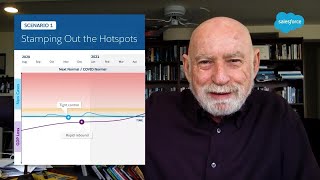
The speaker outlines several COVID-19 recovery scenarios driven by how well regions contain outbreaks: 1) "stamping out the hotspots" (rapid rebound if tight control is maintained, examples: New Zealand, some parts of New York), 2) a slower rebound variant if control lapses (examples: Japan, France), 3) "beating back the spring"/imperfect containment with partial gains or, in a worse variation, losing control that could produce a double-dip recession (examples: Spain, North Carolina; Indonesia and Georgia cited as places where control was weaker), and 4) "wildfire"/depression where the virus burns out of control (examples: Florida, Brazil, Chile, parts of California). The speaker also highlights persistent uncertainty driven by health, policy (stimulus timing, elections), and behavioral responses. Finally, three vaccine uncertainties are emphasized: timing/effectiveness, public willingness to take a rapidly developed vaccine, and equitable/global access; three vaccine rollout scenarios ("fever dream" = early, effective, widely taken; reluctant/politicized distribution; slow/difficult development) are presented and linked to recovery outcomes.
Chapters
Well, the first scenario we see is what's called stamping out the hotspots. Name says it all. This is a scenario based on the fact that you can identify those hotspots and target the interventions and minimize the economic and social consequences. And so what we see are number of places that have done a pretty good job of maintaining tight control and as a result are beginning to see a fairly rapid rebound on the bottom of this graph, the GDP loss. And they will begin to return to near normal soon. By that I mean sort of the next six months, call it first, second quarter next year. And I say near normal because until many more people are returning to a full economy, even if you're doing okay, your neighbors may not be. If you're New Zealand, you trade with the world, you sell and you buy with the world. If the rest isn't buying and can't sell to you, you may be subpar. So what we're seeing is until you really get a more widespread opening, everybody will be just a bit below, no matter what. The Economist use the term the 90% economy, and I think that's fairly apt, basically saying 10% goes away immediately. The question is, does more. And on the other hand, it does create room for new opportunity as well. So the first scenario is what we call stamping out the hotspots. And the best case is early establishment of tight control and maintaining it. However. Oh, oh, the places that are obviously have done this very well are New Zealand, and that's where New York is now. Their early catastrophic experience have led them to maintain tight control. But there's a second variation on this scenario, and that is for those places that frankly have not done as good a job of maintaining tight control. And we've seen some degree of resurgence, not out of control yet, but still having to struggle to maintain it, that will slow down the rebound. You can't open up as fast. People can't come out of their homes, go back to work, go back to the stores, go back to restaurants as quickly as possible. So that stretches the time well into the second half of next year for the economic recovery. And if you think about, say, Japan and France are probably in that category, they did well, but now they've got a number of outbreaks. France is struggling a bit, so they've had to shut down some of the part of southern France. So you'd say that, yes, they're still in that green zone, but they're at risk of moving out. And they're right at the edge in that yellow space. And they still can come back, but they've got to gain control. So a high degree of uncertainty in those places. The second scenario we call beating back the spring. And this is a scenario where basically you have imperfect containment, where you've got essentially more than hot spots. You've got large areas that are really out of control. And you can bring back some places, say in your country, but not everywhere. So you've got partial gains. This stretches the recovery time well into next year. And what we see are places like Spain and say state of North Carolina are like that. Spain had a big outbreak at the beginning. As I said earlier, they suppressed it, but now they're seeing major outbreaks and they're having to take much more aggressive action to contain it as well. So that's the second scenario. But there's another version of that where essentially you really let it get out of control. That is that imperfect containment leads to losing control and you end up with the economic consequences being much worse. Instead of the gradual recovery, what you've got is another major downturn next year, a second recession, more of a double dip recession, if you think about it that way, and it's pretty severe. It's important to understand that what we're talking about here is a very dynamic situation. And that's why we're talking about in terms of how people respond at each stage along the way will shape the next stage. And countries that fit, that are places like Indonesia and the state of Georgia in the United States. And then the final scenario are places that have never really managed to get it under control at all, where it really is burning out of control. This is a scenario of wildfires raging all over the place. These places are in what amount to a depression. They are not going to come back anytime soon. And you start thinking about places like that. Florida, Brazil, completely out of control. Florida rises and falls a bit, but it is still way out of control. The measures are completely inadequate in the state of Florida to deal with things Now. They could get it under control and that might be the second variation. Maybe the extremity of it might lead them to find their feet, get things under control before the end of the year. Doesn't seem to be happening in Brazil at all. So you think about a couple places like Chile and California. We still have the option of getting it under control before it really rages out of control. Statewide, we've got a big problem in the Central Valley in Southern California, not nearly as bad in the Bay Area. So that's fundamentally the question. Will the economies come back? Well, if you come up from below and you get it under control, you have a chance of recovery by mid year, next year. But if you lose control, we're talking a depression and indeed if many countries lose control, then we're really talking about a worldwide depression. So when you think about all of these scenarios together, what this points to is persistent uncertainty. That is, we're going to be in a very uncertain environment for at least the rest of the year. We won't really know what's going to happen with respect to the health care crisis. We won't really know what the consequences of the economic crisis in the US if the Congress doesn't come back till September and doesn't pass a stimulus until late September, the effect won't be felt until well into the fourth quarter. We also have a big election coming up. So the uncertainty here is enormous and will be persistent. And that uncertainty in turn leads people to be a bit more restrained. They don't spend, they don't go out, they don't do nearly as much, they don't go back to work nearly as fast. So all of that uncertainty is itself to some extent debilitating. But there are better scenarios than worse scenarios. It is not implausible that where you live and work may be in one of the better scenarios of stamping out the hotspots. On the other hand, if you're in the scenario of essentially unconstrained wildfire, you better be prepared for the worst. So need to think about multiple scenarios and how your particular industry, geography, community may begin to develop. So the three big uncertainties with respect to the vaccine are first of all, when will we get it? Will it work? How effective will it be? So will it happen sooner or later? Obviously a lot of effort is driving us toward sooner, but this is a hard biological problem. We've never developed an HIV vaccine. It may take many months or even years or never to develop a vaccine. So the timing of the availability matters a lot. Secondly, will people take it right? You know, and I'm not talking about the anti vax movement, but a brand new vaccine that has rushed to the market is going to be challenging for many people. Would you give your kid a brand new vaccine that has not, maybe not been tested adequately? So there will be only a slow rollout. So even if it's a reliable vaccine, people are going to be slow to want to take it. And then finally, who develops it and provides access may matter. That is, if it is open to everybody, it's fairly available to anybody who wants it. That's one thing, but others are using it for political purposes. China, Russia, United States, any of those could then we get into something very different. So we looked at three possibilities. What we looked at was what we call fever dream. And this is a scenario essentially of the vaccine is available early, people are willing to take it, people and it's available to everybody. It's fair. That would mean a fairly early effective response and would improve the likelihood of one of the better scenarios. On the other hand, while it might be available, people might be reluctant and you might have political issues determining whether it is available to whom. And then finally, it may take a long time to get to a vaccine may prove to be an extremely difficult and it may be slow to get into people's hands and people to take it, and it may be politically charged. So the vaccine itself introduces another fundamental dimension of uncertainty.