What Matters to The New Guard of Tech at The Cloud 100 2020
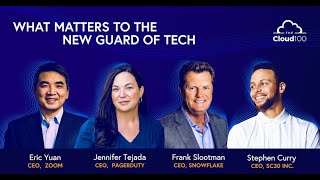
Stephen Curry moderates a panel with Frank Slootman, Jen Tejada, and Eric Yuan on lessons from 2020. They discuss scaling during COVID, keeping startup culture alive remotely, and why culture and values-driven decisions matter more than ever.
Chapters
Foreign.
I'm Jen Tejada, the CEO of PagerDuty.
I'm Eric, CEO of Zoom.
I'm Frank Slootman, CEO of Snowflake.
Stephen Curry with the Golden State warriors and founder of SC30 Inc. Welcome to Cloud 100. Really excited to have this opportunity. So let's get into the first question and I guess I'll ask the three amazing CEOs that we have with us today. We know 2020 has kind of presented a host of problems and issues, but also opportunities. What's been the hardest lesson you've learned this year, specifically with everything that you've had to adjust to during the year?
Well, I'll take a crack at that, Steph, and thank you. I think the first challenge was just the sheer volume and diversity of unprecedented problems and challenges that we've never seen before, all coming at us in a very short time period earlier this year when COVID 19 hit, and then dealing with the associated market volatility and economic environment that followed on the back of a global pandemic that would keep any CEO pretty busy. I found that we've really had to expand our leadership beyond customers and employees and partners to all of our stakeholders and, and think first about keeping people safe, second, about how we can leverage our voices, our platforms, our products and our technology to try and help stop the spread of COVID and help solve for unemployment and joblessness and some of the challenges that we've seen arise. And third, for me, what I've found is being values driven has served as an advantage. It's been really important to really understand and listen to our people and to our customers and empathize with what they're going through. And note that every single person is experiencing this environment and this pandemic little differently. So there isn't a one size fits all solution to the set of challenges that we have.
I'm actually amazed how well it has worked and we sort of learned a whole bunch of new lessons in the process. But what was incredibly important is that as a company, if you were, you know, more structured, more institutionalized about how you get through the day, in other words, having your set meetings, your set check ins, standard processes. But I will tell you that in the beginning, you know, we all thought this is going to be a matter of weeks and months. And of course, you know, we're now four or five months into it with no end in sight. But we've also much more settled in as a group and as a, as an organization. So, you know, we think we can, we can keep this up, hopefully not indefinitely, but we would and we could if we had to.
I think for us, Zoom's challenge is about how to serve those totally unexpected first time users. Given that so many new use cases from online yoga class, telemedicine, online classes, wedding ceremony, there's so many new use cases, how to keep the service up. And it was full of uncertainty. Our team got to work so hard. Also I had more sleepless nights than any time before. And the good news, our investment on culture is well, well paid off. And no one at Zoom complain. We do all we can to truly care about every user. Think about how to truly deliver happiness to all those users all over the globe. And yeah, that's a lesson learned. And think about customer, think about employees. You'll be okay.
A big challenge just in terms of when it comes to our SD30 Inc. We're not on any level like Frank, Jennifer and Eric, but in terms of it being a really startup kind of culture with a small roster, trying to keep the chemistry and the culture of how we operate kind of to Frank's point around when you're not in person and having that connection face to face, especially in the early days, that was a challenge. And I think a big part of it is how you balance the disciplines of your day to day. Knowing that everybody has their specific roles and ways to impact the direction of what we're trying to do. And for us, staying true to that is the most important thing we can. No matter what the medium is, whether it's a Zoom call or an email or whatever the case is, that communication is extremely important. That's something that you have to continue to develop no matter what the circumstances are.
So Stefan, you are a world class athlete. As a tech company CEO, I can tell you in addition to keep working hard to make our business successful, also have a dream. If I can't have a sighted dream, I want to be your teammate. You are not only a world class athlete, a great leader. I think my friend Andre Iwadala, he speaks very highly about you as a great teammate, great leader, wonderful father. And also a lot of people may not know that you're also the founder of SC30. I really want to understand how you learned from your experience. Time on a possible call to building a successful business.
Sports teaches you so much about the discipline, to be able to be collaborative, the ability to work in a team environment, to hold your own weight, to be inspired and motivated by the other people around you. But the one piece that I've learned just in how we've had success, especially with the warriors, is high character, high quality, good people. First and foremost, that they fill the locker room. Everybody vibes off of that energy. And when you set a certain mission and goal, everybody buys into it, no matter what their role is, no matter how many minutes they play, no matter what they're getting paid, it's about them feeling valued in the process. And so if you can find as many people that measure up to that and the leaders exemplify that with everything that they do for us, that's what the secret sauce to success. You obviously have to have talent and you have to have skill and expertise. But without good people that can work together, can be collaborative, that share in that same value kind of driven process, then you're going to hit more speed bumps than successes in our world.
That's awesome. That's great. Thank you.
You know, culture is really the only thing that's uniquely yours. Companies have access to talent, they have access to capital, they have access to anything. But the only thing that's uniquely you is your culture. So if you're not driving your culture with very, very explicit expectations and objectives, what you get is what people import from their priorities. Companies. Right. And that may not be what you want, probably isn't what you want. Right. And it also becomes sort of a, you know, a mix of all different kinds of styles and different organizations and different locations and so on. So if you're not getting after a culture, you're just defaulting to a mode of operation that is going to be highly suboptimal because it can be a one man or a one woman mission.
Yeah, that totally resonates with me. I think culture is defined by the lowest level of behavior you're willing to tolerate. And so, Frank, Frank, when you mention expectations, I think it's so important to articulate to your team and to your employees what are the behaviors that exemplify the values that you hold true? And how do you expect employees, no matter what they're doing, where they are, to demonstrate those values day in and day out. And I think that's incredibly important in times of stress and times when we're surrounded by a lot of uncertainty. I think values can be sort of the foundation that helps you weather any uncertain storm, but likewise thrive in an environment like this. And I just. I can't imagine trying to lead an organization through the amount of just change and constant chaos that we're going through right now without a very strong set of values that kind of bond us all together. Well, Frank, it's been a momentous year for Snowflake with everything that you've experienced and that's happened this year. Can you talk about your leadership approach? Because you've done this a few times before.
I am incredibly focused on the mission. I don't tolerate distraction very well. And to stick with the sports metaphors, it's not uncommon in sports to see a team go from a losing season to a winning season, literally in one year with the same roster. So an enormous amount of progress can be made by the whole mental discipline, the mental focus that we have on the job. And there is this intangible quality in organizations that can be tapped, you know, if, you know, once you sort of get a sense of how you get to go after it. And, you know, we've done that at Snowflake, and obviously it's a sensational platform, but, you know, it doesn't matter how good your product is. You need to have an organization to match it.
And what advice would you give to CEOs or founders on how to increase the pace of innovation?
Well, I talk about this all the time. You know, in the world of tech, if you're not intensely focused on your product, right. You haven't figured out yet what really matters. And product is the only thing that matters in our world. Right. Looking for opportunities to reinvent having extremely high standards. You know, I'm still inspired every single day by the late Steve Jobs, who always said it has to be insanely great or I'm going to be completely disinterested. You actually have more colorful language than what I just used. But in other words, it had to totally inspire. Otherwise, I'm not interested. Right. So innovation is about setting extremely high standards for your product.
I'd like to toss it to Eric. We know in 2020 how a lot of people have been able to stay connected. If you haven't used your product through this last six months, then you might be living under a rock. So I just. In terms of your company and how you deal with this massive growth and scale, how do you balance that as a leader of such a massively scaling company?
Stefan, that's a great question. I would say the number of things back to water from the side, the product is number one when it comes to product, architecture is a foundation. From our perspective, we feel very proud about our architecture. So, Stephan, very similar to your three point. We're very proud about our architecture. We work so hard because without that, your product really will have a problem when you have a massive growth. And also during this Massive growth, for sure. You are going to experience all kinds of issues. I think you got to stay true to your company's value and culture and keep everything open and transparent. As a team, we got to realize the number one important thing is how to think about everything from customer perspective in terms of quickly innovate or offer the free service to some K 12 schools and to show our care to the community, to society. Let everyone at Zoom feel like they are part of the big dream. And that's very important for us to capture this massive growth.
Can you give us maybe an insight on how you prioritize those decisions or how you stay focused through what is probably some immense chaos when you're in these type of times?
How to prioritize is really the key to success. For me. Whenever there's very complex problems, I'd like to get our team together, not only for me, and trust my team and also put all the problems on the table and look at why we have this problem. What's the root cause?
I'd love to ask a quick question of Stefan because I get to talk to Jennifer and Eric.
I never get to talk to Stefan. I won't take offense to that, Frank.
So may never get that opportunity again. But, you know, the thing that I always take away from watching your play is, first of all, you're not the biggest guy on the court. You're probably a big guy, but you don't look big on the court because these other guys aren't so huge. And you have this uncanny ability to electrify the team. I mean, you put them into a different mode, like an insane mode or whatever you want to call it. And marshaling that quality in yourself is what leaders have to do anywhere, right? And, you know, how do you do that? I mean, is there a switch?
It's a great question because a part of it's very natural in terms of how I enjoy the game, how I enjoy the ups and downs of being in that leadership role. I love the pressure of it. I love being in that moment where, you know, how I handle a certain situation, a certain decision may influence whether we win or lose. My coach from my college, Davidson College, he also told me, you know, help somebody, you help yourself. And in terms of the power and the collective of when I'm on my game and I'm making all the right decisions and I'm executing my style to the best of my ability, that makes everybody else look amazing, which then in turn is going to allow me to do what I do best. And so my Role has changed so much from 10 years ago to now. And I think as you guys can probably speak to that as well in terms of as your companies have grown, there's just different demands. But the process of it, if you figure that out, that stays the same.
It's amazing to watch.
Stefan, let's switch gears towards a topic that I know all of us are very passionate about and that's the impact that our companies can have on our teams, our customers and beyond. And you spoke earlier with Frank about trying to bring out the best in those around you when you're on the court or in the office. But I also know that you have a unique perspective as someone who's very committed to supporting social causes and social movements. What do you think the role of leaders and teams and corporations is in terms of thinking about supporting social causes or supporting activation in social movements? What role should a leader be playing there?
A big role, I think in terms of one, be authentic. I think people can weed through when you feel like you're forced to do something or forced to speak on something and it's okay to take your time. One, understand what the right way to be involved and participate is. For me, the rule is make sure you're knowledgeable in what you're talking about, but make sure you have something to add to the conversation, something to kind of influence change in a material way. And again, it's that authenticity and being genuine about that process because I know we all have a lot to offer. In terms. You spoke about it earlier in terms of being thoughtful about the resources that you have that you can deploy and the way that your company can solve some tough issues through this pandemic. And leaders have to be accountable to that process to hold their employees, their entire company, to that, to that standard. Be consistent with that, but be authentic.
I think I agree with you 100%. Making sure that you put actionable and measurable goals in place and checking the progress on those things as you go, just like you would any other business. Impairment is critical because I think employees can get behind you and it engenders a lot of trust when you demonstrate that you actually want to see outcomes as opposed to just be a voice in the narrative. Since you started your own company, how has your perspective evolved on leadership and your role in driving social causes and social movements forward? Has it changed?
It hasn't changed, but I feel like the perspective of how to move within that purpose has changed, if that makes sense. So it's about. I've always had that on the radar and found trying to find ways, especially when it comes to speaking for people that can't speak for themselves or finding ways to create opportunities for people that wouldn't otherwise have them. That's always been a mission of how we thought about any opportunity that we kind of commit to or start or any idea or vision that we set for what we're doing. But I think in terms of having those tough conversations, getting outside your comfort zone a little bit, and then holding other people that you're connected to accountable to, that same mission has become more and more consistent and I think received a lot better than years past. And that's an inflection point, obviously three, four months ago, when talking about what racial injustices there are going on in our country and representation in many different industries and creating more pipelines to get more diversity within high leadership positions, but in companies overall. So I have a unique ability, I think, to bring awareness to certain conversations and issues when it comes to that and hopefully be better at connecting the dots to make meaningful, long lasting change.
That's great. And I think it's been really incredible to watch you go from being a role model for athletes and kids on the basketball court to setting a great example for all of us as leaders in taking a strong position and advocating for change. That, to your point, is really important and really timely in these moments. So thank you for that.
Absolutely. I have a lot to learn from the people that are doing it well and have an ability to kind of see the landscape as a whole. It's been really awesome to see the participation across the board of people in very powerful positions that have access to everything that we need for change to get involved in the fight. So that's meaningful in and of itself to watch that take place more and more. And the long term effects of what that will be will be amazing to know. We were a part of, you know.
Companies are microcosms of society. Right. And when you get big enough, and I certainly experience that in, in prior lives, sooner or later you'll inherit all the problems of society in your company. It's just a numbers game when that happens. So when you're running a company, you're basically setting out to be much better than society as a whole because you have a much smaller group of people, obviously, and you have far greater influence and control in driving a culture that is much more the way it should be as opposed to, you know, what happens in society at large. And I think that's a great opportunity. When we talk about culture, it's not just about performance, it's about behavior. It's like, you know, how do we get along? Right. That's an enormous opportunity. I mean, we get to set the standard for conduct and behavior and how people come together on a day to day basis. And I think that's one of the great attractions I think of running, running companies.
I agree with that. And I'd add that when you're a growth company, you have an even bigger opportunity to design the complexion of your company as you're adding headcount. It's much easier to be intentional and programmatic around how you build the tapestry of talent within your organization than when you're in a slower growing, more static company or to your point, broader society. And so I think it's a privilege to lead, but it's also responsibility on our part to build organizations that sort of represent what we want the future to look like as opposed to just incrementally improve on the past.
So Jen, you have a great reputation as a great leader in the CEO community. I can tell you actually we all feel very lucky to know you because you truly care about others. Whenever we need any help, you proactively help others help me. And also pitch duty has a great reputation to have such an inclusive culture during this pandemic crisis. Quite often you hire employees. How to onboard them is totally different. How do you cultivate the same sense of community during this working from home and full of uncertainty time?
Well, it's not easy and I think anybody who tells you it is easy is lying or not paying attention. But one, it starts with intent. We believe that we will get the best out of our people and that will reflect the communities we serve the most effectively. If we are intentionally inclusive, if we create a culture that is welcoming and helps individuals and teams develop a sense of belonging very quickly, we believe that the best ideas come from diverse teams and people from different backgrounds. So we probably proactively seek both diverse leaders at the board level as well as at our management level, but throughout every level in the organization. And you know, since we moved to working from home environment and almost a default digital environment, it's been harder. But we've had to find new ways to demonstrate empathy to role model vulnerability. Because vulnerability in groups like leads to trust and trust is a super important element of creating a culture of belonging. Things that I've had to change myself as a leader to really try and continue to create that inclusive feeling within the company is to be much more visible frequently on videos, doing ask me any things. But I also can't underscore the importance of the more casual, spontaneous check ins. Like really just picking up the phone and calling a team member, checking and doing a skip, skip level just to see how someone is doing and not asking about the business, but asking, how are you? Like, how are you feeling? How's your family? How's the transition been? You know, what are you working on? What is most important to you? How can I be helpful to you? Because I think for four or five months into this we're all experiencing a little fatigue. But also we've programmatically built creating a culture of belonging into the onboarding process. So it's not enough to just have a balanced and diverse slate. It's not enough to just have a balanced interview screening panel. You also have to make sure that once an employee receives a job offer in the business, that their experience in getting to know the business and getting up and running within your teams is also inclusive. And then there's just the constant reminding of your employees and your team to look out for each other. I feel like every town hall, every conversation that we're having, I'm saying to the team, hey, if you haven't called someone today to check in on them, the person that you used to bump into at the coffee machine or the person you used to slack with first thing in the morning, check in on them, take. Because mental health issues in this environment are real, we have no idea what they're going through. And so making sure that there are multiple layers of folks within your teams checking in on each other is really important. And the last thing I would just add is that we're always playing the long game. We're always looking at what can we learn from what's happened, what's our vision two or three years from now and what are we going to go do right now to make that happen. If you want to create a culture of belonging, then you better fund it. You better be prepared to have someone who's responsible for driving it. And you need to make it the job of every leader in the business to ensure that those programs get executed throughout their organization. So consistency and standing behind that with resources really matters.
Awesome. Super awesome. Very, very excited. Thank you. Thank you.
So there will be hopefully a ton of CEOs watching this segment. And if you could impart just one thing, not five things, not three things, just one thing in what you think they have to know, it doesn't have to be, you know, specific to Covid and all that, all that stuff. Let's have a bigger view of things. What is that one nugget you want to drop in their lap? Like, this is valuable, this is important, this is what I want to pass on. So you got to do it in like 10 seconds. Just kidding. I'll start. Okay. And you guys can think about it. You know, one of the things that the conversation I always have with other CEOs, especially the younger ones, and there's a lot of young whippersnappers these days, you know, as CEOs, it's amazing how young they are. They get younger every day, it seems. But something will happen. As a CEO, you will be confronted with the need for transformation of the business. The question is, are you going to recognize it? Are you going to recognize it in time? Because eventually everybody will recognize it. So the timing is really important. And then related to that, the third thing is, can you execute on it? And I've lived through episodes of where I recognize it, where I didn't recognize it, and where I didn't recognize it in time. And also situations where I couldn't execute on it. And I tell you what, as a CEO, I lose enormous amount of sleep and I am enormously paranoid about am I seeing what I'm supposed to be seeing? Am I reading it? Am I reading it correctly? Right. But the question really is, you got to have your antenna out all the time. This paranoia about am I correctly parsing what is happening out there? And I think it's a very important question. Your team, they have their heads down. They're not the ones that are necessarily thinking along this line. It's only you as the CEO that needs to be hyper alert to what is going on, that is going to force transformation. It can be traumatic, it can be just life changing. It's one of my favorite conversations because it will test you to the absolute core of your being as a CEO. Right.
That is well said. I would say I don't know how to follow that up because that was might be in the middle of that right now. But in terms of when you have the decision that you need to be making, the collaborative process of gathering all the pertinent information, however long that process does take, the decision part, and you come up with a decision, the execution needs to be quick and swift and fast so that you don't lose any momentum on that end. And your conviction around it is you're the only one that's accountable to it. So you have to kind of go with it and do it quickly and swiftly and with the strategy that you put in place. And then there's also obviously the trust that the talent that you have in your team will be able to go out and execute it right there with you.
Frank, my short answer to that question is that write down your company's culture and value, make it very simple, very catchy, keep investing on that and keep talking about that, and your investment will be very well paid off, in particular in tough times.
And I would add to that to choose your partners wisely. I mean, we're only as good as the people we are surrounding ourselves by. And I think that to your point, Frank, sometimes the world is transforming and the business is transforming and you have to change your partners out. And that's one of the most painful challenges in scaling a company, leveling and recognizing when you need to make a change. And, you know, I think we've all learned from the hard mistake of not moving on an instinct soon enough, not bringing in the talent you needed early enough. You are never, ever done building a team in high growth. You know, there's this forming, storming, norming thing. You're never getting to norming. It's just not going to happen. You're going to be forming, storming, going back to forming, storming again, so to speak, because of the growth curve and the opportunity that's in front of you. So choose your partners wisely. This has just been an incredible conversation. I feel so fortunate to have been able to spend the last several minutes with three wonderful leaders in Stefan, Frank and Eric. I wish the very best for all of the CEOs and founders that have teams tuned in to watch the Cloud 100 this year. So thank you very much and have a great day.
Thanks, Jennifer.
Thank you.
Thank you.









